SLIDE 1 1
DSAT update - a technical funding audit workshop
14 May 2014
Nick Linford
Director at Lsect
Karl Bentley
Auditor at Baker Tilly 10.30 Welcome and introduction to the provider DSAT 11.00 DSAT reports for 16-19 Study Programmes 11.50 Break for refreshments 12.10 DSAT reports for 16-19 Study Programmes cont. 13.00 Break for lunch 13.50 DSAT reports for 19+ adult skills budget provision (incl. apprenticeships) 15.30 Workshop end
Agenda
Slides will be emailed after the event
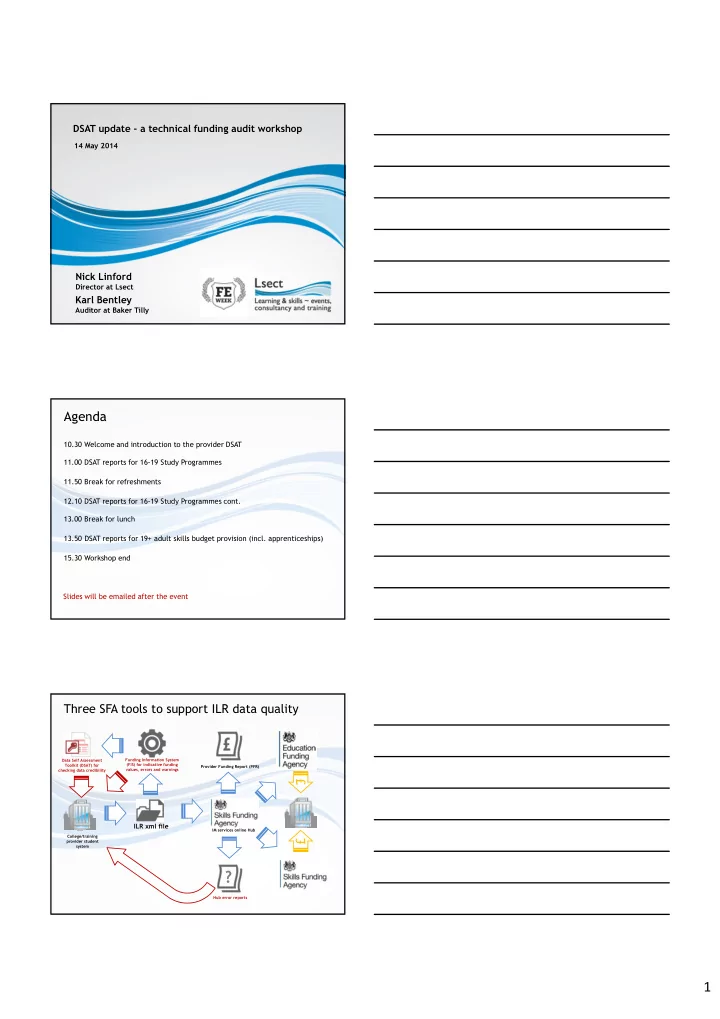
Three SFA tools to support ILR data quality
College/training provider student system
ILR xml file
Funding Information System (FIS) for indicative funding values, errors and warnings Data Self Assessment Toolkit (DSAT) for checking data credibility IM services online Hub Provider Funding Report (PFR)
?
Hub error reports
£ £
SLIDE 2 2
Funding Information System
First challenge is to ensure FIS can export ILR data to an Access database Import ILR Perform Funding calcs Export database Best to ‘execute’ one procedure at a time, and the final export could take 1-2 hours
https://www.gov.uk/government/publications/ilr-data- check-that-it-meets-standards-and-quality-requirements
The Provider Data Self Assessment Toolkit (DSAT)
“PDSAT has been designed to:
- give providers a toolkit to analyse ILR data
- assist auditors in the audit of FE providers’
ILR data for 2013 to 2014 We [SFA] do not require FE providers use PDSAT , although you may find it useful in your routine data cleansing and helpful when preparing for assurance visits. FE providers funded by the Education Funding Agency (EFA) must use PDSAT during the funding year. As PDSAT v14 was only made available on 3 February, providers were not required to use it for the ILR R06 data collection that closed on 6 February. The first return period when ILR data is expected to have been checked for accuracy before being submitted is R10 in June. However, the EFA recommend that providers use the PDSAT as early as possible to check that ILR data is valid and correct. By starting early you will avoid any unnecessary problems later in the year.”
Importing the ILR DB into the DSAT
Once DSAT downloaded and installed the ILR database is imported
SLIDE 3
3
DSAT sampling
Auditors use this facility, and you can too if you undertake your own internal substantive testing audit
DSAT sampling (EFA)
Auditors use this facility, and you can too if you undertake your own internal substantive testing audit
DSAT sampling (SFA)
Auditors use this facility, and you can too if you undertake your own internal substantive testing audit
SLIDE 4 4
53 DSAT reports, and we will look at these 22:
Report ID Report Title 140-170 Full Time Learners on Short Study Programmes 140-180 Learners with High Weekly Study Hours 140-480 Core Aims 140-190 Learners with High Study Hours In-Year 140-210 Learners with funding hours split by qualification hours and non-qualification hours 140-220 Learners on study programmes of no more than four weeks duration 140-230 Funded hours thresholds 140-060 Possible Duplicate Learners 140-070 Possible Duplicate Learning Aims 140-240 Withdrawals on Short and Long Programmes 140-110 19+ Learners with Full Funding Claimed 140-200 Learning Aims where the Cap has been applied 140-300 Early Completers 140-260 Learning Actual End Date within 2 days of Census Date 140-450 Learner Nos by Full or Co-Funding 140-460 Learning Aims by Delivery Postcode 140-090 Apprentices with prior attainment at level 4 and above 140-140 16-18 Apprenticeships Minimum Duration Exceptions 140-150 19+ Apprenticeships Minimum Duration Exceptions 140-290 Apprenticeship Achievers 140-520 24+ Advanced Learning Loan and Loans Bursary Fund Learners 140-530 Level 3+ Advanced Learning Loans Exceptions
EFA Both SFA
140-170 (EFA)
Lists learners (and their learning aims) with a total of 540 hours or more who are recorded
- n a study programme of less than 24 weeks.
Full Time Learners on Short Study Programmes
The recording of inappropriate programme durations in the ILR may distort the funding claimed by the provider.
140-180 (EFA)
Lists learners (and their learning aims) that have at least 35 weekly study hours during their programme.
Learners with High Weekly Study Hours
Large volumes of weekly study hours could indicate that the number of hours recorded and the associated funding may be overstated.
SLIDE 5
5
140-480 (EFA)
Identifies all individual core aims in the ILR and the learners enrolled on them.
Core Aims
Assists Providers in ensuring that the correct core aims have been identified as such in the ILR.
140-190 (EFA)
Lists learners (and their learning aims) that have at least 800 study hours in the year.
Learners with High Study Hours In-Year
High volumes of in‐year study hours may indicate that such hours have been incorrectly recorded for the whole duration of the programme rather than the academic year only.
140-210 (EFA)
Lists learners, the split of funding hours between qualification hours and non‐qualification hours and the proportion that is qualification hours.
Learners with funding hours split by qualification hours and non-qualification hours
Most EFA learners should be spending most of their funded time undertaking qualification activity.
SLIDE 6 6
140-220 (EFA)
Identifies learners enrolled onto short programmes.
Learners on study programmes of no more than four weeks duration
Providers should be able to demonstrate that the study hours recorded on the ILR are being delivered and that such learners are not being funded elsewhere on longer
- programmes. This will also identify unfunded learners.
140-230 (EFA)
Identifies learners whose funded hours are within 5% of the previous funding band maximum.
Funded hours thresholds
Large volumes of learners whose funded hours are just over the maximum for the previous funding band may indicate incorrect recording of funded hours.
140-060 (EFA & SFA)
Lists potentially duplicated learners within the ILR, assessed according to 8 different matching criteria.
Possible Duplicate Learners
Duplicate learners are not permitted and an adjustment to the ILR and to the funding claimed may be required. Note that twins may appear on this report as a potential duplicate and the Provider should be able to demonstrate that this is the case.
SLIDE 7
7
140-070 (EFA & SFA)
Lists potentially duplicated learning delivery within the ILR, assessed according to 6 different matching criteria.
Possible Duplicate Learning Aims
Duplicated learning delivery is not permitted and an adjustment to the ILR and to the funding claim may be required. Note that twins may appear on this report as a potential duplicate and the Provider should be able to demonstrate that this is the case.
140-240 (EFA & SFA)
Identifies learners that withdraw close to the start qualifying threshold date for funded learning.
Withdrawals on Short and Long Programmes
The systematic recording of learners' withdrawals near a start qualifying period may require investigation to ensure accurate data that can be supported by evidence.
140-110 (SFA)
Lists learners aged 19 and over that are in workplace learning and are recorded as fully funded.
19+ Learners with Full Funding Claimed
SFA funded learners aged 19 and over are eligible for full funding only if they satisfy specific criteria. Providers must be able to demonstrate that learners appearing on this report are eligible for full funding.
SLIDE 8
8
140-200 (SFA)
Lists learners and their learning aims where the total value of the learner's provision exceeds the funding cap.
Learning Aims where the Cap has been applied
This may identify errors in data that are causing the cap to be applied inappropriately, such as unrealistic sizes of programme or incorrect learning aim durations.
140-300 (SFA)
Identifies learners who have been recorded in the ILR as having completed more than 14 days before the learning planned end date.
Early Completers
Records can be reviewed to confirm that learners have actually completed and not withdrawn and that learning planned end dates are recorded accurately in the ILR. Where learners have completed particularly early, this could indicate that there was prior learning that should have been taken into account in determining the funding remaining.
140-260 (SFA)
Identifies learners who have been recorded in the ILR as havng withdrawn close to a monthly census date
Learning Actual End Date within 2 days of Census Date
A disproportionate number of learners leaving within 2 days of a monthly census date could indicate that withdrawals are not being accurately recorded in the ILR.
SLIDE 9
9
140-450 (SFA)
Summarises the volumes of learners on each learning aim by age and by the Full or Co‐ funded indicator
Learner Nos by Full or Co-Funding
The report can be filtered by age group and Full or Co‐funded indicator to provide an indication as to whether the provider is applying the rules on financial contributions correctly.
140-460 (SFA)
Summarises the volume of learning aim enrolments in the ILR by delivery location postcode.
Learning Aims by Delivery Postcode
Allows analysis in conjunction with knowledge of the Provider and its off‐site and subcontracted provision.
140-090 (SFA)
Identifies apprentices with prior attainment of level 4 or above that are enrolled on a programme other than Higher Apprenticeship at level 5 or above.
Apprentices with prior attainment at level 4 and above
Learners who already have a qualification at level 4 or above are only eligible for funding for a higher Apprenticeship at level 5 or above so any other programme or learning aim listed will result in a funding error.
SLIDE 10
10
140-140 (SFA)
Identifies 16‐18 Apprenticeships that may not satisfy Apprenticeship minimum duration requirements.
16-18 Apprenticeships Minimum Duration Exceptions
Apprenticeships for learners aged 16‐18 must have a minimum planned delivery duration of 12 months or more otherwise they may not be eligible for funding.
140-150 (SFA)
Identifies 19+ Apprenticeships that may not satisfy Apprenticeship minimum duration requirements.
19+ Apprenticeships Minimum Duration Exceptions
Apprenticeships for learners aged 19 and over must have a minimum planned delivery duration of 12 months or more, unless there is Recognition of Prior Learning, otherwise they may not be eligible for funding.
140-290 (SFA)
Lists all apprentices and their aims who are recorded in the ILR as having achieved their Apprenticeship in less than a year and a day.
Apprenticeship Achievers
The actual duration, based on the learning start date and the learning actual end date, needs to be a year and a day in order for an Apprenticeship achievement payment to be made, except where a learner aged 19 and over has Recognition of Prior Learning or exemption on the basis of previously certificated achievement.
SLIDE 11
11
140-520 (SFA)
Identifies learners funded by 24+ Advanced Learning Loans and, in addition, identifies learners receiving 24+ Advanced Learning Loans Bursary funding.
24+ Advanced Learning Loan and Loans Bursary Fund Learners
Extracts population should any specific assurance work be required for loans learners or loans bursary funding, including reconciliation to SLC records.
140-530 (SFA)
Identifies learners aged 24+ that are enrolled on learning aims at level 3 or above funded through a source other than a loan.
Level 3+ Advanced Learning Loans Exceptions
SFA funding is not available for learners aged 24 and over undertaking provision at level 3 and above except for two specific groups as defined in the Funding Rules.
Ofsted/Cross reports
dsdssd
SLIDE 12 Report ID Report Title Description Logic Implications
140-010 Report Logic by Report Describes all of the PDSAT reports and provides a record count for each report. NA None 140-020 C1 (SFA) PDSAT Reports Provides record counts for PDSAT Reports used in assurance reviews of SFA funding NA None 140-030 C1 (EFA) PDSAT Reports Provides record counts for PDSAT Reports used in assurance reviews of EFA funding NA None 140-040 C1 (SFA & EFA) PDSAT Reports Provides record counts for PDSAT Reports used in assurance reviews of SFA and EFA funding NA None 140-050 FIS Reported Data Errors/Warnings Report Lists errors and warnings in the ILR as reported by FIS. Informs the assessment of whether this ILR dataset meets the ILR validation rules. NA Errors (Severity = E) in this report may indicate that the ILR is not deemed to be a valid ILR and consideration should be given as to whether an assurance review should be carried
140-060 Possible Duplicate Learners Lists potentially duplicated learners within the ILR, assessed according to 8 different matching criteria. All learners by Learner Reference Number where the following are duplicated: - Type 1: Family Name, Date of Birth, Sex, Postcode and National Insurance Number - Type 2: Family Name, Date of Birth, Sex and Postcode - Type 3: Family Name, Date of Birth, Sex and National Insurance Number - Type 4: Family Name, Date of Birth and Sex - Type 5: Date of Birth, Sex, Postcode and National Insurance Number - Type 6: Date of Birth, Sex and Postcode - Type 7: National Insurance Number - Type 8: Unique Learner Number Duplicate learners are not permitted and an adjustment to the ILR and to the funding claimed may be required. Note that twins may appear on this report as a potential duplicate and the Provider should be able to demonstrate that this is the case. 140-070 Possible Duplicate Learning Aims Lists potentially duplicated learning delivery within the ILR, assessed according to 6 different matching criteria. All learning Aims by Learner aim reference where the following are duplicated: - Type 1: Family Name, Date of Birth, Sex, Postcode, National Insurance Number and Learner aim reference (LearnAimRef) - Type 2: Family Name, Date of Birth, Sex, Postcode and Learner aim reference - Type 3: Family Name, Date of Birth, Sex, National Insurance Number and Learner aim reference - Type 4: Family Name, Date of Birth, Sex and Learner aim reference - Type 5: Date of Birth, Sex, Postcode, National Insurance Number and Learner aim reference - Type 6: Date of Birth, Sex, Postcode and Learner aim reference Duplicated learning delivery is not permitted and an adjustment to the ILR and to the funding claim may be required. Note that twins may appear on this report as a potential duplicate and the Provider should be able to demonstrate that this is the case. 140-080 Learners Under 16 Lists learners (and their learning aims) recorded as under 16 on the start date of their Apprenticeship programme or under 16 at start of the academic year for EFA provision and non-Apprenticeship SFA provision. Identify all learners where Funding Model = 35 and Programme Type in {2, 3, 10, 20, 21, 22, 23} and Learning Aim Reference = ZPROG001 and Age on Start Date <16. List all learning aims within the programme. List learners (other than apprentices) and learning aims funded by EFA or SFA where (Programme Type is not in {2, 3, 10, 20, 21, 22, 23} or is null) and Age at Start of Academic Year <16. Only certain learners under 16 are eligible to participate in provision funded by the SFA or
- EFA. For example, learners that have legally
left school prior to their 16th birthday. 140-090 Apprentices with prior attainment at level 4 and above Identifies apprenticies with prior attainment
- f level 4 or above that are enrolled on a
programme other than Higher Apprenticeship at level 5 or above. Identify SFA funded learners where Programme Type is in { 02, 03, 10, 20 } and Prior Attainment is in { 4, 5, 10, 11, 12, 13 } Learners who already have a qualification at level 4 or above are only eligible for funding for a higher Apprenticeship at level 5 or above so any other programme or learning aim listed will result in a funding error. 140-100 16-18 Learners with Co-Funding Lists learners aged 16-18 that are recorded as co-funded. Identify all learners and learning aims where Funding Model = 35 and Programme Type in {2, 3, 10, 20, 21, 22, 23} and Age on Start Date between 16 and 18. List learners (other than apprentices) and learning aims where (Programme Type is not in {2, 3, 10, 20, 21, 22, 23} or is null) and Age at Start of Academic Year between 16 and 18 and FFI=2. All SFA funded learners aged 16-18 are entitled to full funding. Entries on this report could be under claims of funding. 140-110 19+ Learners with Full Funding Claimed Lists learners aged 19 and over that are in workplace learning and are recorded as fully funded. All SFA funded learners for Funding Model = 35 where Age at Start of Program/Aim > 18 and WPL = 1 and FFI = 1 SFA funded learners aged 19 and over are eligible for full funding only if they satisfy specific criteria. Providers must be able to demonstrate that learners appearing on this report are eligible for full funding. 140-120 19+ Learners with Enhanced Funding Lists learners aged 19 and over for whom enhanced Apprenticeship funding is being claimed. All SFA funding learners and aims where EEF = 2
- r 3 and Age at Start of Program/Aim > 18
Providers must be able to demonstrate that the learners contained on this report are eligible for enhanced funding.
SLIDE 13 Report ID Report Title Description Logic Implications
140-130 Adult Learners who are 16-18 at the Start
Lists Adult Skills learners (other than apprentices) and their learning aims where the learners are under 19 years of age at the start of the academic year. Any records listed are likely to be errors. The Provider may be missing out on 16-18 funding
- r the date of birth recorded for the learner
may be incorrect. 140-140 16-18 Apprenticeships Minimum Duration Exceptions Identifies 16-18 Apprenticeships that may not satisfy Apprenticeship minimum duration requirements. Apprenticeships for learners aged 16-18 must have a minimum planned delivery duration of 12 months or more otherwise they may not be eligible for funding. 140-150 19+ Apprenticeships Minimum Duration Exceptions Identifies 19+ Apprenticeships that may not satisfy Apprenticeship minimum duration requirements. Apprenticeships for learners aged 19 and over must have a minimum planned delivery duration of 12 months or more, unless there is Recognition of Prior Learning, otherwise they may not be eligible for funding. 140-160 Prior Attainment Lists learners and learning aims where the learner's prior attainment level is the same
- r higher than the level of the learning aim.
Where a learner's prior attainment is the same as or higher than the learning being undertaken, it can determine whether or not their learning can be fully funded or whether it can be funded at all. 140-170 Lists learners (and their learning aims) with a total of 540 hours or more who are recorded on a study programme of less than 24 weeks. The recording of inappropriate programme durations in the ILR may distort the funding claimed by the provider. 140-180 Learners with High Weekly Study Hours Lists learners (and their learning aims) that have at least 35 weekly study hours during their programme. Large volumes of weekly study hours could indicate that the number of hours recorded and the associated funding may be overstated. 140-190 Learners with High Study Hours In-Year Lists learners (and their learning aims) that have at least 800 study hours in the year. High volumes of in-year study hours may indicate that such hours have been incorrectly recorded for the whole duration of the programme rather than the academic year
140-200 Learning Aims where the Cap has been applied Lists learners and their learning aims where the total value of the learner's provision exceeds the funding cap. This may identify errors in data that are causing the cap to be applied inappropriately, such as unrealistic sizes of programme or incorrect learning aim durations. 140-210 Learners with funding hours split by qualification hours and non-qualification hours Lists learners, the split of funding hours between qualification hours and non- qualification hours and the proportion that is qualification hours. Most EFA learners should be spending most of their funded time undertaking qualification activity. 140-220 Learners on study programmes of no more than four weeks duration Identifies learners enrolled onto short programmes. Providers should be able to demonstrate that the study hours recorded on the ILR are being deliveredand that such learners are not being funded elsewhere on longer programmes. This will also identify unfunded learners. 140-230 Funded hours thresholds Identifies learners whose funded hours are within 5% of the previous funding band maximum. Large volumes of learners whose funded hours are just over the maximum for the previous funding band may indicate incorrect recording
140-240 Withdrawals on Short and Long Programmes Identifies learners that withdraw close to the start qualifying threshold date for funded learning. The systematic recording of learners' withdrawals near a start qualifying period may require investigation to ensure accurate data that can be supported by evidence. 140-250 Learners past their Learning Planned End Date Identifies learners in the ILR as continuing past their learning planned end date. Learners and learning aims listed should be reviewed by the provider in order to ascertain whether these learners are still in learning or have completed or withdrawn as any inaccuracies may lead to incorrect funding being claimed. 140-260 Learning Actual End Date within 2 days of Census Date Identifies learners who have been recorded in the ILR as havng withdrawn close to a monthly census date A disproportionate number of learners leaving within 2 days of a monthly census date could indicate that withdrawals are not being accurately recorded in the ILR. 140-270 Transferring Learners Identifies learners and their learning aims where the learner has been recorded as having transferred from at least one of their aims with the same Provider. Inappropriate recording of transfers may lead to a mis-statement of the funding claimed and/or result in enhanced success rates. 140-280 Resuming Learners Identifies learners and their learning aims where the learner has been recorded as having resumed at least one of their learning aims. Where learners resume a learning aim, there should be an appropriate funding adjustment for prior learning made to ensure that there is no over claim of funding.
SLIDE 14 Report ID Report Title Description Logic Implications
140-290 Apprenticeship Achievers Lists all apprentices and their aims who are recorded in the ILR as having achieved their Apprenticeship in less than a year and a day. The actual duration, based on the learning start date and the learning actual end date, needs to be a year and a day in order for an Apprenticeship achievement payment to be made, except where a learner aged 19 and
- ver has Recognition of Prior Learning or
exemption on the basis of previously certificated achievement. 140-300 Early Completers Identifies learners who have been recorded in the ILR as having completed more than 14 days before the learning planned end date. Records can be reviewed to confirm that learners have actually completed and not withdrawn and that learning planned end dates are recorded accurately in the ILR. Where learners have completed particularly early, this could indicate that there was prior learning that should have been taken into account in determining the funding remaining. 140-310 Completers who have Unknown Outcomes Identifies learners and their learning aims where they are reported as having completed the aim but the outcome is not known or the examination has not been taken and there is an intention to take the examination. Providers could miss out on achievement funding and perfomance measures could be affected where outcomes are not accurately recorded. 140-320 Learners with Prior Attainment Level Recorded as Not Known Identifies learners and their learning aims where their Prior Attainment Level is recorded in the ILR as Not Known using values 97 or 98. Providers should establish the level of prior attainment during the initial assessment process to inform the suitability of learning programmes, entitlement to full or co-funding and whether a funding adjustment for prior learning should be applied. Funding for learners with unknown prior attainment could have been claimed at an incorrect rate. 140-330 Postcodes that are Generic or Null Lists learners and their learning aims where postcode prior to enrolment, current postcode or delivery location postcode recorded in the ILR are generic or null values. Generic or missing postcodes could result in incorrect area cost or disadvantage uplift funding. Postcodes prior to enrolment are required in
- rder that learners can be used correctly for
ESF match funding purposes. 140-340 19-24 Learners with LLDD Lists 19-24 learners who have been recorded in the ILR as being in receipt of a Learner Disability Assessment (LDA) or Education Health and Care Plan (EHCP) and the respective funding agency. Learners (other than apprentices) aged 19-24 with an LDA are funded by the EFA. All learners aged 19-24 with an EHCP are funded by the EFA. Any entries on this report are contrary to these rules and indicate miscoded provision. 140-350 Learner Difficulty/Disability Inconsistency Identifies learners where their self- assessment of LLDD is inconsistent with the claim for Learning Support funding. Where the learner's self-assessment of LLDD is inconsistent with the Provider's claim for learning support funding, there should be appropriate evidence in place to support any claim for funding. 140-360 NI Numbers Null, Temporary, Invalid Format or used for HMRC Administrative Purposes Identifies learners with NI Numbers that are null, temporary, in an invalid format or listed by the HMRC as being for administrative use. NI numbers should be treated as compulsory in the ILR and be input for Apprenticeship learners and learners in workplace learning. NI numbers are also used by the Student Loans Company and must be fully and accurately recorded for loans learners. 140-370 Learners with Invalid
Identifies learners and their learning aims where their Unique Learner Number has been set to a value that is invalid or generic. All instances need to be corrected where necessary otherwise they could cause validation errors to occur in future data submissions. 140-380 Incorrect Learning Aim Achievement Timescales Identifies all learners and learning aims that have been started after the Aim Discontinued Date. Aims listed should be reviewed in order to identify whether the correct learning aim has being recorded in the ILR. 140-390 Employment Status Exceptions Identifies Workplace Learners whose Employment Status on their start date is not "in paid employment" and the learner is not
- n an Access to Apprenticeship programme.
Workplace learners (other than Access to Apprenticeships) should be employed (except in the case of alternative completion conditions). Learners incorrectly recorded as workplace learners could be funded at an incorrect rate. 140-400 European Social Fund Match Funding Data Identifies potential anomalies and omissions in data relating to learners whose provision may be indirectly co-financed by ESF. The ILR fields relating to employment status and destination should be checked to ensure that they have been fully and accurately completed in order that the SFA can use the learners as match funding in its ESF funding claim. 140-410 Learners not studying English or Maths Identifies learners that are enrolled on neither English nor Maths. Allows Providers to check progress towards meeting the EFA's Condition of Funding for 2014/15, in that learners must be enrolled on
- ne of a range of English and Maths
qualifications if they have not already achieved GCSE A*-C level. The report has no funding impact in 2013/14.
SLIDE 15 Report ID Report Title Description Logic Implications
140-420 Employment Outcome Identifies where an Employment Outcome has been claimed but the relevant ILR fields have not been correctly identified A claim for an employment outcome may be a funding error if the learner is recorded incorrectly in the ILR, including not being unemployed, being in workplace learning or not having a benefit status indicator. 140-430 Non-English Postcodes with SFA
Lists learners (and their learning aims) who may not be eligible for SFA or EFA funding due to their postcode prior to enrolment being outside England. Scotland, Northern Ireland and Wales have their own funding arrangements and only in certain circumstances will the SFA or EFA fund such learners. Approval from the relevant Agency may be required. Learners living in the Channel Islands and the Isle of Man are ineligible for funding. 140-440 All HEFCE Funded Learners Lists all learners recorded in the ILR as being funded by HEFCE and all of their other ILR learning aims. The Skills Funding Agency does not expect systematic claims of FE funding for HE learners. 140-450 Learner Nos by Full
Summarises the volumes of learners on each learning aim by age and by the Full or Co- funded indicator The report can be filtered by age group and Full or Co-funded indicator to provide an indication as to whether the provider is applying the rules on financial contributions correctly. 140-460 Learning Aims by Delivery Postcode Summarises the volume of learning aim enrolments in the ILR by delivery location postcode. Allows analysis in conjunction with knowledge
- f the Provider and its off-site and
subcontracted provision. 140-470 Learners on a Specified Learning Aim Lists all learners and their learning aims so that the user can filter on any specific learning aim(s). Provides the full population so that where any additional assurance work is required on any specific learning aim(s), the sub-population affected can be identified. 140-480 Core Aims Identifies all individual core aims in the ILR and the learners enrolled on them. Assists Providers in ensuring that the correct core aims have been identified as such in the ILR. 140-490 Learners enrolled on English and Maths learning aims Lists all learners and any English and Maths learning aims on which they have been enrolled. Extracts population to faciliate specific assurance work on funding for English and Maths qualifications. 140-500 Learning Support Funding Identifies learners and all recorded instances
- f Learning Support Funding.
Extracts population should any specific assurance work be required on Learning Support funding. 140-510 Funding by Subcontractor Summarises the value of all subcontracted provision recorded in the ILR by subcontractor. Determines those subcontractors that have been recorded in the ILR to allow comparison with the Provider's Subcontractor Declaration Form for accuracy and completeness. 140-520 24+ Advanced Learning Loan and Loans Bursary Fund Learners Identifies learners funded by 24+ Advanced Learning Loans and, in addition, identifies learners receiving 24+ Advanced Learning Loans Bursary funding. Extracts population should any specific assurance work be required for loans learners
- r loans bursary funding, including
reconciliation to SLC records. 140-530 Level 3+ Advanced Learning Loans Exceptions Identifies learners aged 24+ that are enrolled on learning aims at level 3 or above funded through a source other than a loan. SFA funding is not available for learners aged 24 and over undertaking provision at level 3 and above except for two specific groups as defined in the Funding Rules.
SLIDE 16 Education Funding Agency External Assurance EFA Funded 16-19 Funding Assurance Review 2013/14
No Test 2013/14 Reference
(Funding guidance for young people 2013/14 unless otherwise stated)
EFA Guidance to auditors Outcome for negative responses 1 Has the Institute correctly assessed that the student is eligible for Agency funding? FR Paragraphs 17-60 & 117-120 (Note: Students may be over 19 if they are still on a programme which they began pre-19 or up to 25 years old if they are classified as "high needs"). Traineeship Guidance Check eligibility for residency, Age. (Institution management must check enrolment forms to see if evidence has been gathered on the residency status and eligibility of the student). For traineeships - check institutions checks on age, unemployed on day 1 / little work experience / focused on work. Check the learning agreement records reasonable chance of being ready for employment , and apprenticeship or F/T study within 6 months. For age the critical funding audit issue is "has the student date of birth been correctly recorded on the ILR? If the date of birth is correctly recorded for all students (other than those aged 19-24 if they have a Learning Difficulty Assessment (LDA)/Education, health and care plan (EHCP) Funding error if the student is not eligible for funding (The institution would be expected to revise their data return to record such students as not eligible for EFA funding). Control error if documentation not as per
- guidance. Note for ILR funded students
FIS automatically screens out over age students so they are not normally a funding error if the date of birth correctly recorded. 2 Does the learning agreement/enrolment form/timetable agree to the ILR in terms of data? FR Paragraphs 124-127 & 138 Compare records. If the ILR shows a study programme which the student is not doing, or the total planned hours (after qualifying period) are
- verstated, this may constitute a funding
error if the correct number of planned hours falls into a lower band from that which has been recorded. Please note that if the correct number of planned hours falls into a higher band from that which has been recorded, then the understatement should also be reported. 3 Has the learning agreement/enrolment form been signed by both the student & Institute? FR Paragraphs 125-126 Check for signed documents (check paragraph 126 guidance for electronic signatures). This will usually be an Internal Controls issue, unless there is the possibility that the student did not commence the study programme/does not exist (rare). 4 Has the correct learning aim been recorded as the Core Learning Aim? R&F Paragraphs 13-23 SILR Page 96 Note: This may not be the learning aim with the greatest number of hours attached but it should be clear from the learning plan which learning aim is identified as the core. This aim of this test is not for auditors to determine what is or isn't a core aim. This is a data check where auditors should ensure that the core aim of the study programme as agreed on the learning plan/learning agreement has been recorded accurately on the ILR. Please note that the core aim is used:
- a. to calculate future programme
cost weighting,
- b. to determine whether a student
is retained on the programme or not, for future funding retention factors, and
- c. whether the programme consists
- f substantial qualification, work
experience or other . IMPORTANT NOTE: Please do not use the terminology "academic"
- r "vocational " qualification but
use "substantial qualification, work experience or other". No funding impact expected in current year from recording the wrong core aim as this simply affects "lagged funding factors". Possible funding error for future allocations only - if the core aim on the ILR is not the core aim on the learning plan and as a result the correct aim would bring the programme cost weighting down for future funding allocations . Hence a Data Error and not a funding error for 2013/14. Otherwise it will be a control issue.
2013/14 Version 2 (April 2014)
SLIDE 17 Education Funding Agency External Assurance EFA Funded 16-19 Funding Assurance Review 2013/14
No Test 2013/14 Reference
(Funding guidance for young people 2013/14 unless otherwise stated)
EFA Guidance to auditors Outcome for negative responses 5 Are the activities included in the study programme eligible activities (relevant, planned and take place during institution's normal working hours)? FR Paragraphs 64-84, 121-124 & Appendix B Please review the study programme to ensure that activities (whether qualification or non- qualification) that are not eligible to be funded (as detailed in the funding guidance) are not included in the planned hours. Be aware of the in-year additional ILR guidance that allows study hours delivered for withdrawn learning aims before the start criteria is met to be included in total study hours for the year where this affects the funding band for the student. Possible funding error if when excluding the ineligible activities, the planned hours would reduce the study programme to part-time or a lower band. 6 Has the number of planned hours for the academic year been correctly recorded on the ILR? FR Paragraph 127 R&F Paragraph 11 Data check - Check that the planned hours recorded matches to the ILR. An additional check is needed for compressed delivery, particularly if the study hours are in excess of 30 hours a week (6 study hours per day) as this may mean the study hours have been wrongly recorded. Possible funding error if the planned hours reduces the study programme to part time / lower band. 7 Is there evidence that the student has been provided with IAG, an Initial assessment, a Learning Plan and
documentation (including timetable if applicable)? FR Paragraph 125-127 Check that the learning agreement / enrolment form is signed and includes all of the key details as per paragraph 127 of the funding regulations. Not a funding error at an individual student
- level. If it is apparent that any groups of
students have been enrolled on a programme of study which is not appropriate for their needs then this should be referred to the EFA Funding Allocation and Student Support (FASS) team for further discussions as this may constitute a funding error. 8 Attendance: Does the start date recorded on the ILR reconcile to registers held? Note: In the absence
evidence to support attendance can be accepted. FR Paragraphs 130-133 Data check - Check attendance evidence to confirm the study programme start date. Complete a data check to ensure that the student is in attendance for start / end dates of the study programme. Be aware of the additional in-year change to EFA ILR guidance that allows study hours delivered, for withdrawn learning aims before the start criteria is met, to be included in total study hours for the year where this affects the funding band for the student. Control issue if start date does not match. Possible funding error if no attendance evidence is available to confirm the qualifying period of the study programme. 9 If the student is undertaking Work Experience as part of their programme, have the placement details been fully documented and have arrangements for the recording of attendance been made? R&F Paragraphs 18-23 Note: For a Traineeship, Work Experience must be the Core Learning Aim. Check documentation to ensure that work experience processes are being followed (work experience is planned, organised and supervised). Traineeship - check traineeship guidance (work placement 6 weeks
- 5 months in duration. Core
learning aim. In workplace setting, interview offered at end of placement etc.) Here we would check that there is evidence that the student agreed to the placement, the paperwork clearly states what is required (days / times and who to see when get there) and that there is attendance evidence from the placement provider. Control issue if requirements are not being followed otherwise funding error if student withdrawn without meeting the qualifying period and/or resulting in drop to Part time or lower band. 10 If the student has withdrawn from the programme or any learning aims, have the correct learning end dates been recorded? FR Paragraphs 134-137, Annex C R&F Paragraphs 28-36 Data check - check correct leave dates have been recorded. Control issue if the incorrect leave date is after the qualifying period. Possible lagged funding retention issue (error that will affect future funding allocation) if students are recorded as completed when they have withdrawn during the year from their core learning aim.
2013/14 Version 2 (April 2014)
SLIDE 18 Education Funding Agency External Assurance EFA Funded 16-19 Funding Assurance Review 2013/14
No Test 2013/14 Reference
(Funding guidance for young people 2013/14 unless otherwise stated)
EFA Guidance to auditors Outcome for negative responses 11 If the student has withdrawn from the programme or any learning aims, does the period of attendance qualify for funding? Note: If one or more learning aims do not qualify as a start, the planned number of programme hours should be reduced. For the purpose of calculating the planned length of programme, take the earliest start date of all the learning aims and the latest planned end date of all the learning FR Paragraphs 123, 129 & 135-137, Annex C R&F Paragraphs 24-36 Check the study programme planned length and qualifying
- period. The planned programme
length is determined using the earliest start date and latest planned end date of all aims within a study programme. The actual length used to determine whether
- r not the student has met the
qualifying period uses the earliest start date and latest actual/planned end date of all aims within a study
- programme. Programmes shorter
than two weeks are no longer
- funded. Note that students that
meet study programme start criteria are not usually expected to have study hours amended later in the year including any reductions for aims not yet started. Funding error if a student has left the institution before the qualifying period and an incorrect leave date has generated
- funding. Also a funding error if incorrect
withdrawal date is recorded and one or more learning aims would not meet the qualifying period, therefore taking the planned hours of the study programme into a lower band or part-time. Possible lagged funding retention issue if students are recorded as completed when they have withdrawn during the year from their core learning aim. Control issue if the incorrect leave date is after the qualifying period. 12 If the student has withdrawn have the correct leaving codes been recorded on the ILR? FR Paragraphs 123 & 135-137, Annex C R&F Paragraphs 28-36 Data check - Check that the correct leaving code has been used. Any errors would be reported as internal control issue. 13 Are you satisfied that the student has not withdrawn from any learning aims which have not been processed as withdrawn? FR Paragraphs 123, 129 & 135-137, Annex C R&F Paragraphs 28-36 Check that all learning aims which show as “continuing” are in fact still being studied by the student and that the student has not actually
- withdrawn. If the student has
withdrawn from the study programme or one or more eligible learning aims before the qualifying period the planned hours should have been reduced accordingly. Note that students that meet study programme start criteria are not usually expected to have study hours amended later in the year including any reductions for aims not yet started. Funding error if a student has left the institution before the qualifying period and an incorrect leave date has generated
- funding. Also a funding error if incorrect
withdrawal date is recorded and one or more learning aims would not meet the qualifying period, therefore taking the planned hours of the study programme into a lower band or part-time. Possible lagged funding retention issue if students are recorded as completed when they have withdrawn during the year from their core learning aim. Control issue if the incorrect leave date is after the qualifying period and a data error for all withdrawals not correctly recorded. 14 If any of the learning aims are recorded as achieved, is there evidence to support this? FR Paragraphs 135-137 For this question we are checking student retention not success. Expected evidence for student retention: (a) if completed - either evidence from an external awarding body of success in the core qualification, or evidence, from registers or
- therwise, that the student had
completed the learning activities leading to the core qualification. (b) if continuing - evidence (for example registers) that the student was still attending the core qualification at the end of the academic year. If the completion status is incorrect this may result in a lagged funding error (a data error that will affect future funding allocation) if a completion code has been entered when the student withdrew during the year - see Tests 12 and 13. 15 Is the student either undertaking Maths & English, in order to progress the student to GCSE level, or is there evidence of Prior Attainment to support the rationale for not undertaking them both? FR Paragraph 124 & Appendix D This is not a funding error for 2013/14, but will be in 2014/15. Please make an appropriate recommendation for non-compliance in 2013/14. Check processes. Report any issues as control issues. 16 Does the range of documents reviewed provide reasonable evidence of student existence, and do the student's signatures appear consistent? Check records for existence. Funding error if learner does not exist.
2013/14 Version 2 (April 2014)
SLIDE 19 Education Funding Agency External Assurance EFA Funded 16-19 Funding Assurance Review 2013/14
No Test 2013/14 Reference
(Funding guidance for young people 2013/14 unless otherwise stated)
EFA Guidance to auditors Outcome for negative responses 17 High Needs Student Support: For 16-18 high needs students where Learner support payment is £6,000 or above, as flagged in the ILR, is there evidence of the home Local Authority agreement to fund the students higher cost needs? For 19-24 EFA funded students is there evidence of a Learning Difficulty Assessment and/or an Education, Health and Care Plan and/or are continuing students funded in 2012/13 with high cost additional learning support as flagged in the ILR? FR Paragraph 11b R&F Paragraphs 61-62 Check if appropriate documentation is in place. Missing paperwork does not automatically make student funding recoverable. Funding error or internal control issues if the appropriate documentation is not in place. Key : FR: Funding guidance for young people 2013/14: Funding Regulations R&F: Funding guidance for young people 2013/14: Rates & formula SILR: Specification of the Individualised Learner Record for 2013/14
2013/14 Version 2 (April 2014)
SLIDE 20 Skills Funding Agency Provider Financial Assurance Funding Assurance Review 2013/14 Adult Skills Budget, 16-18 Apprenticeships & OLASS No Test Issue
Critical Factor
2013/14 Reference
Funding Rules 2013/14 Version 3 (including February 2014 Addendum) unless otherwise stated
App s Oth er WL CL T's hip s OL AS S
1 Does evidence exist to confirm that the learner is eligible for Agency funding? i) Eligibility for funding The learner satisfies the Agency's eligibility criteria. Paragraph 4, 167 Annex 1 Paragraphs 1- 40 Yes Yes Yes Yes 2 Is the learner eligible for the programme(s) and has/have the programme(s) been correctly identified and coded? i) Employed status Workplace learners are employed (except Access to Apprenticeships and Alternative Completion Conditions) Page 15 (Definition of Workplace Learning in introduction) Page 29 (Employment box) Yes Yes ii) Correct funding rate The funding rate claimed (16-18
- r 19+) is consistent with the age
- f the learner as defined by the
type of programme. Paragraph 21.2 Yes Yes Yes Yes iii) Minimum hours of employment Apprentices are employed for at least 16 hours per week. Paragraph 119.1 Yes iv) Planned duration for part-time programme The planned duration of the programme has been extended accordingly to account for the learner's part-time hours. Page 31 (Employment Hours box) Paragraphs 103, 126.2 Annex 1 Paragraphs 72- 73 Yes v) Prior attainment at level 4 The learner with prior attainment at level 4 is undertaking a Higher Apprenticeship at level 5 or above, except for Apprentices that were funded by a loan when they started and have become grant funded. Paragraph 94 F24+APP Paragraph 6 Yes vi) Alternative Completion Conditions Unemployed and self-employed apprentices must satisfy Alternative Completion Conditions to be eligible. Paragraphs 117-118 Annex 1, Pages 107-108 (Apprenticeships alternative completion conditions tables) Yes vii) Access to Apprenticeship eligibility The learner satisfies the specific eligibility criteria for the Access to Apprenticeship programme. Paragraph 96 Yes Yes viii) Traineeship eligibility The learner satisfies the specific eligibility criteria for the Traineeship programme. Paragraphs 168, 170- 173 Yes ix) OLASS eligibility The learner satisfies the eligibility criteria for OLASS provision. OLASS Page 5 (Eligibility for funding box) OLASS Paragraphs 4-7 Yes 3 Is the programme as designed eligible for funding and is the correct funding being claimed? i) Eligible qualifications/units Qualifications and/or units must be eligible for funding and units must not be exploited for funding advantage Paragraphs 21.3, 46-48 Yes Yes Yes Yes Yes ii) Mandatory aims The learner is undertaking aims that are mandatory within the framework. Paragraph 93 Yes iii) Distance learning The learner is undertaking an Apprenticeship that is not delivered solely by distance learning. Paragraph 95 Yes iv) Apprenticeship duration The Apprenticeship must be planned to satisfy the minimum duration requirements. Paragraphs 124-136 Yes v) Traineeship duration The Traineeship and its components must satisfy the maximum and minimum duration requirements Paragraphs 175-176, 199 Yes vi) English and Maths in Apprenticeships Intermediate and Advanced Apprenticeship learners must be
- ffered Level 2 Functional Skills
- r GCSE in English and/or maths
where they have not yet achieved Level 2 in either or both of these subjects. Paragraph 142 Yes vii) English and Maths The learner's programme is consistent with the outcome of the diagnostic assessment. Paragraphs 61-64, 63E, 64E, 70, 192-196 Yes Yes Yes Yes
2013/14 Version 2 (April 2014)
SLIDE 21 Skills Funding Agency Provider Financial Assurance Funding Assurance Review 2013/14 Adult Skills Budget, 16-18 Apprenticeships & OLASS No Test Issue
Critical Factor
2013/14 Reference
Funding Rules 2013/14 Version 3 (including February 2014 Addendum) unless otherwise stated
App s Oth er WL CL T's hip s OL AS S
viii) Full/Co-funding Claims for full funding are supported by an assessment of the learner's circumstances and the learner has confirmed that they are eligible for a financial contribution from the government where applicable. Annex 1, Paragraphs 41- 48, 56 Yes Yes Yes ix) Apprenticeship Training Agencies (ATAs) Only recognised ATAs can employ apprentices purely for the purpose of delivering an Apprenticeship. Paragraphs 112-116 Yes x) 24+ Advanced Learning Loans exceptions The learner is 24 or over and belongs to a group for which 24+ ALLs do not apply. Paragraph 323 Yes Yes Yes xi) Large employers The Employer Reference Number for learners employed by large employers is correctly recorded in the ILR. Annex 1, Paragraphs 52- 55 Yes Yes xii) Achievement of prior qualifications Any certificated exemption or credit transfer is taken into account when establishing whether a learning aim can be funded and calculating the proportion of funding remaining. Paragraphs 10, 13 Yes Yes Yes Yes Yes xiii) Recognition of Prior Learning Any uncertificated prior learning is taken into account when assessing the learner and calculating the proportion of funding remaining. Paragraphs 11-12 Yes Yes Yes Yes Yes xiv) Duplication/overlap in learning Any duplication or overlap in learning aim content is considered when establishing whether a learning aim can be funded and calculating the proportion of funding remaining. Paragraph 9 Yes Yes Yes Yes Yes xv) Breaks in learning The funding rate, planned duration, proportion of funding remaining and the restart indicator for a learner returning after an agreed break have been correctly recorded in the ILR. Paragraphs 85-89, 132, 136 Yes Yes Yes Yes Yes 4 Does learner documentation meet the minimum requirements
Funding Rules and agree to underlying data? i) ILR consistent with Learning Agreement Funding is driven by the underlying ILR data which must agree with information confirmed by the learner in the Learning Agreement. Paragraph 33 Annex 1, Paragraphs 67- 75 Yes Yes Yes Yes Yes ii) Subcontracted provision ILR field PartnerUKPRN reflects provision delivered by a subcontractor, as recorded in the Learning Agreement. Annex 1, Paragraphs 67- 75 SILR Page 108 Yes Yes Yes Yes Yes 5 Is the learner eligible for Learning Support funding and is there evidence of delivery of Learning Support? i) Eligible for Learning Support Learning Support claimed through the ILR is supported by an assessment and there is a planned programme of support included in the Leaning Agreement. Paragraphs 21.6, 211, 229-234 Yes Yes Yes Yes Yes ii) Delivery of Learning Support Learning Support claimed through the ILR is supported by evidence
- f delivery of the planned
programme of support included in the Learning Agreement. Paragraphs 21.6, 229- 234 Yes Yes Yes Yes Yes 6 Is the learner's programme and the learner's attendance as recorded on the ILR consistent with the underlying records? i) Learning activity Funding claimed for the learner's continued participation in learning is confirmed by evidence of learning activity from the start date of each aim (i.e. up to the learning actual end date or to date, as applicable). Paragraphs 21.4, 21E, 31E, 30-32 Annex 1, Paragraph 72- 73 Yes Yes Yes Yes Yes
2013/14 Version 2 (April 2014)
SLIDE 22 Skills Funding Agency Provider Financial Assurance Funding Assurance Review 2013/14 Adult Skills Budget, 16-18 Apprenticeships & OLASS No Test Issue
Critical Factor
2013/14 Reference
Funding Rules 2013/14 Version 3 (including February 2014 Addendum) unless otherwise stated
App s Oth er WL CL T's hip s OL AS S
7 Where the learner has not achieved, does the learning actual end date recorded on the ILR agree with underlying records? i) Learning actual end date The learning actual end date recorded in the ILR reflects the last date that there is evidence of learning activity for each learning aim (or for any learning aim within an Apprenticeship framework). Paragraphs 21E, 23, 30- 31 Yes Yes Yes Yes Yes ii) Transfers The correct learning actual end date and subsequent start date have been recorded in the ILR for a learner transferring between learning aims or programmes. PSM Section 10.8, Paragraphs 335-360 Yes Yes Yes Yes Yes 8 Does evidence exist to confirm that the learner has achieved/comple ted the learning aim/framework? i) Learning aim achievement The achievement is correctly recorded in the ILR and is supported by certification from the Awarding Organisation within three months. Paragraph 21.5, 21E Annex 1, Paragraph 72 Yes Yes Yes Yes Yes ii) Work placement achievement The achievement is correctly recorded in the ILR and is supported by evidence of progression. Paragraph 188 Yes iii) Framework completion The framework achievement payment claimed is supported by a completion certificate within three months, or by signed completion certificate documentation, confirming that minimum duration requirements have been met. Paragraphs 21E, 137- 141 Yes iv) Eligibility for framework achievement payment For learners that started on Access to Apprenticeships, framework achievement payments claimed are supported by appropriate evidence of employment. Paragraph 104 Yes 9 Is there evidence that the learner is eligible for, and has evidence to support, the claim for a job
payment? i) Eligible job
Job outcome payment claimed through the ILR is for an eligible job and is supported by a learner declaration confirming that the funding conditions have been met. Page 20 (Job Outcome payments box) Paragraphs 21.6, 21E, 71-74 Yes Yes 10 Is the learner eligible to be used in the Agency's ESF match funding claim? i) Eligibility for ESF Match Learner meets the eligibility criteria for ESF Match Funding. Note: Letter with contract Page 44 (European Social Fund introduction) Paragraphs 19-20, 242- 245, 247-248 Yes Yes Yes Yes iii) ESF Publicity Learner documentation used in administering the programme clearly displays the ESF logo Note: Letter with contract Page 44 (European Social Fund introduction) Paragraphs 19-20, 278- 281 Yes Yes Yes Yes Note: Paragraph number followed by E signifies evidence requirement at the end of the relevant section of the Funding Rules 2013/14 Key: F24+APP: Funding 24+ Advanced-level and Higher Apprenticeships: Provider Operational Guidance (February 2014) OLASS: Funding rules and guidance 2013/2014 for the Offenders' Learning and Skills Service PSM: Individualised Learner Record 2013/14 Provider Support Manua SILR: Specification of the Individualised Learner Record for 2013/14
2013/14 Version 2 (April 2014)