
SLIDE 1
http://xkcd.com/224/
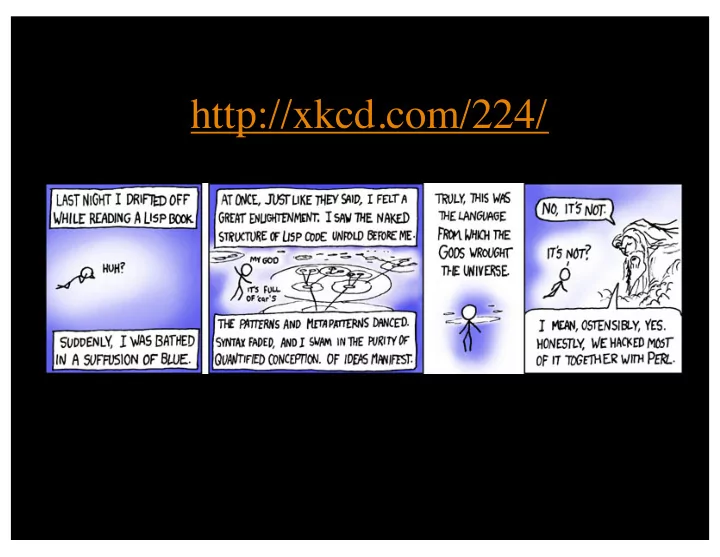
http://xkcd.com/224/ CS 152: Programming Language Paradigms Prof. - - PowerPoint PPT Presentation
http://xkcd.com/224/ CS 152: Programming Language Paradigms Prof. Tom Austin San Jos State University What are some programming languages? Taken from http://pypl.github.io/PYPL.html January 2016 Why are there so many? Different domains
http://xkcd.com/224/
CS 152: Programming Language Paradigms
San José State University
Taken from http://pypl.github.io/PYPL.html January 2016
Different domains
Different design choices
Good language features
These goals almost always conflict
Conflict: Type Systems
Stop "bad" programs … but ... restrict the programmer
Why do we make you take a programming languages course?
language of the future (whatever that means).
to make you suffer too.
We want to warp your minds.
Course goal: change the way that you think about programming.
That will make you a better Java programmer.
The "Blub" paradox
Why do I need higher order functions? My language doesn't have them, and it works just fine!!!
"As long as our hypothetical Blub programmer is looking down the power continuum, he knows he's looking down… [Blub programmers are] satisfied with whatever language they happen to use, because it dictates the way they think about programs."
http://www.paulgraham.com/avg.html
Languages we will cover
(subject to change)
Administrative Details
http://www.cs.sjsu.edu/~austin/cs152- spring19/Greensheet.html.
https://sjsu.instructure.com/
http://info.sjsu.edu/static/catalog/integrity.html
Schedule
Canvas.
CLASS.
Prerequisites
Resources Dorai Sitaram "Teach Yourself Scheme in Fixnum Days". http://ds26gte.github.io/tyscheme/ Other references TBD.
Grading
(individual work)
Participation: Labs
Homework
with others.
How to fail yourself and your friend
If two of you turn in similar assignments:
Project
Office hours
What is Scheme?
– Describe what things are, not how to do them. – More mathematical compared to imperative langs.
Symbolic Expressions (s-expressions)
The single datatype in Scheme. Includes:
characters, and symbols.
and of course…
Scheme lists
(list 1 2 3 4)
'(1 2 3 4)
– car: gets the first element of the list. – cdr: gets the tail of the list. – cons: combines an element and a list. – append: appends multiple lists together.
Calling functions in Scheme
// Java foo(x, y, z); ; Scheme (foo x y z)
$ racket Welcome to Racket v6.0.1. > '(1 2 3 4) '(1 2 3 4) > (car '(1 2 3 4)) 1 > (cdr '(1 2 3 4)) '(2 3 4) > (+ 1 (* 2 4) (- 5 1)) 13 >
Quote indicates list is data First element is assumed to be a function
Before next class
Scheme.
Averages" article. http://www.paulgraham.com/avg.html
First homework due September 10th
you up and running with Racket.
–If you don't have access to Canvas, see http://www.cs.sjsu.edu/~austin/cs152- spring19/hw/hw1/ instead.
Lab 0
Familiarize yourself with scheme Write functions to calculate the area of