HP indicator on abundance & distribution Working group Lead: - - PowerPoint PPT Presentation

hp indicator on abundance
SMART_READER_LITE
LIVE PREVIEW

HP indicator on abundance & distribution Working group Lead: - - PowerPoint PPT Presentation

HP indicator on abundance & distribution Working group Lead: Anita Gilles (DE), Julia Carlstrm (SE) National members: Michael Dhne (DE), Dominik Nachtsheim (DE), Olli Loisa (FI), Iwona Pawliczka (PL) JG chair: Ida


slide-1
SLIDE 1

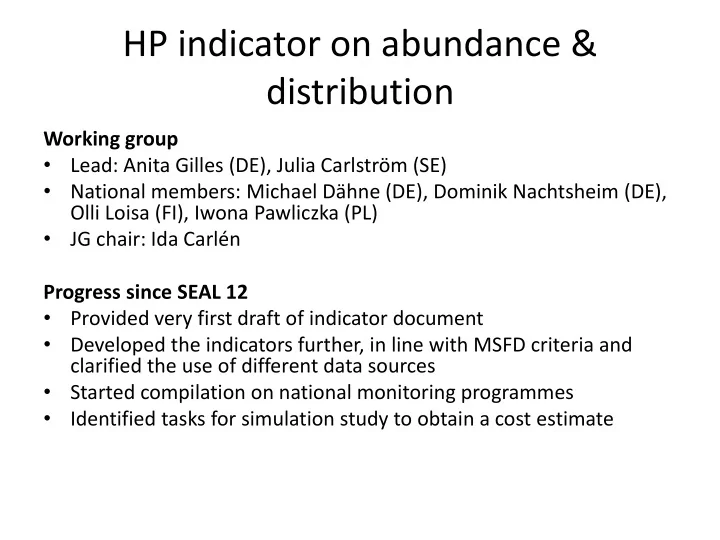
HP indicator on abundance & distribution

Working group

  • Lead: Anita Gilles (DE), Julia Carlström (SE)
  • National members: Michael Dähne (DE), Dominik Nachtsheim (DE),

Olli Loisa (FI), Iwona Pawliczka (PL)

  • JG chair: Ida Carlén

Progress since SEAL 12

  • Provided very first draft of indicator document
  • Developed the indicators further, in line with MSFD criteria and

clarified the use of different data sources

  • Started compilation on national monitoring programmes
  • Identified tasks for simulation study to obtain a cost estimate
slide-2
SLIDE 2

Primary MSFD criteria for HP

  • D1C2: The population abundance of the

species is not adversely affected due to anthropogenic pressures, such that its long- term viability is ensured.

  • D1C4: The species distributional range and,

where relevant, pattern is in line with prevailing physiographic, geographic and climatic conditions.

slide-3
SLIDE 3

Two types of main datasets

Large-scale surveys

  • SCANS, MiniSCANS,

SAMBAH

  • Every 6 or ~12 yrs
  • Visual or PAM

Key site monitoring

  • Primarily national

monitoring programmes

  • Frequent or continuous
  • Visual or PAM

Also available data: opportunistic sightings (live and dead), Danish telemetry data. Not yet considered.

slide-4
SLIDE 4

What large-scale surveys provide

  • Estimate of absolute abundance
  • (Distribution range within survey area, requires a

definition of range)

  • Large-scale distribution pattern
  • 1 datapoint/ 6 or 12 yrs  takes very long time to

detect trends

  • Coarse spatial resolution
  • On population level
slide-5
SLIDE 5

What key site monitoring provide

  • Core key sites (high-density): trend in population

abundance, assuming no change in distribution

  • Strategic key sites (high and medium density): trend in

local density  more fine-scale changes in local distribution patterns

  • Frequent or continuous data  trends can be detected

much quicker

  • Spatially representative of monitored sites
  • For key sites only, but also give early warning for

population level assuming representativeness

slide-6
SLIDE 6

What is a strategic key site?

A site where a change in density is expected to occur when:

  • The population abundance increases or decreases
  • The population distributional pattern changes

I.e. sites capturing for example:

  • A future increase in HP abundance in the Baltic Proper
  • A distributional shift such as observed in the North Sea
slide-7
SLIDE 7

Current national monitoring

  • Visual aerial surveys

and PAM

  • Frequency varies,

e.g. 1/yr, 2 continuous yrs/6 yrs, continuously

  • Future funding often

uncertain

  • Not yet compiled

detailed methodological information

slide-8
SLIDE 8

Proposed HP indicators on abundance & distribution

Indicator Large-scale surveys Key site monitoring Absolute abundance Absolute estimate of population abundance Trend in abundance Trend in absolute abundance Trend in (relative) density in core key sites (Distributional range) (Range within surveyed area) Distributional pattern Large-scale pattern Trend in (relative) density in strategic key sites

slide-9
SLIDE 9

Simulation study

  • When can we detect a trend in absolute abundance

based on SAMBAH surveys only, and if we increase the survey frequency?

  • What is the optimal design for key site monitoring?
  • What is the suitable time unit for detecting trends in

key site monitoring?

  • When can we detect trends in key site densities?
  • In core key sites: trend in population abundance
  • In strategic key sites: change in distribution pattern
slide-10
SLIDE 10

Next steps

  • Definition of Reference Levels
  • Definition of key sites
  • Identify strategic key sites for distributional monitoring
  • Simulation study
  • Continue working on the indicator document, need

clarification on full division or subdivision of the indicators (# of documents?)

  • Develop monitoring guidelines for harmonised key site

monitoring, based on information from national monitoring programmes