How we count them and how much they count: Conceptual framework and - - PowerPoint PPT Presentation

how we count them and how much they count
SMART_READER_LITE
LIVE PREVIEW

How we count them and how much they count: Conceptual framework and - - PowerPoint PPT Presentation

How we count them and how much they count: Conceptual framework and guidelines for statistics on cooperatives Marie J. Bouchard* Madeg Le Guernic ** Damien Rousselire *** * Chair, COPAC TWG on Co-op Statistics, Professor, Universit du


slide-1
SLIDE 1

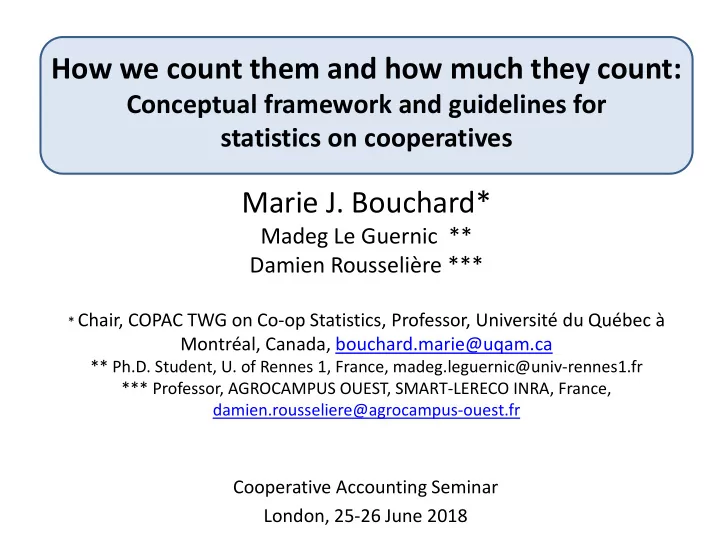
How we count them and how much they count:

Conceptual framework and guidelines for statistics on cooperatives

Marie J. Bouchard*

Madeg Le Guernic ** Damien Rousselière ***

* Chair, COPAC TWG on Co-op Statistics, Professor, Université du Québec à

Montréal, Canada, bouchard.marie@uqam.ca

** Ph.D. Student, U. of Rennes 1, France, madeg.leguernic@univ-rennes1.fr *** Professor, AGROCAMPUS OUEST, SMART-LERECO INRA, France, damien.rousseliere@agrocampus-ouest.fr

Cooperative Accounting Seminar London, 25-26 June 2018

slide-2
SLIDE 2

Introduction

Context:

  • No agreed uniform statistical

definition of co-operatives

  • No single classification of co-
  • peratives
  • Need of similar data for

international comparability

  • Risk of misrepresentation of the

co-operative world with few hard figures on the number of coops, workers, members, economic value

  • Need of a better recognition of the

economic and social impacts of coops by governments and people, improved policies for a model proved valuable (resilient to crises, countervailing market power, internalizing social costs…) Major questions regarding cooperative statistical representation:  Conceptual (size, scope, boundary)  Classification (specific to countries)

  • Membership and employment
  • Measurement of the wealth

(value-added) produced by coops

Defining:

  • To capture the core nature of the coop
  • Without expanding to much

Classifying:

  • In continuation with existing

classifications

  • While enabling translation between

those

Measuring:

  • Specificity
  • Comparability
  • Aggregation
slide-3
SLIDE 3

Building blocks towards 20th ICLS

  • 2016: ILO Mapping of 70 countries (Galhardi); Creation of the COPAC

TWG after multistakeholder meeting in Rome

  • 2017: ILO 11 case studies (Eum; Carini, Borzaga &Carpita); ILO

Conceptual Framework (Bouchard, Le Guernic & Rousselière) discussed at Geneva TWG meeting

  • 2018: COPAC Report on Proposed Classification (Eum, Carini &

Bouchard); ILO Report on Economic Performance and Contribution (Rousselière, Bouchard & Le Guernic); ILO Report on Guidelines (Bouchard) and Guidelines to be adopted at 20th ICLS in Geneva, October 2018

  • 2002: ILO’s Promotion of Cooperatives

Recommendation No. 193 : national policies should “seek to improve national statistics on cooperatives with a view to the formulation and implementation of development policies”.

  • 2013: ICLS Resolution on further work on the

statistics of cooperatives

slide-4
SLIDE 4

Major issues

  • Definition and classification

– On the cooperative side: Various socially constructed definitions and classifications; not always a clear understanding of how national statistical agencies work – On the producers of statistics’ side: Not always a clear understanding of what a co-operative is or how it differs from other for-profit or non-profit corporations

  • Members

– Issue of double counting in establishment survey; issue of misunderstanding of the notion in household surveys

  • Work

– All types of work and work relations apply to cooperatives – Difficulty with worker-owners – Difficulty in differentiating producer and worker cooperatives

  • Economic contribution

– Value added is not an appropriate measurement for some cooperatives (see Damien’s following presentation)

slide-5
SLIDE 5

Three general premises:

  • A co-op is an organization with a legal identity that functions according to

specific principles.

  • It is a member-based organization, which implies the shared identity of

members-users.

  • Co-ops have specific economic objectives and functions.

Conceptual definition

slide-6
SLIDE 6

Set of 4

  • perational

criteria

i. A cooperative should be a formally established institutional unit (non- financial corporation, financial corporation or non-profit institution); ii. A cooperative should be controlled democratically by its members according to the principle that each member has an equal vote; iii. Membership of the cooperative should be voluntary and non-restrictive; iv. Distribution of profits or surpluses among the members is not directly linked to the capital or fees contributed by each member.

slide-7
SLIDE 7
slide-8
SLIDE 8

Screening decisions

  • SNA Institutional

Units

– S-11: Non- financial corporations – S-12: Financial corporations – S-15: NPI serving households

  • Co-op criteria
slide-9
SLIDE 9

Existing classifications

slide-10
SLIDE 10

Member-based organization serving members’ interest

Members-clients: The co-op minimizes intermediation costs for members’ purchases of goods or services Members-providers: The co-op maximizes the value of members’ products Members-workers: The co-op maximises job creation and good work conditions

slide-11
SLIDE 11

Proposed classification for intl comparability: type of activity (ISIC) + members’ interest

slide-12
SLIDE 12

Membership

  • Both persons and legal entities can be members of more than one
  • cooperative. Cooperatives therefore have memberships that may not be

mutually exclusive, but membership may be important for groups or types of cooperatives.

  • Membership is defined as the number of members of each

cooperative.

  • Statistics of cooperatives should include statistics on the persons and

enterprises that are members of cooperatives, and on subsidiaries that are not cooperatives, such as incorporated enterprises which are owned or controlled by cooperatives.

Subsidiaries

slide-13
SLIDE 13

Work

  • Worker-members of cooperatives are dependent workers as they do not

have complete control over the operation of their enterprise. If these workers are paid a wage or salary for time worked or for each task or piece

  • f work done in the cooperative, they should be classified as employees of

their own cooperative; if they are paid only in profit or surplus, or paid a fee per service, they should be classified as dependent contractors according to the (draft) resolution concerning statistics on work relationship (to be) adopted by the 20th ICLS.

  • Owner-operators of enterprises that are members of producer

cooperatives should in general be classified as independent workers; they could be classified as dependent workers if their business depends significantly or entirely on the cooperative in terms of access to markets,

  • rganization or pricing of work (i.e., the cooperative implicitly or explicitly

controls the activities of the members) and satisfy the criteria to be classified as dependent contractors specified in the current standards for statistics on work relationships.

slide-14
SLIDE 14

Data collection

  • To assess the economic contribution of cooperatives it is important to take

the characteristics of different types of cooperatives into account. Different measures of this contribution may be needed depending on the type of cooperative (and thus the interest of the members). For this purpose, information should be collected on employment, value added, the use of profits or surpluses, investment and the earnings of workers within the scope of statistics on cooperatives. Information should also be collected on the (share of) transactions with members and non- members.

  • Comprehensive statistics on cooperatives, members of cooperatives and

jobs or work activities performed within the scope of statistics on cooperatives should be produced on a regular basis, if possible at least every five years. Such comprehensive statistics should preferably be based

  • n a census of cooperatives.
  • To the extent possible statistics should be compiled separately for

cooperatives, enterprises that are members of cooperatives, and enterprises that are owned and controlled by cooperatives.

slide-15
SLIDE 15
  • Regular, preferably annual, monitoring of cooperatives can be based
  • n administrative data and establishment surveys; data on

members can also be collected through household surveys.

  • Statistics of cooperatives should be systematically tabulated:

– By type; classification by sub-types can be considered – By main economic activity – By region

  • Statistics on natural members of cooperatives and on employment

in cooperatives should be systematically tabulated by significant characteristics of the person, particularly sex, age group and by region.

  • If possible, inactive cooperatives should be identified separately in

statistics on cooperatives.

slide-16
SLIDE 16

Future Work

  • The ILO, in cooperation with interested

countries and institutions, should arrange for testing of the concepts and definitions presented in these guidelines.

  • The ILO should, in collaboration with

interested parties, work on the development

  • f measures to assess the economic

contribution of cooperatives.

slide-17
SLIDE 17

Thank you!