How to Properly Maintain How to Properly Maintain Your Water Well - - PowerPoint PPT Presentation

how to properly maintain how to properly maintain your
SMART_READER_LITE
LIVE PREVIEW

How to Properly Maintain How to Properly Maintain Your Water Well - - PowerPoint PPT Presentation

How to Properly Maintain How to Properly Maintain Your Water Well and Avoid Your Water Well and Avoid Problems Problems Craig Smith, P.G. Craig Smith, P.G. Trihydro Corporation Trihydro Corporation Overview - Overview - Fremont County


slide-1
SLIDE 1

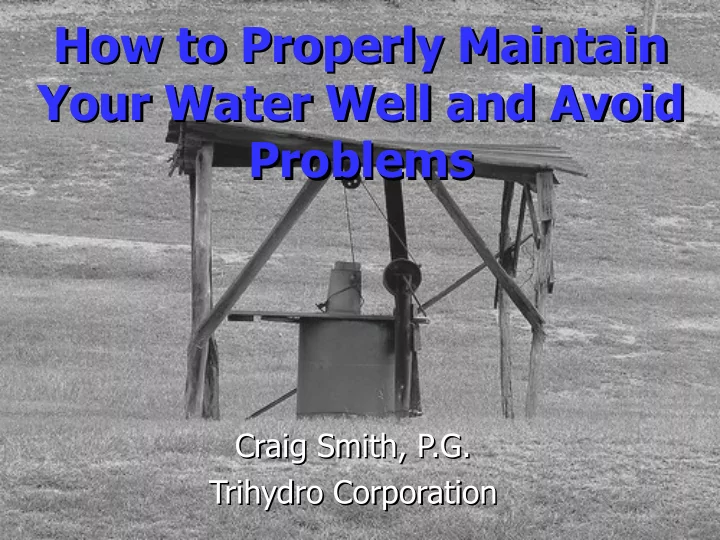
How to Properly Maintain How to Properly Maintain Your Water Well and Avoid Your Water Well and Avoid Problems Problems

Craig Smith, P.G. Craig Smith, P.G. Trihydro Corporation Trihydro Corporation

slide-2
SLIDE 2

Overview - Overview -

  • Fremont County Water Wells

Fremont County Water Wells

  • Municipal Water Systems

Municipal Water Systems

  • Source of Ground Water

Source of Ground Water

  • Types of Wells

Types of Wells

  • Sources of Contamination

Sources of Contamination

  • Well Water Quality Issues

Well Water Quality Issues

  • Well Performance Issues

Well Performance Issues

  • Maintaining Your Well

Maintaining Your Well

  • Resources

Resources

slide-3
SLIDE 3

Fremont County Water Wells Fremont County Water Wells

  • State Engineer has issued*:

State Engineer has issued*:

– 6,480 Domestic Well Permits 6,480 Domestic Well Permits – 2,740 Stock Well Permits 2,740 Stock Well Permits – 134 Irrigation Permits 134 Irrigation Permits

*Ground Water Permits *Ground Water Permits

slide-4
SLIDE 4

Municipal Water Systems Municipal Water Systems

  • Water Quality

Water Quality

– Municipal Water Sources Municipal Water Sources

  • Lander

Lander

– at: at: http://www.landerwyoming.org/pdf/CCR-2006.pdf http://www.landerwyoming.org/pdf/CCR-2006.pdf

  • Riverton

Riverton

– at: at: http://www.riverton.wyoming.com/PDF-forms/WaterQualityRep http://www.riverton.wyoming.com/PDF-forms/WaterQualityRep

slide-5
SLIDE 5

Municipal Water Systems (cont.) Municipal Water Systems (cont.)

  • Source Water Assessment and Protect

Source Water Assessment and Protect (SWAP) (SWAP)

– Program to Protect Public’s Water Supply Program to Protect Public’s Water Supply – Delineates, Inventories, Conducts Delineates, Inventories, Conducts Susceptibility Analysis, and Reports Susceptibility Analysis, and Reports

slide-6
SLIDE 6

Source of Ground Water Source of Ground Water

Hydrologic Cycle - Hydrologic Cycle -

slide-7
SLIDE 7

Types of Wells Types of Wells

  • Dug Wells

Dug Wells

– High Risk of Contamination High Risk of Contamination – Typically 10’-30’ Deep Typically 10’-30’ Deep

  • Driven Wells

Driven Wells

– Typically 30’-50’ Deep Typically 30’-50’ Deep – Shallow Ground Water Shallow Ground Water – Moderate Risk for Contamination Moderate Risk for Contamination

  • Drilled

Drilled

– Typically Drilled 100’- 400’ into Bedrock Typically Drilled 100’- 400’ into Bedrock – Submersible pumps commonly pump water to Surface Submersible pumps commonly pump water to Surface – Low Risk for Contamination from Surface Sources Low Risk for Contamination from Surface Sources

slide-8
SLIDE 8

Typical Well Construction Typical Well Construction

slide-9
SLIDE 9

Contamination Sources Contamination Sources

  • Poor Well Construction

Poor Well Construction

– Dug Wells Dug Wells – Improperly Sealed Wells Improperly Sealed Wells – Height of Casing Height of Casing – Old Casings Old Casings

slide-10
SLIDE 10

Contamination Sources (cont.) Contamination Sources (cont.)

  • Unusually High Ground Water

Unusually High Ground Water

  • Nearby Sources

Nearby Sources

– Agricultural Operations Agricultural Operations – Commercial and Industrial Commercial and Industrial – Other Potential Sources Other Potential Sources

slide-11
SLIDE 11

Well Water Quality Issues Well Water Quality Issues

  • Physical

Physical

– Turbidity, Color, Odor Turbidity, Color, Odor – TDS (Total Dissolved Solids) TDS (Total Dissolved Solids)

  • Solutions

Solutions

– Ion-Exchange (water softening), Reverse Ion-Exchange (water softening), Reverse

  • smosis, and Filtration
  • smosis, and Filtration
  • Cost

Cost

– Water Softeners - $1,200 - $2,000 Water Softeners - $1,200 - $2,000 – Reverse Osmosis - $700+ Reverse Osmosis - $700+

slide-12
SLIDE 12

Well Water Quality Issues (cont.) Well Water Quality Issues (cont.)

  • Biological

Biological

– Pathogenic Microorganisms Pathogenic Microorganisms – Coliform Bacteria Coliform Bacteria

  • Solutions

Solutions

– Chlorine Disinfection, Filtration, and Ultraviolet Chlorine Disinfection, Filtration, and Ultraviolet Irradiation Irradiation

  • Cost

Cost

– Chlorination - $1,700+ Chlorination - $1,700+ – Ultraviolet Irradiation - $450 - $700 Ultraviolet Irradiation - $450 - $700

slide-13
SLIDE 13

Well Water Quality Issues (cont.) Well Water Quality Issues (cont.)

  • Chemical

Chemical

– Hardness and Alkalinity Hardness and Alkalinity – Iron and Manganese Iron and Manganese – Chloride Chloride – Nitrates Nitrates

  • Solutions

Solutions

– Filtration/Oxidation, Water Softening, Reverse Filtration/Oxidation, Water Softening, Reverse Osmosis, Aeration Osmosis, Aeration

  • Cost

Cost

– Green Sand Filtration - $1,000 - $1,300 Green Sand Filtration - $1,000 - $1,300 – Radon Radon – Sulfur Sulfur – Arsenic Arsenic

slide-14
SLIDE 14

Well Performance Issues Well Performance Issues

  • Biological

Biological

– Iron bacteria or Iron Biofouling Iron bacteria or Iron Biofouling

  • Solutions

Solutions

– Shock Chlorination, Chelating Acids, Surging, Shock Chlorination, Chelating Acids, Surging, Fully Developing Wells Fully Developing Wells

slide-15
SLIDE 15

Well Performance Issues (cont.) Well Performance Issues (cont.)

  • Plugging of Formation

Plugging of Formation

– Small Particles Filling Voids Small Particles Filling Voids

  • Solutions

Solutions

– Fully Develop Wells, Treat with Chelating Fully Develop Wells, Treat with Chelating Compounds and Dispersion Agents, and Compounds and Dispersion Agents, and Physical Agitation Physical Agitation

slide-16
SLIDE 16

Well Performance Issues (cont.) Well Performance Issues (cont.)

  • Other Issues

Other Issues

– Sand Pumping, Structural Collapse of Casing, Sand Pumping, Structural Collapse of Casing, and Poor Pump Condition and Poor Pump Condition

  • Solutions

Solutions

– Fully Develop Well, Rehabilitate Screen, Fully Develop Well, Rehabilitate Screen, Design Screen with Lower Velocities Design Screen with Lower Velocities

  • Cost

Cost

slide-17
SLIDE 17

Maintaining Your Well Maintaining Your Well

  • Annual Maintenance Check

Annual Maintenance Check

– Flow and Drawdown test Flow and Drawdown test – General Water Quality General Water Quality – Inspect Well Equipment Inspect Well Equipment – Test for Coliform Bacteria and Nitrates as Well Test for Coliform Bacteria and Nitrates as Well as any Other Local Concerns as any Other Local Concerns

slide-18
SLIDE 18

Maintaining Your Well (cont.) Maintaining Your Well (cont.)

  • Keep Hazardous Chemicals Away

Keep Hazardous Chemicals Away

  • Periodically Check Well Cover

Periodically Check Well Cover

  • Maintain Proper Separation

Maintain Proper Separation

  • Prevent Back Siphonage

Prevent Back Siphonage

  • Be aware of changes on and around

Be aware of changes on and around property property

slide-19
SLIDE 19

Water Well Resources Water Well Resources

  • Local Contractors

Local Contractors

– Require Licensing as of July 1, 2008 Require Licensing as of July 1, 2008

  • Licensing Regulated Through

Licensing Regulated Through State Board State Board

  • f Examining Water Well Drilling
  • f Examining Water Well Drilling

Contractors and Water Well Pump Contractors and Water Well Pump Installation Contractors Installation Contractors

– Local Contractor Listed Online at: Local Contractor Listed Online at:

  • http://seo.state.wy.us

http://seo.state.wy.us

– Or by Phone at: Or by Phone at:

  • 1-307-777-6163

1-307-777-6163

slide-20
SLIDE 20

Water Well Resources (cont.) Water Well Resources (cont.)

  • State-Wide Resources

State-Wide Resources

– Wyoming Water Association Wyoming Water Association

  • 307-766-2329

307-766-2329

– State Engineer’s Office State Engineer’s Office

  • 307-777-7354

307-777-7354

– Wyoming Association of Rural Water Systems Wyoming Association of Rural Water Systems

  • 307-436-8636

307-436-8636

– Wyoming Department of Environmental Quality Wyoming Department of Environmental Quality

  • 307-777-7938

307-777-7938

slide-21
SLIDE 21

Water Well Resources (cont.) Water Well Resources (cont.)

  • Nationwide Resources

Nationwide Resources

– American Ground Water Trust American Ground Water Trust

  • 603-228-5444

603-228-5444

– Environmental Protection Agency Environmental Protection Agency

  • 303-312-6312

303-312-6312

  • References

References

– Water Quality Association Water Quality Association

  • Diagnose Your Water

Diagnose Your Water

– http://www.wqa.org/consumer/enter.cfm http://www.wqa.org/consumer/enter.cfm

slide-22
SLIDE 22

Water Well Resources (cont.) Water Well Resources (cont.)

Sources: Sources:

  • http://www.riverton.wyoming.com

http://www.riverton.wyoming.com

  • http://www.wellowner.org

http://www.wellowner.org

  • http://landerwyoming.org

http://landerwyoming.org

  • http://www.agwt.org

http://www.agwt.org

  • http://www.epa.gov

http://www.epa.gov

  • http://www.ngwa.org

http://www.ngwa.org

  • http://www.wga.org

http://www.wga.org

  • http://deq.state.wy.us

http://deq.state.wy.us

  • http://www.wywaterwell.org

http://www.wywaterwell.org

  • http://seo.state.wy.us

http://seo.state.wy.us

slide-23
SLIDE 23

Questions? Questions?