SLIDE 1
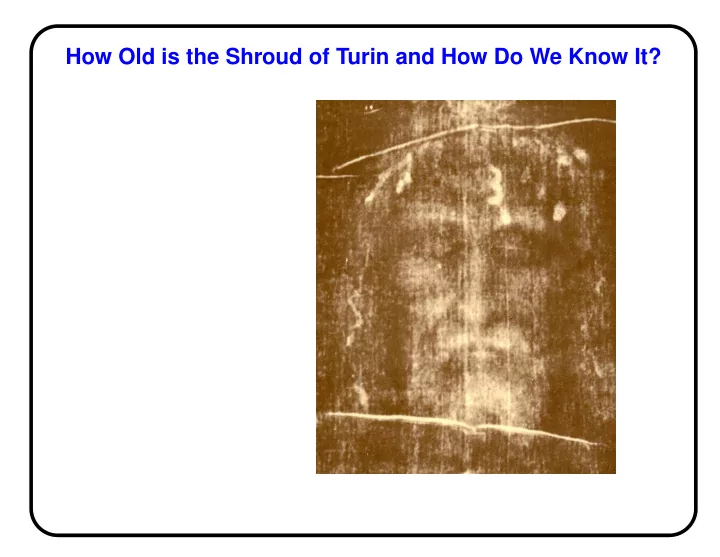
How Old is the Shroud of Turin and How Do We Know It?
SLIDE 2 How Old is the Shroud of Turin and How Do We Know It?
SLIDE 3 How Old is the Shroud of Turin and How Do We Know It?
- Radiocarbon Dating.
- Mass Spectrometry
SLIDE 4 B out
A Mass Spectrometer
Sputter Source Detectors
SLIDE 5 Radiocarbon Dating
N
14
N
14
C
14
CO 2
14
O2 dead or buried material proton neutron loses C
14
Atmosphere Cosmic ray proton
SLIDE 6
Radiocarbon Calibration Curve
SLIDE 7
The REAL Table of Elements
SLIDE 8 Comparing the Electrical and Gravitational Forces
The electron and proton of a hydrogen atom are separated from each
- ther by a distance r = 5.2 × 10⁻¹¹ m. What are the magnitudes and
directions of the electrical and gravitational forces between the two particles? What is the centripetal acceleration of the electron? What is the period of the electron’s orbit if it follows a circular orbit moving at constant speed?
q = e = 1.6 × 10⁻¹⁹ C me = 9.11 × 10⁻³¹ kg ke = 8.99 × 10⁹ Nm2/C2 mp = 1.67 × 1027 kg G = 6.67 × 10⁻¹¹ Nm2/kg2
SLIDE 9 The Electric Dipole
Consider the set of charges shown below. What is the force on charge 3 due to charges 1 and 2 given the conditions on the charges shown below? Express the answer in terms of q, x, and a. What is the electric field at the position of charge 3 due to the other charges?
q1 = q > 0 q2 = −q q3 > 0
q2 q3 q1 x y d/2 d/2
SLIDE 10
The Electric Dipole Moment of Water
The asymmetry of the water molecule leads to a dipole moment in the symmetry plane pointed toward the more positive hydrogen atoms. The measured magnitude of this dipole moment is p = 6.2 × 10⁻³⁰C − m where p is NOT the momentum, but defined as
p = qd where d is the separation between between two charges +q and −q. Calculate
the electric potential at any point along the axis defined by the dipole moment
p in terms of q, d, and r the distance along the axis. Where are the equilibrium points?
105
H H Oxygen p
SLIDE 11 The Electric Dipole Moment of Water
The asymmetry of the water molecule leads to a dipole moment in the symmetry plane pointed toward the more positive hydrogen atoms. The measured magnitude of this dipole moment is p = 6.2 × 10⁻³⁰C − m where p is NOT the momentum, but defined as
p = qd where d is the separation between between two charges +q and −q. Calculate
the electric potential at any point along the axis defined by the dipole moment
p in terms of q, d, and r the distance along the axis. Where are the equilibrium points?
105
H H Oxygen p
1.0 0.5 0.0 0.5 1.0 40 20 20 40 x units of d V units of kq
SLIDE 12 The Electric Dipole Moment of Water
The asymmetry of the water molecule leads to a dipole moment in the symmetry plane pointed toward the more positive hydrogen atoms. The measured magnitude of this dipole moment is p = 6.2 × 10⁻³⁰C − m where p is NOT the momentum, but defined as
p = qd where d is the separation between between two charges +q and −q. Calculate
the electric potential at any point along the axis defined by the dipole moment
p in terms of q, d, and r the distance along the axis. Where are the equilibrium points?
105
H H Oxygen p
1.0 0.5 0.0 0.5 1.0 40 20 20 40 x units of d V units of kq 1.0 0.5 0.0 0.5 1.0 40 20 20 40 x units of d V units of kq
SLIDE 13
The Electric Dipole Moment of Water
The asymmetry of the water molecule leads to a dipole moment in the symmetry plane pointed toward the more positive hydrogen atoms. The measured magnitude of this dipole moment is
p = 6.2 × 10⁻³⁰C − m
where p is NOT the momentum, but defined as p = qd where d is the separation between between two charges +q and −q. Treating this system like a negative charge of 10 electrons and a positive charge of 10e, the effective separation of the negative and positive charge centers is
d = p 10e = 3.9 × 10⁻¹²m
This is 0.0039 nm compared with about
0.15 nm for the effective radius of
hydrogen in liquid form, so the charge separation is small compared to an atomic radius.
105
H H Oxygen p
SLIDE 14 The Electric Potential of a Point Charge
Calculate the electric potential due to a point charge in terms of the radial dis- tance from the charge r, the amount of charge q, and any other necessary con-
- stants. A plot of the fields lines is shown
to the right.
+
SLIDE 15 The Electric Potential of a Point Charge
Calculate the electric potential due to a point charge in terms of the radial dis- tance from the charge r, the amount of charge q, and any other necessary con-
- stants. A plot of the fields lines is shown
to the right.
+
x y V x y
SLIDE 16
‘Electric Fields and Equipotentials’ lab results
two point charges two line charges a line and a point charge
SLIDE 17 The Charged Ring
A ring of radius a as shown in the figure has a positive charge distribution per unit length with total charge Q. Calculate the electric field
E
along the axis of the ring at a point lying a distance x from the center of the
- ring. Get your answer in terms of a, x, Q.
a x
SLIDE 18
The Charged Ring
SLIDE 19
The Charged Ring
SLIDE 20 The Charged Disk - 1
Consider an infinitely-large, flat plate covered with a uniform distribution
- f charge on its surface σ. What is the electric field above the plate in terms
- f this surface charge density σ and any other constants? What is the
electric potential?
x y z charge densityσ Plane with surface
SLIDE 21 The Charged Disk - 2
Consider an infinitely-large, flat plate covered with a uniform distribution
- f charge on its surface σ. What is the electric field above the plate in terms
- f this surface charge density σ and any other constants? What is the
electric potential?
r dr dE Plane with surface charge densityσ
SLIDE 22 The Acceleration Phase
The starting point of a magnetic spectrometer is an accelerator that pushes atoms with a single, added electron to a final velocity before injection into the magnetic part of the spectrometer (see figure). The accelerator consists of two, large, flat, metal plates with surface charge densities ±σ on each plate and separated by a distance d. Charged particles are ‘sputtered’ from a source and speed up as they cross between the plates. What is the electric potential across the plates in terms of the charge density and the separation d? What is the velocity of a charged particle after it leaves the accelerator? What is the velocity
- f a 12C− ion after it leaves the
accelerator if d = 0.1 m and
σ = 8.85 × 10⁻⁸ C/m2?
B out d σ σ + Sputter Source
SLIDE 23
The Parallel Plate Electric Field
SLIDE 24 Going from V to
E
The electric potential in the x − z plane of the electric dipole in the figure can be written as
V (r, θ) = kepcos θ r2
where r and θ are polar coordinates as defined in the figure, p = qd is the dipole moment, q is the charge, d is the charge separation, and r >> d. What is the electric potential in terms
- f Cartesian coordinates? What are
the x and z components of the electric field?
d/2 d/2 x z (x,z) +q −q r θ
SLIDE 25
Electric Circuits - 1
a + − b c f d e ε
SLIDE 26
Electric Circuits - 1
a + − b c f d e ε
b c d e f a b Potential Energy (J)
SLIDE 27
Electric Circuits - 2
a + − b c d e f ε
SLIDE 28
Electric Circuits - 2
a + − b c d e f ε
b Potential Energy (J) b c a f e d
SLIDE 29
Multiple Loop Circuits
What is the current in each of the resistors in the circuit shown in the figure?
R1 = 4 Ω R2 = 4 Ω R3 = 2 Ω ǫ1 = 16 V ǫ2 = 12 V
R1 R2 R3 ε 1 ε 2 + +
SLIDE 30 2007-10-16 11:35:02
Current (A)
0.02 0.04 0.06 0.08 0.1 0.12 0.14 0.16 0.18
Voltage (V)
1 2 3 4 5 6 7 8 9 10
Ohm’s Law
Ω 8 ± slope = 46 Ω = 46.5
meas
R
SLIDE 31
The Drift Velocity of Conduction Electrons - 1
We are using the free-electron model to describe the conduction electrons in a metal. In this model these electrons are free to move about the entire volume of the metal and behave like the molecules or atoms of a gas in a closed container. This is a product of quantum mechanical tunneling. Potential energy of an electron in a single atom. Potential energy of an electron in a metal.
SLIDE 32 The Drift Velocity of Conduction Electrons - 2
v
d
E v
d
positive negative
+
Area = A i L t
∆
SLIDE 33 The Drift Velocity of Conduction Electrons - 3
A copper wire carrying i = 20 C/s has a cross sectional area of
A = 7.1 × 10⁻⁶ m2. The number density of conduction electrons in
copper is n = 8.46 × 1028 particles/m3. What is the drift velocity
vd of
the conduction electrons? What is the average speed of electrons in the metal at a temperature T = 25◦C? How do these two velocities compare with each other? Recall the relationship between temperature and the average kinetic energy of particles in a gas.
KE = 1 2m2v2
rms = 3
2kBT
SLIDE 34 The Drift Velocity of Conduction Electrons - 4
A, A’ B B’ E Blue: No applied voltage or field Red: Voltage applied.
Electron Paths in a Metal
SLIDE 35 Resistivities of Materials at Room Temperature
Material Resistivity Type of Material Silver
1.62 × 10⁻⁸
Metal Copper
1.69 × 10⁻⁸
Metal Aluminum
2.75 × 10⁻⁸
Metal Iron
9.68 × 10⁻⁸
Metal Silicon, pure
2.5 × 10⁻³
Semiconductor Silicon, n-type
8.7 × 10⁻³
Semiconductor Glass
1010 − 1014
Insulator Quartz
≈ 1016
Insulator
SLIDE 36
The Magnetic Dipole Field
SLIDE 37 The Magnetic Force
A uniform magnetic field has a magnitude |
B| = 1.2 T and points
straight up. A proton with energy E = 5.3 MeV enters the field moving
- horizontally. What is the magnitude and direction of the force on the proton?
How would the force change for an electron moving with the same initial velocity? Describe the trajectory of the particle.
B
proton
SLIDE 38
Centripetal Force - 1
SLIDE 39 Centripetal Force - 2
θ /2 θ /2
1
θ
2
θ r2 r 1
SLIDE 40 Centripetal Force - 3
θ /2 θ /2 r 1 s ∆ v 1 v 2 r ∆ r2 θ /2 θ0 /2
SLIDE 41 Centripetal Force - 3
θ /2 θ /2 r 1 s ∆ v 1 v 2 r ∆ r2 θ /2 θ0 /2
v ∆ v2 v1 θ
SLIDE 42 Centripetal Force - 3
θ /2 θ /2 r 1 s ∆ v 1 v 2 r ∆ r2 θ /2 θ0 /2
v ∆ v2 v1 θ r 1 θ r ∆ r2
SLIDE 43 Centripetal Force on the Earth
As we stand on the Earth’s surface we orbit the center of the planet. A centripetal acceleration ac is required to maintain our circular orbit,
- therwise we might go flying off into outer space. How does this
acceleration ac compare with the known acceleration of gravity g at the Earth’s surface? At what speed will things start to ‘fly off’ the Earth’s surface? At this ‘fly-off’ speed, what is the length of one day? Earth’s radius:
6.37 × 10⁶ m
g
9.8 m/s2
SLIDE 44
Radiocarbon Mass Spectrometry
Two isotopes of carbon, 13C and 14C are accelerated across a potential difference V = 5.0 × 10⁶ V . Each atom carries an extra electron so
q = −e = −1.6 × 10⁻¹⁹ C. The atoms are moving horizontally when they enter
a uniform magnetic field pointing straight up with B = 3.0 T . The negatively-charged atoms follow a semi-circular path before striking detectors that measure their passage. The variation in the trajectory of each atom is such that the variation in their final position is about ±0.01 m. Will the spectrometer be able to separate the two isotopes? B out Sputter Source Detectors
SLIDE 45 Radiocarbon Mass Spectrometry
13C:14C 1:1
0.70 0.75 0.80 0.85 0.90 0.0 0.2 0.4 0.6 0.8 1.0 1.2 m Counts Separating 14C and 13C
SLIDE 46 Radiocarbon Mass Spectrometry
13C:14C 10:1
0.70 0.75 0.80 0.85 0.90 2 4 6 8 10 12 m Counts Separating 14C and 13C
SLIDE 47
Radiocarbon Mass Spectrometry
Two isotopes of carbon, 12C and 14C are accelerated across a potential difference V = 5.0 × 10⁶ V . Each atom carries an extra electron so
q = −e = −1.6 × 10⁻¹⁹ C. The atoms are moving horizontally when they enter
a uniform magnetic field pointing straight up with B = 3.0 T . The negatively-charged atoms follow a semi-circular path before striking detectors that measure their passage. The variation in the trajectory of each atom is such that the variation in their final position is about ±0.01 m. Will the spectrometer be able to separate the two isotopes? B out Sputter Source Detectors
SLIDE 48 The Age of the Earth
The figure below shows the decay scheme for 238U which can be approximated as 238U → 206Pb + other decay products where the half-life is determined by that first step. Why? A rock is found containing
mU = 0.0042 kg of 238U and mPb = 0.0024 kg of 206Pb. Assume the
rock contained no lead at all when it was formed so all the lead present is from the decay of uranium. What is the age of the rock? What does this say about the age of the Earth? U
92
Th
90
Pa
91
U
92
Th
90
Ra
88
Rn
86 84Po
Pb
82
Bi
83 84Po
Pb
82 84Po
Bi
83
Pb
82 α β β α α α α α β β α β α 238 234 234 234 226 222 218 214 214 214 210 210 206 210 β 230
4.5x10 y 24 d 6.7 h 3.1 m 3.8 d 1600 y 0.16 ms 22 y 5.0 d 2.5x10 y 7.4x10 y 27 m 20 m 138 d
9 5 4
SLIDE 49
Testing the No-Lead Assumption
SLIDE 50
Testing the No-Lead Assumption