SLIDE 1
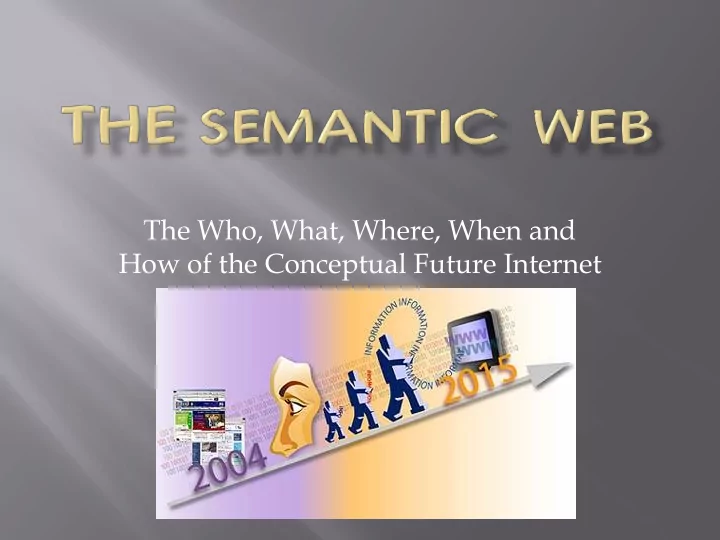
The Who, What, Where, When and How of the Conceptual Future Internet
SLIDE 2
Links lead to links that link to other links. Many people use only the first few links
provided by search engines, much of the valuable information is not used.
In particular, the science community remains
affected.
SLIDE 3
The term Semantic Web originated from Tim
Berners-Lee.
Also known as Web 3.0, the Semantic Web is an
extension of the World Wide Web.
Content would be easier to disperse amongst a
wider range due to its integration of current information applications creating a substantial data source.
SLIDE 4
SLIDE 5 CATEGORIZING BY LOGICAL UNDERSTANDING
CATEGORIZING BY KEYWORD
Reasons like a human
Context of the word is taken into consideration
- Ex. (Block-The street, A solid
piece of something, or to
Many options, but thousands
Many search engines like Google sort by popularity or “hits”
Valuable and relevant information could be hidden
SLIDE 6
SLIDE 7
Basic Simple Wikipedia Example:
“The sky has the color blue”
Subject=“The Sky” Predicate= “has the color” Object= “blue”
SLIDE 8
OWL – distinguishes vocabulary and makes
them machine readable
RDF allows the user to input more scientific
related material and receive information more relevant to their topic.
SLIDE 9
Created by Carnegie Mellon University NELL uses similar humanistic qualities to
attain information.
The algorithms are automated, so the
programming input is simple.
NELL unfortunately has problems
distinguishing the contexts of words.
SLIDE 10 Can help relieve students of the hassle of
searching for information, and create more time to actively understand, analyze and critically think about the information when quickly found.
Institutions would also have better access to
- ther universities’ scientific work with a more
- rganized and detailed manner.
SLIDE 11 The United States of America, New Zealand,
United Kingdom, and Australia have been
- pening up their government data.
Creation of Linked Data replenishes the
interest of the computer science community.
Linked Data uses the web to publish and
connect data using RDF.
SLIDE 12
Needs more support Needs funding Users must learn basic programming skills Governments need to share data Mandatory to be free or low cost like the
current web