HOW DO WE Compare the most recent research regarding the care of - - PDF document

how do we
SMART_READER_LITE
LIVE PREVIEW

HOW DO WE Compare the most recent research regarding the care of - - PDF document

2/27/2014 Current Recommendations Timely care Hot Topics: Adult In vs. Outpatient Febrile Neutopenia: Safely Navigating ED Process the Emergency Department Timely care Pediatric ED Process Tiffany Zook, RN, BSN,


slide-1
SLIDE 1

2/27/2014 1 Hot Topics: Febrile Neutopenia: Safely Navigating the Emergency Department

Tiffany Zook, RN, BSN, CPHON

Objectives

  • Compare the most recent research regarding

the care of febrile pediatric and adult oncology & stem‐cell transplant patients with the current practice in his/her institution

  • Analyze the use of the fast‐track method of

admission at Cardon Children’s Medical Center and the corresponding patient education.

  • Evaluate how the fast‐track method of ED to in‐

patient admission can be implemented in other programs

Current Practice

Adult

  • Program specific

practices

  • No general

consensus

  • Program specific

practices

  • No general

consensus Pediatric

  • “Rapid”

administration

  • f antibiotics
  • Inconsistent ED

practices

  • “Rapid”

administration

  • f antibiotics
  • Inconsistent ED

practices

Best et al., 2011; Cull & Nolan, 2009 Gunderson et al., 2013; Wierema, Konecny & Links, 2013 Burry et al., 2012; Cash, Deloach, Graham, Shirm & Mian, 2014; Dobrasz et al., 2013; Volpe et al., 2014

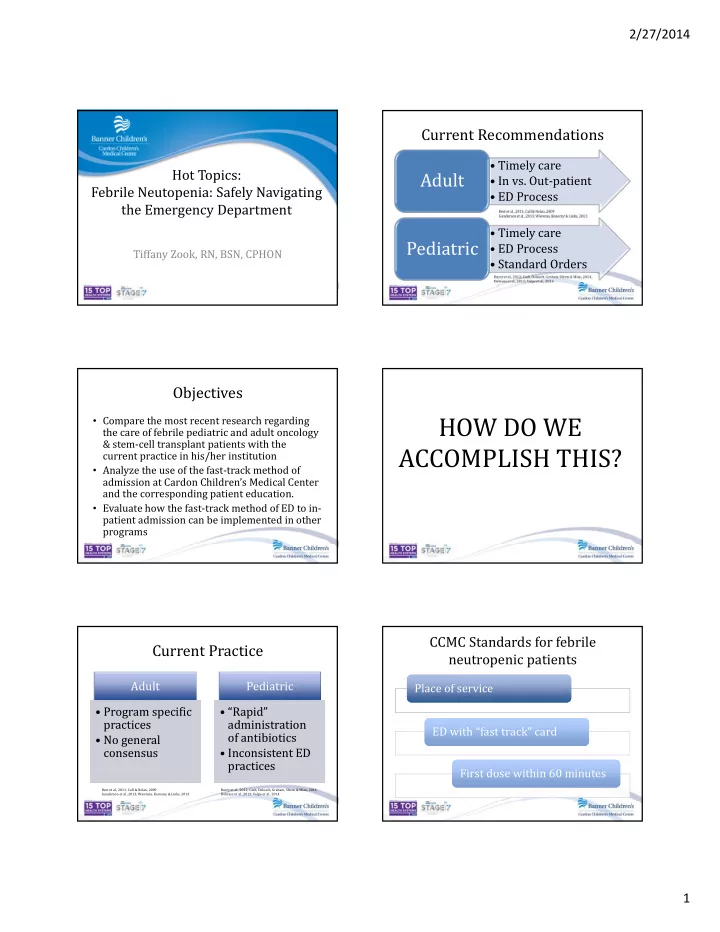
Current Recommendations

  • Timely care
  • In vs. Out‐patient
  • ED Process

Adult

  • Timely care
  • ED Process
  • Standard Orders

Pediatric

HOW DO WE ACCOMPLISH THIS?

CCMC Standards for febrile neutropenic patients

Place of service Place of service ED with “fast track” card ED with “fast track” card First dose within 60 minutes First dose within 60 minutes

slide-2
SLIDE 2

2/27/2014 2

ED “fast track” card Spanish reverse side Family Education

New Diagnosis Checklist

Home Magnet ED “Fast Track” Card New Diagnosis Checklist

Indicate who was taught: M=Mother, F=Father, P=Patient, O=Other Signature/Date Reinforced Verbalized Diagnosis and Treatment Plan: Initials/Date Initials/Date Verbalizes understanding of diagnosis Have copy of roadmap or calendar and drug sheets Copy of COG Family Handbook given to patient/family Fever and Neutropenia Protocol: Verbalizes s/s of infection and temp of 100.5 (no rectal temps) Has a thermometer at home (demonstrates use) Has a laminated ED card & Family Information packet Knows ways to prevent infection (handwashing, daily hygiene)

Nurse Magnet

Emergency Information

#480‐412‐4100 Oncology Outpatient Clinic and Physicians (24 hour answering) #480‐412‐6275 Pediatric Outpatient Treatment Center (M‐F, daytime hours regarding procedures, outpatient chemotherapy) #480‐412‐6600 Cardon Pediatric inpatient unit Call 911 if your child:  Is not breathing or has difficulty breathing  Has skin or lips that look blue  Is having a seizure and you have not been told that these can be managed at home  Does not wake up after you have attempted to awaken them (loss of consciousness) Call #480‐412‐4100 if your child has:  Fever (100.4°F or 38.0°C) or chills (**call immediately – day or night)  Uncontrolled bleeding that does not stop within 5‐10 minutes  A change in behavior or level of consciousness (such as being sleepy, very irritable, or not making sense when talking)  A sudden change in vision  A severe headache  New weakness of the face, arm, or leg  Uncontrolled pain  Repeated vomiting or diarrhea  The inability to drink or keep down fluids  A break in the central line (clamp closest to patient)  Exposure to chickenpox or shingles  Any other symptom your physician or nurse has instructed you to call with **If instructed to go to the ER or hospital by the physician, take your ER card and medications with you and inform the ER you are a pediatric oncology patient.

Challenges

Patient

  • Education
  • Compliance (Calling, Using Resources)

Staff

  • Education
  • Reinforcement of procedure

ED

  • Education
  • Compliance
slide-3
SLIDE 3

2/27/2014 3

Application

  • What current pediatric practices

are in place at your institutions?

  • What current adult practices are in

place at your institutions?

  • How would you apply this process

to your institution?

Questions?

References

Burry, E., Punnett, A., Mehta, A., Thull‐Freedman, J., Robinson, L., & Gupta, S. (2012). Identification of educational and infrastructural barriers to prompt antibiotic delivery in febrile neutropenia: A quality improvement initiative. Pediatric Blood and Cancer, 59, 431‐435. Best, J. T., Frith, K., Anderson, F., Rapp, C. G., Rioux, L., & Ciccarello, C. (2011). Implementation of an evidence‐based order set to impact initial antibiotic time intervals in adult febrile neutropenia. Oncology Nursing Forum, 38(6), 661‐668. Cash, T., Deloach, T., Graham, J., Shirm, S., & Mian, A. (2014). Standardizzed process used in the emergency department for pediatric oncology patients with fever and neutropenia improves the time to the first dose of antibiotics. Pediatric Emergency Care, 30(2), 91‐93. Cull, L. F., & Nolan, M. B. (2009). Treating neutropenic fever in the emergency department: Delays may be deadly! Journal of Emergency Nursing, 35(1), 36‐39. Dobras, G., Hatfield, M., Jones, L. M., Berdis, J. J., Miller, E. E., & Entrekin, M. S. (2013). Nurse‐driven protocols for febrile pediatric oncology patients. Journal of Emergency Nursing, 39(3), 289‐295. Gunderson, C. C., Farrell, R., Dinh, B. C., Thomas, E. D., Vesely, S. K., Lauer, J. K., …, Moore, K. N. (2013). Inpatient versus outpatient management of neutropenic fever in gynecologic oncology patients: Is risk stratification useful? Gynecologic Oncology, 130, 411‐415. Volpe, D., Harrison, S., Damian, F., Rachh, P., Kahlon, P. S., Morrissey, L., …, Stack, A. M. (2012). Improving timeliness of antibiotic delivery for patients with fever and suspected neutropenia in a pediatric emergency department. Pediatrics, 130(1), e201‐e210. Wierema, J., Konecny, P., & Links, M. (2013). Implementation of risk stratified antibiotic therapy for neutropenic fever: What are the risks? Internal Medicine Journal, doi:10.1111/imj.12251.