How do senators vote? -Issues - Strategies -Affiliation - - - PDF document

how do senators vote
SMART_READER_LITE
LIVE PREVIEW

How do senators vote? -Issues - Strategies -Affiliation - - - PDF document

4/30/18 CSCI 3210: Computational Game Theory The Power of Context: Ideal Points with Social Interactions Ref: Irfan & Gordon Mohammad T. Irfan How do senators vote? -Issues - Strategies -Affiliation - Influence Voting Behavior 1


slide-1
SLIDE 1

4/30/18 1

CSCI 3210: Computational Game Theory

Mohammad T. Irfan

The Power of Context: Ideal Points with Social Interactions

Ref: Irfan & Gordon

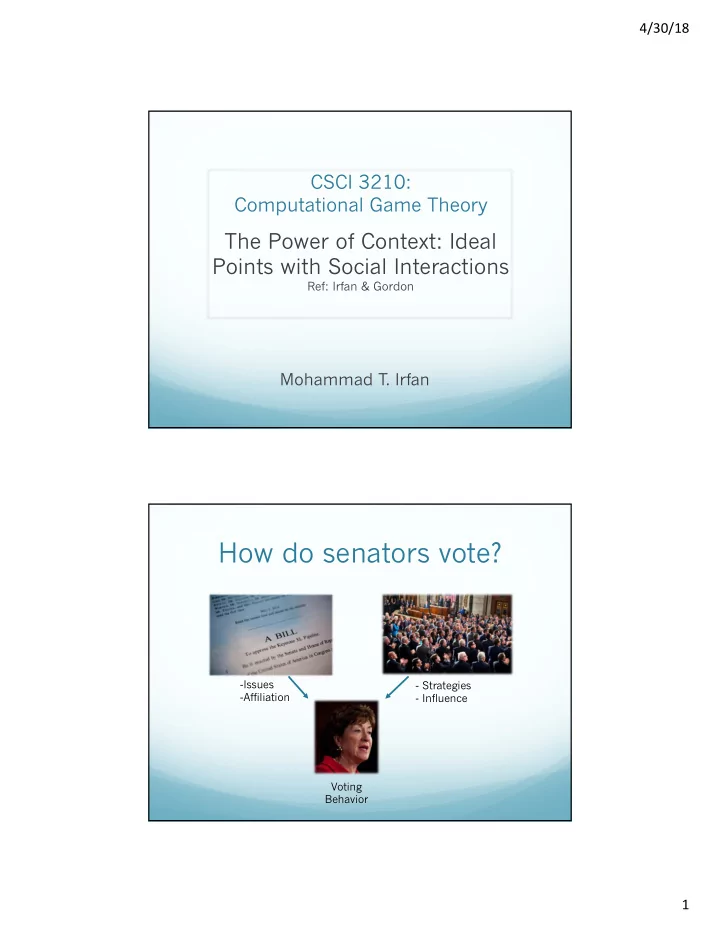
How do senators vote?

  • Issues
  • Affiliation
  • Strategies
  • Influence

Voting Behavior

slide-2
SLIDE 2

4/30/18 2

Stat: Ideal Point Models (Davis+, 1970)

Parameters:

§ pi – ideal point of senator i § ad – polarity of bill d § bd – popularity of bill d

Variable:

§ xid – yea (+1) or nay (-1)

p(xi,d = yea|pi, ad, bd) = σ(piad + bd).

http://k7moa.com/images/ png/Sen114_Ideal_Point_Pl

  • tB.png

Linear Influence Game (LIG) (Irfan & Ortiz, 2014)

slide-3
SLIDE 3

4/30/18 3

Strengths & Weaknesses of Models

Mo Model: St Strengths: We Weaknesses: Linear Influence Game (LIG) Strategic behavior Bill-specific voting Ideal Point Bill-specific voting Strategic behavior

Ideal Point Model with Social Interactions

Idea: add ideal point parameters to LIG model

Terms Description xi ∈ X Votes of senator i wi,−i ∈ W Incoming influence on senator i from all other senators −i ti Influence threshold of senator i pi Ideal point of senator i al Polarity of bill l m Number of bills `d ∈ D The topics in each bill d (Sec. (3.2.2)) Learn Observe Predict

slide-4
SLIDE 4

4/30/18 4

Ideal Point Model with Social Interactions

— Influence function of Senator i for bill l — Influence function > 0 è B.R. is vote yea — Influence function < 0 è B.R. is vote nay — Influence function = 0 è Indifferent

fi(x−i, l) ≡ X

j∈Ni

wijxj − ti + (pi · al) =

Voting Data

slide-5
SLIDE 5

4/30/18 5

Learn Parameters

Data

Compute Equilibria

Model

§Model does not immediately predict anything

§Must compute equilibria first

§ NP-Hard (Irfan & Ortiz, 2014)

slide-6
SLIDE 6

4/30/18 6

Implementation Issues: scaling

Sanders (I-VT)

  • 4

Warren(D-MA)

  • 4

Shelby (R-AL) +4 Cruz (R-TX) +4

Implementation Issues: polarity of unseen bills

New bill Polarity = ? Euclidean dist. to existing bills

slide-7
SLIDE 7

4/30/18 7

0.0001 0.000125 0.00015 0.000175 0.0002 0.000225 0.00025 0.000275 0.0003 0.000325 0.00035 0.000375 0.0004 0.000425 0.00045 rho' rho 0-10 10-20 20-30 30-40 40-50 0.0001 0.000125 0.00015 0.000175 0.0002 0.000225 0.00025 0.000275 0.0003 0.000325 0.00035 0.000375 0.0004 0.000425 0.00045

rho' rho 0-5 5-10 10-15 15-20 20-25

Euclidean dist. Validation error

0.0001 0.000125 0.00015 0.000175 0.0002 0.000225 0.00025 0.000275 0.0003 0.000325 0.00035 0.000375 0.0004 0.000425 0.00045 rho' rho 0-500 500-1000 1000-1500

# edges

Se Selected M Model: ⍴ = 0.0225 ⍴’ = 0.004 ≈1000 edges 16% validation error

Model Evaluation

Our model vs. LIG model

slide-8
SLIDE 8

4/30/18 8

Criterion: % data that are NE

100% Test Accuracy

Empty Model

Problem: large # of NE % data as eq. # eq.

Want

slide-9
SLIDE 9

4/30/18 9

Model Evaluation

§ True proportion of equilibria:

π(G) ≡ |NE(G)|/2N

§Proportion of equilibria in data:

§ q = fraction of observed data captured as NE

G), we want as

q·m |N E(G)|/2N . S

log q |NE(G)|

Model Evaluation

LIG model:

§ q = 20% § |NE(G)| =

287,494

Our model: § q = 4.83% § |NE(G)| = 3,242

log10 q |NE(G)| = log 4.83 3242 ≈ −2.69 log10 q |NE(G)| = log 20 287494 ≈ −4.16

(Our model constrained to ensure similar graph size)

slide-10
SLIDE 10

4/30/18 10

114th U.S. Senate

January 2015 – January 2017

Ideal Point −4 −2 2 4

WARREN SANDERS KING CANTWELL SCHATZ DURBIN NELSON LEAHY MERKLEY BOXER CARPER WHITEHOUSE FRANKEN BOOKER MARKEY WYDEN BROWN GILLIBRAND BALDWIN HIRONO REID BLUMENTHAL REED COONS TESTER UDALL PETERS MURRAY MIKULSKI SHAHEEN STABENOW KLOBUCHAR KAINE FEINSTEIN MURPHY MCCASKILL CARDIN HEINRICH MENENDEZ SCHUMER WARNER BENNET MANCHIN HEITKAMP CASEY DONNELLY MCCONNELL ALEXANDER AYOTTE GARDNER KIRK COLLINS GRAHAM COCHRAN CORKER PAUL DAINES RUBIO ISAKSON LEE SESSIONS BARASSO BURR CRAPO CORNYN ROUNDS MCCAIN TILLIS RISCH ROBERTS HELLER THUNE HATCH PORTMAN FISCHER ERNST PERDUE JOHNSON CAPITO SCOTT ENZI FLAKE BOOZMAN BLUNT SASSE HOEVEN CASSIDY COATS INHOFE WICKER VITTER LANKFORD TOOMEY MURKOWSKI SULLIVAN COTTON SHELBY CRUZ MORAN GRASSLEY

−4 −2 2 4

WARREN SANDERS KING CANTWELL SCHATZ DURBIN NELSON LEAHY MERKLEY BOXER CARPER WHITEHOUSE FRANKEN BOOKER MARKEY WYDEN BROWN GILLIBRAND BALDWIN HIRONO REID BLUMENTHAL REED COONS TESTER UDALL PETERS MURRAY MIKULSKI SHAHEEN STABENOW KLOBUCHAR KAINE FEINSTEIN MURPHY MCCASKILL CARDIN HEINRICH MENENDEZ SCHUMER WARNER BENNET MANCHIN HEITKAMP CASEY DONNELLY MCCONNELL ALEXANDER AYOTTE GARDNER KIRK COLLINS GRAHAM COCHRAN CORKER PAUL DAINES RUBIO ISAKSON LEE SESSIONS BARASSO BURR CRAPO CORNYN ROUNDS MCCAIN TILLIS RISCH ROBERTS HELLER THUNE HATCH PORTMAN FISCHER ERNST PERDUE JOHNSON CAPITO SCOTT ENZI FLAKE BOOZMAN BLUNT SASSE HOEVEN CASSIDY COATS INHOFE WICKER VITTER LANKFORD TOOMEY MURKOWSKI SULLIVAN COTTON SHELBY CRUZ MORAN GRASSLEY
slide-11
SLIDE 11

4/30/18 11

CARPER D DE CARDIN D MD MENENDEZ D NJ SCHUMER D NY CRUZ R TX LEE R UT PAUL R KY PETERS D MI MCCASKILL D MO

Most influential senators (al = 0)

Most i influential s senators: group of senators who can enforce a desirable outcome

slide-12
SLIDE 12

4/30/18 12

Case Studies

Three bills (Not in training set)

Polarity (a) −4 −2 2 4 −4 −2 2 4

  • Amdt. 777

Keystone XL Motion to Proceed

Bill polarities

slide-13
SLIDE 13

4/30/18 13

Case Study: Keystone XL Pipeline

§ Passed 62 - 36 § Polarity: 1.426 § LIG Model:

§ 287,400 NE § Median correct votes: 50 § 0.005% of eq. had at least 90

§ Our Model:

§ Only one possible NE § 91 correct votes

Case Study:

  • Amdt. 777

“To establish a deficit-neutral reserve fund to recognize that climate change is real and caused by human activity and that Congress needs to take action to cut carbon pollution.”

§ Failed 49 - 50 § Polarity: -3.705 § LIG Model:

§ 287,400 NE

§ Median correct votes: 50 § 0.005% of eq. had at least 90 § Our Model: § Only one possible NE § 92 correct votes

slide-14
SLIDE 14

4/30/18 14

Case Study: Motion to Invoke Cloture

§ Passed 84-12

§ Cruz, Paul, Warren, and Sanders voted yea

§ Polarity: -0.0297 § LIG Model:

§ 287,400 NE § Median correct votes: 44

§ Our Model:

§ 3,200 NE § Median correct votes: 77

Main Take-Aways

§ Significant improvement in quality of equilibria

§ Stronger predictive power than LIG model

§ Ability to adjust for bills leads to specific NE § Improved computation time

slide-15
SLIDE 15

4/30/18 15

Future Work

§ More efficient equilibrium computation § Topic modeling § Bayesian games