Housing Summit 2019 Recap income housing creation, assist - - PowerPoint PPT Presentation

housing summit 2019 recap
SMART_READER_LITE
LIVE PREVIEW

Housing Summit 2019 Recap income housing creation, assist - - PowerPoint PPT Presentation

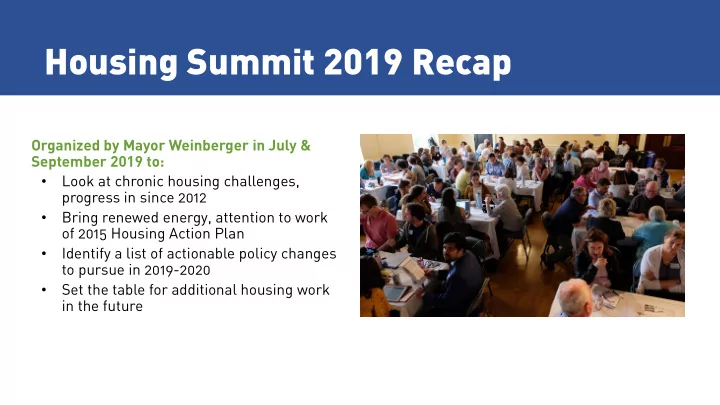
Organized by Mayor Weinberger in July & September 2019 to: Look at chronic housing challenges, progress in since 2012 Bring renewed energy, attention to work of 2015 Housing Action Plan Identify a list of actionable policy changes to


slide-1
SLIDE 1

Organized by Mayor Weinberger in July & September 2019 to:

  • Look at chronic housing challenges,

progress in since 2012

  • Bring renewed energy, attention to work
  • f 2015 Housing Action Plan
  • Identify a list of actionable policy changes

to pursue in 2019-2020

  • Set the table for additional housing work

in the future

Housing Summit 2019 Recap

slide-2
SLIDE 2

2015 Housing Action Plan

  • Expand municipal resources to support new low- and moderate-

income housing creation, assist those ineligible for subsidy

  • Consider land use reforms to address regulatory barriers and

disincentives to housing production

  • Pursue strategies for housing college students, improving quality of

life and housing cost in historic neighborhoods

  • Identify new approaches to homelessness in our community
  • Provide appropriate housing options for an aging population
slide-3
SLIDE 3

2019 Housing Summit Reforms

  • Updating standards for energy efficiency in rental housing- in

progress

  • Making it easier to build Accessory Dwelling Units- adopted
  • Implementing regulations for short-term rental- in progress
  • Reforming requirements for building new parking- adopted
  • Restoring the level of funding for the City’s Housing Trust Fund-

approved by voters, but postponed in 2020

slide-4
SLIDE 4

Staff has updated corresponding elements to reflect Committee input. Framework includes changes to several city ordinances/policies:

  • Proposed zoning amendments to the Burlington Comprehensive Development Ordinance
  • Following discussion, recommend warning for a public hearing
  • Proposed amendments to Chapter 18 of the Code of Ordinances regarding “Minimum

Housing Standards”

  • Typically not within the purview of the Planning Commission, but included for discussion
  • Proposed Council Action to impose an additional tax or fee on nights or revenue
  • Not included in packet, would be recommended when transmitting proposal to Council

Current draft STR Proposal

4

slide-5
SLIDE 5

Per Oct 2019 Council Resolution, a framework that “creates tiers for different types of [STRs] and disincentivizes the most impactful uses…by:

  • limiting the number of housing units that can be

converted for [STR] purposes and

  • ensuring that those conversions are contributing to the

city’s efforts to preserve and expand permanently affordable housing, while also

  • preserving some flexibility and ability to earn greater

income for Burlington homeowners, and

  • recognizing that some supply of [STRs] benefits the

Burlington economy…”

STR Discussion Recap

Original proposal included three strategies to limit conversion:

  • Tiered limit to number of STRs

based on units on a property

  • Host residency required in all

scenarios

  • Some STR’s considered

commercial use, and/or conditional use

slide-6
SLIDE 6

Per Oct 2019 Council Resolution, a framework that “creates tiers for different types of [STRs] and disincentivizes the most impactful uses…by:

  • limiting the number of housing units that can be

converted for [STR] purposes and

  • ensuring that those conversions are contributing to the

city’s efforts to preserve and expand permanently affordable housing, while also

  • preserving some flexibility and ability to earn greater

income for Burlington homeowners, and

  • recognizing that some supply of [STRs] benefits the

Burlington economy…”

STR Discussion Recap

Joint Committee has discussed this proposal in 7 meetings in 2020, providing feedback that has led to changes to:

  • number of STRs allowed in multi-

unit buildings

  • when host is required on-site
  • STRs as special residential use

(changes applicability of housing replacement)

  • fewer scenarios as conditional use
slide-7
SLIDE 7

Key Policy Questions

We are looking for consensus from Committee on the following issues:

  • Scenarios that allow for off-site host
  • Whether hosts must be an owner
  • Proposed limits on the number of STR’s by property type
  • Policy objective behind a nightly fee for STR use
  • Others?
slide-8
SLIDE 8

Background on STR’s in Burlington

50 100 150 200 250 300 350 400 450 Listings Whole Dwelling Partial Dwelling 50 100 150 200 250 300 350 400 450 Permit Status Permitted Unpermitted

Short-Term Rentals, Burlington July 2020

Map and data on number of STR’s in Burlington provided by HostCompliance. Data on number of permits issued provided by Department of Permitting & Inspections.

Short-term rentals are dwelling units rented in whole or part to guests for stays of 30 days or less.

Slides have previously been presented to Joint Committee in meetings throughout 2020. Some slides may not be current based on changes to the proposal. These slides are being shared for reference, and most current proposal can be found in upcoming Planning Commission agenda. 8

slide-9
SLIDE 9

Background on STR’s in Burlington

Data in charts/graphics on slide provided by Host Compliance. Total listings has varied from 405 to 420 listings between June – Sept. 2020

2019 report by AirBnB:

  • Burlington was #1 destination in VT, summer 2019
  • Avg. monthly revenue for a STR in Burlington was

$2,700 in 2019. Sept 2020 Data from Host Compliance:

  • Median Nightly Rate in BTV is $129, from $119 in

July 2019

50 100 150 200 250 300 350 400 450 Rentals

Growth in STR Listings in Burlington

2018 2019 2020 71% 29%

% of STRs, Unit Type

Whole Unit Partial Unit

Update: Whole Unit STR’s increased from 67% to 71% in the last year.

55% 45%

% STRs, Property Type

Single-Family Multi-Family

Update: Single-Family properties decreased from 58% to 55% in July.

9

slide-10
SLIDE 10

Background on STR’s in Burlington

Short-Term Rentals by Ward Jan. 2020

Map and data on number of STR’s in Burlington provided by HostCompliance.

10 20 30 40 50 60 70 80 90 100 Ward 1 Ward 2 Ward 3 Ward 4 Ward 5 Ward 6 Ward 7 Ward 8 Listings Unique Properties

Listings:

  • All rental advertisements that are

available across all platforms

  • May duplicate portion(s) of other listings

Unique Properties:

  • Controls for duplicate listings

Active Listings

  • STR’s currently being advertised for rent,

whether booked or available.

Varying approaches to renting in 2020 may impact ongoing variation in “active” listings, frequency of rentals

Slides have previously been presented to Joint Committee in meetings throughout 2020. Some slides may not be current based on changes to the proposal. These slides are being shared for reference, and most current proposal can be found in upcoming Planning Commission agenda. 10

slide-11
SLIDE 11

Additional Data on STR’s

Additional stats are included on following slides regarding the number, type, and frequency of short- term rentals in Burlington.

  • 25% increase in number of STRs 2018-2019, doubled 2016-2019. Not much change in total listings in 2020; unclear

what long-term COVID-19 impacts will be.

  • There is some, but not dramatic, seasonal variation in the number of STR’s. During 2020 Stay Home Stay Safe Order,

all STRs were prohibited, and AirBnB disabled renting. Aug 2019- Aug 2020 data shows impact of COVID-19 in shift in number of nights rented (slide 13).

  • In Nov 2020, AirDNA estimated that 74% of active STRs are efficiency, one-bedroom, or two-bedroom units
  • In FY2019, City collected ~$121,000 in RMT taxes attributable to STRs, for ~$6.05M in host income. This is 12.4% of RMT

collected in 2019.

  • In FY2020, City collected ~$103,715 in RMT taxes attributable to STRs, for ~$5.2M in host income. This is 13% of RMT

collected in FY20, and 14% less than FY 19

11 Slides have previously been presented to Joint Committee in meetings throughout 2020. Some slides may not be current based on changes to the proposal. These slides are being shared for reference, and most current proposal can be found in upcoming Planning Commission agenda.

slide-12
SLIDE 12

Housing Characteristics

Type of Structure

% of All Occupied Units Single Unit Detached Dwelling 30% Single Unit Attached (i.e. townhomes) 5.5% 2 Units 13% 3 or more Units 50.3% Mobile home or other type 1.2%

There are approximately 17,000 housing units in Burlington, 60% of which are renter-occupied.

2018 American Community Survey 5-Year Estimates

12

  • Single-unit properties (attached and

detached):

  • 35.5% of total housing stock, but
  • 80% of all owner-occupied housing units
  • Duplex (2-unit) properties:
  • 13% of total housing stock
  • 5.5% of all owner-occupied units, 17% of all

renter-occupied units

  • Multi-unit properties:
  • 50.3% of total housing stock, and
  • 73% of all rental housing units
slide-13
SLIDE 13

Housing & Vacancy Trends

According to Allen, Brooks & Minor:

  • 1.6% in July 2019, compared to 2.5% in Chittenden

County

  • Average annual vacancy rate in Burlington was:
  • 0.7% from 2006-2011
  • 1.5% from 2012-2018

Housing Growth

  • Approx. 930 new housing units 2012-Sept 2019
  • Vast majority have been in multi-unit, rental

developments

  • According to ABM, 60% of new housing growth in

2019 was in suburban Chittenden County

13

Despite some positive progress, BTV’s apartment vacancy rate continues to be less than 2%.

50 100 150 200 250 300

2012 2013 2014 2015 2016 2017 2018 2019

New Housing Units Housing Production Burlington, 2012-2019

Inclusionary Zoning (IZ) Units Affordable Units (non-IZ) Market Rate Units

Source: CEDO IZ Reports, AMANDA

slide-14
SLIDE 14

Housing & Vacancy Trends

According to Allen, Brooks & Minor:

  • 1.6% in July 2019, compared to 2.5% in Chittenden

County

  • Average annual vacancy rate in Burlington was:
  • 0.7% from 2006-2011
  • 1.5% from 2012-2018

Housing Growth

  • Approx. 930 new housing units 2012-Sept 2019
  • Vast majority have been in multi-unit, rental

developments

  • According to ABM, 60% of new housing growth in

2019 was in suburban Chittenden County

14

Most of the recent and anticipated housing growth is in multi-unit developments.

Housing Units in the queue (all multi-unit)

Permitted

  • 113 units received zoning permits in FY20 and so far

in FY21; not yet built/have certificate of occupancy

Applications pending

  • 64 senior housing units
  • ~425 at 75 Cherry Street (City Place)

Conceptual (no application yet)

  • ~200 more at Cambrian Rise
  • 100+/- in 2 to 3 additional projects
slide-15
SLIDE 15

Residential Property Tax Rates

15 $4,000 $4,500 $5,000 $5,500 $6,000 $6,500 $7,000 $7,500 $8,000 FY12 FY13 FY14 FY15 FY16 FY17 FY18 FY19 FY20 FY21

Municipal + Education Taxes for Residential Property Valued at $250,000

Homestead Non-Homestead

slide-16
SLIDE 16

Host Residency on Property

Considerations:

  • STRs can both generate income for hosts to afford

homes and increase demand for existing housing units

  • Original proposal required host on-site in all

scenarios; current proposal requires for single- family & duplex properties

  • Impact of requiring host on-site varies based on

related definition of host

  • Property types requiring host on-site relative to

share of city’s housing stock

What is the primary objective for requiring host-residency?

  • Limiting the conversion of properties from

long-term housing to 100% short-term rental use

  • Enable flexibility for residents to use their
  • wn homes to generate income
  • May be some benefit from a neighborhood

impact perspective, but not primary driver

16

slide-17
SLIDE 17

Defining STR Host

Residency Standards:

Primary residence of the host- current proposal

  • Host is defined as owner or a tenant operating an STR

in their home or on the same property as their primary residence

  • Primary residence means they live there at least half

the year- I.e. “host on-site”

  • Required to live on-site for STRs in single-family and

duplex, not required on-site for multi-unit Owner-occupied

  • The property owner lives onsite for at least half of the

year

17

What is the primary objective for requiring host to be an owner?

  • Staff recommendation prioritized host on

property, not owner

  • Widely believed that few rental property
  • wners will allow tenants to STR
  • Impact of requiring host to be an owner

depends on related question of where host is required on-site.

slide-18
SLIDE 18

Hosting Requirements

Type of Structure

% of All Occupied Units % of Unit Type Owner-Occupied % of Unit Type Renter-Occupied Single Unit Detached Dwelling 30% 88% 12% Single Unit Attached 5.5% 69% 31% 2 Units 13% 16% 84% 3 or more Units 50.3% 10% 90% Mobile home or other type 1.2% 23% 77%

Per the current proposal…

2018 American Community Survey 5-Year Estimates

18

Host: owner or tenant On Site: single-unit, duplex properties Off Site: multi-unit properties

  • Most single-unit properties can host

an STR, including small number of rentals if owner allows tenant to host

  • Most multi-unit properties can host

STR subject to max building limits

  • Duplexes can host STR if owner

allows tenant to be host

slide-19
SLIDE 19

Hosting Requirements

Type of Structure

% of All Occupied Units % of Unit Type Owner-Occupied % of Unit Type Renter-Occupied Single Unit Detached Dwelling 30% 88% 12% Single Unit Attached 5.5% 69% 31% 2 Units 13% 16% 84% 3 or more Units 50.3% 10% 90% Mobile home or other type 1.2% 23% 77%

No change to definition of host, but allow off-site hosting for all scenarios…

2018 American Community Survey 5-Year Estimates

19

Host: owner or tenant On Site: Off Site: all scenarios

Who the host is and where they live has no bearing on potential for STR:

  • Small, but notable opportunity for

single-family rental to become STR, potential to create demand for single-unit properties

  • No change to STRs in multi-units
  • Makes it easier to STR in a duplex
slide-20
SLIDE 20

Hosting Requirements

Type of Structure

% of All Occupied Units % of Unit Type Owner-Occupied % of Unit Type Renter-Occupied Single Unit Detached Dwelling 30% 88% 12% Single Unit Attached 5.5% 69% 31% 2 Units 13% 16% 84% 3 or more Units 50.3% 10% 90% Mobile home or other type 1.2% 23% 77%

If host is required to be owner, but no change to on-site requirements…

2018 American Community Survey 5-Year Estimates

20

Host: owner On Site: single-unit, duplex properties Off Site: multi-unit properties

  • Minimal change to circumstances for

single-unit, small number no longer have option for tenant to host

  • Little change to when an STR could

happen in multi-unit, but no longer allows tenant to host

  • Majority of duplexes not able to STR
slide-21
SLIDE 21

Hosting Requirements

Type of Structure

% of All Occupied Units % of Unit Type Owner-Occupied % of Unit Type Renter-Occupied Single Unit Detached Dwelling 30% 88% 12% Single Unit Attached 5.5% 69% 31% 2 Units 13% 16% 84% 3 or more Units 50.3% 10% 90% Mobile home or other type 1.2% 23% 77%

If host is required to live on-site in all scenarios, but no change to who is host…

2018 American Community Survey 5-Year Estimates

21

Host: owner or tenant On Site: all scenarios Off Site:

  • No change from current proposal for

single-units

  • May have a significant impact on

STRs in multi-unit properties, unless owner allows tenant to host

  • No change from current proposal for

duplex

slide-22
SLIDE 22

Hosting Requirements

Type of Structure

% of All Occupied Units % of Unit Type Owner-Occupied % of Unit Type Renter-Occupied Single Unit Detached Dwelling 30% 88% 12% Single Unit Attached 5.5% 69% 31% 2 Units 13% 16% 84% 3 or more Units 50.3% 10% 90% Mobile home or other type 1.2% 23% 77%

If host is required to be owner, and live on-site in all scenarios…

2018 American Community Survey 5-Year Estimates

22

Host: owner On Site: all scenarios Off Site:

  • Little change to circumstances for

single-unit, small number no longer have option for tenant to host

  • Will prohibit STR in most multi-unit

scenarios

  • Majority of duplexes not able to STR
slide-23
SLIDE 23

Key Host Questions

With that background, we are looking for consensus from Committee on the following issues:

  • Should off-site hosting be allowed in all, some, or none of the scenarios?

If some, which ones?

  • Should the definition of host be revised to include only property owners?

If so, why?

slide-24
SLIDE 24

Proposed STR Limits

Considerations:

  • Looking for committee to confirm support for

proposed limits, which have been revised down for multi-unit properties

  • Two options for properties that exceed these

limits:

  • Treat as “lodging”- a commercial use that’s

prohibited in residential areas

  • Don’t allow properties to exceed these limits

anywhere in the city

Proposed Whole Unit STR Limits

24

Units in Building Whole Unit STRs

Single Unit 1 Single Unit w/ADU or Duplex 1 3-4 Units 1 5-6 Units 2 7 or more Units 3

slide-25
SLIDE 25

Additional STR Fees

Considerations:

  • Looking for committee to confirm what it views

the purpose of a fee to be

  • Original intent of Housing Replacement was

not to generate a defined amount of revenue for the Housing Trust Fund

  • A fee that is more equitable, and based on

actual use of STR could be a more fair way for STRs to “contribute to the city’s affordable housing efforts”

25

Comparing revenue from Housing Replacement to a “nightly fee” is difficult:

  • We know how much revenue the city has earned in

the last 2 years from 2% Gross Receipts on STR income, but we don’t yet know long-term impacts of COVID-19 on STRs

  • We don’t know how many STRs would have continued

if housing replacement were applicable

  • We don’t know how many existing STRs would have

been exempt from Housing Replacement

  • Housing replacement is based on upfront, one-time

fee based on number of bedrooms in unit vs. alternatives which could be based on duration of use as an STR, which could be highly variable.

slide-26
SLIDE 26

Housing Replacement Fee

Recap of Committee Discussion:

  • Flexible nature of an STR means a unit can be STR &

long-term housing in the same year. Turning a housing unit into an STR is not the same as physical change to a café, for example

  • Housing Replacement may remove the incentive for

an owner to reconvert a unit to long-term housing due to need to recoup upfront cost.

  • Some have suggested as an alternative a special

registration fee or tax (annual or on-going) related to duration of actual STR use Supporting housing affordability still important given many STRs are utilizing existing housing units.

26

Why {did} some scenarios require Housing Replacement Fee?

  • Housing Replacement Ordinance is an existing standard,

that applies when a housing unit is converted to a commercial use.

  • Fees benefit the Housing Trust Fund

How much are the Fees?

Fees are set each year, based on the cost of subsidizing an housing unit of a similar size to be affordable at 65% AMI. In 2019 these rates were:

  • Studio: $1,700
  • 1 Bedroom: $7,930
  • 2 Bedroom: $19,015
  • 3 Bedroom: $42,950
slide-27
SLIDE 27

Burlington’s Housing Trust Fund

0% 10% 20% 30% 40% 50% 60% 70% 80% 90% 100% 1990 2019

Low Income Households with Cost Burden

Cost Burdened All

Historic Contribution to Housing Trust Fund

Adjusted for Inflation to 2019 Dollar

$0 $100,000 $200,000 $300,000 $400,000 $500,000 $600,000 1990 1992 1994 1996 1998 2000 2002 2004 2006 2008 2010 2012 2014 2016 2018 Dedicated Tax Additional Allocation

Slide is from the September 2019 Housing Summit public session. 27

Dedicated tax of ½ penny/$100 assessed value contributes $200k/year to Housing Trust Fund. Since 1990, $6.9M has been invested to create 1,800 affordable homes & beds.