
SLIDE 1
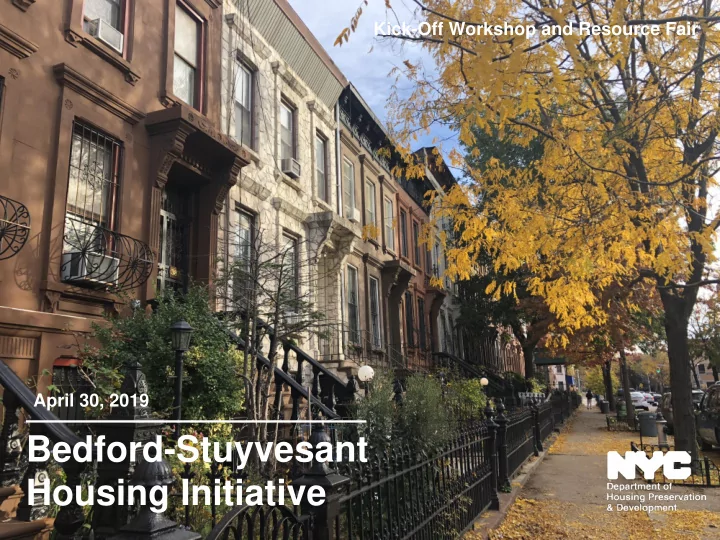
Bedford-Stuyvesant Housing Initiative
April 30, 2019 Kick-Off Workshop and Resource Fair
Housing Initiative Agenda 01 Why Bedford-Stuyvesant? 02 Housing - - PowerPoint PPT Presentation
Kick-Off Workshop and Resource Fair April 30, 2019 Bedford-Stuyvesant Housing Initiative Agenda 01 Why Bedford-Stuyvesant? 02 Housing Initiative Overview Preliminary goals Timeline 03 Next Steps 2 Why Bedford- Stuyvesant? Rapid
April 30, 2019 Kick-Off Workshop and Resource Fair
01 Why Bedford-Stuyvesant? 02 Housing Initiative Overview
03 Next Steps
2
Why Bedford- Stuyvesant?
3
Rapid social and market changes
Black, though demographics are changing rapidly:1
by 24 percentage points, while the White population increased by 22 percentage points.
rent in Bed-Stuy increased by more than double the city’s rate (23% vs 11%).2
price appreciation of repeat sales. 3
3
1 US Census 2000 and 2010; ACS 2013-2017; based on census tracts that approx. BK03. Overall population increased by 20% 2 NYC Housing and Vacancy Survey (HVS) 2011 and 2017; normalized to 2017 dollars 3 Based on HPD Office of Policy and Strategy Housing Price Index 2018
Demographic Shift between 2000-20171
Black Non- Hispanic White Non- Hispanic Hispanic All Races Asian Non- Hispanic Other Non Hispanic
0% 10% 20% 30% 40% 50% 60% 70% 80%
2000 2010 2013-2017
Significant housing issues persist
more than a third of their income in rent (rent burdened), and about one third of renters pay more than half their income in rent.1
are in buildings built before 1947.1
more maintenance deficiencies.2
4
1 NYC Housing and Vacancy Survey (HVS) 2017 2 Ibid; maintenance deficiencies include insufficient heating in winter, heating breakdowns, cracks or holes, presence of rodents, peeling paint, broken plaster, toilet breakdowns, and water leaks
Why Bedford- Stuyvesant?
14% 32% 54%
Not Rent Burdened Moderately Rent Burdened (31-49%
Severely Rent Burdened (50% or more of income)
Rent Burden*
*excludes public housing tenants and voucher holders
Significant housing issues persist
5
Why Bedford- Stuyvesant?
33% 15% 15% 14% 11% 12%
< $25,770 0% - 30% AMI $25,771- $42,950 31% - 50% AMI $42,591- $68,720 51% - 80% AMI $68,721 - $103,080 81% - 120% AMI $ 141,736+ 165% AMI +
Sample incomes are for a three-person household based on 2017 Income Limits; ACS 2013-17
$103,081-$141,735 121%-165% AMI
Household Incomes in BK03 (2013-2017)
Extremely Low-Income Very Low-Income Low-Income Moderate Income Middle Income High Income
Why Bedford- Stuyvesant?
6
Challenging stock for HPD programs
Stuyvesant are in small buildings with fewer than six units. Only 16% of units are in buildings larger than 50 units.1
publicly-supported housing. Overall, about a third of units are rent stabilized (including buildings with regulatory agreements). 2
construction and preservation of almost 6,900 units of affordable housing in Community District 3. 3
6
13% 12% 75%
Not Government Assisted NYCHA Residential Units by Type Government- Assisted
1 NYC Housing and Vacancy Survey (HVS) 2017 2 HPD Office of Policy and Strategy 2018; includes NYCHA properties as of 12/2016 3 HPD Performance Management and Analytics 2018 Of ~63,500 homes
Type 2003-2013 2014-2018 Total New Construction 1,424 551 1,975 Preservation 2,950 1899 4,849 Total homes 4,374 2,450 6,824
Affordable Homes Financed in BK03 (2003-2018)
7
driven, faith-based groups
Request for Proposals (RFP) to redevelop City-owned Vacant Land: A B C
Fulton Street Site C
Why Bedford- Stuyvesant?
Marcy-Myrtle (~170 affordable homes) Fulton-Utica: ~150 affordable homes Fulton-Saratoga A, B, and C: ~350 total affordable homes
8
Preliminary Goals
to units and supporting economic development
programs that can be improved citywide Housing Initiative Overview
9
Timeline and Planning Process Housing Initiative Overview
Updated 4/30/2019. Timeline subject to change. Visit nyc.gov/bedstuy
10
Today’s Agenda
financial distress
Next Steps
11
Visit nyc.gov/bedstuy
Contact:
Giovania Tiarachristie
Chris Antonelli