
SLIDE 1
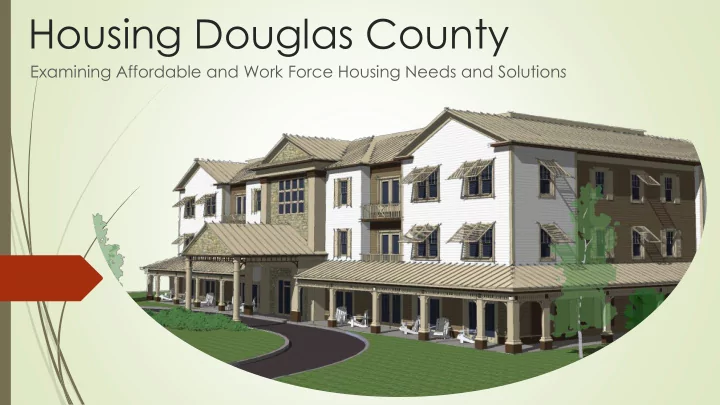
Housing Douglas County
Examining Affordable and Work Force Housing Needs and Solutions
Housing Douglas County Examining Affordable and Work Force Housing - - PowerPoint PPT Presentation
Housing Douglas County Examining Affordable and Work Force Housing Needs and Solution s About Nevada Rural Housing Authority (NRHA) NRHA was created by the State Legislature in 1975, was made independent of the State in 1995, and its service
Examining Affordable and Work Force Housing Needs and Solutions
NRHA was created by the State Legislature in 1975, was made independent of the State in 1995, and its service territory and roles were enhanced by the Legislature in 2005 NRHA is Douglas County’s Housing Authority NRHA administers the HUD Housing Choice Voucher program throughout rural Nevada; there are approximately 273 active vouchers in use in Douglas County NRHA administers a mortgage program that provides down-payment assistance to homebuyers; over $72MM in mortgages have been originated for over 360 homebuyers over the last 10 years in Douglas County alone NRHA’s Community Development Group builds, rehabilitates and manages almost 500 units across rural Nevada; NRHA does not currently own any multi-family units in Douglas County.
NRHA, having recognized the need for the collection of housing and economic data in the state’s rural areas, conducted its first housing study in 2005 which encompassed 10 rural counties along the I-80 and SH-50 corridors across northern and central Nevada. From 2012 to 2015, we conducted three major housing studies that included
the 2015 Northern Nevada Housing Demand Study. In late 2016, and into 2017, we initiated a comprehensive update of those three studies which now focuses on all rural areas situated throughout Nevada’s 17 Counties. These studies identified 35 unique rural housing markets situated throughout the state. Our goal is to utilize our present model as we move forward through time, and update these Studies as housing conditions change in those rural areas
Our latest housing study model is by far the most concentrated and comprehensive to-date, including:
Homeowner households
market conditions
“Rental” and “For-Sale” housing
Three housing markets were identified within Douglas County
Hills
Douglas County has over 6,300 renter households Over 2,250 of the Renter Households in Douglas County pay more than 35% of their income for housing, and are thereby considered to be “Overburdened”
(paying more than 50% of their annual income toward housing costs) Over 4,500 of the Homeowner Households in the County pay more than 35% of their income for housing, and are thereby also considered to be “Overburdened”
Burdened (paying more than 50% of their income for housing)
Over 74% of respondents indicated they plan to add employees
Over 70% of respondents felt there is not sufficient housing stock to serve their employees 27% of respondents have tried to hire employees in the last three years who could not find available housing 27% of respondents have lost employees over the last three years due to changes in their housing status
From 2010 to 2016 the supply of multi-family housing increased by only 49 units From 2010 to 2016 Renter Households have increased by almost 15% (an estimated 795 households over this 6 year span), placing even greater pressure on the County’s rental housing market The present MEDIAN GROSS MARKET RENT VALUE for an average (834 sq. ft.) 2 bedroom garden apartment in Douglas County is $1,053 per month. The monthly household income required to rent this average apartment (using 30% of the gross monthly income, and a typical utility allowance of $68.00/month) = $3,736/month
The present MEDIAN GROSS WORKFORCE RENT VALUE for an average (834 sq. ft.) 2 bedroom garden apartment in Douglas County is $877 per month. The monthly household income required to rent this average apartment (using 30% of the gross monthly income, and a typical utility allowance of $68.00/month) = $3,150/month
The remaining renter households not included in these two categories, and earning less than $30,000 annually, totals 2,996 Renter Households, of which 1,931 are economically challenged to some degree (paying more than 30% of their gross monthly income for rent and utilities)
From 2010 to 2016 the supply of single family housing has increased by only 533 homes. There is an additional demand of 105 units/year for single-family homes. Permits for new homes have averaged just over 150/year for the past two years. The Homeowner Households earning less than $40,000 annually totals 6,653 Households, of which 1,931 are paying more than 30% of their gross monthly income for housing and utilities. The Median Home Value for a home in Carson Valley in December 2017 was $372,000. This represents a year-over-year increase of over 13%. Monthly income required to purchase a home at the present “Median Home Value”, with a minimum 5% down payment of $12,096, using a 5% interest rate on a 30 year mortgage, adding Taxes, Insurance and MIP = $7,083/month or $85,000/year, while the “Area Median Household Income” for Douglas County at this time is $69,200/Year. Average Income for a teacher in Douglas County is $45,293; Average Income for a full-time County employee is $54,782.
It has taken NRHA over a year to realign its overall housing study initiative. Accordingly, the data in our most recent housing study is now over 6 months old, and the housing markets have only grown tighter Occupancy is nearly 100% across the County for existing rental properties, and most have waiting lists Housing markets in surrounding areas including Reno/Sparks, Dayton and Carson City are also experiencing very tight market conditions Rents are increasing rapidly with lower-income tenants being forced out of current residences Our study indicates a current need for over 300 rental units in Douglas County within the immediate future The “Overburdened Populations” within Douglas County are now growing at a rapid pace.
Of the 300 new units of multi-family housing needed:
80 units are needed at market rate
(approximately $55,350/year for a family of 4) 93 units are needed to serve workforce needs
(approximately $34,600 - $55,000 for a family of 4) 133 units are needed at subsidized/affordable rates
(approximately $34,600 or less for a family of 4)
Work with County Supervisors to adopt ordinances that will encourage the development of housing that will meet current need. Work with developers and providers to bring needed housing to the area. Federal and State assistance is available through tax credits, HOME Funds, and State Trust Funds. Although these resources are limited they should be tapped wherever possible (Without assistance of some type, demand for workforce or subsidized/affordable housing will NOT be met) Make the public aware of the County’s housing concerns by providing a clear understanding of the County’s housing needs, and its goals to address its housing needs. Encourage the creation of housing “types” that will serve a wide variety of residents, such as Mutual Housing which encourages resident participation in management and leadership development
Grant priority to, and expedite approval of plans and specs relating to the development of affordable housing Support zoning changes/variations that could bring in additional housing, e.g. Mixed-use Commercial Donating and/or the Long-term leasing of County-owned land to qualified non-profits, public entities, and/or private developers for the specific development of workforce and affordable housing Tax Increment Financing (TIF) or special purpose districts could be established which would generate a pool of funds that could be used to support housing or other infrastructure needs Establishing a Trust Fund to support affordable housing initiatives
square feet of habitable space, or other basis
Providing density bonuses and development impact cost reductions specifically for:
lowering of building restrictions and costs imposed by government that directly impact project development costs, requiring the recipient of these adjustments to substantiate that the cost savings are passed on to the ultimate user or purchaser of the housing in such a development
Southgate, Carson City
A 140 Unit Independent Living Facility for Seniors
Richards Crossing, Carson City
A 39 Unit Transitional Housing Community for the Homeless