
SLIDE 1
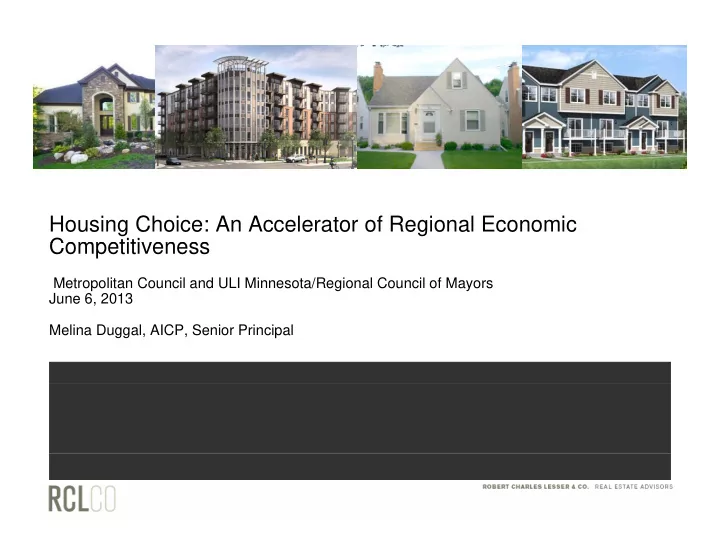
Housing Choice: An Accelerator of Regional Economic Competitiveness Competitiveness
Metropolitan Council and ULI Minnesota/Regional Council of Mayors June 6, 2013 Melina Duggal, AICP, Senior Principal
Housing Choice: An Accelerator of Regional Economic Competitiveness - - PowerPoint PPT Presentation
Housing Choice: An Accelerator of Regional Economic Competitiveness Competitiveness Metropolitan Council and ULI Minnesota/Regional Council of Mayors June 6, 2013 Melina Duggal, AICP, Senior Principal LOCATION, LOCATION, LOCATION Most
Metropolitan Council and ULI Minnesota/Regional Council of Mayors June 6, 2013 Melina Duggal, AICP, Senior Principal
Metropolitan Council and ULI MN
1
Metropolitan Council and ULI MN
2
Metropolitan Council and ULI MN
3
Generation 2010 Age 2010 Pop. US 2010 % Pop. US Minn.-St. Paul MSA 2010 % Pop. MSA US US MSA MSA Eisenhowers 65+ 40M 13% 350K 11% Baby Boomers 46 – 64 76M 25% 879K 27% Gen X 30 – 45 66M 21% 684K 21% Gen X 30 45 66M 21% 684K 21% Gen Y 11 – 29 80M 26% 912K 27% Gen Z (?) 0 – 10 46M 15% 452K 14%
Metropolitan Council and ULI MN
4 SOURCE: U.S. Census Bureau, Population Division, 2010 Demographic Analysis
Year Student Housing Single & Roommate Rental Rent as Couple / 1st Young Family Own Mature Family Own Empty Nester Downsize Retiree Senior Housing g Rental Home Own Own Own Housing 2010 Gen Y Gen Y Gen Y Gen X Gen Y Baby B Gen X Baby B Eisen Baby B y 2015 Gen Y Gen Y Gen Y Gen Y Gen X Baby B Gen X Eisen Baby B 2020 Gen Z Gen Y Gen Y Gen Y Gen X Gen Y Gen X Baby B Baby B 2025 Gen Z Gen Z Gen Y Gen Y Gen Y Gen X Gen X Baby B
Metropolitan Council and ULI MN
5 SOURCE: RCLCO
30% 32% 16% 19% 11% 8% 6% Under 18 18 & 19 20 to 29 30 to 39 40 to 49 50 to 59 60 +
Metropolitan Council and ULI MN
SOURCE: 2009 ACS 6
50% 30% 40% 20% 30% 0% 10% G Y G X B b B Ei h Gen Y Gen X Baby Boomers Eisenhowers Owner Households Renter Households Total Distribution
Metropolitan Council and ULI MN
SOURCE: RCLCO 7
Metropolitan Council and ULI MN
8
30% 20% 25% 10% 15% 0% 5% City - City - Suburban Suburban Small Rural City Downtown City Residential Area Suburban Mixed Suburban
Only Small Town Rural Currently Live Prefer to Live
Metropolitan Council and ULI MN
Currently Live Prefer to Live
9 SOURCE: NAR 2011 Community Preference Survey
30% 20% 25% 10% 15% 0% 5% City - City - Suburban Suburban Small Rural City Downtown City Residential Area Suburban Mixed Suburban
Only Small Town Rural Currently Live Prefer to Live
Metropolitan Council and ULI MN
Currently Live Prefer to Live
10 SOURCE: NAR 2011 Community Preference Survey
20%
19%
20% 39% 19% 40% 41% 40%
Metropolitan Council and ULI MN
11 SOURCE: NAR 2011 Community Preference Survey
25% 30% 15% 20% 5% 10% 0% City - Downtown City - Residential Suburban Mixed Suburban Ngd HH Small Town Rural Downtown Residential Area Mixed Ngd- HH Only Town Gen Y Gen X Baby Boomers Eisenhowers
Metropolitan Council and ULI MN
SOURCE: NAR 2011 Community Preference Survey 12
25% 30% 15% 20% 5% 10% 0% City - Downtown City - Residential Suburban Mixed Suburban Ngd HH Small Town Rural Downtown Residential Area Mixed Ngd- HH Only Town Gen Y Gen X Baby Boomers Eisenhowers
Metropolitan Council and ULI MN
13
25% 30% 15% 20% 5% 10% 0% City - Downtown City - Residential Suburban Mixed Suburban Ngd HH Small Town Rural Downtown Residential Area Mixed Ngd- HH Only Town Gen Y Gen X Baby Boomers Eisenhowers
Metropolitan Council and ULI MN
SOURCE: NAR 2011 Community Preference Survey 14
Metropolitan Council and ULI MN
15
80% 90% 50% 60% 70% 20% 30% 40% 50% 0% 10% 20% SFD SFA/TH Apt/Condo Mobile Home Other Currently Live Prefer to Live
Metropolitan Council and ULI MN
16 SOURCE: NAR 2011 Community Preference Survey
8% 3% 8% 8% 8% 8% 5% 4% 15% 8% 6% 78% 83% 84% 84% 74%
60+ (Eisenhower) 50-59 (BB) 40-49 (BB & Gen X) 30-39 (Gen X) 18-29 (Gen Y) SFD SFA/TH Apt/Condo
Metropolitan Council and ULI MN
17 SOURCE: 2011 National Community Preference Survey, National Association of Realtors, March 2011
Image: digitalart / FreeDigitalPhotos.net
Image: digitalart / FreeDigitalPhotos.net
Metropolitan Council and ULI MN
SOURCE: RCLCO, 2013 Investment and Vacation Home Buyers Survey - NAR 18
Metropolitan Council and ULI MN
SOURCE: NAR 19
Taylor Morrison
Lennar
Metropolitan Council and ULI MN
20
Metropolitan Council and ULI MN
21
Metropolitan Council and ULI MN
22 SOURCE: NAR; Canin Associates; RCLCO
Metropolitan Council and ULI MN
SOURCE: NAR; RCLCO 23
Different Product Broader Marketing Clever Programming
Metropolitan Council and ULI MN
24
Metropolitan Council and ULI MN
25
Housing Intentions for Households 55-74, with Income $50,000+ April, 2012
N=1,135
8% 8% 26% 57% 9% 35% Current Owners, Not Likely to Move Current Renters, Not Likely to Move Owners Who Might Move Next Year, Stay Owners Owners Who Might Move Next Year, Consider Renting
Metropolitan Council and ULI MN
26 SOURCE: RCLCO
Metropolitan Council and ULI MN
27
Rental 30% For Sale 70% 13% 8% 68% 11% 13%
Multifamily Apts
8%
Small Apt Buildings; Multiunit H
68%
Individually-owned Single-Family Detached Homes
11%
Other: Condo, SFA, Mobile Home Homes 30% 70% 45% 25% 30%
30% of rental market already leases single family units which are 30% of rental market already leases single-family units, which are primarily individually owned and not professionally managed
Metropolitan Council and ULI MN
28 SOURCE: PUMS (ACS 2007 – 2009)
Metropolitan Council and ULI MN
29
Metropolitan Council and ULI MN
30 SOURCE: Avalon Bay
Metropolitan Council and ULI MN
31
Metropolitan Council and ULI MN
32 SOURCE: RCLCO
35% 24% 40% 41%
75% 65% Grocery store Pharmacy Very important Somewhat important
24% 25% 18% 17% 41% 36% 42% 42%
65% 61% 60% 59% Pharmacy Hospital Restaurants Cultural resources
26% 19% 21% 29% 36% 29%
55% 55% 50% Schools Doctors' offices Public transportation by bus
12% 17% 14% 35% 30% 28%
47% 47% 42% Recreational facilities Place of worship Public transportation by rail
following within an easy walk: very important, somewhat important, not very important, or not at all important. (RANDOMIZE)
Metropolitan Council and ULI MN
33 SOURCE: National Association of REALTORS, 2011; RCLCO
Consumer Preference: Currently Live and Want to Live in a Suburban Neighborhood With a Mix of Houses, Shops, and Businesses 25% 30% Opportunity 15% 20% 25% Currently Live 5% 10% 15% Currently Live Want to Live 0% 5% National Minnesota
Metropolitan Council and ULI MN
National Minnesota
SOURCE: NAR 34
Financial Characteristics of Mixed-Use Areas with Critical Mass (Blue) versus traditional Suburban Development (Red)
250%
+
200% 250%
100% 150%
eation / Cash Flo
50% 100%
Value Cre
0% 1 2 3 4 5 6 7 8 9 10 11 12 13 14 15 16 17 18 19 20
Time (years)
Metropolitan Council and ULI MN
35 SOURCE: The Brookings Institution
$150
Example Residual Land Values
$50 $100 ($50) $0 homes homes me MR eel MR ete HR ete HR Wrap me MR eel MR ete HR Strip ed Use anding Medical ry/R&D e Steel ucation gh Rise Trophy Service pscale ehouse
Flex ($100) ($50) Town tacked Town Wood Fram ht Gauge Ste scale Concre uxury Concre Wood Fram ht Gauge Ste Concre estyle or Mixe hored Freesta M Laborator e Light Gauge ation and Edu Hig T mited/Select S U Ware Lo ($200) ($150) St Lig Mid L Lig Life Anch Midrise Innova Lim For Sale Residential For Rent Residential Retail Office Hotel Industrial
Metropolitan Council and ULI MN
36
Residential
Residual L d V l Financing $2M Profits $3M Land Value = $16M Capitalized Value $50M Construction $20M Financing $2M Cost to Deliver= Parking $5M Site Costs $1M
Marketing $1M
e e $34M
Costs Revenues
Entitlements $2M
Site Costs $1M
Metropolitan Council and ULI MN
37
Profits Feasibility Potential for Premium Pricing Financing Profits eas b ty Gap Parking Capitalized g Construction Value of What Gets Built
Entitlements Site Costs
Revenues Costs
Land
Entitlements
Metropolitan Council and ULI MN
38
Metropolitan Council and ULI MN
39
Metropolitan Council and ULI Minnesota/Regional Council of Mayors June 6, 2013 Melina Duggal, AICP, Senior Principal
Metropolitan Council and ULI MN
41
Percent Renters by Generation United States, 1992 – 2011
100%
2011: Oldest Gen Y 30 1995: Oldest Gen X are 30
80% 100%
Oldest Gen Y 30, Renter Rate 69% Renter Rate: 71%
60% 20% 40% 0% 1992 1993 1994 1995 1996 1997 1998 1999 2000 2001 2002 2003 2004 2005 2006 2007 2008 2009 2010 2011 Eisenhowers & Greatest Generation Baby Boomers Gen X Gen Y U.S. Overall
Metropolitan Council and ULI MN
42
Eisenhowers & Greatest Generation Baby Boomers Gen X Gen Y U.S. Overall
SOURCE: U.S. Census Current Population Survey
Survey Question: How would you rate the importance of being a homeowner? (CHOOSE ONE): 39% 42% 50% 12% 34% 5% 2% 12% 5% 2% 9% Very Unimportant Somewhat Unimportant Neutral Somewhat Important Very Important Gen Y Gen X
Metropolitan Council and ULI MN
43 SOURCE: RCLCO consumer research, Fall 2007
Metropolitan Council and ULI MN
44
Metropolitan Council and ULI MN
45
70% 79% 49% 55% 57% 51% 45% 43% 30% 21% Under 10 10-29 30 - 44 45 - 64 65+ White, Not Hisp Not White
Metropolitan Council and ULI MN
SOURCE: 2009 ACS 46
Metropolitan Council and ULI Minnesota/Regional Council of Mayors June 6, 2013 Melina Duggal, AICP, Senior Principal