Hotel Occupancy Tax Review Wednesday, October 17 1:55-3:10 p.m. - - PDF document

hotel occupancy tax review
SMART_READER_LITE
LIVE PREVIEW

Hotel Occupancy Tax Review Wednesday, October 17 1:55-3:10 p.m. - - PDF document

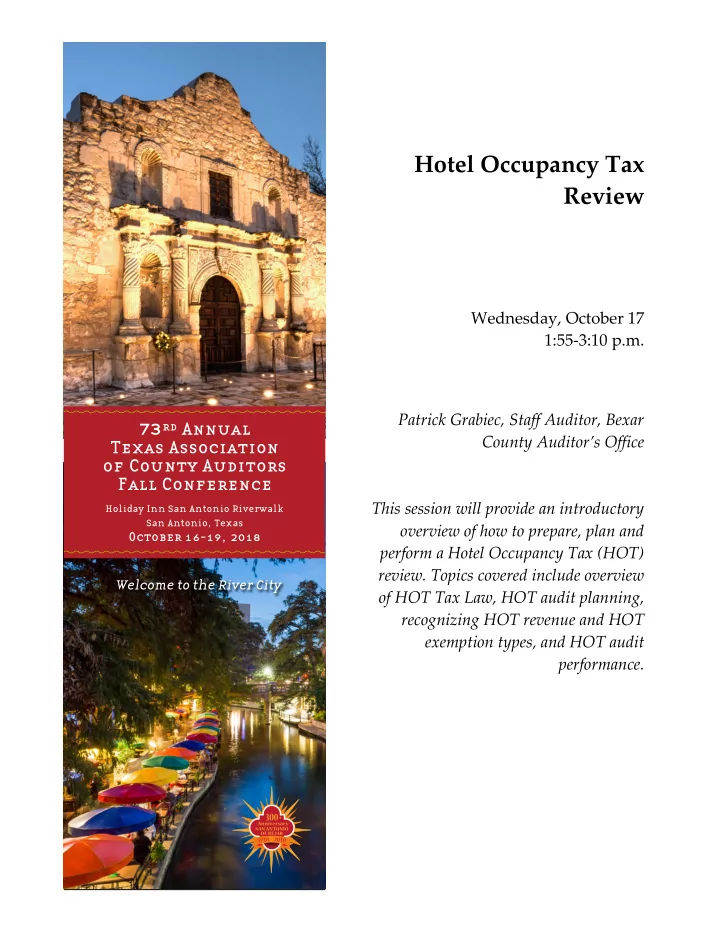
Hotel Occupancy Tax Review Wednesday, October 17 1:55-3:10 p.m. Patrick Grabiec, Staff Auditor, Bexar 73 rd Annual County Auditors Office Texas Association of County Auditors Fall Conference This session will provide an introductory


slide-1
SLIDE 1

73rd Annual

Texas Association

  • f County Auditors

Fall Conference

Holiday Inn San Antonio Riverwalk San Antonio, Texas

October 16-19, 2018

Anniversary SAN ANTONIO

300

DE BÉJAR

th

Welcome to the River City

Hotel Occupancy Tax Review

Wednesday, October 17 1:55-3:10 p.m. Patrick Grabiec, Staff Auditor, Bexar County Auditor’s Office This session will provide an introductory

  • verview of how to prepare, plan and

perform a Hotel Occupancy Tax (HOT)

  • review. Topics covered include overview
  • f HOT Tax Law, HOT audit planning,

recognizing HOT revenue and HOT exemption types, and HOT audit performance.

slide-2
SLIDE 2

Patrick Grabiec, Staff Auditor, Bexar County Auditor’s Office, San Antonio Grabiec is a staff auditor for the Bexar County Auditor’s Office. He graduated from the University of Texas at San Antonio in December of 2014 with a Master of Public Administration degree. He has worked for Bexar County for over six years and currently works in the Internal Audit Division of the Bexar County Auditor’s Office. He is a member

  • f the Institute of Internal Auditors and

is currently pursuing a Certified Internal Auditor (CIA) designation.

slide-3
SLIDE 3

1

73RD ANNUAL TEXAS ASSOCIATION OF C OUNTY AUDITORS FALL C ONFERENCE SAN ANTONIO, TEXAS

P r e p a r e d B y : P a t r i c k G r a b i e c 0 9 / 1 3 / 1 8

HOTEL OCCUPANCY TAX (HOT) PRESENTATION

Overview

 Benefits of Assessing HOT  HOT Tax Law and Policy  HOT Audit Planning  Recognizing Revenue and Exemption Types  HOT Audit Procedures  References

slide-4
SLIDE 4

2

Benefits of Assessing HOT

 Additional Revenue for Public Improvements

 Bexar County Hot Revenue FY 2015-16 $17,475,219

 Public Improvements such as:

 San Antonio River Improvements  Amateur Sports Facilities  Community Arenas and Grounds  Performing Arts Facilities

 Tax is usually imposed on out-of-county individuals

HOT Law & Policy

 State Hotel Occupancy Tax Law is covered in TEX.

TAX CODE ANN. Chapter 156.

 Referenced often in statues below.

 Local Hotel Occupancy Tax Law is covered in the

following statues:

 Chapter 351. Municipal Hotel Occupancy Taxes  Chapter 352. County Hotel Occupancy Taxes  Chapter 334. Sports and Community Venues

slide-5
SLIDE 5

3

HOT Law & Policy (continued)

 TEX. TAX CODE ANN. Chapter 156. –

Hotel Occupancy Tax

 Hotel Definition – “… a building in which members of the public obtain

sleeping accommodations for consideration. “Hotel” includes a short- term rental.”

 “The term includes a hotel, motel, tourist home, tourist house, tourist court,

lodging house, inn, rooming house, or bed and breakfast.”

 Tax Imposed – “A tax is imposed on a person who, under a lease,

concession, permit, right of access, license, contract, or agreement, pays for the use or possession or for the right to the use or possession of a room or space in a hotel costing $15.00 or more each day($2.00 minimum for local taxes).”

 Collection of Tax – “A person owning, operating, managing, or

controlling a hotel shall collect for the state the tax that is imposed by this chapter and that is calculated on the amount paid for a room in the hotel.”

HOT Law & Policy (continued)

 Tax Code Section 352. - County Hotel

Occupancy Taxes

 Authorization to assess tax is restricted to Tax Code  Such as… “(21) a county through which the Pedernales River flows

and in which the birthplace of a president of the United States is located…”

slide-6
SLIDE 6

4

HOT Law & Policy (continued)

 Local Government Code Section 334. - Sports and

Community Venues

 Sec. 334.252. IMPOSITION OF TAX.  (a) A municipality by ordinance or a county by order may impose a tax on a person

who, under a lease, concession, permit, right of access, license, contract, or agreement, pays for the use or possession or for the right to the use or possession of a room that is in a hotel, costs $2 or more each day, and is ordinarily used for sleeping.

 (b) A municipality or county may impose a tax under this subchapter only if:

 (1) an approved venue project is or is planned to be located in the municipality or

county; and

 (2) the tax is approved at an election held under Section 334.024.

 Sec. 334.253. TAX CODE APPLICABLE.  (b) Sections 352.002(c), 352.004, 352.0041, 352.005, and 352.007, Tax Code,

govern the imposition, computation, administration, collection, and remittance of a county tax authorized under this subchapter except as inconsistent with this subchapter.

 (c) The tax imposed by this subchapter is in addition to a tax imposed under

Chapter 351 or 352, Tax Code.

HOT Law & Policy (continued)

 Sec. 334.254. TAX RATE.

(a) Except as provided by Subsections (c) and (d), the tax authorized by this subchapter may be imposed by a municipality or county at any rate not to exceed two percent of the price paid for a room in a hotel.

(b) The ballot proposition at the election held to adopt the tax must specify:

 (1) the maximum rate of the tax to be adopted; and  (2) the maximum combined hotel occupancy tax rate that would be imposed from all sources at

any location in the municipality or county, as applicable, if the rate proposed in the ballot proposition is adopted.

 Sec. 334.257. EFFECTIVE DATE AND ENDING DATE OF TAX.

(a) A tax imposed under this subchapter or a change in the tax rate takes effect on the date prescribed by the ordinance or order imposing the tax or changing the rate.

(b) A municipality or county may impose a tax under this subchapter only if the municipality

  • r county issues bonds or other obligations under Section 334.043 before the first

anniversary of the date the tax is imposed. The municipality or county may impose the tax only while those bonds or other obligations are outstanding and unpaid.

 Sec. 334.258. DEPOSIT OF TAX REVENUE.

Revenue from the tax imposed under this subchapter shall be deposited in the venue project fund of the municipality or county imposing the tax.
slide-7
SLIDE 7

5

HOT Risk Assessment

CRITERIA

Laws, Regulation, Internal Policy

TEXAS TAX CODE ANN. CHAPTER 352. COUNTY HOTEL OCCUPANCY TAXES (HOT); SUBCHAPTER A. IMPOSITION AND COLLECTION OF TAX, §352.002(a)(b), §352.004(a), §352.007(a)(b)(c)(d)(e)(f)(g) §352.002(a). ...a tax is imposed on a person who, under a lease, concession, permit, right of access, license, contract, or agreement, pays for the use or possession or for the right to the use or possession of a room that is in a hotel, costs $2 or more each day, and is ordinarily used for sleeping. (Room Revenue) §352.002(b). The price of a room in a hotel does not include the cost of food served by the hotel and the cost of personal services performed by the hotel for the person except for those services related to cleaning and readying the room for use or possession. (Other Revenue) §352.004(a). The owner or operator of a hotel shall report and send the taxes collected under this chapter to the county as provided by the resolution or order imposing the tax. §352.007(a)(b)(c)(d)(e)(f)(g). Exemptions as described in §156.103(a)(b)(c)(d).(Exemptions) INHERENT RISKS

What could go wrong?

  • 1. Hotel may be underreporting or over reporting room revenue on the Hotel Occupancy Tax Report.
  • 2. Hotel may be underreporting or over reporting room exemptions on the Hotel Occupancy Tax Report.

EFFECT

Why do we care?

  • 1. Loss of revenue.
  • 2. Overpayment of taxes by hotels.

MAGNITUDE RATING* High, Moderate, Low LIKELIHOOD RATING* Very Likely, Likely, Unlikely SUB-OBJECTIVE

Substantive Testing Procedures Are the Hotel Occupancy Tax Reports prepared and completed accurately?

CONTROLS IN PLACE

Control Testing Procedures

Discussion CONTROL RATING* Weak, Adequate, Strong AUDITOR RESPONSE

Planned Audit Procedures

  • 1. Assess the hotels understanding of Hotel Occupancy Tax Law.
  • 2. Gain an understanding of the hotels process for completing Hotel Occupancy Tax Reports.
  • 3. Select a sample of Hotel Occupancy Tax Reports to ensure adequate support and accuracy (recalculation test).

* If these ratings are Low, Unlikely or Strong respectively, auditor(s) may choose to not perform further review or test.

HOT Audit Planning

 Create a HOT Schedule

 Elements:  Account for all Hotels in Jurisdiction

 Texas Hotel Data Search (open records request), current collections database

 Hotel Location, Owner Name, Contact Information  Gross Receipts  Exemptions

 If no exemptions for the time period, maybe no need to perform audit

 Date of Last Audit Performed  Hotel Status

 Closed?, New Owners?, Converted to long term rental (apt.)?

slide-8
SLIDE 8

6

HOT Schedule Example

You must decide what is “worth” auditing.

HOT Audit Planning

 Pre-Audit Research

 Obtain Hotel Occupancy Tax Report (Monthly)  Perform trend analysis  Under-reporting taxable receipts  Over-reporting exemptions  Seasonal business  Prior audit results

 Sample Selection

 Hotel Occupancy Tax has a four year statute of limitations.  Sniff Test (one or two months)  Select largest exemption months (accounts for seasonality)  Largest ROI  Non Random (cannot extrapolate results) but…  Results guide additional testing

slide-9
SLIDE 9

7

Hotel Occupancy Tax Report Example

Gross Room Revenue COH Line 1. COSA Line 1. Exemptions Claimed COH Line 4. COSA Line 2.

HOT Audit Planning

 Notice to Hotel Owner

 Include the following:  Date of inspection  Sample selection  Request for accommodations (workspace)  Requested items list:  Documentation to support all gross sleeping accommodations

revenue, including bank statements

 Statements with details and support for any “rewards” or other

special programs

 EXEMPTION CERTIFICATES which support exemptions  COMPLETE FOLIOS to support exemptions and long term

exemptions

 All folios for the review period  Daily “Audit Packages” for the period reviewed

slide-10
SLIDE 10

8

Recognizing Revenue

 Charges not subject to Hotel Occupancy Tax must be

unrelated to the cost of the actual occupancy of the room

 Charges also must be separately stated on receipts

 Charges not subject to Hotel Occupancy Tax

 Messenger service  Room service  Valet service  Use of a telephone  Baby sitting service  Shuttle service

Recognizing Revenue (continued)

 Charges subject to Hotel Occupancy Tax

 Package Deals (Charges are not separately stated on receipts)  Charges must be related to the cost of the actual occupancy of the room  Equipment rentals - Use of a television, rental of audio/visual equipment  Additional rollaway bed rental  Pet charges  Pet cleaning services  Reservation fees  In-room safe rental charges  Microwave and refrigerator rentals  Energy charge  Charges for guaranteed rooms (“no-show”)

 Occupancy includes the “right” to use  Not subject to Hotel Occupancy Tax if a percentage or sliding scale is

applied

slide-11
SLIDE 11

9

 If an exemption applies, then the organization or individual

claiming exemption must present an exemption certificate to the

  • hotel. Starting October 1, 2003, hotel owners and operators may

accept, in good faith, hotel occupancy tax exemption certificates when presented with documentation proscribed by the Comptroller.

 Exemptions include:

 Non-transient residents  Government agencies  Charitable or Eleemosynary Organizations  Educational Organizations  Religious Organizations  Rentals by Private Clubs to members  College/University Dormitories  Specific Nonprofit Entities

*Bold text denotes County Exemptions

Exemptions from HOT Texas Hotel Occupancy Tax Exemption Certificate (Form 12-302)

slide-12
SLIDE 12

10

Non-Transient Residents

 To qualify for exemption, non transients may either

  • ccupy a room for more than 30 days (pay tax on first 30

days but exempt after) or provide written notice of intention to stay (reservations/payment for 30+ days can be used in lieu of a written notice of intent)

 If there is no written notice of intention, tax is due on the

first 30 days and thereafter is exempt from tax

 Does not have to be the same individual occupying the room or the

same room be rented each night.

 Businesses can qualify for Non Transient exemption if it is invoiced

and paid for by the business.

Exemption Types

Exempt From County HOT

 Government Agencies

 Federal employees, foreign diplomatic personnel, and certain Texas state

employees are exempt from HOT.

 State employees must provide a Hotel Tax Exemption Photo Identification Card.  Local government personnel must pay all HOT.

 Rentals by Private Clubs to Members

 Private clubs are exempt from HOT on room rentals to their members only.

 Specific Non-Profit Entities

 Certain non-profit entities are exempt by law other than HOT statutes.  Entity must have a letter of hotel tax exemption issued by the Comptrollers office.  The reason for the exemption should be written on the exemption certificate.

Exemption Types (continued)

slide-13
SLIDE 13

11 Not Exempt From County HOT

 Charitable or Eleemosynary Organizations  Educational Organizations  Religious Organizations  College/University Dormitories

Exemption Types (continued) HOT Audit Procedures

 Day of Inspection

 Perform brief interview with staff including  Hotels understanding of Hotel Occupancy Tax  Business operations  Accounting system  Reporting procedure  Reconciliation of Room Revenue to HOT Report  DON’T RELY SOLELY ON MANAGERS REPORT

 Compare daily reports in “Audit Packages” to Managers Report to HOT

Report

 Reconciliation of Tax Collected to Tax Reported  State, Municipal, and County tax/exemptions should be stated separately (not

always the case)

 RED FLAG – Hotel is likely incorrectly calculating tax  Remember some Exemption types are for state tax ONLY

slide-14
SLIDE 14

12

HOT Audit Procedures (continued)

 Rewards Programs

 Reward points redemption programs may or not be subject to hotel

  • ccupancy tax, depending of the specifics of the program.

 Tax is due when the hotel receives consideration.  When a specific hotel is reimbursed or credited by contributions

previously paid by that hotel to the rewards fund that hotel is, in effect, paying itself for the redeemed rooms and upgrades. There is no consideration and, thus, no tax is due.

 If a hotel, however, has not previously contributed to the rewards

fund an amount that covers a reimbursement or credit, including administrative charges, then there is consideration and tax is due.

HOT Audit Procedures (continued)

Generate a worksheet with all exemptions found

Hotel should have a exemption report but verify information using “Audit Packages”

If not, go through all folios and locate the exemptions using Exemptions Certificates and calculating 30-day stays

Include Guest Name, Folio #, Check-in Date, Check-out Date, # of days, Room Rate (may change daily), Exemption Total, Type of Exemption, Notice of Intention to Stay 

Exemption Certificates

Check to ensure that the business is valid and the exemption applies to County Tax

  • Ex. Federal Exemption

Check address to see if it is a military base or government building

Check acronyms

Federal Credit Unions are exempt 

Make sure that 30-day stays are uninterrupted using the folios to verify

Calculate exemption totals using number of days and room rate

Pay close attention to room rate fluctuations 

Check total exemptions found to actual exemptions taken

Report exemption errors to staff and attempt to resolve discrepancies on-site

If it is “worth” it, consider auditing additional months.

slide-15
SLIDE 15

13

Work Paper Exemptions Example Calculating Tax, Penalty, and Interest

Calculate the difference between the HOT Tax Report and the Inspection Results using your local tax rate.

Calculate Penalty and Interest based on Order approved by voters.

Bexar County's penalty is 5%

  • n delinquent taxes for the

second month and third month past due. Each penalty will be at a minimum of $5.00.

Bexar County’s interest is 10% annually or .833% a month.

 Pro tip: Pay attention

to rounding errors.

slide-16
SLIDE 16

14

Send the Bill

Once calculation of penalties and interest is complete, send the bill.

Send a letter even if the audit is clean.

Bexar County includes the calculation sheet (previous slide) as backup.

Notify collections.

References

 Texas Comptroller of Public Accounts

 Audit Procedures for Hotel Occupancy Tax (PDF)

Revised 08/2017

 https://comptroller.texas.gov/taxes/audit/manuals  Texas Tax-Exempt Entity Search  http://comptroller.texas.gov/taxes/exempt/search.php

slide-17
SLIDE 17

15

Contact Information

Patrick Grabiec Internal Auditor Bexar County Auditors Office Phone#: 210-335-2953 Email: pgrabiec@bexar.org Thank You

slide-18
SLIDE 18
slide-19
SLIDE 19

Free Lined Graph Paper from http://incompetech.com/graphpaper/lined/

slide-20
SLIDE 20

Free Lined Graph Paper from http://incompetech.com/graphpaper/lined/