Hot and cold domain walls and anomaly matching Erich Poppitz - - PowerPoint PPT Presentation

hot and cold domain walls and anomaly matching
SMART_READER_LITE
LIVE PREVIEW

Hot and cold domain walls and anomaly matching Erich Poppitz - - PowerPoint PPT Presentation

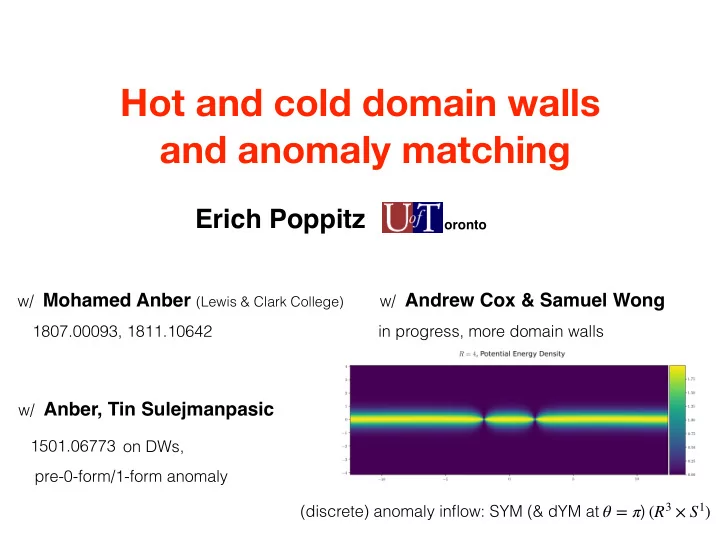
Hot and cold domain walls and anomaly matching Erich Poppitz oronto w/ Mohamed Anber (Lewis & Clark College) w/ Andrew Cox & Samuel Wong 1807.00093, 1811.10642 in progress, more domain walls w/ Anber, Tin Sulejmanpasic 1501.06773 on


slide-1
SLIDE 1

Erich Poppitz

Hot and cold domain walls and anomaly matching

1807.00093, 1811.10642 w/ Anber, Tin Sulejmanpasic 1501.06773 w/ Andrew Cox & Samuel Wong in progress, more domain walls

  • n DWs,

pre-0-form/1-form anomaly w/ Mohamed Anber (Lewis & Clark College)

  • ronto

(R3 × S1)

(discrete) anomaly inflow: SYM (& dYM at )

θ = π

slide-2
SLIDE 2

Erich Poppitz

  • ronto

Hot and cold domain walls and anomaly matching

1807.00093, 1811.10642 1501.06773 pre-0-form/1-form anomaly w/ Mohamed Anber (Lewis & Clark College) w/ Andrew Cox & Samuel Wong in progress, more domain walls

  • n DWs,

w/ Anber, Tin Sulejmanpasic (discrete) anomaly inflow: SYM (& dYM at )

θ = π (R3 × S1)

slide-3
SLIDE 3

UV IR

quarks, gluons hadrons complicated RG flow QCD

  • ther gauge

theories what is the IR?

few general constraints:

  • inequalities (“a theorem”)
  • a rare equality: ’t Hooft

anomalies, UV = IR!

  • ca. 1980, all done?
  • NOT!

missed anomalies involving higher-form symmetries Gaiotto, Kapustin, Komargodski, Seiberg, Willett… 2014-2017

hence, new anomaly matching conditions!

slide-4
SLIDE 4

new anomaly matching conditions! e.g. implications for phases of 4D adjoint QCD 0-form/1-form ’t Hooft anomalies are shown/believed to imply:

crucial subtleties clarified; ultimately, need lattice to figure out IR phases… won’t discuss here.

Anber-EP; Cordova-Dumitrescu; Bi-Senthil; Wan-Wang, Ryttov-EP (2018-2019)

  • IR phases can’t be “trivial”
  • domain walls “nontrivial” due to ‘discrete anomaly inflow’

this talk:

  • examples of nontrivial DWs, where mechanism of
  • walls in high-T phase exhibit features of low-T phase and v.v.
  • related [for sure or perhaps…] to confinement mechanism

anomaly inflow can be described semiclassically

slide-5
SLIDE 5

Higher form symmetry 1-form symmetry center symmetry 2D compact U(1) with (integer) charge-N massless Dirac

“charge N Schwinger model”

4D SU(N) with massless Weyl adjoints = SYM

“ QCD(adj)” “ QCD(adj)”

slide-6
SLIDE 6

Higher form symmetry 1-form symmetry center symmetry 2D compact U(1) with (integer) charge-N massless Dirac

“charge N Schwinger model”

4D SU(N) with massless Weyl adjoints = SYM

“ QCD(adj)”

remarkably alike

“ QCD(adj)”

both have similar mixed 0-form/1-form anomalies 1 2 high-T domain walls in SU(2) SYM (high-T “center vortices”) world-volume theory “=“ charge-2 Schwinger model (realization of anomaly inflow) 3 simplest interacting QFT (solvable) with new anomaly

interesting generalizations/applications: Armoni, Sugimoto ‘18; Misumi, Tanizaki, Unsal ‘19

slide-7
SLIDE 7

Higher form symmetry 1-form symmetry center symmetry 2D compact U(1) with (integer) charge-N massless Dirac

“charge N Schwinger model”

Qtop.

axial anomaly is unity when discrete chiral phase (likewise, 4D QCD(adj) has global chiral symmetry)

Z(0)

2N

=

slide-8
SLIDE 8

We want to know what charge-N Schwinger model or QCD(adj) “do” in the IR? assisted by claim that: there is a mixed anomaly between discrete “0-form” chiral, present in both models discrete “1-form” center, present in both models gauging the center (turning on nondynamical background) explicitly breaks the chiral!

  • “’t Hooft flux” (twisted b.c.) or “thin center vortex,”

results in topological charge ~ 1/N, not integer mixed chiral/center ’t Hooft anomaly in three lines:

slide-9
SLIDE 9

gauging the center (turning on nondynamical background) explicitly breaks the chiral! results in topological charge ~ 1/N, not integer

’t Hooft fluxes in 1-2 and 3-4 planes intersecting center vortices = 2 codimension two objects

(here: two 2-planes of plaquettes w/ empty coboundary)

topological (no flux thru cubes) background for

  • 2-form

gauge field, introduced to gauge 1-form center symmetry

B(2)

μν dxμ ∧ dxν

ZN ZN

= = =

SU(N)/ZN bundle gauge background

  • “’t Hooft flux” (twisted b.c.) or “thin center vortex,”

mixed chiral/center ’t Hooft anomaly in three lines:

slide-10
SLIDE 10

given that, simply recall measure transform under anomaly-free chiral: in theory with gauged center gauging explicitly breaks : likewise, in a theory without fermions but with term, fractionalization of

θ

“anomaly in the space of couplings” (or, at there is a mixed anomaly with CP )

θ = π

[Cordova, Freed, Lam, Seiberg ’19 ]

  • phase IS the mixed ’t Hooft anomaly!
  • RG invariant, same at all scales (eg torus size-independent)

2π topological charge breaks the periodicity

slide-11
SLIDE 11

now, to mixed ’t Hooft anomaly in charge-N Schwinger model:

  • perator language - Hamiltonian,

gauge, on space:

A0 = 0 S1

discrete chiral generator conserved charge involves 1D CS term

slide-12
SLIDE 12

nonperiodic “gauge transformation” center symmetry generator:

codimension-2

  • perator; links w/lines

=0 on physical states (needed to commute with H)

now, to mixed ’t Hooft anomaly in charge-N Schwinger model:

discrete chiral generator:

slide-13
SLIDE 13

now, to mixed ’t Hooft anomaly in charge-N Schwinger model:

commute

slide-14
SLIDE 14

’t Hooft loop/Wilson loop algebra)

’t Hooft anomaly

(recall

now, to mixed ’t Hooft anomaly in charge-N Schwinger model:

do not commute

slide-15
SLIDE 15

N vacua;

’t Hooft anomaly

  • discrete E-field
  • “DW” = ‘fundamental’ unit charge Wilson loop

> P vacuum

  • th

P+1 vacuum

  • th

W

discrete chiral broken by fermion bilinear; massive boson in each vacuum

now, to mixed ’t Hooft anomaly in charge-N Schwinger model:

slide-16
SLIDE 16
  • an IR TQFT, a “chiral lagrangian” describing the N vacua.

this is usually not trivial to derive from the UV theory, but here it is S2−D = i N 2π Z

M2

ϕ(0)da(1)

(0) ! (0) + 2⇡ N

a(1) ! a(1) + 1 N ✏(1)

chiral center

  • compact scalar and compact U(1)

TQFT: N-dim Hilbert space (the N vacua) as spectrum is gapped, what matches the anomaly below mass gap? …upon gauging center in TQFT, the phase of partition function under chiral transform matches anomaly, so all is consistent and as explicit as can be! The charge-N Schwinger model is the simplest solvable interacting QFT with a mixed 0-form/1-form anomaly, so has at least pedagogical value… …now, to promised relation to 4D SYM:

now, to mixed ’t Hooft anomaly in charge-N Schwinger model:

slide-17
SLIDE 17

high-T domain walls in SU(2) SYM, or high-T “center vortices” worldvolume theory “=“ charge-2 Schwinger model (realization of anomaly inflow)

… promised relation to 4D SYM (in words/pictures):

(for SU(N), see

1811.10642 Anber, EP)

slide-18
SLIDE 18

… promised relation to 4D SYM (in words/pictures):

First, what are high-T “center vortices”? confinement, low-T deep in deconfined high-T phase twisted boundary conditions (say, unit ’t Hooft flux): k=1 wall

B(2)

zβ ≠ 0

width these “DW”s are the high-T “center vortices” (semiclassical!)

Bhattacharya, Gocksch, Korthals-Altes, Pisarski,…~’92 lattice, down to Tc: Bursa, Teper ’05;…

Polyakov loop

DWs:

high-T phase breaks “0-form” center (in modern parlance; preserves 1-form, or

center)

R3

  • codimension-2 objects, link with Wilson loops

SU(2)!
slide-19
SLIDE 19

… promised relation to 4D SYM (in words/pictures):

First, what are high-T “center vortices”? confinement, low-T deep in deconfined high-T phase high-T phase breaks “0-form” center (in modern parlance; preserves 1-form, or

center)

R3 twisted boundary conditions (say, unit ’t Hooft flux): k=1 wall

B(2)

zβ ≠ 0

width these “DW”s are the high-T “center vortices” (semiclassical!) pure YM:

Bhattacharya, Gocksch, Korthals-Altes, Pisarski…~’91 lattice, down to Tc: Bursa, Teper ’05;…

Polyakov loop

  • “light” at low-T: condense, disorder nonzero N-ality Wilson loops:
  • “heavy” at high-T: semiclassical and unlikely to appear;

area law, confinement, N-ality dependence of string tensions…

Greensite et al, ’97; D’ Elia, de Forcrand ’99,…

lattice evidence: DWs:

  • f course, not theoretically controlled confinement but
  • codimension-2 objects, link with Wilson loops

SU(2)!

slide-20
SLIDE 20

high-T domain walls in SU(2) SYM, or high-T “center vortices” worldvolume theory “=“ charge-2 Schwinger model (realization of anomaly inflow)

(for SU(N), see

1811.10642 Anber, EP)

Next, what about high-T “center vortices” in SYM?

  • high-T “center vortices” also exist in SYM
  • SYM has a

chiral center anomaly

  • has to be matched at any size/shape of torus, hence at any T
  • recall that anomaly requires turning on perpendicular ’t Hooft fluxes

(2)

  • turning on produces a k=1 wall (SU(2)) in high-T phase

Ω(z) = ei

A0(z) T τ3 2

A0(z → − ∞) = 0 A0(z → + ∞) = 2πT Ω(−∞) = 1 Ω(+∞) = − 1 Ω(0) = diag(i, − i) SU(2) → U(1) , massless photon, W-boson mass ~ T

  • at center of wall
  • localized fermion zero modes:

ψ+ charge 2, ψ− -2: “axial charge-2 Schwinger model”

Z(0)

4

− Z(1)

2

⟨B(2)

12 ⟩ ≠ 0

Z(1)

2

Z(0)

4

  • we saw it has vector and center with mixed anomaly, turning on on worldvolume:

matches the bulk SYM anomaly (= “anomaly inflow”)

… promised relation to 4D SYM (in words/pictures):

slide-21
SLIDE 21

formally, anomaly (bulk) from 5D CS:

iation of a 5d Chern-Simons term: S5−D = i 2π N Z

M5 (∂M5=M4)

2NA(1) 2π ∧ NB(2) 2π ∧ NB(2) 2π

S3−D = i 2πk N Z

M3 (∂M3=M2)

2NA(1) 2π ∧ NB(2) 2π .

anomaly inflow (wall) from 3D CS :

(2)

(*) we just argued wall theory matches (*) in the regime of perturbative wall theory What does the wall worldvolume do at large distances?

  • anomaly has to be matched at any scale
  • bulk is gapped (confinement in 3D pure YM)
  • either fermions on wall remain massless (unlikely, as flow to strong coupling), or as in

charge-2 Schwinger ⟨ψ+ψ−⟩P ≠ 0 breaking

Z(0)

4

→ Z(0)

2

  • above is more likely, but not proven, as bulk and DW expected to become strongly coupled

at about the same scale, the bulk confinement scale ~

g2T

T Λ

’t Hooft anomaly matched by

Z(0)

2N

Z(1)

N

  • nonvanishing fermion condensate on k-wall: at high-T, in chirally restored and

deconfined phase wall shows features of low-T phase - perhaps testable on lattice?

  • quarks “deconfined” on k-wall, also broken, as per the

IR TQFT…

ZN

Z(1)

N

… promised relation to 4D SYM (in words/pictures):

we take this to predict that, at

slide-22
SLIDE 22

> P vacuum

  • th

P+1 vacuum

  • th

W

T Λ

’t Hooft anomaly: Z(0)

2N Z(1) N

R bulk

3

quarks “deconfined” on k-wall, so bulk confining strings end

[Aharony, Witten 1999;…]

fermion condensate on k-wall k-wall

1

2

z x

first via holography: F1 on D1

y

(in high-T phase! “testable” - lattice?)

(one can’t help but wonder whether different worldvolume of high-T center vortex reflected in different confinement mechanism in SYM/YM?)

⟨ψ+ψ−⟩P ∼ ei 2πP

N

… promised relation to 4D SYM (in words/pictures):

slide-23
SLIDE 23

… finally, some pictures about cold DWs in 4D SYM on small :

R3 × S1

cold DWs [lines!] between chirally broken vacua

Z(0)

2N → Z(0) N

  • consider k=1 DWs between neighbouring chirally broken vacua
  • 0-form center

and 1-form center broken on the DW

Z(1),S1

N

Z(1),R3

N

k=1 DWs have N “vacua” quarks are deconfined on k=1 DWs

  • there are N different BPS walls between neighbouring vacua
  • these walls each carry a fraction of a flux of a quark
  • each quark has its flux split between two walls of equal tension
  • hence, quarks deconfined on walls

(there are ( ) BPS k walls)

k N

slide-24
SLIDE 24

… finally, some pictures about cold DWs in 4D SYM on small :

R3 × S1

for the above k=1 ‘cold’ walls the 2D TQFT is the same as for the ‘hot’ k=1 walls described above (replace 0-form center with 0-form chiral) ‘cold’ wall story under complete control = magnetic bion confinement

R3 × S1

‘hot’ wall story needs further (lattice) studies, as strong coupling…

slide-25
SLIDE 25

anomaly matching implies deconfinement of quarks

  • n walls between chirally broken vacua

magnetic bion mechanism realizes deconfinement using the DW’ properties, namely the electric flux carried by them

… finally, some pictures about cold DWs in 4D SYM on small :

R3 × S1

it also implies that heavy baryons in SYM shaped like (lattice anyone?)

Δ

slide-26
SLIDE 26

this talk:

  • examples of nontrivial DWs, where mechanism of
  • walls in high-T phase exhibit features of low-T phase and v.v.
  • related [for sure or perhaps…] to confinement mechanism

anomaly inflow can be described semiclassically conclusion: there is more to these anomalies than we have found out so far