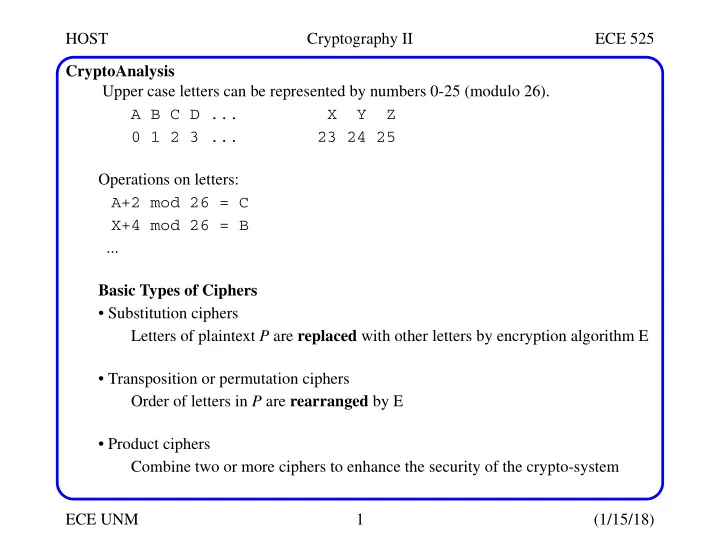
SLIDE 1 HOST Cryptography II ECE 525 ECE UNM 1 (1/15/18) CryptoAnalysis Upper case letters can be represented by numbers 0-25 (modulo 26). A B C D ... X Y Z 0 1 2 3 ... 23 24 25 Operations on letters: A+2 mod 26 = C X+4 mod 26 = B ... Basic Types of Ciphers
Letters of plaintext P are replaced with other letters by encryption algorithm E
- Transposition or permutation ciphers
Order of letters in P are rearranged by E
Combine two or more ciphers to enhance the security of the crypto-system
SLIDE 2 HOST Cryptography II ECE 525 ECE UNM 2 (1/15/18) Substitution Ciphers Outline:
- a. The Caesar Cipher
- b. Other Substitution Ciphers
- c. One-Time Pads
The Caesar Cipher ci = E(pi) = (pi+3) mod 26 (26 letters in the English alphabet) Change each letter to the third letter following it (circularly) A->D, B->E, ... X->A, Y->B, Z->C Can represent as a permutation π: π(i) = (i+3) mod 26 π(0)=3, π(1)=4, ..., π(23)=26 mod 26=0, π(24)=1, π(25)=2 Key = 3, or key = ’D’ (b/c D represents 3)
SLIDE 3
HOST Cryptography II ECE 525 ECE UNM 3 (1/15/18) Caesar Cipher (Barbara Endicott-Popovsky, U. Washington) Example P (plaintext): HELLO WORLD C (ciphertext): khoor zruog Caesar Cipher is a monoalphabetic substitution cipher (a simple substitution cipher) Exhaustive search If the key space is small enough, try all possible keys until you find the right one Caesar cipher has 25 possible keys (1 to 25) (assuming 0 would never be used!) Statistical analysis (attack) Compare to 1-gram (unigram) model of English, which shows frequency of (single) characters in English
SLIDE 4
HOST Cryptography II ECE 525 ECE UNM 4 (1/15/18) Statistical Attack 1-grams (unigrams) for English Step 1: Statistical Attack Compute frequency f(c) of each letter c in ciphertext Example: C = ’khoor zruog’ 10 characters: ’o’: 3, ’r’: 2, {k, h, z, u, g}: 1 f(c): f(g)=0.1 f(h)=0.1 f(k)=0.1 f(o)=0.3 f(r)= 0.2 f(u)=0.1 f(z)=0.1 f(ci) = 0 for all other ci
SLIDE 5
HOST Cryptography II ECE 525 ECE UNM 5 (1/15/18) Statistical Attack Step 2: Statistical Analysis φ(i): Correlation of frequency of letters in ciphertext with frequency of corre- sponding letters in English for a particular key i For key i: φ(i) = Σ0 <= c <= 25 f(c) * p(c - i) c is representation of character (0-25) f(c) is frequency of letter c in ciphertext C p(x) is frequency of character x in English This is correlation analysis, i.e., the value of i that generates the largest sum indicates the closest match between frequencies in alphabet and cipher text.
SLIDE 6
HOST Cryptography II ECE 525 ECE UNM 6 (1/15/18) Statistical Attack Example: C = ’khoor zruog’ (P = ’HELLO WORLD’) f(c): f(g)=0.1, f(h)=0.1, f(k)=0.1, f(o)=0.3, f(r)=0.2, f(u)=0.1, f(z)=0.1 Convert letters to numbers: g: 6, h: 7, k: 10, o: 14, r: 17, u: 20, z: 25 Compute correlation value: φ(i) = 0.1p(6 - i) + 0.1p(7 - i) + 0.1p(10 - i) + 0.3p(14 - i) + 0.2p(17 - i) + 0.1p(20 - i) + 0.1p(25 - i) Step 2a: Statistical Attack Calculations
SLIDE 7
HOST Cryptography II ECE 525 ECE UNM 7 (1/15/18) Statistical Attack Most probable keys are the largest φ(i) values: i = 6, φ(i) = 0.0660 Plaintext EBIIL TLOLA i = 10, φ(i) = 0.0635 Plaintext AXEEH PHKEW i = 3, φ(i) = 0.0575 Plaintext HELLO WORLD i = 14, φ(i) = 0.0535 Plaintext WTAAD LDGAS The plaintext is ’legible English’ only for the case when i = 3 So the key is 3 or ’D’ and the code broken
SLIDE 8 HOST Cryptography II ECE 525 ECE UNM 8 (1/15/18) Caesar’s Problem Problem: Key is too short Only used a 1-char key (monoalphabetic substitution)
- Can be found by exhaustive search
- Statistical frequencies not concealed well by the short key, i.e., ciphertext looks
too much like the composition of ’regular’ English phrases Solution: Make the key longer n-char key (n >= 2) - polyalphabetic substitution
- Makes exhaustive search much more difficult
- Statistical frequencies concealed much better
- Makes cryptoanalysis harder
Other Substitution Ciphers Vigenere Tableaux cipher is a polyalphabetic substitution cipher
SLIDE 9
HOST Cryptography II ECE 525 ECE UNM 9 (1/15/18) Polyalphabetic Substitution Ciphers (J. Leiwo, VU, NL) Attempts to flatten (diffuse) the frequency distribution of letters by combining high frequency letters with low frequency letters Example: key substitution: Key definition: Key1: Start with ’a’, skip 2, take next, skip 2, take next letter, ... (circular) Key2: Start with ’n’ (2nd half of alphabet), skip 4, take next, skip 4, take next, ... (circular) Encryption involves using Key1 for first letter of plaintext, Key2 for second letter, Key1 again for third letter, etc. skip 2 letters skip 4 letters
SLIDE 10 HOST Cryptography II ECE 525 ECE UNM 10 (1/15/18) Polyalphabetic Substitution Ciphers Plaintext: TOUGH STUFF Ciphertext: ffirv zfjpm Obtained by mapping T->f using Key1, O->f using Key2, U->i using Key1, etc. Characteristics:
- Different chars mapped into the same one: T, O -> f
- Same char mapped into different ones: F -> p, m
- ’f’ most frequent in Ciphertext => 0.30
In English: f(f) = 0.02 << f(e) = 0.13 skip 2 letters skip 4 letters
SLIDE 11 HOST Cryptography II ECE 525 ECE UNM 11 (1/15/18) Vigenere Tableaux Key: EXODUS Plaintext: YELLOW SUBMARINE FROM YELLOW RIVER Extended keyword: Re-applied to match length of plaintext: YELLOW SUBMARINE FROM YELLOW RIVER EXODUS EXODUSEXO DUSE XODUSE XODUS Ciphertext: cbzoio wlppujmks ilgq vsofhb owyyj How does this work? Char from plaintext indexes row and char from extended key indexes column For example,
- row Y and column E: ’c’
- row E and column X: ’b’
- row L and column O: ’z’
SLIDE 12
HOST Cryptography II ECE 525 ECE UNM 12 (1/15/18) Vigenere Tableaux
SLIDE 13
HOST Cryptography II ECE 525 ECE UNM 13 (1/15/18) One-Time Pads OPT: Variant of using Vigenere Tableaux Designed to fix problem its problem that the key used might be too short Above: ’EXODUS’ is only 6 chars Sometimes considered a perfect cipher Used extensively during Cold War One-Time Pad: Large, non-repeating set of long keys on pad sheets/pages Sender and receiver have identical pads Example: 300-char msg to send, 20-char key per sheet Use & tear off 300/20 = 15 pages from the pad Encryption: Sender writes letters of consecutive 20-char keys above the letters of the plain- text
SLIDE 14 HOST Cryptography II ECE 525 ECE UNM 14 (1/15/18) One-Time Pads Encryption: Sender creates ciphertext by adding the plaintext and key characters in each of the columns and takes the sum mod 26 And then destroys the used keys Decryption: Receiver constructs columns in the same way with ciphertext and the key char- acters from the same 15 consecutive pages of the pad Receiver subtracts key characters from ciphertext mod 26 and destroys the keys Characteristics:
- The key is as long as the message
- The key is always changing (and destroyed after use)
Weaknesses:
- Requires perfect synchronization required between S and R
Intercepted or dropped messages can destroy synchronization
SLIDE 15 HOST Cryptography II ECE 525 ECE UNM 15 (1/15/18) One-Time Pads Weaknesses:
- Need lots of keys
- Need to distribute pads securely
Transposition Ciphers Rearrange letters in plaintext to produce ciphertext Example of columnar transposition Plaintext: HELLO WORLD (a) Transposition into 3 columns: HEL LOW ORL DXX XX - padding
SLIDE 16
HOST Cryptography II ECE 525 ECE UNM 16 (1/15/18) Transposition Ciphers (b) Transposition into 2 columns: HE LL OW OR LD Ciphertext is constructed by reading table column-wise: (a) hlodeorxlwlx (b) hloolelwrd What is the key? Number of columns: (a) key = 3 and (b) key = 2 Example 2: Rail-Fence Cipher Plaintext: HELLO WORLD
SLIDE 17
HOST Cryptography II ECE 525 ECE UNM 17 (1/15/18) Transposition Ciphers Transposition into 2 rows (rails) column-by-column: HLOOL ELWRD Ciphertext: hloolelwrd (Does it look familiar?) What is the key? Number of rails: key = 2 Attacking Transposition Ciphers Anagramming n-gram: n-char strings in English Digrams (2-grams) for English alphabet are: aa, ab, ac, ...az, ba, bb, bc, ..., zz (262 = 676 rows in table) Trigrams are: aaa, aab, ... (263 = 17,576 rows in table)
SLIDE 18
HOST Cryptography II ECE 525 ECE UNM 18 (1/15/18) Attacking Transposition Ciphers Anagramming 4-grams are: aaaa, aaab, ... Attack procedure: If 1-gram frequencies in C match their frequencies in English BUT other n- gram frequencies in C do not match their frequencies in English, THEN It is probably a transposition encryption Find n-grams with the highest frequencies in ciphertext then rearrange sub- strings in ciphertext to form n-grams with highest frequencies Start with n=2 Ciphertext C: hloolelwrd (from Rail-Fence cipher) N-gram frequency check 1-gram frequencies in C do match their frequencies in English
SLIDE 19
HOST Cryptography II ECE 525 ECE UNM 19 (1/15/18) Attacking Transposition Ciphers N-gram frequency check 2-gram (hl, lo, oo, ...) frequencies in C do not match their frequencies in English 3-gram (hlo, loo, ool, ...) frequencies in C do not match their frequencies in English ... => Conclude it is probably a transposition Frequencies in English for all 2-grams from C starting with h (from table of frequen- cies of English digrams) he 0.0305 ho 0.0043 hl, hw, hr, hd < 0.0010 Implies that in hloolelwrd, e follows h
SLIDE 20 HOST Cryptography II ECE 525 ECE UNM 20 (1/15/18) Attacking Transposition Ciphers Arrange C so that the h and e are adjacent Since 2-gram suggests a solution, cut C into 2 substrings with the 2nd substring start- ing with e: hlool elwrd Put them in 2 columns: he ll
ld Read row by row to get original plaintext: HELLO WORLD
SLIDE 21 HOST Cryptography II ECE 525 ECE UNM 21 (1/15/18) Product Ciphers Another name for combination ciphers Built of multiple blocks, where each is based on substitution or transposition Example: two-block product cipher E2(E1(P, KE1), KE2) Product cipher might not be stronger than its individual components used separately! Might not even be as strong as individual components! Criteria for Good Ciphers (Claude Shannon’s criteria (1949)
- Needed degree of secrecy should determine amount of labor
- Set of keys and enciphering algorithm should be free from complexity
- Implementation should be as simple as possible
- Size & storage of C should be restricted, e.g., size(C) should not be > size(P)
These were proposed at the dawn of computer era are still valid!
SLIDE 22 HOST Cryptography II ECE 525 ECE UNM 22 (1/15/18) Criteria for Good Ciphers Plus, one additional one
- Propagation of errors should be limited
Characteristics of good encryption schemes
Interceptor cannot predict what will happen to C when she changes one charac- ter in P Encryptor with good confusion hides relationship between P + K and C
Changes in P spread out over many parts of C Encryptor with good diffusion requires attacker to collect/analyze a lot of C Two basic types of Ciphers
SLIDE 23
HOST Cryptography II ECE 525 ECE UNM 23 (1/15/18) Stream and Block Ciphers Stream Cipher: 1 char from P transformed into 1 char for C The polyalphabetic cipher we saw earlier is an example, e.g., P and K (repeated "EXODUS") YELLOWSUBMARINEFROMYELLOWRIVER EXODUSEXODUSEXODUSEXODUSEXODUS Encryption involves translating P one character at a time and transmitting to receiver Problem: dropping a char results in wrong decryption Block Ciphers 1 block of chars from P transformed to 1 block of chars for C Example is the columnar transposition we saw earlier
SLIDE 24 HOST Cryptography II ECE 525 ECE UNM 24 (1/15/18) Stream and Block Ciphers Pros/Cons of Stream Ciphers
- Positive: Low delay for decoding individual symbols
Can start decoding as soon as the C begins to be received
- Positive: Low error propagation
Error in E(c1) does not affect E(c2)
Each char encoded separately and therefore can reveal frequency information
- Drawback: Susceptibility to malicious insertion and manipulation
Adversary can fabricate a new msg from pieces of broken msgs, even if he doesn’t know E Pros/Cons for Block Ciphers
Frequency of a chars in P diffused over a block of C
- Positive: Immune to insertion
Impossible to insert a char into a block without easy detection (block size would change) Impossible to modify a char in a block without easy detection (checksums)
SLIDE 25 HOST Cryptography II ECE 525 ECE UNM 25 (1/15/18) Stream and Block Ciphers Pros/Cons for Block Ciphers
- Drawback: Large delay for decoding individual chars
For some E, can not decode 1st char of C until entire block is received
- Drawback: High error propagation
Errors affect the entire block, not just a single character