Integration-by-parts reductions via algebraic geometry Kasper J. - - PowerPoint PPT Presentation

integration by parts reductions via algebraic geometry
SMART_READER_LITE
LIVE PREVIEW

Integration-by-parts reductions via algebraic geometry Kasper J. - - PowerPoint PPT Presentation

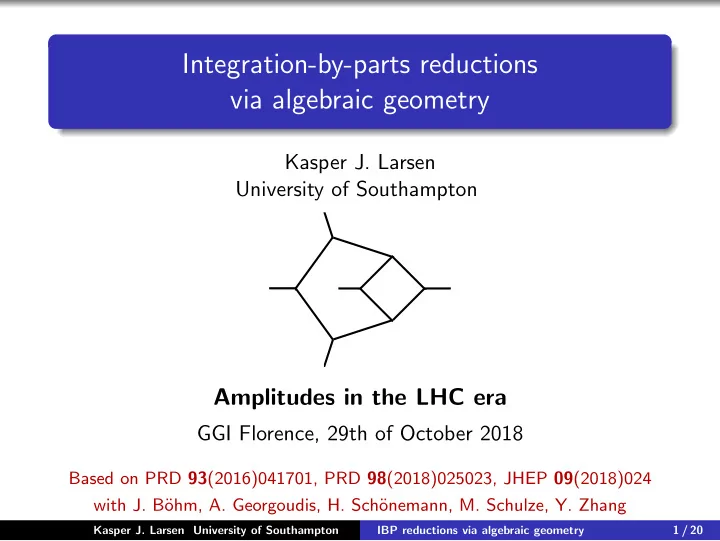
Integration-by-parts reductions via algebraic geometry Kasper J. Larsen University of Southampton Amplitudes in the LHC era GGI Florence, 29th of October 2018 Based on PRD 93 (2016)041701, PRD 98 (2018)025023, JHEP 09 (2018)024 with J. B


slide-1
SLIDE 1

Integration-by-parts reductions via algebraic geometry

Kasper J. Larsen University of Southampton

Amplitudes in the LHC era

GGI Florence, 29th of October 2018

Based on PRD 93(2016)041701, PRD 98(2018)025023, JHEP 09(2018)024 with J. B¨

  • hm, A. Georgoudis, H. Sch¨
  • nemann, M. Schulze, Y. Zhang

Kasper J. Larsen University of Southampton IBP reductions via algebraic geometry 1 / 20

slide-2
SLIDE 2

Overview

1

Motivation

2

IBP identities on unitarity cuts

3

Syzygy equations and their solution

4

Main example:

Kasper J. Larsen University of Southampton IBP reductions via algebraic geometry 2 / 20

slide-3
SLIDE 3

Integration-by-parts reductions

IBP identities arise from the vanishing integration of total derivatives,

[Chertyrkin, Tchakov, Nucl. Phys. B 192, 159 (1981)]

  • L
  • i=1

dDℓi πD/2

L

  • j=1

∂ ∂ℓµ

j

v µ

j P

Da1

1 · · · Dak k

= 0 where P and v µ

j are polynomials in ℓi, pj, and ai ∈ N.

Role in perturbative QFT calculations:

  • Reduction. Reduce number of contributing loop integrals by factor
  • f O(102) − O(106) to basis.

Computing master integrals. Enable setting up differential equations for basis integrals Ij:

[Gehrmann and Remiddi, Nucl. Phys. B 580, 485 (2000)] [Henn, PRL 110 (2013) 251601]

∂ ∂xm I(x, ǫ) = Am(x, ǫ)I(x, ǫ) where xm denotes a kinematical invariant.

Kasper J. Larsen University of Southampton IBP reductions via algebraic geometry 3 / 20

slide-4
SLIDE 4

IBP reductions on unitarity cuts

Standard approach: enumerate all linear relations and apply Gauss-Jordan elimination to large linear systems

[Laporta, Int.J.Mod.Phys. A 15 (2000) 5087-5159]

Idea here: use unitarity cuts to block-diagonalize system We use the Baikov representation

  • k = L(L+1)

2

+LE , I(N; a) ≡

  • L
  • j=1

dDℓj iπD/2 N Da1

1 · · · Dak k

= dz1 · · · dzk za1

1 · · · zak k

Gram

( p,ℓ) (z)

D−L−E−1 2

N

[Baikov, Phys.Lett. B 385 (1996) 404-410]

in which cuts are straightforward to apply,

dzi zai

i

− →

cut

  • Γǫ(0)

dzi zai

i

i ∈ Scut

Kasper J. Larsen University of Southampton IBP reductions via algebraic geometry 4 / 20

slide-5
SLIDE 5

Example: Zurich-flag cut

Let us construct IBP identities on the Zurich-flag cut Define Scut = {1, 2, 4, 5, 7} and G = Gram(

p,ℓ).

On Scut, the double-box integral takes the form I DB

cut [P] =

  • i∈Scut
  • Γǫ(0)

d zi

  • zi

j / ∈Scut

d zj G( z)

D−6 2

  • z3

z6 P( z)

Kasper J. Larsen University of Southampton IBP reductions via algebraic geometry 5 / 20

slide-6
SLIDE 6

Example: Zurich-flag cut

Let us construct IBP identities on the Zurich-flag cut Define Scut = {1, 2, 4, 5, 7} and G = Gram(

p,ℓ).

On Scut, the double-box integral takes the form I DB

cut [P] =

  • i∈Scut
  • Γǫ(0)

d zi

  • zi

j / ∈Scut

d zj G( z)

D−6 2

  • z3

z6 P( z) Relabeling z{1,2,3,4} = z{3,6,8,9}, this becomes I DB

cut [P] =

dz1 dz2 dz3 dz4 z1z2 G(z)

D−6 2 P(z)

Kasper J. Larsen University of Southampton IBP reductions via algebraic geometry 5 / 20

slide-7
SLIDE 7

Generic total derivative on cut

Need to find IBP identities which involve I DB

cut [P] =

dz1 dz2 dz3 dz4 z1z2 G(z)

D−6 2 P(z)

Total derivatives − → IBP identities. Generic total derivative on cut:

0 =

4

  • i=1

∂ ∂zi ai(z)G(z)

D−6 2

z1z2

  • dz1 · · · dz4

=

4

  • i=1

∂ai ∂zi + D − 6 2G ai ∂G ∂zi

  • j=1,2

aj zj G(z)

D−6 2

z1z2 dz1 · · · dz4

The red term corresponds to an integral in (D − 2) dimensions, and the purple term in general produces doubled propagators.

Kasper J. Larsen University of Southampton IBP reductions via algebraic geometry 6 / 20

slide-8
SLIDE 8

IBP identities from syzygies

To avoid dimension shifts and doubled propagators in 0 =

4

  • i=1

∂ai ∂zi + D − 6 2G ai ∂G ∂zi

  • j=1,2

aj zj G(z)

D−6 2

z1z2 dz1 · · · dz4 we demand that each term is polynomial,

4

  • i=1

ai ∂G ∂zi + bG = 0 aj + bjzj = 0 with ai, bi, b polynomials in z. Such eqs. are known as syzygy equations.

[Gluza, Kajda, Kosower, PRD83(2011)045012], [Schabinger, JHEP01(2012)077], [Ita, PRD94(2016)116015]

Obtain IBPs by plugging (ai, b) into the top equation. Note: (qai, qb) is also a solution, for polynomial q.

Kasper J. Larsen University of Southampton IBP reductions via algebraic geometry 7 / 20

slide-9
SLIDE 9

Strategy to solve syzygy equations

Solve syzygy equations with c cuts aj + bjzj = 0 , j = 1, . . . , k−c (1)

m−c

  • j=1

aj ∂G ∂zk + bG = 0 (2) as follows. 1) The generators of (1) are trivial: M1 = z1e1, . . . , zkek, ek+1, . . . , em 2) Generators M2 =

  • (a1, . . . , am, b), . . .
  • f (2) for the off-shell

case c = 0 can be explicitly found: (aα, b) = E+L

  • k=1

(1+δik)xjk ∂zα ∂xik , 2δij

  • where

xij = vi · vj with vi,j ∈ {p1, . . . , pE, ℓ1, . . . , ℓL} .

[B¨

  • hm, Georgoudis, KJL, Schulze, Zhang, PRD 98(2018)025023]

3) Take module intersection M1

  • cut ∩ M2
  • cut

Kasper J. Larsen University of Southampton IBP reductions via algebraic geometry 8 / 20

slide-10
SLIDE 10

Example 1: syzygies of planar double box

Set P12 = p1 + p2 and z1 = ℓ2

1 ,

z2 = (ℓ1 − p1)2 , z3 = (ℓ1 − P12)2 z4 = (ℓ2 + P12)2 , z5 = (ℓ2 − p4)2 , z6 = ℓ2

2

z7 = (ℓ1 + ℓ2)2 , z8 = (ℓ1 + p4)2 , z9 = (ℓ2 + p1)2

Only need to find explicit relation z = Ax + B. Here

A =               1 −2 1 −2 −2 1 2 2 1 2 2 2 1 1 1 2 1 −2 −2 −2 1 2 1              

Set ti,j = (aα, b). The syzygy generators are linear in the zk

t4,1 = (z1−z2, z1−z2, −s+z1−z2, 0, 0, 0, z1−z2−z6+z9, t+z1−z2, 0, 0) t4,2 = (s+z2−z3, z2−z3, z2−z3, 0, 0, 0, z2−z3+z4−z9, −t+z2−z3, 0, 0) t4,3 = (−s+z3−z8, t+z3−z8, z3−z8, 0, 0, 0, z3−z4+z5−z8, z3−z8, 0, 0) t4,4 = (2z1, z1+z2, −s+z1+z3, 0, 0, 0, z1−z6+z7, z1+z8, 0, −2) t4,5 = (−z1−z6+z7, −z1+z7−z9, s−z1−z4+z7, 0, 0, 0, −z1+z6+z7, −z1−z5+z7, 0, 0) t5,1 = (0, 0, 0, s−z6+z9, −t−z6+z9, z9−z6, z1−z2−z6+z9, 0, z9−z6, 0) t5,2 = (0, 0, 0, z4−z9, t+z4−z9, −s+z4−z9, z2−z3+z4−z9, 0, z4−z9, 0) t5,3 = (0, 0, 0, z5−z4, z5−z4, s−z4+z5, z3−z4+z5−z8, 0, −t−z4+z5, 0) t5,4 = (0, 0, 0, s−z3−z6+z7, −z6+z7−z8, −z1−z6+z7, z1−z6+z7, 0, −z2−z6+z7, 0) t5,5 = (0, 0, 0, −s+z4+z6, z5+z6, 2z6, −z1+z6+z7, 0, z6+z9, −2) Kasper J. Larsen University of Southampton IBP reductions via algebraic geometry 9 / 20

slide-11
SLIDE 11

Example 2: syzygies of non-planar double pentagon

Set Pi,j ≡ pi + pj and z1 = ℓ2

1 ,

z2 = (ℓ1−p1)2 , z3 = (ℓ1−P1,2)2 , z4 = (ℓ2−P3,4)2 , z5 = (ℓ2−p4)2 , z6 = ℓ2

2 ,

z7 = (ℓ1+ℓ2)2 , z8 = (ℓ1+ℓ2+p5)2 , z9 = (ℓ1+p3)2 , z10 = (ℓ1+p4)2 , z11 = (ℓ2+p1)2 Here z = Ax + B with

A =                 1 −2 1 −2 −2 1 −2 −2 1 −2 1 1 1 2 1 −2 −2 −2 −2 −2 −2 −2 −2 1 2 1 2 1 2 1 2 1                 ,

and the syzygy generators are again compact:

Kasper J. Larsen University of Southampton IBP reductions via algebraic geometry 10 / 20

slide-12
SLIDE 12

Computing module intersections

Given M1 = v1, . . . , vp and M2 = w1, . . . , wq with vi, wj m-tuples of

  • polynomials. Let Q denote the m × (p+q) matrix

Q =        . . . . . . . . . . . . v1 · · · vp w1 · · · wq . . . . . . . . . . . .       

Then compute wrt. POT and variable order [z1, . . . , zm] ≻ [sij]

h1, . . . , ht ≡ Gr¨

  • bner basis of column space of

     Q 1 ... 1     

Selecting hi = (

m

0, . . . , 0, x1, . . . , xp, y1, . . . , yq), we have 0 =

p

  • j=1

xjvj +

q

  • k=1

ykwk

Kasper J. Larsen University of Southampton IBP reductions via algebraic geometry 11 / 20

slide-13
SLIDE 13

Computing module intersections

Given M1 = v1, . . . , vp and M2 = w1, . . . , wq with vi, wj m-tuples of

  • polynomials. Let Q denote the m × (p+q) matrix

Q =        . . . . . . . . . . . . v1 · · · vp w1 · · · wq . . . . . . . . . . . .       

Then compute wrt. POT and variable order [z1, . . . , zm] ≻ [sij]

h1, . . . , ht ≡ Gr¨

  • bner basis of column space of

     Q 1 ... 1     

Selecting hi = (

m

0, . . . , 0, x1, . . . , xp, y1, . . . , yq), we have 0 =

p

  • j=1

xjvj +

q

  • k=1

ykwk = ⇒

p

  • j=1

xjvj = −

q

  • k=1

ykwk ∈ M1 ∩ M2 Hence p

j=1 xjvj generate M1 ∩ M2, taking (x1, . . . , xp) from each hi.

Kasper J. Larsen University of Southampton IBP reductions via algebraic geometry 11 / 20

slide-14
SLIDE 14

Spanning set of cuts for IBPs

To find the complete IBP reduction, we must consider the cuts associated with “uncollapsible” masters: A bit more explicitly, the cuts we need to consider are

Kasper J. Larsen University of Southampton IBP reductions via algebraic geometry 12 / 20

slide-15
SLIDE 15

Main example: non-planar hexagon box

Task: IBP reduce non-planar hexagon box with numerator insertions of degree four in the zi

[Chicherin, Henn, Mitev JHEP 05(2018)164] [Badger, Brønnum-Hansen, Hartanto, Peraro, PRL 120(2018)092001] [Abreu, Cordero, Ita, Page, Zeng, PRD 97(2018)116014] [Chawdhry, Lim, Mitov, 1805.09182] [S. Abreu, B. Page, M. Zeng, 1807.11522] [D. Chicherin, T. Gehrmann, J. Henn, N.A. Lo Presti, V. Mitev, P. Wasser, 1809.06240]

There are 10 cuts to consider:

Kasper J. Larsen University of Southampton IBP reductions via algebraic geometry 13 / 20

slide-16
SLIDE 16

Non-planar hexagon box: spanning set of cuts

Construct and solve IBP identities on a spanning set of cuts.

Kasper J. Larsen University of Southampton IBP reductions via algebraic geometry 14 / 20

slide-17
SLIDE 17

Non-planar hexagon box: spanning set of cuts

Construct and solve IBP identities on a spanning set of cuts.

Kasper J. Larsen University of Southampton IBP reductions via algebraic geometry 14 / 20

slide-18
SLIDE 18

Non-planar hexagon box: spanning set of cuts

Construct and solve IBP identities on a spanning set of cuts.

Kasper J. Larsen University of Southampton IBP reductions via algebraic geometry 14 / 20

slide-19
SLIDE 19

Non-planar hexagon box: spanning set of cuts

Construct and solve IBP identities on a spanning set of cuts.

Kasper J. Larsen University of Southampton IBP reductions via algebraic geometry 14 / 20

slide-20
SLIDE 20

Non-planar hexagon box: spanning set of cuts

Construct and solve IBP identities on a spanning set of cuts.

Kasper J. Larsen University of Southampton IBP reductions via algebraic geometry 14 / 20

slide-21
SLIDE 21

Non-planar hexagon box: spanning set of cuts

Construct and solve IBP identities on a spanning set of cuts.

Kasper J. Larsen University of Southampton IBP reductions via algebraic geometry 14 / 20

slide-22
SLIDE 22

Non-planar hexagon box: spanning set of cuts

Construct and solve IBP identities on a spanning set of cuts.

Kasper J. Larsen University of Southampton IBP reductions via algebraic geometry 14 / 20

slide-23
SLIDE 23

Non-planar hexagon box: spanning set of cuts

Construct and solve IBP identities on a spanning set of cuts.

Kasper J. Larsen University of Southampton IBP reductions via algebraic geometry 14 / 20

slide-24
SLIDE 24

Non-planar hexagon box: spanning set of cuts

Construct and solve IBP identities on a spanning set of cuts.

Kasper J. Larsen University of Southampton IBP reductions via algebraic geometry 14 / 20

slide-25
SLIDE 25

Non-planar hexagon box: spanning set of cuts

Construct and solve IBP identities on a spanning set of cuts.

Kasper J. Larsen University of Southampton IBP reductions via algebraic geometry 14 / 20

slide-26
SLIDE 26

Syzygies for the non-planar hexagon box

Syzygies for ensuring D-dimensionality: Syzygies for ensuring no doubled propagators: Compute intersection of M1

  • cut ∩ M2
  • cut on each of the 10 cuts.

Kasper J. Larsen University of Southampton IBP reductions via algebraic geometry 15 / 20

slide-27
SLIDE 27

Complexity of IBP systems

Resources to compute M1

  • cut ∩ M2
  • cut: 25-800 s and

1-14 GB RAM (on 24 cores, 3.40 GHz) Size of generating systems after trimming: 1.5-10 MB Plug resulting generators into ansatz for total derivative:

0 =  

m−c

  • i=1

∂ari ∂zri + D−L−E−1 2G(z) ari ∂G ∂zri

k−c

  • i=1

ari zri   G(z)

D−L−E−1 2

zr1 · · · zrk−c dzr1· · · dzrm−c

Resulting linear systems to solve: 700-1200 equations, size 1 MB, density 1.5%

Kasper J. Larsen University of Southampton IBP reductions via algebraic geometry 16 / 20

slide-28
SLIDE 28

Gauss-Jordan elimination of IBP systems

To find the IBP reductions, Gauss-Jordan eliminate IBP systems. Some remarks: To preserve sparsity, use a total pivoting strategy (i.e., allow column swaps) For cut {1, 4, 6, 7}, the RREF can be performed fully analytically, requiring 31 minutes on one core and 1.5 GB RAM. . . . For {3, 6, 7}, assigned numerical values to two sij. Ran 440 points on cluster (2.5 h and 1.8 GB RAM per job). Used interpolation code to get analytical results (23 min and 15 GB RAM on one core).

[von Manteuffel and Schabinger, PLB 744(2015)101] [Peraro, JHEP12(2016)030] Kasper J. Larsen University of Southampton IBP reductions via algebraic geometry 17 / 20

slide-29
SLIDE 29

Merging on-shell IBP reductions

By solving the IBP identities on the following cuts we reconstruct the complete IBP reductions by merging the partial results. An example of an IBP relation produced by our method (χ ≡ t/s):

Kasper J. Larsen University of Southampton IBP reductions via algebraic geometry 18 / 20

slide-30
SLIDE 30

Results for IBP reductions

Fully analytic IBP reductions of the 32 hexagon boxes

  • I(1, 1, 1, 1, 1, 1, 1, 1, 0, 0, −4),

I(1, 1, 1, 1, 1, 1, 1, 1, 0, −1, −3), I(1, 1, 1, 1, 1, 1, 1, 1, 0, −2, −2) I(1, 1, 1, 1, 1, 1, 1, 1, 0, −3, −1), I(1, 1, 1, 1, 1, 1, 1, 1, 0, −4, 0), I(1, 1, 1, 1, 1, 1, 1, 1, −1, 0, −3) I(1, 1, 1, 1, 1, 1, 1, 1, −1, −1, −2), I(1, 1, 1, 1, 1, 1, 1, 1, −1, −2, −1), I(1, 1, 1, 1, 1, 1, 1, 1, −1, −3, 0) I(1, 1, 1, 1, 1, 1, 1, 1, −2, 0, −2), I(1, 1, 1, 1, 1, 1, 1, 1, −2, −1, −1), I(1, 1, 1, 1, 1, 1, 1, 1, −2, −2, 0) I(1, 1, 1, 1, 1, 1, 1, 1, −3, 0, −1), I(1, 1, 1, 1, 1, 1, 1, 1, −3, −1, 0), I(1, 1, 1, 1, 1, 1, 1, 1, −4, 0, 0) I(1, 1, 1, 1, 1, 1, 1, 1, 0, 0, −3), I(1, 1, 1, 1, 1, 1, 1, 1, 0, −1, −2), I(1, 1, 1, 1, 1, 1, 1, 1, 0, −2, −1) I(1, 1, 1, 1, 1, 1, 1, 1, 0, −3, 0), I(1, 1, 1, 1, 1, 1, 1, 1, −1, 0, −2), I(1, 1, 1, 1, 1, 1, 1, 1, −1, −1, −1) I(1, 1, 1, 1, 1, 1, 1, 1, −1, −2, 0), I(1, 1, 1, 1, 1, 1, 1, 1, −2, 0, −1), I(1, 1, 1, 1, 1, 1, 1, 1, −2, −1, 0) I(1, 1, 1, 1, 1, 1, 1, 1, −3, 0, 0), I(1, 1, 1, 1, 1, 1, 1, 1, 0, 0, −2), I(1, 1, 1, 1, 1, 1, 1, 1, 0, −1, −1) I(1, 1, 1, 1, 1, 1, 1, 1, 0, −2, 0), I(1, 1, 1, 1, 1, 1, 1, 1, −1, 0, −1), I(1, 1, 1, 1, 1, 1, 1, 1, −1, −1, 0) I(1, 1, 1, 1, 1, 1, 1, 1, 0, 0, −1), I(1, 1, 1, 1, 1, 1, 1, 1, 0, −1, 0)

  • can be downloaded from (268 MB compressed / 790 MB uncompressed)

https://github.com/yzhphy/hexagonbox reduction/releases/download/1.0.0/hexagon box degree 4 Final.zip

Our results agree with fully numerical results from FIRE5 C++ (6 hours per point).

[A. Smirnov, CPC 189(2015)182] Kasper J. Larsen University of Southampton IBP reductions via algebraic geometry 19 / 20
slide-31
SLIDE 31

Conclusions

New formalism for IBP reductions. Main ideas: cuts, IBP identities from syzygies, total pivoting, rational reconstruction Obtained the fully analytic IBP reductions of with numerator insertions up to degree 4 in the zi. Powerful framework. IBP reductions for further 2 → 3 two-loop processes seem well within reach.

Kasper J. Larsen University of Southampton IBP reductions via algebraic geometry 20 / 20