Honiara Urban Resilience & Climate Adaptation Plan SPREP Honiara - - PowerPoint PPT Presentation

honiara urban resilience climate adaptation plan
SMART_READER_LITE
LIVE PREVIEW

Honiara Urban Resilience & Climate Adaptation Plan SPREP Honiara - - PowerPoint PPT Presentation

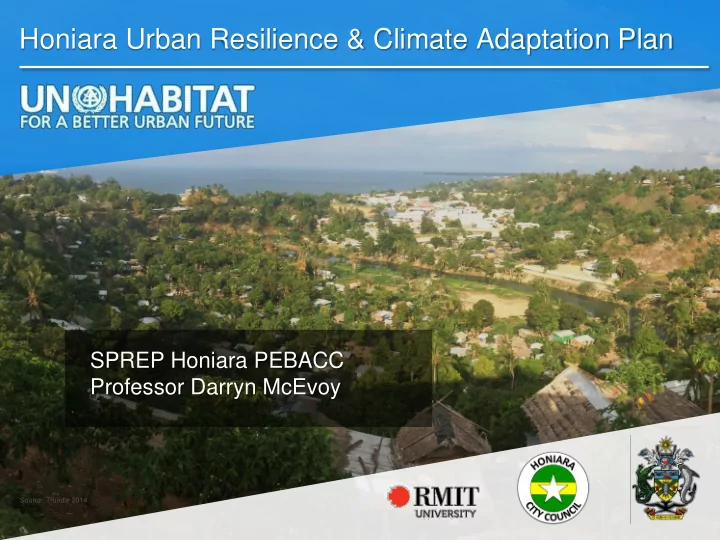
Honiara Urban Resilience & Climate Adaptation Plan SPREP Honiara PEBACC Professor Darryn McEvoy Source: Trundle 2014 RMIT Climate Change Adaptation Program Asia & Oceania Sector-Specific Urban Governance Sector-specific & Urban


slide-1
SLIDE 1

SPREP Honiara PEBACC Professor Darryn McEvoy

Honiara Urban Resilience & Climate Adaptation Plan

Source: Trundle 2014
slide-2
SLIDE 2

RMIT Climate Change Adaptation Program

Asia & Oceania Sector-Specific Sector-specific & Urban Climate Adaptation in the Asia-Pacific Region Urban Governance

slide-3
SLIDE 3

UN Habitat Cities & Climate Change Initiative

  • Developing Climate Change Strategies for cities

across the Asia-Pacific & globally

  • Applying a consistent structured assessment

methodology

  • Aim: 50 cities by 2015
slide-4
SLIDE 4

Planning for Climate Change Process

UN Habitat Planning Structure:

  • Module A completed in 2014
  • Module B currently underway
  • Modules C, D ultimately need

stakeholder

  • wnership/buy-in
  • Focus on ‘bottom-up’

participatory data integration with wide engagement & action research Our Role:

  • Facilitating the process
  • Providing technical expertise, input & communication skills
  • Training for local independent ownership of Module D
slide-5
SLIDE 5

Phase 2 Engagement Process

slide-6
SLIDE 6

Endorsement & Ownership

  • VAA Report formally endorsed by MECCDM, MLHS and

Honiara City Council in May 2015 as part of ongoing support of the UN-Habitat programme

  • SIG & HCC ownerships is critical as Planning for Climate

Change moves into Phases 3 & 4 – implementation, M&E

slide-7
SLIDE 7

Key Stakeholder Issues

  • Urban Growth & Infrastructure
  • Sanitation, overcrowding, speed of population growth
  • Rubbish disposal/management, land use planning
  • Quality/maintenance of urban infrastructure & assets
  • Hazard Specific
  • Localised flooding, water security/quality, human health
  • Sea level rise, coastal erosion, landslides, cyclones
  • Community Awareness
  • Lack of climate change understanding/awareness
  • Inconsistent/inadequate community consultation

generally

  • Lack of social ownership of the city
  • Other issues
  • Underemployment, environmental & social damage

Source: Trundle 2014

slide-8
SLIDE 8

Socio-Economic Data

City-wide figures

  • 32% of the population below the

Basic Needs Poverty Line

  • 75% covered by piped water
  • 54% have private flush toilets
  • 64% have access to electricity
  • 36% w/ govt. waste disposal

Localised sensitivity hotspots

  • Urban fringe & informal areas
  • Critical areas:
  • Literacy/education
  • Income distribution
  • Building materials
  • Fishing/gardening

Households with unsealed or no sanitation facilities (2009) Honiara population density by enumeration area (2009)

Source: Trundle & McEvoy 2015

slide-9
SLIDE 9

Informal Settlements

  • Currently make up 35% of the total population of Honiara
  • Lack basic services resulting in pollution, health risks,

vulnerable structures and low adaptive capacity

  • Often in highly exposed area (flood plains, steep slopes etc.)

Source: Trundle 2014

slide-10
SLIDE 10

Exposure – more than recent events

slide-11
SLIDE 11

Critical Infrastructure & Sectoral Impacts

  • Primary road network & bridges: main highway runs along

coastline, bridges susceptible to flood damage

  • Seaport: wharves historically at risk from tropical cyclones,

rough seas

  • Sanitation: gravity-based network w/ coastal outfalls &

septic tanks – ground & coastal water risk

  • Electricity: highly dependent on imported diesel

Source: UN Habitat 2014

slide-12
SLIDE 12

Adaptive Capacity – Rapid Assessment

slide-13
SLIDE 13

Vulnerability Hotspots

  • Most vulnerable areas correlate with the overlap of high exposure,

sensitivity & low adaptive capacity

slide-14
SLIDE 14

Future Non-Climate Variables

  • Land Tenure Formalisation
  • Shifting Infrastructure
  • CBD re-development
  • Population growth forecast
  • vs. key disrupting factors
slide-15
SLIDE 15

HURCAP Next Steps

  • Draft to be circulated for feedback

in March

  • Finalisation/endorsement in April
  • Government, community buy-in

and cross-project partnerships critical

slide-16
SLIDE 16

Tanggio tumas!

Source: Trundle 2014