
SLIDE 1
Homelessness in New Orleans: The Big Picture
June 30, 2011
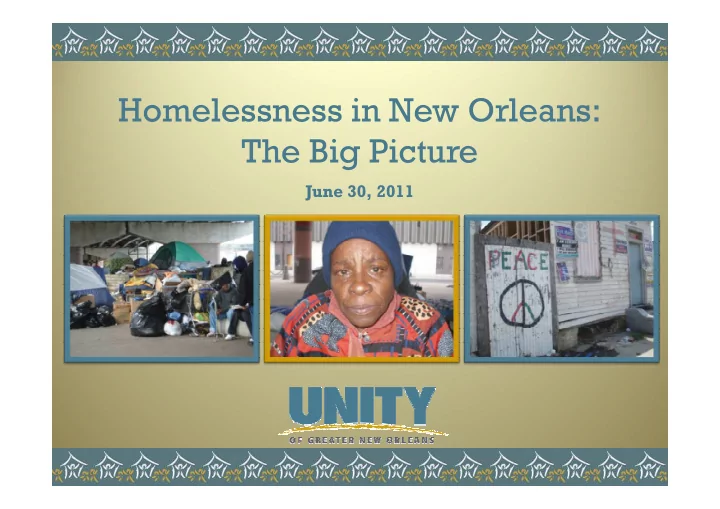
Homelessness in New Orleans: The Big Picture June 30, 2011 UNITY - - PowerPoint PPT Presentation
Homelessness in New Orleans: The Big Picture June 30, 2011 UNITY of Greater New Orleans A Collaborative of 63 Agencies Providing Housing and Services to the Homeless Founded in 1992 with assistance from the City, UNITY of Greater New
June 30, 2011
Founded in 1992 with assistance from the City, UNITY of Greater New Orleans is a nonprofit organization designated by HUD as the lead agency for the homeless Continuum of Care (CoC) for New Orleans and Jefferson Parish and working in partnership with the City to implement a strategy to reduce and end homelessness. The UNITY Collaborative was selected from 9,000
nationwide to receive the 2010 Nonprofit Achievement Award by the National Alliance to End Homelessness, the leader in this field.
A Collaborative of 63 Agencies Providing Housing and Services to the Homeless
UNITY does strategic planning and coordination, ensures high performance of the CoC, and applies for and administers CoC funds for its member organizations to provide housing and services for the homeless. UNITY also performs training, monitoring, and evaluation of its agencies’ programs. The Collaborative also runs a Homeless Management Information System (HMIS) and the UNITYhousinglingk.org housing search database; advocates for sound public policies; develops affordable housing and Permanent Supportive Housing (PSH); mobilizes an outreach team; and maintains a system-wide PSH Registry, currently listing 1,077 disabled homeless people awaiting housing placement, who are ranked in order of their likelihood to die if not housed.
A Collaborative of 63 Agencies Providing Housing and Services to the Homeless
Harry Tompson Center Healthcare for the Homeless Home Again Hope House House of Esther Ministry House of Ruth Jefferson Parish Community Development Jefferson Parish Human Services Authority Last Hope Liberty House Lindy’s Place Living Witness Lovetouch Ministries Loyola Law Clinic McCaleb Educational Fund Metropolitan Battered Women’s Program Metropolitan Human Services District National Alliance for the Mentally Ill Ninth Ward Neighborhood Empowerment Network Association New Hope Church AIDSLaw of Louisiana Alternatives Living Armstrong Family Services Baptist Friendship House Belle Reve Bridge House Catholic Charities Archdiocese
City of New Orleans Office of Community Development Collaborative Solutions Community Service Center Covenant House Daughters of Charity Desire Community Housing Excelth Episcopal Community Services Family Services of Greater New Orleans First Evangelist CDC First Pilgrim Baptist Church Gateway Recovery Systems Goodwill Industries, SELA Gulf Coast Teaching Family Services New Orleans Council on Aging New Orleans Mission New Orleans Public Schools – Homeless Education New Orleans Women’s Shelter NO/AIDS Taskforce Odyssey House Ozanam Inn Pillow House for Humanity Pro-Bono Project Project Lazarus Resources for Human Development Responsibility House Salvation Army Southeast Louisiana Legal Services Seven Wonders of God, Inc Shared Housing of New Orleans
Total Community Action Traveler’s Aid Tulane Drop In Center Via Link Volunteers of America
Supportive Services Permanent Supportive Housing Transitional Housing Emergency Shelters Homeless Prevention/ Rapid Rehousing Safe Haven for Women Outreach Crisis Line/Information Referral Case Management Employment Assistance Medical Care Mental Health Services Day Program Substance Abuse Treatment HIV/AIDS Services Domestic Violence Services Legal Services Youth Drop-In Center Day Care for Children Transportation Housing Search
Supportive Services:
as recorded by the Homeless Management Information System (HMIS)
Number of persons served by homeless programs Subpopulations: 3,118 Homeless children 950 Unaccompanied youth 4,285 Young adults (18 – 24 years old) 1,263 People over age 60 7,555 People in families 14,030 Unaccompanied individuals 5,474 Persons living in abandoned buildings, on the streets and in cars 6,749 Disabled adults 4,064 Chronically homeless persons
* These numbers exceed 21,585 because many clients meet multiple subpopulation criteria
years after Katrina.
(including people facing imminent eviction or discharge from institutions) in Orleans and Jefferson Parish on any given night. An additional 1,603 persons residing in Permanent Supportive Housing.
not meant for human habitation, emergency shelters and transitional housing.
5,360 11,294 10,360 9,165 940 706 1,140 1,603 Jan 2005 Jan 2007 Jan 2009 Feb 2011 Homeless Persons living in PSH for Homeless
697 335 643 575 763 655 697 738 591 10,629 7,385 5,374 2,051 11,619 8,725 6,687 Jan 2005 Jan 2007 Jan 2009 Feb 2011 Emergency Shelter Transitional Housing Unsheltered Total
1. Devastation of Rental Stock 2. Escalating Rents 3. Physical and Mental Health Trauma 4. Loss of Healthcare Infrastructure 5. Loss of Extended Family and Neighborhood Supports
By the Numbers
$674
SSI monthly check for a disabled person in Louisiana. There is no state supplement to SSI in Louisiana.
$850
2011 Fair Market Rent (FMR) for 1 bedroom apartment in New Orleans. Pre – Katrina, FMR for a 1 bedroom apartment was $578.
47%
Percentage that rents have increased since Hurricane Katrina.
66%
Percentage of persons who are rent-burdened in New Orleans. Highest percentage in the country.
people housed from two large squalid homeless camps in the heart
national record.
documented who lived in one or both
abandoned building
concentrated in downtown as it was before Katrina – now it is spread across the city, with Central City the largest “hot spot.”
We are the only outreach team in the nation to send its outreach workers, armed
and rescue severely disabled homeless people.
459 375 597 4679 116 363 10 88 Emergency Shelter Transitional Housing Streets Abandoned Buildings Individuals Persons in Families
14% 17% 11% 58% 1x Homeless = 14% 1 - 2x homeless in past = 17% 4x homeless in past 3 years = 11% Continuously homeless >1 yr = 58%
Chronic Homelessness in New Orleans National Rate of Chronic Homelessness
39% 61% % of Persons who are not Chronically Homeless % of Homeless Persons who are Chronically Homeless 65% 35% % of Persons who are not Chronically Homeless % of Homeless Persons who are Chronically Homeless
A Chronically Homeless person is a homeless person with disabilities living in emergency shelters or places not meant for human habitation for more than a year or having 4 or more episodes of such homelessness in the past 3 years.
6% 4% 7% 19% 55% 9% >18 18 - 24 25 - 34 35 - 44 45 - 61 62 +
73% 27%
Male Female
374 369 473 3,671 201 369 134 1,096 Emergency Shelter Transitional Housing Streets Abandoned Buildings Male Female
5254, 79% 1,398 , 21% Disabled Non-Disabled
68% 57% 53% 13% 32% 53% 47% 87% Emergency Shelter Transitional Housing Streets Abandoned Buildings Non-Disabled Disabled
50 45 90 330 515 Emergency Shelter Transitional Housing Streets Abandoned Buildings Total
10 12 4 26 22 35 7 64 449 147 308 15 1,202 2,121 94 18 432 513 1,057 575 165 787 15 1,726 3,268
Emergency Shelter HPRP Transitional Housing Safe Haven for Women Permanent Housing Total
Youth Singles Youth Families Singles Families Total
1,174 15 354 459 5,276 1,206 15 320 459
Permanent Supportive Housing Safe Haven for Women Transitional Housing Emergency Shelter Unsheltered
Bed Utilization for Singles
# of Beds # of People
428 369 116 98 520 467 116
Permanent Supportive Housing Transitional Housing Emergency Shelter Unsheltered
Bed Utilization for Families
# of Beds # of People
4% 14% 11% 71% Emergency Shelter Singles Transitional Housing Families Permanent Supportive Housing forFamilies Permanent Supportive Housing for Singles A total of 372 homeless beds will be added to current housing resources
1,493 451 1,944 HUD Homeless Prevention and Rapid Rehousing Program
Households served by HPRP Resources since December 2009
Homeless Prevention Rapid Rehousing Total
apartments linked to on-site case management services – PSH is proven to end homelessness for people with disabilities living on the street or in emergency shelters. The best practice is to target the most vulnerable with the greatest need for housing. PSH is cost-effective compared to high cost of keeping people homeless with resultant
term rent assistance and short-term case management services end and prevent homelessness for families and individuals who do not have serious disabilities, or serve as a bridge to Permanent Supportive Housing for those who do have disabilities. The City currently implements a national pilot program of Rapid Rehousing for unsheltered youth.
management services designed to produce permanent housing outcomes.
with semi-private accommodations and intensive services designed for unsheltered mentally ill persons with co-
New Orleans has a Safe Haven for Women, but needs several more for men and women.
Permanent Housing.
Continuum of Care Assessment of Unmet Housing Needs, May 2011
311 2,352 100 2,469 70 446 103 Emergency Shelter Rapid Rehousing Transitional Housing Safe Haven Permanent Supportive Housing Beds needed for Individuals Beds needed for Persons in Families
Martha J. Kegel Executive Director mkegel@unitygno.org (504) 821-4496, Ext. 109 www.unitygno.org www.unityhousinglink.org www.facebook.com/unitygno.org
For more information about available resources in the UNITY Homeless CoC, contact 211 anytime or UNITY’s Director of Information & Referral at (504) 821-4496 (Mon-Thurs, 9 – 11 am & Friday, 1-3pm).