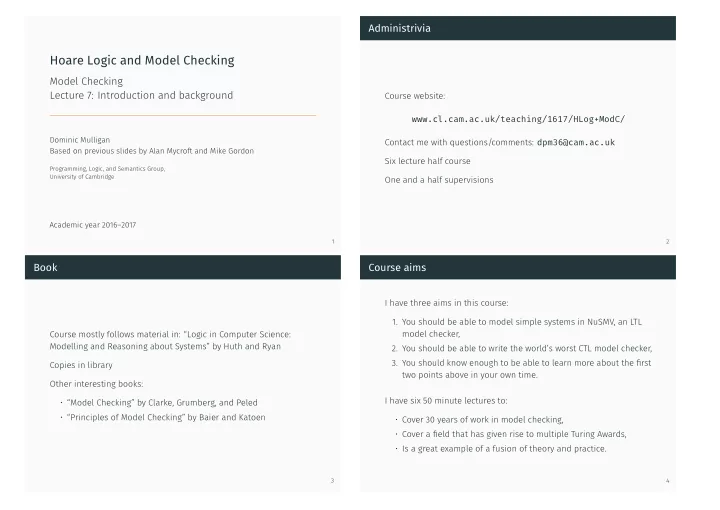
Hoare Logic and Model Checking 1. You should be able to model simple - - PowerPoint PPT Presentation

hoare logic and model checking
SMART_READER_LITE
LIVE PREVIEW

Hoare Logic and Model Checking 1. You should be able to model simple - - PowerPoint PPT Presentation

Hoare Logic and Model Checking 1. You should be able to model simple systems in NuSMV, an LTL Other interesting books: Model Checking by Clarke, Grumberg, and Peled Principles of Model Checking by Baier and Katoen 3 Course


slide-1
SLIDE 1

Hoare Logic and Model Checking

Model Checking Lecture 7: Introduction and background

Dominic Mulligan Based on previous slides by Alan Mycroft and Mike Gordon

Programming, Logic, and Semantics Group, University of Cambridge

Academic year 2016–2017

1

Administrivia

Course website: www.cl.cam.ac.uk/teaching/1617/HLog+ModC/ Contact me with questions/comments: dpm36@cam.ac.uk Six lecture half course One and a half supervisions

2

Book

Course mostly follows material in: “Logic in Computer Science: Modelling and Reasoning about Systems” by Huth and Ryan Copies in library Other interesting books:

  • “Model Checking” by Clarke, Grumberg, and Peled
  • “Principles of Model Checking” by Baier and Katoen

3

Course aims

I have three aims in this course:

  • 1. You should be able to model simple systems in NuSMV, an LTL

model checker,

  • 2. You should be able to write the world’s worst CTL model checker,
  • 3. You should know enough to be able to learn more about the fjrst

two points above in your own time. I have six 50 minute lectures to:

  • Cover 30 years of work in model checking,
  • Cover a fjeld that has given rise to multiple Turing Awards,
  • Is a great example of a fusion of theory and practice.

4

slide-2
SLIDE 2

Model checking: an application

  • f “formal methods”

Systems as mathematical objects

One common approach to building “better” systems is:

  • Treat designs and implementations as mathematical objects
  • Use mathematical methods to reason about objects
  • Use mathematics to describe behaviour of objects

Systems now amenable to mathematical proof Can establish theorems about system behaviour:

  • Testing can show presence of bugs, but not absence
  • Mathematical proof can establish absence of bugs

5

Model checking from distance

We focus on one type of formal method: model checking A model checker takes as input:

  • A formal model of the system to be verifjed,
  • A property of the system to be established.

As output, a model checker gives:

  • Either an assurance that the property holds of the system,
  • or a counterexample execution, or trace.

6

Origins

Model checking originated in 1980s Pioneers were Clarke, Emerson, Queille, and Sifakis Three decades of non-stop development Multiple existing implementations of model checking Dedicated conferences and model checking competitions Clarke, Emerson, and Sifakis won 2007 Turing Award for work

7

slide-3
SLIDE 3

What is model checking good for?

Model checking is well suited to reasoning about:

  • Concurrent and reactive systems,
  • Asynchronous and synchronous circuits and hardware,
  • Programs with complex control fmow,
  • Protocols, etc.

Often have insidious, hard to reproduce bugs Counterexamples help:

  • Refjne designs and implementations,
  • Aid in “intelligent debugging”

8

Model checking advantages (I)

Model checking is largely “push button”:

  • Decidable,
  • Requires little interaction from user,
  • Can be used by engineers with minimal training,
  • Some model checkers can understand Verilog/Java/C fjles.

Other advantages:

  • Can be used early in the design process,
  • Can be used repeatedly through implementation phase,
  • Many industrial success stories.

9

A general tool for reasoning about systems

Can be used for reasoning about systems, widely construed:

  • Railway interlocking mechanisms, traffjc lights, etc.
  • Cancer pathways, metabolic networks,
  • Automated planning as model checking,
  • Clinical guidelines (e.g. stroke treatment and care),
  • Many other applications...

10

Not a panacea

But there’s also disadvantages:

  • State space explosion,
  • Some specifjcation languages are unintuitive,
  • Still not widely used as matter of course,
  • Not well suited to programs with complex data.

11

slide-4
SLIDE 4

Temporal properties

FOL?

Q: what language should we express system properties in? Obvious contender: fjrst-order logic (FOL) Recall semantics of fjrst-order logic from Logic and Proof:

  • Fix a domain,
  • Provide interpretations of function symbols and relations,
  • Extend to a recursively-defjned denotation for formulae, defjned

relative to a valuation. Semantics works well for fjrst-order logic

12

“Static” truth

Truth-value assigned by denotation function never changes Notion of truth is static Works well for mathematics: 2 + 2 = 4 unconditionally Natural numbers do not “evolve” through time

13

A linguistic puzzle

Consider the following utterance: It is raining How should a truth value be assigned? Note that truth of utterance is relative to time and place:

  • It may be raining now in Trondheim but is not in Cambridge,
  • it may be dry now in Cambridge, but may rain tonight,
  • it may never rain in Cambridge again (!?)

14

slide-5
SLIDE 5

Other examples

The lift car only moves after the doors have fully closed After detecting a possible mid-air collision, the aircraft control software will audibly and visually alert the pilots before taking evasive action All uses of free are preceded by an accompanying use

  • f malloc

15

Moral: systems evolve through time

Like the weather, systems evolve through time Time-relative properties are called temporal properties Model checkers establish temporal properties of systems

16

“Dynamic” truth

Need a logic that can handle temporal properties We also need an alternative notion of truth:

  • What is true now need not be true in next state evolution,
  • Assign truth values to claims about evolving systems.

Truth is no longer static, but has a dynamic fmavour Propositions hold in some worlds but not others

17

Temporal logics

Idea: use temporal logic for specifying system behaviour Temporal logic:

  • Developed by philosopher A. N. Prior in 1950s (as “tense logic”)

for reasoning about time,

  • Applied to verifjcation by Pnueli (1996 Turing Award winner),
  • Family of modal logics,
  • Modalities make truth of formulae relative to time.

As modal logics, natural notion of truth is Kripkean Worlds are system states, or timepoints

18

slide-6
SLIDE 6

What is time?

Q: how should we model time? Large design space:

  • Is time continuous, or discrete?
  • Does the future ‘branch’? Does the past?
  • Should we consider time intervals?

Temporal logics exist with all these features (and more!) In this course:

  • We focus on two temporal logics with different conceptions of

time: LTL and CTL

  • Both popular industrially and academically

19

Modelling systems

Vending machine

Consider a simple example: a vending machine Machine can dispense coke, or water Users insert money and make a drink selection The machine dispenses their drink, user removes it How can we model this “system”?

20

Pictorial model of vending machine

21

slide-7
SLIDE 7

Some notes

Model is very abstract We say nothing about e.g. internal electronics of machine Abstractness dependent on properties we wish to establish

22

Some example properties

From the start state, can we get the machine to dispense water? Is there a trace of the machine where both coke and water are dispensed?

23

Lift

Consider an example: a lift in a two-storey building The lift has an up and down button It waits with its doors open for passengers

24

Pictorial model of lift

25

slide-8
SLIDE 8

Some example properties

Can the lift ever move without a button being pressed? Can the lift ever keep passengers inside indefjnitely?

26

Clocked sequential circuit

R = register, with a “memory” and initially holding 0

27

Pictorial model of circuit

28

Example properties

Output bit Y is set infjnitely often

29

slide-9
SLIDE 9

Some notes

We now have two start states: not restraining initial value of X Representation of states now tied to system being modelled States no longer mysterious abstract objects

30

A simple imperative program

00 r := x 01 q := 0 02 while y <= r do: 03 r := r - y 04 q := q + 1 05

31

Abstract representation

States modelled as tuples (representation of “state space”):

  • Concrete state representation = [0..5] × Z × Z × Z × Z
  • State = pc, x, y, r, q

Transitions between states follow semantics of language:

  • 0, x, y, r, q → 1, x, y, x, q
  • 1, x, y, r, q → 2, x, y, r, 0
  • If y ≤ r then 2, x, y, r, q → 3, x, y, r, q
  • If r < y then 2, x, y, r, q → 5, x, y, r, q
  • and so on...

32

Example property

We will always eventually reach a point where pc = 5

33

slide-10
SLIDE 10

Labelled transition systems

Transition Systems (LTS)

Examples abstracted as transition systems (TS):

  • A (fjnite) set of states S, with initial states S0 ⊆ S
  • A transition relation → ⊆ S × S

In this course actions are ignored (use TS rather than LTS) We only care about transitions and states Do not care what caused them! Also satisfy:

  • A set of labels, or atomic propositions, AP
  • A labelling function L : S → P(AP)

34

Example: handling clocked sequential circuits

Clocked sequential circuit with n inputs, m outputs, k registers

  • S = {0, 1}n+k
  • S0 = {(a1, . . . , an, c1, . . . , ck) | ci = 0, aj ∈ {0, 1}}
  • AP = {x1, . . . , xn, y1, . . . , ym, . . . c1, . . . , cm}
  • L = λs. {xi | xi = 1 at s} ∪ {ci | ci = 1 at s} ∪ {yi | yi = 1 at s}
  • → = derived from semantics of circuit diagram

35

Kripke Frames

A transition system is also known as a Kripke Frame Recall from Logic and Proof: Model for modal logic = Kripke Frame + labelling function (+ satisfaction relation) TS and labelling function is model of system Temporal (modal) logics let us reason about models

36

slide-11
SLIDE 11

Summary

  • Serious software and hardware faults can and do happen
  • Formal methods one way to mitigate or prevent them
  • Model checking is one type of formal method
  • Has advantages and disadvantages: not a silver bullet
  • Can model a system using transition systems
  • Can describe properties of systems using temporal logics
  • Model checking: means of establishing temporal properties of

models of systems

37