1 Attacks on randomization - Error repeating the question - - PowerPoint PPT Presentation

1
SMART_READER_LITE
LIVE PREVIEW

1 Attacks on randomization - Error repeating the question - - PowerPoint PPT Presentation

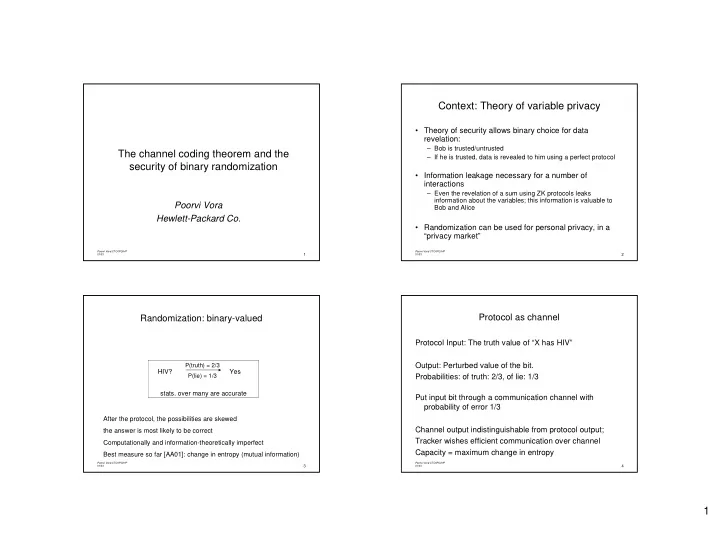
Context: Theory of variable privacy Theory of security allows binary choice for data revelation: Bob is trusted/untrusted The channel coding theorem and the If he is trusted, data is revealed to him using a perfect protocol


slide-1
SLIDE 1

1

Poorvi Vora/CTO/IPG/HP 01/03

1

The channel coding theorem and the security of binary randomization

Poorvi Vora Hewlett-Packard Co.

Poorvi Vora/CTO/IPG/HP 01/03

2

Context: Theory of variable privacy

  • Theory of security allows binary choice for data

revelation:

– Bob is trusted/untrusted – If he is trusted, data is revealed to him using a perfect protocol

  • Information leakage necessary for a number of

interactions

– Even the revelation of a sum using ZK protocols leaks information about the variables; this information is valuable to Bob and Alice

  • Randomization can be used for personal privacy, in a

“privacy market”

Poorvi Vora/CTO/IPG/HP 01/03

3

Randomization: binary-valued

HIV?

P(truth) = 2/3 P(lie) = 1/3

Yes

  • stats. over many are accurate

After the protocol, the possibilities are skewed the answer is most likely to be correct Computationally and information-theoretically imperfect Best measure so far [AA01]: change in entropy (mutual information)

Poorvi Vora/CTO/IPG/HP 01/03

4

Protocol as channel

Protocol Input: The truth value of “X has HIV” Output: Perturbed value of the bit. Probabilities: of truth: 2/3, of lie: 1/3 Put input bit through a communication channel with probability of error 1/3 Channel output indistinguishable from protocol output; Tracker wishes efficient communication over channel Capacity = maximum change in entropy

slide-2
SLIDE 2

2

Poorvi Vora/CTO/IPG/HP 01/03

5

Attacks on randomization - repeating the question

  • An attack: asking the same question many times
  • Can be thwarted by

– never answering the same question twice, or – always answering it the same.

  • Query repetition:

– corresponds to an error-correcting code word a a a a a a a – probability of error is monotonic decreasing with n for n-symbol code words – rate of code = 1/n

Poorvi Vora/CTO/IPG/HP 01/03

6

Error

Known that:

– tracker can reduce estimation error indefinitely – by increasing the number of repeated queries indefinitely;

n

  • ∞ εn
  • – and that this is the best he can do with repeated queries

εn

  • 0 cost per data point = n/1

Poorvi Vora/CTO/IPG/HP 01/03

7

Is the following an attack?

  • Requested Bit 1: “location = North”;
  • Requested Bit 2: “virus X test = positive”;
  • Requested Bit 3: “gender = male” AND “muscular sclerosis =

present” If (location = North) ⊕ (virus X test = positive) ⇔ (gender = male) AND (muscular sclerosis = present) Then: A3 = A1⊕A2; check-sum bit; M = number of possible strings of interest; n = no. of queries rate = (log2M)/n = 2/3 i.e., k/n Deterministically-related query sequence (DRQS)

Poorvi Vora/CTO/IPG/HP 01/03

8

Theorem: Channel codes are DRQS attacks and vice versa

A code is

– a (binary) function from M message words to n code bits – an estimation function from n bits to one of M message words

The only difference between codes and DRQS attacks is that the coding entity in the communication channel knows the bits The tracker does not know the bits, but forces a pattern among them through the queries

slide-3
SLIDE 3

3

Poorvi Vora/CTO/IPG/HP 01/03

9

What kind of information transfer do DRQS attacks provide?

Recall: repetition attack sacrificed rate (1/n) for accuracy Does looking at more than one target bit at a time help the tracker? Can he maintain the rate of a DRQS attack while decreasing estimation error? i.e., Can he maintain k/n while εn

  • Poorvi Vora/CTO/IPG/HP

01/03

10

Shannon (1948) Channel Coding (“second”) Theorem

Existence result; tight upper bound on transmission efficiency

(Really only weak law of large numbers) Codes exist for reliable transmission at all rates below capacity A channel cannot transmit reliably at rates above capacity.

Reliable transmission defined as decreasing error arbitrarily while maintaining rate

Poorvi Vora/CTO/IPG/HP 01/03

11

  • Shannon (1948): Codes exist for reliable transmission at

all rates below capacity

  • Forney (1966): Existence of polynomial-time encodable

and decodable Shannon codes

  • Spielman (1995): Construction of linear-time encodable

and decodable codes approaching Shannon codes Corollary: Construction methods for linear time DRQS attacks with k/n approaching C while εn

  • Existence of reliable DRQS attacks

Poorvi Vora/CTO/IPG/HP 01/03

12

Types of attacks

  • PRQS (Probabilistically-related Query Sequence)

Attacks: Queries are probabilistically-related to required

  • bits. Most general
  • DRQS (Deterministically-related Query Sequence)

Attacks: Queries are deterministically-related to required

  • bits. Among most efficient
  • Reliable attacks: maintain rate while increasing accuracy
slide-4
SLIDE 4

4

Poorvi Vora/CTO/IPG/HP 01/03

13

Theorem: The rate of a reliable PRQS attack is tightly bounded above by protocol capacity

A channel cannot transmit reliably at rates above capacity Corollary: The capacity of a protocol is the (tight) upper bound on the rate of a reliable DRQS attack.

While the protocol is not perfect, there is a cost to exploiting its non-

perfectness Bound also holds for: εn

  • 0 ; adaptive, non-deterministic; also many
  • ther protocols

i.e. εn

  • 0 lim k/n ≤ C

Poorvi Vora/CTO/IPG/HP 01/03

14

Theorem: Lower bound on total queries for arbitrarily small error

If requested bits are all independent, minimum queries when maximum rate: Minimum no. of queries on average = target entropy/maximum rate = target entropy/channel capacity; n ≥ k/C - δ Shown using the source-channel coding theorem which enables entropy to be addressed separately from the query pattern

Poorvi Vora/CTO/IPG/HP 01/03

15

We have shown that

The tracker can do better by

– increasing the number of points combined in a single query – i.e. there exist attacks for which

n

  • ∞ εn
  • εn
  • 0 n/k

There is a tight lower bound on the limit of n/k such that n

  • ∞ εn
  • i.e, (n
  • ∞ εn
  • 0) lim n/k > 1/C Privacy measure

Recall: C is max. value of change in entropy

\

Poorvi Vora/CTO/IPG/HP 01/03

16

Why our approach is so powerful

  • All other information-theoretic approaches stop with the

notion of entropy, and do not approach the notion of a channel

  • All they provide access to is Shannon’s first (source

coding) theorem “entropy is the minimum number of bits required, on average, to represent a random variable”

  • Communication channels provide access to other work
  • n both information theory and coding
  • Clearly just a beginning
slide-5
SLIDE 5

5

Poorvi Vora/CTO/IPG/HP 01/03

17

This work was influenced by conversations with

Umesh Vazirani Gadiel Seroussi Cormac Herley