History and Prospects of Innocence Project Japan (IPJ) Mitsuyuki - - PowerPoint PPT Presentation

history and prospects of innocence project japan ipj
SMART_READER_LITE
LIVE PREVIEW

History and Prospects of Innocence Project Japan (IPJ) Mitsuyuki - - PowerPoint PPT Presentation

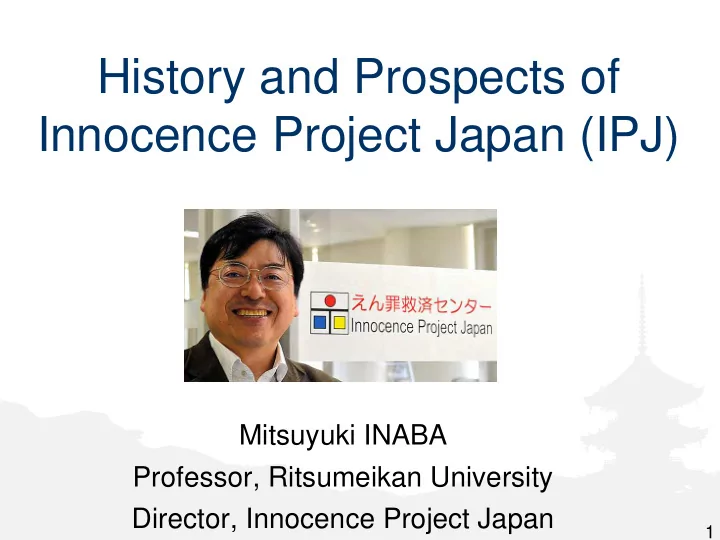
History and Prospects of Innocence Project Japan (IPJ) Mitsuyuki INABA Professor, Ritsumeikan University Director, Innocence Project Japan 1 1. History 2 a computer scientist meets criminal justice. 3 Shibushi case 13 people were

slide-1
SLIDE 1

History and Prospects of Innocence Project Japan (IPJ)

Mitsuyuki INABA Professor, Ritsumeikan University Director, Innocence Project Japan

1

slide-2
SLIDE 2

1. History

2

slide-3
SLIDE 3

a computer scientist meets criminal justice.

3

slide-4
SLIDE 4

Shibushi case

http://www.nytimes.com/2007/05/11/world/asia/11japan.html?mcubz=1

13 people were arrested and charged with election violations. They were detained for months to a year. Six of them confessed. One man died during the trial from the stress, and another tried to kill himself. As a result, they were all acquitted because there was no

  • bjective evidence other than a

confession.

4

slide-5
SLIDE 5

Computer-based Analysis

  • f Interrogation Reports (with signature)

Receive + Money Not + Receive + Money 5 Only reports discussed in the court

slide-6
SLIDE 6

http://www.nichibenren.or.jp/library/ja/publicati

  • n/booklet/data/daiyou_kangoku_leaflet.pdf

Japan

France Australia UK Italy Taiwan detention Arrest & detainment

72 h

24 h 48h 24 h 24 h 1 6 h

Max. 24h

20 days

  • Max. 72h

Re- arrest

Comparison of police detention period in Japan

6

https://cdn-ak.f.st- hatena.com/images/fotolife/k/kazemachi gusa/20171118/20171118232830.jpg

Confession and apology are important!

slide-7
SLIDE 7

Trial

  • 17-year-old girl claimed that she got raped by Mr. I.
  • 1st DNA Test: Crime lab staff couldn’t analyze sperm DNA.
  • Mr. I had consumed so much alcohol that night that he had no

memory of it, but he confessed during interrogation. ⇒ The judge accepted the victim's claim.

  • Mr. I was sentenced to “4 years in prison.”

Appeal trial

Victim’s Deposition Analysis

  • Strange transition of a victim statements
  • Unnaturally hidden victim's SMS history

2nd DNA Test: Outside expert found third person’s DNA ⇒ Mr. I was sentenced “not guilty.“

Kagoshima Rape Case

7

slide-8
SLIDE 8

Need for Scientific Thinking in Criminal Justice

8

Check if science and technology are used appropriately in criminal justice

slide-9
SLIDE 9

2. Innocence Project: pro-science movement for saving innocent people

9

slide-10
SLIDE 10

The Innocence Project

In 1992, Barry Scheck and Peter Neufeld started the Innocence Project.

https://25years.innocenceproject.org/

10

21 of 375 people served time on death row 375 DNA exonerees to date (2020/09/05)

https://www.innocenceproject.org/exonerate/

slide-11
SLIDE 11

The Innocence Project (Mar. 2015)

  • Ms. Angela Amel

(Social Work)

  • Mr. Chris Fabricant

(Strategic Litigation)

  • Ms. Maddy deLone

(Director)

  • Dr. Saul Kassin

(CUNY, False Confession)

  • Dr. Jennifer Dysart

(CUNY, Eyewitness)

  • Dr. Jeffrey Fagan

(Policing)

The Innocence Project External Experts

11

slide-12
SLIDE 12

California Innocence Project (Mar. 2015)

  • Prof. Justin Brooks
  • Based on California Western School of Law (San Diego).
  • Prof. Justin Brooks, other faculties, and law school

students are involved in the project.

  • They handle cases that prove false charges other than

DNA evidence

12

slide-13
SLIDE 13

3. Launch of Innocence Project Japan (IPJ)

13

slide-14
SLIDE 14

Ritsumeikan Univ.

Framework of Innocence Project Japan (IPJ)

DNA Division Forensic Sci. Division Deposition Analysis Division

DNA test Experts Various Scientists

Innocence Project Japan

Deposition Analysis Experts

Attorney at Law Law Psychology Forensic Science

Steering committee

Collaboration

Computer Science

  • Cog. Sci.

Western Japan Attorneys Group

Legal Review Division

Eastern Japan Attorneys Group 14

slide-15
SLIDE 15

Activities of IPJ

15

Discuss

  • “The Frontier of the Innocence Movement in

the United States”

  • “The Future of the Innocence Movement”
  • “Biased Scientific Evidence”
  • “Bias and Tunnel Vision”
  • “Transparency in Interrogation”

Exonerate

  • Received requests: 367
  • Exonerated (Mar. 2020): 2

Network

  • Close interaction with the

Taiwan Innocence Project

  • MOU with Int’l Innocence

Thailand

  • Information Exchange with

IPs in US

Educate

  • IPJ Student Projects
  • Study meeting
  • Lectures
  • Event supports

2015.7 Preparatory Office 2016.4 Launch of IPJ

https://ch.konan- u.ac.jp/information/informati

  • n/category-12/541.html

https://www.keiben-oasis.com/wp- content/uploads/2019/06/5ninyokonarabi.jpg

slide-16
SLIDE 16

4. Results of Activities

16

slide-17
SLIDE 17

Case 1:SBS/AHT case

On January 28, 2020, the man was found not guilty in a case involving Shaken Baby Syndrome (SBS), or Abusive Head Trauma (AHT). IPJ members joined the defense team from the first trial. The defense team has argued that the SBS hypothesis has been considered as scientifically unreliable in the UK, US and other countries.

17

slide-18
SLIDE 18

Case 2: Koto Memorial Hospital Case

  • In 2003, a patient was found dead

while in a hospital. A nursing aide confessed to the murder.

  • At the trial, she said she confessed

because of her romantic feelings for the interrogator.

  • She was sentenced to 12 years in

prison (and served 12 years).

  • Later, defense lawyers found a

medical report that was hidden by the police for 15 years. It suggested that the patient’s death was an accident.

  • She was exonerated in March 2020.

18

https://public.potaufeu.asahi.com/b1e2- p/picture/20790644/872a0c6bbf8ff6232 e00061eaaa827ac.jpg

https://mainichi.jp/english/articles/20190320/ p2a/00m/0na/010000c

slide-19
SLIDE 19

5. Challenges and Prospects

19

slide-20
SLIDE 20

Challenges of Innocence Efforts in Japan

Disregard for evidence and data

20

Culture that emphasizes confession and apology

  • However, before confessions and apologies,

the evidence and data must be properly examined scientifically to find the truth.

  • Otherwise, Japan’s criminal justice will

continue to make mistakes.

slide-21
SLIDE 21

Prospects of IPJ

  • Promoting the importance
  • f the proper use of

evidence and data.

  • Ensuring that Japanese

criminal justice does not repeat the same mistakes.

21

slide-22
SLIDE 22

http://www.ipjapan.org/

Thank you for your attention!

22