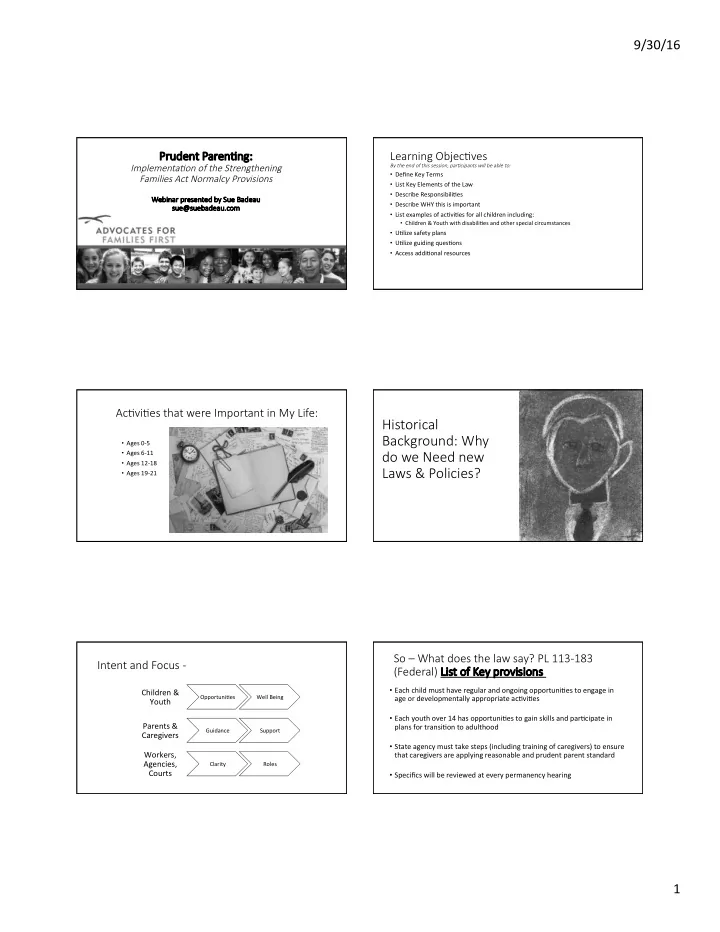
Historical Background: Why Ages 0-5 Ages 6-11 do we Need new - - PDF document

historical background why
SMART_READER_LITE
LIVE PREVIEW

Historical Background: Why Ages 0-5 Ages 6-11 do we Need new - - PDF document

9/30/16 Pruden Prudent P t Par aren*ng: en*ng: Learning Objec*ves By the end of this session, par)cipants will be able to: Implementa)on of the Strengthening Define Key Terms Families Act Normalcy Provisions List Key Elements of the


slide-1
SLIDE 1

9/30/16 1

Pruden Prudent P t Par aren*ng: en*ng:

Implementa)on of the Strengthening Families Act Normalcy Provisions

We Webinar presented by Sue Badeau sue@suebadeau.c sue@suebadeau.com

Webinar for Advocates for Families First October 2016

Learning Objec*ves

By the end of this session, par)cipants will be able to:

  • Define Key Terms
  • List Key Elements of the Law
  • Describe ResponsibiliGes
  • Describe WHY this is important
  • List examples of acGviGes for all children including:
  • Children & Youth with disabiliGes and other special circumstances
  • UGlize safety plans
  • UGlize guiding quesGons
  • Access addiGonal resources

Ac*vi*es that were Important in My Life:

  • Ages 0-5
  • Ages 6-11
  • Ages 12-18
  • Ages 19-21

Historical Background: Why do we Need new Laws & Policies?

Intent and Focus -

Children & Youth

OpportuniGes Well Being

Parents & Caregivers

Guidance Support

Workers, Agencies, Courts

Clarity Roles

So – What does the law say? PL 113-183 (Federal) Lis List o t of K f Key pr y provisio visions ns

  • Each child must have regular and ongoing opportuniGes to engage in

age or developmentally appropriate acGviGes

  • Each youth over 14 has opportuniGes to gain skills and parGcipate in

plans for transiGon to adulthood

  • State agency must take steps (including training of caregivers) to ensure

that caregivers are applying reasonable and prudent parent standard

  • Specifics will be reviewed at every permanency hearing
slide-2
SLIDE 2

9/30/16 2

Ke Key Defini*o Defini*ons ns

Normalcy Reasonable & Prudent Parent Standard Age or Developmentally Appropriate AcGviGes A few others . . .

Examples of Age or Developmentally Appropriate Ac*vi*es

  • Family Life
  • Peers and Friends
  • School
  • Community
  • Becoming Independent

“No-No’ “No-No’s” ” Who Who do does this la es this law apply t w apply to? What Do I Need to Know? Normalcy for Youth in Special Circumstances ~

Pr Providing Sa viding Safety ty, Inc , Inclusio lusion and O n and Oppo pportunity f rtunity for

  • Pregnant and ParenGng Teens
  • Young people who idenGfy as

LGBTQ or other non-conforming expressions of gender and sexuality

  • Youth with history of jusGce-system

contact or involvement

  • Other circumstances?
slide-3
SLIDE 3

9/30/16 3

What is Child Trauma?

How Does Trauma Affect The Child’s Ability to Safely Engage in Ac*vi*es

  • Most of the Gme, the child will

behave and respond like a typically developing child

  • A trauma trigger can change that
  • The child can explode
  • Or withdraw, shut-down
  • Or simply take longer to sefle

down and be ready to parGcipate

  • What examples have you seen?

TRAUMA TRIGGERS & SAFETY PLANNING

Pu`ng the Knowledge All Together: Observing and Knowing the Child in my Care

Ethical Decision Making Model

Decision Making Model Understand The “Ask”

slide-4
SLIDE 4

9/30/16 4

Gather InformaHon

Brainstorm m - Factors to Consider

  • Child's age, maturity and developmental level
  • Appropriateness of the extracurricular, enrichment, cultural or social

acGvity or experience.

  • Child's wishes.
  • Encouraging the child's emoGonal and developmental growth.
  • SupporGng the youth in developing skills to successfully transiGon to

adulthood.

  • Providing the child with the most family-like living experience possible.
  • Any special needs accommodaGons, or trauma-safety plans that the child

may need to safely and fully parGcipate in the acGvity or experience.

  • PotenGal risk factors to the child or to others
  • Best interest of the child, based on informaGon known by the caregiver.

EVALUATE OPTIONS Decide & Act REFLECT

Does Saying “Yes” Guarantee a Good Outcome?

slide-5
SLIDE 5

9/30/16 5

Avoiding the “L” word (*liability ) Wrapping Up

  • Q & A
  • EvaluaHons

26