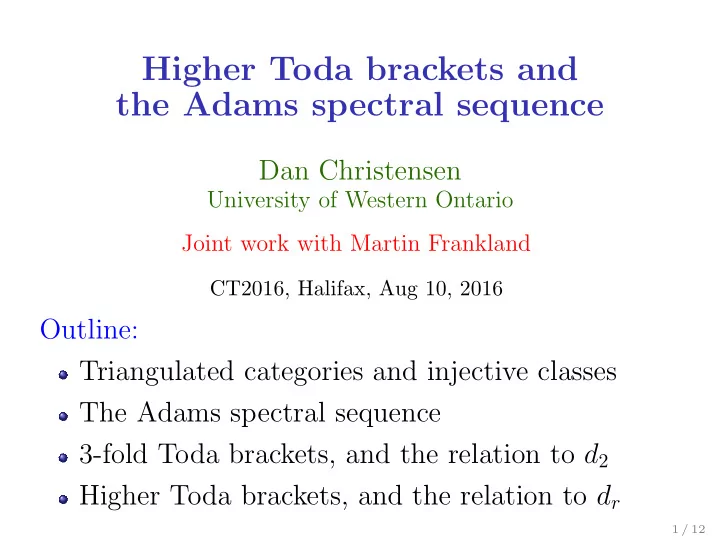
Higher Toda brackets and the Adams spectral sequence Dan - - PowerPoint PPT Presentation

higher toda brackets and the adams spectral sequence
SMART_READER_LITE
LIVE PREVIEW

Higher Toda brackets and the Adams spectral sequence Dan - - PowerPoint PPT Presentation

Higher Toda brackets and the Adams spectral sequence Dan Christensen University of Western Ontario Joint work with Martin Frankland CT2016, Halifax, Aug 10, 2016 Outline: Triangulated categories and injective classes The Adams spectral


slide-1
SLIDE 1

Higher Toda brackets and the Adams spectral sequence

Dan Christensen

University of Western Ontario Joint work with Martin Frankland

CT2016, Halifax, Aug 10, 2016

Outline: Triangulated categories and injective classes The Adams spectral sequence 3-fold Toda brackets, and the relation to d2 Higher Toda brackets, and the relation to dr

1 / 12

slide-2
SLIDE 2

Triangulated categories

A triangulated category is an additive category T equipped with an equivalence Σ : T → T , and with a specified collection of triangles

  • f the form

X

f

− → Y

g

− → Z

h

− → ΣX. (1) These must satisfy the following axioms motivated by (co)fibre sequences in topology. TR0: The triangles are closed under isomorphism. The following is a triangle: X

1

− → X − → 0 − → ΣX. TR1: Every map X → Y is part of a triangle (1). TR2: (1) is a triangle iff (2) is a triangle: Y

g

− → Z

h

− → ΣX

−Σf

− → ΣY. (2)

2 / 12

slide-3
SLIDE 3

Triangulated categories, II

T additive, Σ : T → T an equivalence. TR0: Triangles are closed under isomorphism and contain the trivial triangle. TR1: Every map appears in a triangle. TR2: Triangles can be rotated. TR3: Given a solid diagram X

  • u
  • Y
  • Z
  • ΣX

Σu

  • X′

Y ′ Z′ ΣX′

in which the rows are triangles, the dotted fill-in exists making the two squares commute. TR4: The octahedral axiom holds.

3 / 12

slide-4
SLIDE 4

Examples and consequences

  • Example. The homotopy category of spectra.
  • Example. The derived category of a ring.
  • Example. The stable module category of a group algebra.
  • Example. The homotopy category of any stable Quillen model

category. Consequences: (1) For any object A, the sequences · · · − → T (A, X) − → T (A, Y ) − → T (A, Z) − → T (A, ΣX) − → · · · and · · · ← − T (X, A) ← − T (Y, A) ← − T (Z, A) ← − T (ΣX, A) ← − · · · are exact sequences of abelian groups. (2) The triangle containing a map X → Y is unique up to (non-unique) isomorphism.

4 / 12

slide-5
SLIDE 5

Injective classes

Eilenberg and Moore (1965) gave a framework for homological algebra in any pointed category. When the category is triangulated, their axioms are equivalent to the following:

  • Definition. An injective class in T is a pair (I, N), where

I ⊆ ob T and N ⊆ mor T , such that: (i) I consists of exactly the objects I such that every composite X → Y → I is zero for each X → Y in N, (ii) N consists of exactly the maps X → Y such that every composite X → Y → I is zero for each I in I, (iii) for each Y in T , there is a triangle X → Y → I with I in I and X → Y in N. The first two conditions are easy to satisfy. The third says that there are enough injectives.

5 / 12

slide-6
SLIDE 6

Examples of injective classes

  • Example. Let E be an object in any triangulated category T with

infinite products. Take I to be all retracts of products of suspensions of E and N to consist of all maps X → Y such that every composite X → Y → I is zero, for I in I. Then (I, N) is an injective class. If we write Ek(−) for the cohomological representable functor T (−, ΣkE), then N consists of the maps inducing the zero map under E∗(−).

  • Example. In the category of spectra, if we take E = HFp, this

injective class leads to the classical Adams spectral sequence. We always assume that our injective classes are stable, that is, that they are closed under suspension and desuspension.

6 / 12

slide-7
SLIDE 7

Adams resolutions

  • Definition. An Adams resolution of an object Y in T with respect

to an injective class (I, N) is a diagram Y = Y0

p0

  • Y1

p1

  • i0
  • Y2

p2

  • i1
  • Y3

i2

  • · · ·
  • I0

δ0

  • I1

δ1

  • I2

δ2

  • · · ·

where each Is is injective, each map is is in N, and the triangles are triangles. Axiom (iii) says exactly that you can form such a resolution. Adams resolutions biject with injective resolutions with respect to the injective class.

7 / 12

slide-8
SLIDE 8

The Adams spectral sequence

Miller, 1974; C, 1997

Given objects X and Y and an Adams resolution Y = Y0

p0

  • Y1

p1

  • i0
  • Y2

p2

  • i1
  • Y3

i2

  • · · ·
  • I0

δ0

  • d1

I1

δ1

  • d1

I2

δ2

  • · · ·
  • f Y , applying T (X, −) leads to an exact couple and therefore a

spectral sequence; it is called the Adams spectral sequence. The E1 term is Es,t

1

= T (Σt−sX, Is), and the first differential d1 is given by composition with d1 := pδ : Is − →

  • Ys+1 −

→ Is+1. The E2 term is Exts

I(ΣtX, Y ), essentially by definition.

We regard d1 as a primary operation.

8 / 12

slide-9
SLIDE 9

Adams d2 differential

Recall that E2 is the homology of T (X, Is) w.r.t. d1. Given a class [x] in the E2 term of an Adams spectral sequence, d2[x] is defined in the following way: · · · Ys

  • ps
  • Ys+1

ps+1

  • is
  • Ys+2

ps+2

  • is+1
  • · · ·
  • Is

δs

  • d1

Is+1

δs+1

  • d1

Is+2

X

x

  • x
  • d2[x]
  • d2[x] is a subset of T (X, Is+2). We’ll describe this subset using

“higher operations”.

9 / 12

slide-10
SLIDE 10

3-fold Toda brackets

Toda, 1962

Let X0

f1

− → X1

f2

− → X2

f3

− → X3 be a diagram in T . The Toda bracket f3, f2, f1 ⊆ T (ΣX0, X3) consists of all composites β ◦ Σα: ΣX0 → X3, where α and β appear in a commutative diagram X0

α

  • f1

X1

Σ−1Cf2

X1

f2

X2 Cf2

β

  • X2

f3

X3,

where the middle row is a triangle. The indeterminacy can be explicitly described, and there are other equivalent definitions.

10 / 12

slide-11
SLIDE 11

Adams d2 in terms of Toda brackets

Proposition (C-Frankland). d2[x] = d1, ps+1, δsx =

β

d1, d1, x. The first equality is an elementary exercise, using the properties of injective classes. The second requires some explanation. Recall that f3, f2, f1 was defined to consist of certain composites ΣX0

Σα

− → Cf2

β

− → X3. The notation

β

f3, f2, f1 denotes the subset of the Toda bracket with β held fixed and only α allowed to vary. The choice of β is determined from the Adams resolution and the

  • ctahedral axiom.

11 / 12

slide-12
SLIDE 12

Adams dr in terms of Toda brackets

Following Cohen, Shipley and McKeown, we define r-fold Toda brackets in any triangulated category, and prove basic properties about them. Our main result is: Theorem (C-Frankland). dr can be expressed in terms of (r + 1)-fold Toda brackets as: dr[x] = d1, d1, . . . , d1, ps+1, δsx = d1, d1, . . . , d1, xfixed The first equality is straightforward, using our results. In the second equality, “fixed” means that you choose a particular “filtered object” derived from the Adams resolution, which fixes all

  • f the choices except the very last α.

Details are in arxiv:1510.09216, and these slides are on my website. Thanks for listening!

12 / 12

slide-13
SLIDE 13

Overflow slides

The remaining slides are just in case I have extra time.

slide-14
SLIDE 14

Higher Toda brackets

McKeown, nLab, 2012

  • Definition. Given X0

f1

− → X1

f2

− → X2

f3

− → X3, define the Toda family T(f3, f2, f1) to consist of all pairs (β, Σα), where α and β appear in a commutative diagram ΣX0

Σα −Σf1

ΣX1

X1

f2

X2 Cf2

β

  • ΣX1

X2

f3

X3,

with middle row a triangle. Given X0

f1

− → X1

f2

− → X2

f3

− → · · ·

fn

− → Xn, define the Toda bracket fn, . . . , f1 ⊆ T (Σn−2X0, Xn) inductively as follows: If n = 2, it is the set consisting of just the composite f2f1. If n > 2, it is the union of the sets β, Σα, Σfn−3, . . . , Σf1, where (β, Σα) is in T(fn, fn−1, fn−2).

slide-15
SLIDE 15

4-fold Toda bracket

  • Example. We have

f4, f3, f2, f1 =

β,α β, Σα, Σf1 = β,α

  • β′,α′{β′ ◦ Σα′}.

Σ2X0

Σα′ CΣα

  • β′
  • Σ2X1

row = −Σ2f1 ΣX1

Σα

Cf3

  • β
  • ΣX2

row = −Σf2 X2

f3

X3

  • f4

X4

  • The middle column is what is called a filtered object by Cohen,

Shipley and Sagave, and so this reproduces their definition.

slide-16
SLIDE 16

Self-duality for higher Toda brackets

The definition is asymmetrical. What happens in the opposite category? More generally, we can reduce an n-fold Toda bracket to a 2-fold Toda bracket in (n − 2)! ways, inserting the Toda family operation in any position. Lemma (C-Frankland). The pair (β, Σα) is in T(T(f4, f3, f2), Σf1) iff the pair (−β, Σα) is in T(f4, T(f3, f2, f1)). This is stronger than saying that the two ways of computing the Toda bracket f4, f3, f2, f1 are negatives, and the stronger statement will be important for us. The proof is a careful application of the octahedral axiom.

slide-17
SLIDE 17

Self-duality, II

For j1, j2, . . . , jn−2 with 0 ≤ ji < i, write Tj1(Tj2(Tj3(· · · Tjn−2(fn, . . . , f1) · · · ))) for the subset obtained by applying T in the spot with jn−2 maps to the left, then applying T in the spot with jn−1 maps to the left, etc. Our original definition corresponds to T0(T0(· · · T0(fn, . . . , f1) · · · )). Theorem (C-Frankland). If you compute the Toda bracket using the sequence j1, j2, . . . , jn−2, it equals the original Toda bracket up to the sign (−1)

ji.

  • Proof. One can give an inductive argument showing that the

Lemma lets you convert any such sequence into any other, using the “move” j, j ← → j, j + 1. Animation: http://turl.ca/todaanim The move changes the sign and the parity of the sum.

  • Corollary. The higher Toda brackets are self-dual up to sign.
slide-18
SLIDE 18

An example in the stable module category

Let R = kC4 = k[x]/x4 with char k = 2. Let M = R/x2. In StMod(R), ΩM = M. With respect to the projective class generated by k, M

µx

M

δ

  • µx

M

δ

  • µx

M

δ

  • · · ·

k ⊕ Ωk

p

  • k ⊕ Ωk

p

  • k ⊕ Ωk,

p

  • is an Adams resolution of M, for certain p and δ.

Given any non-zero map κ : k ⊕ Ωk → M, one can show that d2[κ] has no indeterminacy, while κ, d1, d1 has non-trivial indeterminacy, so the containment d2[κ] = κ,

β

d1, d1 ⊆ κ, d1, d1 is proper.

slide-19
SLIDE 19

3-fold Toda brackets determine the triangulation

I’d like to end by advertising this nice result due to Heller (1968) with a cleaner formulation and proof due to Muro (2006 slides, 2015 e-mail):

  • Theorem. The diagram X

f

− → Y

g

− → Z

h

− → ΣX is a triangle iff (i) the sequence of abelian groups T (A, Σ−1Z)

(Σ−1h)∗

− − − − − → T (A, X)

f∗

− → T (A, Y )

g∗

− → T (A, Z) h∗ − → T (A, ΣX) is exact for every object A of T , and (ii) the Toda bracket h, g, f ⊆ T (ΣX, ΣX) contains the identity map 1ΣX. The proof is essentially the Yoneda Lemma and the Five Lemma.

slide-20
SLIDE 20

3-fold Toda brackets determine the higher ones

  • Corollary. Given the suspension functor Σ: T → T , 3-fold Toda

brackets in T determine the triangulated structure. In particular, 3-fold Toda brackets determine the higher Toda brackets, via the triangulation.

  • Remark. It is unclear to us if the higher Toda brackets can be

expressed directly in terms of 3-fold brackets.

Thanks for listening!

These slides are available on my website.