High Stable Silver Nanoparticles for SERS Applications from Dual - - PowerPoint PPT Presentation

high stable silver nanoparticles for sers applications
SMART_READER_LITE
LIVE PREVIEW

High Stable Silver Nanoparticles for SERS Applications from Dual - - PowerPoint PPT Presentation

High Stable Silver Nanoparticles for SERS Applications from Dual Magnetron Ion-Stimulates Deposition Novikov S. M. 1,a) , Streletskiy O. A. 2 , Doroshina N.V. 1 , Sychev V. V. 3 , Tatarkin D. E. 1 , Mironov M. S. 1 , Voronov A. A. 1 , Arsenin A. V.


slide-1
SLIDE 1

High Stable Silver Nanoparticles for SERS Applications from Dual Magnetron Ion-Stimulates Deposition

References [1] N.A.Brazhe, A. B.Evlyukhin, E.A.Goodilin, A.A.Semenova, S. M.Novikov, S. I.Bozhevolnyi, B. N.Chichkov, et al. Sci. Rep. 5,13793 (2015). [2] M. Scuderi, M. Esposito, F. Todisco et. al. J. Phys. Chem. C120, 24314 (2016). [3] L. Ziqi and C. Feng, Appl. Phys. Rev. 4, 011103 (2017).

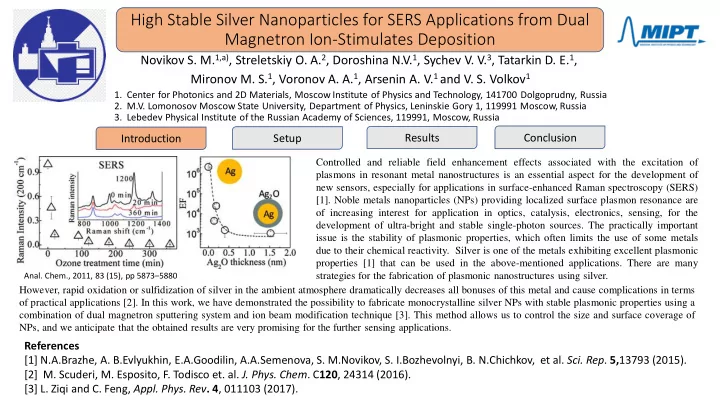
Controlled and reliable field enhancement effects associated with the excitation of plasmons in resonant metal nanostructures is an essential aspect for the development of new sensors, especially for applications in surface-enhanced Raman spectroscopy (SERS) [1]. Noble metals nanoparticles (NPs) providing localized surface plasmon resonance are

  • f increasing interest for application in optics, catalysis, electronics, sensing, for the

development of ultra-bright and stable single-photon sources. The practically important issue is the stability of plasmonic properties, which often limits the use of some metals due to their chemical reactivity. Silver is one of the metals exhibiting excellent plasmonic properties [1] that can be used in the above-mentioned applications. There are many strategies for the fabrication of plasmonic nanostructures using silver.

Novikov S. M.1,a), Streletskiy O. A.2, Doroshina N.V.1, Sychev V. V.3, Tatarkin D. E.1, Mironov M. S.1, Voronov A. A.1, Arsenin A. V.1 and V. S. Volkov1

  • 1. Center for Photonics and 2D Materials, Moscow Institute of Physics and Technology, 141700 Dolgoprudny, Russia
  • 2. M.V. Lomonosov Moscow State University, Department of Physics, Leninskie Gory 1, 119991 Moscow, Russia
  • 3. Lebedev Physical Institute of the Russian Academy of Sciences, 119991, Moscow, Russia

Introduction Setup Results Conclusion

  • Anal. Chem., 2011, 83 (15), pp 5873–5880

However, rapid oxidation or sulfidization of silver in the ambient atmosphere dramatically decreases all bonuses of this metal and cause complications in terms

  • f practical applications [2]. In this work, we have demonstrated the possibility to fabricate monocrystalline silver NPs with stable plasmonic properties using a

combination of dual magnetron sputtering system and ion beam modification technique [3]. This method allows us to control the size and surface coverage of NPs, and we anticipate that the obtained results are very promising for the further sensing applications.

slide-2
SLIDE 2

Experimental realization of the combination of dual magnetron sputtering system and ion beam modification technique

High Stable Silver Nanoparticles for SERS Applications from Dual Magnetron Ion-Stimulates Deposition

Novikov S. M.1,a), Streletskiy O. A.2, Doroshina N.V.1, Sychev V. V.3, Tatarkin D. E.1, Mironov M. S.1, Voronov

  • A. A.1, Arsenin A. V.1 and V. S. Volkov1

The schematic illustration of fabrication sample with Ag NPs

Formation of NPs

a) Schematic illustration of setup for the fabrication of sample with AgNs; SEM images: b) Ag film with a thickness of ~20 nm deposited by RF magnetron. c) After the deposition, the argon-ion irradiation of 150 eV energy and 20 mA current is applied to the deposited films to form the NPs. Results Conclusion Setup Introduction

Ag film Ag film after argon-ion irradiation

slide-3
SLIDE 3

Introduction Setup Results Conclusion

SERS characterizations Absorption spectra and XPS measurements

High Stable Silver Nanoparticles for SERS Applications from Dual Magnetron Ion-Stimulates Deposition

Evolution of the relative absorption of a sample with Ag NPs as a function of time. Insert: XPS spectra obtained from the sample at the day of formation NPs and after 14 days. Typical SERS image obtained for the ensembles of NPs and SERS spectra of Crystal Violet with concentration 10-6 M adsorbed on ensembles of silver NPs and obtained after 0, 14 and 39 days after the formation NPs on the glass substrate. Novikov S. M.1,a), Streletskiy O. A.2, Doroshina N.V.1, Sychev V. V.3, Tatarkin D. E.1, Mironov M. S.1, Voronov

  • A. A.1, Arsenin A. V.1 and V. S. Volkov1
slide-4
SLIDE 4

Novikov S. M.1,a), Streletskiy O. A.2, Doroshina N.V.1, Sychev V. V.3, Tatarkin D. E.1, Mironov M. S.1, Voronov A. A.1, Arsenin A. V.1 and V. S. Volkov1 Introduction Setup Results Conclusion

  • 1. We demonstrate the possibility of fabrication silver NPs with the great stability of plasmonic properties by an ion

beam modification

  • 2. The optical spectroscopy demonstrated that the fabricated ensembles of silver NPs keep stable their plasmonic

properties in an ambient atmosphere at least 39 days due to their monocrystalline nature.

  • 3. The SERS characterization demonstrated that the manufactured ensembles have a strong amplification factor and

this factor is preserved for these ensembles even after more than one month of storage in the surrounding atmosphere.

  • 4. Hereby, by ion beam modification of silver film, it is possible to fabricate the NPs with stable plasmonic properties

and form nanostructured surfaces to be applied in sensor technologies and SERS. Corresponding author: novikov.s@mipt.ru

High Stable Silver Nanoparticles for SERS Applications from Dual Magnetron Ion-Stimulates Deposition

  • 1. Center for Photonics and 2D Materials, Moscow Institute of Physics and Technology, 141700 Dolgoprudny, Russia
  • 2. M.V. Lomonosov Moscow State University, Department of Physics, Leninskie Gory 1, 119991 Moscow, Russia
  • 3. Lebedev Physical Institute of the Russian Academy of Sciences, 119991, Moscow, Russia