Higgs Boson Decays to Light Scalars at ATLAS University of - - PowerPoint PPT Presentation

higgs boson decays to light scalars at atlas
SMART_READER_LITE
LIVE PREVIEW

Higgs Boson Decays to Light Scalars at ATLAS University of - - PowerPoint PPT Presentation

Higgs Boson Decays to Light Scalars at ATLAS University of Birmingham, 22 nd April 2020 Elliot Reynolds Jet a h 125 + Z This project has received funding from the European Research Council (ERC) under the European Unions Horizon


slide-1
SLIDE 1

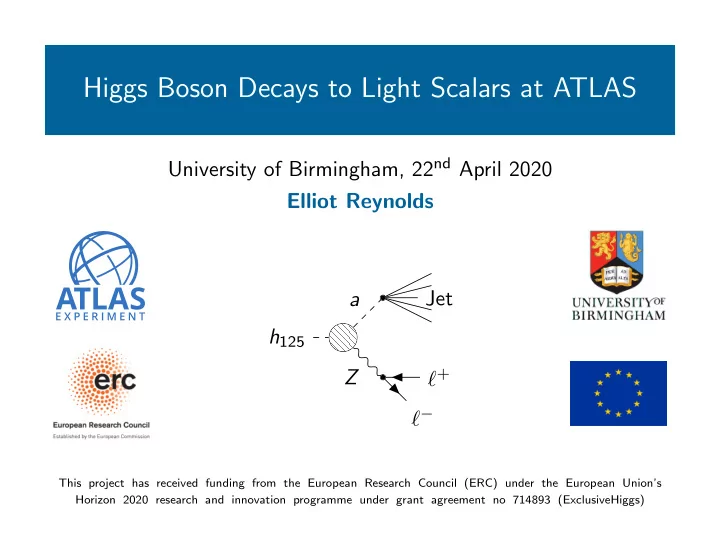
h125 Jet ℓ+ ℓ− a Z

Higgs Boson Decays to Light Scalars at ATLAS

University of Birmingham, 22nd April 2020 Elliot Reynolds

This project has received funding from the European Research Council (ERC) under the European Union’s Horizon 2020 research and innovation programme under grant agreement no 714893 (ExclusiveHiggs)

slide-2
SLIDE 2

Ways to Extend the Higgs Sector

slide-3
SLIDE 3

Standard Model Higgs Sector

Higgs Doublet field introduces gauge invariant mass terms to the Standard Model (SM), facilitates electroweak (EW) symmetry breaking (EWSB), and preserves the unitarity of WLWL → WLWL φ =

1 √ 2

  • v + h(x)
  • φ =

1 √ 2

φ1(x) + iφ2(x) φ3(x) + iφ4(x)

mW = 1

2gW v

mZ = 1

2v

  • g2

W + g′2

Elliot Reynolds Higgs Decays To Light Scalars 1/34

slide-4
SLIDE 4

Observed Higgs Boson

arXiv:1307.1347 Elliot Reynolds Higgs Decays To Light Scalars 2/34

slide-5
SLIDE 5

Observed Higgs Boson

Single neutral Higgs boson (h125) with a mass of 125 GeV discovered in 2012 by ATLAS and CMS

arXiv:1307.1347 ATLAS-CONF-2018-031 Elliot Reynolds Higgs Decays To Light Scalars 2/34

slide-6
SLIDE 6

Extended Higgs Sectors

The SM is not the only possible Higgs sector, just the simplest

Elliot Reynolds Higgs Decays To Light Scalars 3/34

slide-7
SLIDE 7

Extended Higgs Sectors

The SM is not the only possible Higgs sector, just the simplest More motivations: Supersymmetry, CP-violation, dark matter...

Elliot Reynolds Higgs Decays To Light Scalars 3/34

slide-8
SLIDE 8

Extended Higgs Sectors

The SM is not the only possible Higgs sector, just the simplest More motivations: Supersymmetry, CP-violation, dark matter... EW precision measurements impose: ρ ≡ m2

W /(m2 Z cos2 θW ) = 1.00039 ± 0.00019

Naturally achieved by configuration of scalar singlets and doublets

Elliot Reynolds Higgs Decays To Light Scalars 3/34

slide-9
SLIDE 9

Extended Higgs Sectors

The SM is not the only possible Higgs sector, just the simplest More motivations: Supersymmetry, CP-violation, dark matter... EW precision measurements impose: ρ ≡ m2

W /(m2 Z cos2 θW ) = 1.00039 ± 0.00019

Naturally achieved by configuration of scalar singlets and doublets

Simplest extensions to the SM Higgs sector:

Higgs doublet with one or more additional scalar singlets Two Higgs doublet model (2HDM) 2HDM with an additional singlet (2HDM+S)

Elliot Reynolds Higgs Decays To Light Scalars 3/34

slide-10
SLIDE 10

Extended Higgs Sectors

The SM is not the only possible Higgs sector, just the simplest More motivations: Supersymmetry, CP-violation, dark matter... EW precision measurements impose: ρ ≡ m2

W /(m2 Z cos2 θW ) = 1.00039 ± 0.00019

Naturally achieved by configuration of scalar singlets and doublets

Simplest extensions to the SM Higgs sector:

Higgs doublet with one or more additional scalar singlets Two Higgs doublet model (2HDM) 2HDM with an additional singlet (2HDM+S)

More complex scalar sectors (including involving triplets) are possible, leading to exotic signatures such as doubly charged Higgs bosons

Elliot Reynolds Higgs Decays To Light Scalars 3/34

slide-11
SLIDE 11

Two Higgs Doublet Model

The 2HDM has a pair of scalar doublet fields

Elliot Reynolds Higgs Decays To Light Scalars 4/34

slide-12
SLIDE 12

Two Higgs Doublet Model

The 2HDM has a pair of scalar doublet fields Physical Higgs bosons: h and H (CP-even), a (CP-odd), and H±

Elliot Reynolds Higgs Decays To Light Scalars 4/34

slide-13
SLIDE 13

Two Higgs Doublet Model

The 2HDM has a pair of scalar doublet fields Physical Higgs bosons: h and H (CP-even), a (CP-odd), and H± tan β = v2/v1

Elliot Reynolds Higgs Decays To Light Scalars 4/34

slide-14
SLIDE 14

Two Higgs Doublet Model

The 2HDM has a pair of scalar doublet fields Physical Higgs bosons: h and H (CP-even), a (CP-odd), and H± tan β = v2/v1 To avoid tree-level flavour changing neutral currents, all fermions of a given charge and quantum numbers couple to one doublet (arXiv:1207.1083)

2HDM Type First Doublet Second Doublet Type-I All fermions Type-II (Supersymmetry) Up-type fermions Down-type fermions Type-III Quarks Leptons Type-IV Up-type quarks Down-type quarks Down-type leptons Up-type leptons

Elliot Reynolds Higgs Decays To Light Scalars 4/34

slide-15
SLIDE 15

Two Higgs Doublet Model with an Additional Singlet

The 2HDM+S extends the 2HDM by one singlet field This extends the scalar sector of the 2HDM by one neutral CP-even boson and one neutral CP-odd boson The Type-II 2HDM+S is featured in Supersymmetric models, where it solves a naturalness problem in the Higgs mass scale The 2HDM+S is less constrained that the 2HDM

1 2 5 10 20 50 104 0.001 0.01 0.1 1 ma GeV BraSM

tan Β0.5, TYPE II

bb cc ss ΤΤ ΜΜ gg uu dd ΓΓ

arXiv:1312.4992

1 2 5 10 20 50 104 0.001 0.01 0.1 1 ma GeV BraSM

tan Β5, TYPE II

bb cc ss ΤΤ ΜΜ gg uu dd ΓΓ

Elliot Reynolds Higgs Decays To Light Scalars 5/34

slide-16
SLIDE 16

Heavy or Light?

The new scalars can be heavy... Many active search channels:

H → ττ (arXiv:2002.12223) H → µµ (arXiv:1901.08144) H → WW (arXiv:1710.01123) H → γγ (arXiv:1707.04147) bH → bbb (arXiv:1907.02749) H± → tb (arXiv:1808.03599) H± → τν (arXiv:1807.07915) H± → ZW (arXiv:1806.01532) H±± → W ±W ± (arXiv:1808.01899)

They could be too heavy to be produced at the LHC

Elliot Reynolds Higgs Decays To Light Scalars 6/34

slide-17
SLIDE 17

Heavy or Light?

The new scalars can be heavy... Or they can be light Many active search channels:

H → ττ (arXiv:2002.12223) H → µµ (arXiv:1901.08144) H → WW (arXiv:1710.01123) H → γγ (arXiv:1707.04147) bH → bbb (arXiv:1907.02749) H± → tb (arXiv:1808.03599) H± → τν (arXiv:1807.07915) H± → ZW (arXiv:1806.01532) H±± → W ±W ± (arXiv:1808.01899)

They could be too heavy to be produced at the LHC Previous experiments would not have discovered them if their

  • nly large coupling is to h125

h125 → aa and h125 → Za possible Subject of what follows (specifically: m < 4 GeV) Small natural width of h125 means even small couplings to new light resonances would lead to large BRs

Elliot Reynolds Higgs Decays To Light Scalars 6/34

slide-18
SLIDE 18

Heavy or Light?

Γh125 ≈ 4.07 MeV Γh125/mh125 ≈ 3.3 × 10⁻⁵ H → bb,ττ suppressed by yb,τ < O(10−2) H → γγ,gg,Zγ suppressed by loop factors H → WW ∗,ZZ ∗,t¯ t suppressed by phase space Small natural width of h125 means even small couplings to new light resonances would lead to large BRs

Elliot Reynolds Higgs Decays To Light Scalars 6/34

slide-19
SLIDE 19

Current ATLAS Search Programme

(Selection of Searches)

slide-20
SLIDE 20

ATLAS Detector

LHC: 13 TeV pp collisions Run 2: Lint = 139 fb−1 to date

arXiv:1011.6665

Hadrons Photons Electrons+Muons Neutrinos

Elliot Reynolds Higgs Decays To Light Scalars 7/34

slide-21
SLIDE 21

ATLAS 2HDM+S H → aa Summary Plots

HDBS-2018-46

tan β = 5 tan β = 0.5 Type-II

1 10

[GeV]

a

m

6 −

10

5 −

10

4 −

10

3 −

10

2 −

10

1 −

10 1 10

2

10

3

10

4

10

5

10

6

10

7

10

8

10

aa) → B(H ×

SM

σ

H

σ 95% CL on

60 1 10

[GeV]

a

m

6 −

10

5 −

10

4 −

10

3 −

10

2 −

10

1 −

10 1 10

2

10

3

10

4

10

5

10

6

10

7

10

8

10

aa) → B(H ×

SM

σ

H

σ 95% CL on

60

Type-III

1 10

[GeV]

a

m

6 − 10 5 − 10 4 − 10 3 − 10 2 − 10 1 − 10 1 10 2 10 3 10 4 10 5 10 6 10 7 10

aa) → B(H ×

SM

σ

H

σ 95% CL on

60 1 10

[GeV]

a

m

6 −

10

5 −

10

4 −

10

3 −

10

2 −

10

1 −

10 1 10

2

10

3

10

4

10

5

10

6

10

7

10

aa) → B(H ×

SM

σ

H

σ 95% CL on

60

Type-IV

1 10

[GeV]

a

m

3 −

10

2 −

10

1 −

10 1 10

2

10

3

10

4

10

5

10

6

10

7

10

8

10

aa) → B(H ×

SM

σ

H

σ 95% CL on

60 1 10

[GeV]

a

m

3 −

10

2 −

10

1 −

10 1 10

2

10

3

10

4

10

5

10

6

10

7

10

8

10

aa) → B(H ×

SM

σ

H

σ 95% CL on

60

= 5 β 2HDM+S Type-IV, tan

ATLAS Preliminary

  • 1

= 13 TeV, 36.1 fb s : Run 2

  • 1

= 8 TeV, 20.3 fb s : Run 1 arXiv: 1505.01609 τ τ µ µ → aa → H Run 1 arXiv: 1509.05051 γ γ γ γ → aa → H Run 1 arXiv: 1802.03388 µ µ µ µ → aa → H Run 2 arXiv: 1803.11145 jj γ γ → aa → H Run 2 arXiv: 1806.07355 bbbb → aa → H Run 2 arXiv: 1807.00539 µ µ bb → aa → H Run 2 σ 1 ± expected

  • bserved

Elliot Reynolds Higgs Decays To Light Scalars 8/34

slide-22
SLIDE 22

H → aa → ℓℓℓℓ - Overview

arXiv:1802.03388

H Zd Zd S

Lint = 36.1 fb−1 Dual-interpretation analysis:

Pseudoscalar a from 2HDM+S†, 4µ only Vector ZD from Hidden Abelian Higgs Model‡

Dual-range analysis:

Low mass: 1 GeV < ma < 15 GeV, 4µ only High mass: 15 GeV < ma < 60 GeV, 4µ + 2µ2e + 4e

Select quadruplet with min: ∆m = |m12 − m34| Observable: m = (m12 + m34)/2 Dominant background EW, with additional fake lepton background

†arXiv:1002.1956 ‡arXiv:1412.0018

Elliot Reynolds Higgs Decays To Light Scalars 9/34

slide-23
SLIDE 23

H → aa → ℓℓℓℓ - Results

arXiv:1802.03388

[GeV] 〉

ll

m 〈

2 4 6 8 10 12 14 16 18

Events / 0.2 GeV

0.002 0.004 0.006 0.008 0.01 0.012 0.014 Data Total Background Heavy Flavour VVV/VBS 4l →

*

ZZ 4l → ZZ* → H ATLAS

  • 1

13 TeV, 36.1 fb 4l → XX → H

[GeV]

a

m

1 2 3 4 5 6 7 8 910 20 30 40 50

aa) → B(H

SM H

σ

H

σ 95% CL upper limit on

4 −

10

3 −

10

2 −

10

1 −

10 1 Observed Expected σ 1 ± σ 2 ± ATLAS

  • 1

13 TeV, 36.1 fb µ 4 → aa → H = 5 β Type-II, tan

[GeV] 〉

ll

m 〈

10 20 30 40 50 60

Events / GeV

3 −

10

2 −

10

1 −

10 1 10

2

10 Data Total Background Reducible bkg ) Υ / Ψ /J/ t Z+(t VVV/VBS 4l → ZZ* → H 4l → ZZ* =15 GeV

Zd

m =35 GeV

Zd

m =55 GeV

Zd

m ATLAS

  • 1

13 TeV, 36.1 fb 4l → XX → H

[GeV]

d

Z

m

1 2 3 4 5 6 7 8 910 20 30 40 50

)

d

Z

d

Z → B(H

SM H

σ

H

σ 95% CL upper limit on

4 −

10

3 −

10 Observed Expected σ 1 ± σ 2 ± ATLAS

  • 1

13 TeV, 36.1 fb 4l →

d

Z

d

Z → H

Elliot Reynolds Higgs Decays To Light Scalars 10/34

slide-24
SLIDE 24

Gaps in the Search Programme

Most of these searches rely on h125 → aa decay and/or decays of a to down-type fermions, leaving two gaps in the search programme

Elliot Reynolds Higgs Decays To Light Scalars 11/34

slide-25
SLIDE 25

Gaps in the Search Programme

Most of these searches rely on h125 → aa decay and/or decays of a to down-type fermions, leaving two gaps in the search programme When h125 → aa decays are suppressed

BR(h125 → aa) and BR(h125 → Za) can be adjusted independently (arXiv:1312.4992, arXiv:1606.09177)

Elliot Reynolds Higgs Decays To Light Scalars 11/34

slide-26
SLIDE 26

Gaps in the Search Programme

Most of these searches rely on h125 → aa decay and/or decays of a to down-type fermions, leaving two gaps in the search programme When h125 → aa decays are suppressed

BR(h125 → aa) and BR(h125 → Za) can be adjusted independently (arXiv:1312.4992, arXiv:1606.09177)

When decays of a to down-type fermions are suppressed

Type-II, tan β = 0.5 Type-III, tan β = 0.5 Type-IV, tan β = 5

HDBS-2018-46

1 10

[GeV]

a

m

6 −

10

5 −

10

4 −

10

3 −

10

2 −

10

1 −

10 1 10

2

10

3

10

4

10

5

10

6

10

7

10

8

10

aa) → B(H ×

SM

σ

H

σ 95% CL on

60 1 10

[GeV]

a

m

6 −

10

5 −

10

4 −

10

3 −

10

2 −

10

1 −

10 1 10

2

10

3

10

4

10

5

10

6

10

7

10

aa) → B(H ×

SM

σ

H

σ 95% CL on

60 1 10

[GeV]

a

m

3 −

10

2 −

10

1 −

10 1 10

2

10

3

10

4

10

5

10

6

10

7

10

8

10

aa) → B(H ×

SM

σ

H

σ 95% CL on

60

= 5 β 2HDM+S Type-IV, tan

ATLAS Preliminary

  • 1

= 13 TeV, 36.1 fb s : Run 2

  • 1

= 8 TeV, 20.3 fb s : Run 1 arXiv: 1505.01609 τ τ µ µ → aa → H Run 1 arXiv: 1509.05051 γ γ γ γ → aa → H Run 1 arXiv: 1802.03388 µ µ µ µ → aa → H Run 2 arXiv: 1803.11145 jj γ γ → aa → H Run 2 arXiv: 1806.07355 bbbb → aa → H Run 2 arXiv: 1807.00539 µ µ bb → aa → H Run 2 σ 1 ± expected

  • bserved

Elliot Reynolds Higgs Decays To Light Scalars 11/34

slide-27
SLIDE 27

H → ZZD → ℓℓℓℓ - Overview

arXiv:1802.03388

Lint = 36.1 fb−1 ZD arises from kinetic mixing to Z † Search range: 15 GeV < mZD < 55 GeV Quadruplet with dilepton mass closest to mZ selected Observable: m34 Dominant backgrounds: ZZ ∗ and H → ZZ ∗

Estimated in MC

Small fake lepton background

Estimated using data-driven method

†arXiv:1412.0018

H ℓ ℓ ℓ ℓ Zd Z Z ϵ

Elliot Reynolds Higgs Decays To Light Scalars 12/34

slide-28
SLIDE 28

H → ZZD → ℓℓℓℓ - Results

arXiv:1802.03388

15 20 25 30 35 40 45 50 55 [GeV]

34

m 2 4 6 8 10 12 14 16 18 20 22 Events / 2 GeV

Data Total Background 4l → ZZ* → H 4l → ZZ* +V, VVV t t Reducible bkg =15 GeV

d Z

m =35 GeV

d Z

m =55 GeV

d Z

m

ATLAS

4l →

d

ZZ → H

  • 1

13 TeV, 36.1 fb

15 20 25 30 35 40 45 50 55 [GeV]

d

Z

m

4 −

10

3 −

10

2 −

10

1 −

10 )

d

ZZ → B(H

SM H

σ

H

σ 95% CL upper limit on

Observed Expected σ 1 ± σ 2 ±

ATLAS

4l →

d

ZZ → H

  • 1

13 TeV, 36.1 fb

Elliot Reynolds Higgs Decays To Light Scalars 13/34

slide-29
SLIDE 29

H → aa → γγjj - Overview

arXiv:1803.11145

Sensitive to models where down-type fermionic decays are suppressed

Jets are gluon-induced

Search range: 20 GeV < ma < 60 GeV VBF production mode targeted:

mmax

jj

> 500 GeV

100 GeV < mjjγγ < 150 GeV Main backgrounds: γγjj and jjjj

mγγ regime Definition Range of ma values xR [GeV] 1 17.5 GeV < mγγ < 27.5 GeV 20 GeV ≤ ma ≤ 25 GeV 12 2 22.5 GeV < mγγ < 37.5 GeV 25 GeV ≤ ma ≤ 35 GeV 12 3 32.5 GeV < mγγ < 47.5 GeV 35 GeV ≤ ma ≤ 45 GeV 16 4 42.5 GeV < mγγ < 57.5 GeV 45 GeV ≤ ma ≤ 55 GeV 20 5 52.5 GeV < mγγ < 65.0 GeV 55 GeV ≤ ma ≤ 60 GeV 24

200 400 600 800 1000 1200 MVBF

jj

[GeV] 10

3

10

2

10

1

100 Fraction of Events / 40 GeV ATLAS

= 13 TeV, 36.7 fb

1

VBF Signal MC ggF Signal MC Data

Photon requirements TightLoose TightTight |mjj − mγγ| > xR A C ≤ xR B D

Elliot Reynolds Higgs Decays To Light Scalars 14/34

slide-30
SLIDE 30

H → aa → γγjj - Results

arXiv:1803.11145

Likelihood fit to various mass regions and ABCD categories No significant excess is observed

20 30 40 50 60 ma [GeV] 0.0 0.1 0.2 0.3 0.4 0.5

H × (H

aa gg)

ATLAS

= 13 TeV, 36.7 fb

1

Observed 95% CL limit Expected 95% CL limit Expected limit ±1 Expected limit ±2 Elliot Reynolds Higgs Decays To Light Scalars 15/34

slide-31
SLIDE 31

H → aa → γγjj - Results

arXiv:1803.11145

Likelihood fit to various mass regions and ABCD categories No significant excess is observed

1 2 5 10 20 50 104 0.001 0.01 0.1 1 ma GeV BraSM

tan Β0.5, TYPE II

bb cc ss ΤΤ ΜΜ gg uu dd ΓΓ 1 2 5 10 20 50 104 0.001 0.01 0.1 1 ma GeV BraSM

tan Β5, TYPE II

bb cc ss ΤΤ ΜΜ gg uu dd ΓΓ

arXiv:1312.4992 Elliot Reynolds Higgs Decays To Light Scalars 15/34

slide-32
SLIDE 32

H → aa → γγjj - Results

arXiv:1803.11145

Likelihood fit to various mass regions and ABCD categories No significant excess is observed

tan β = 5 tan β = 0.5 Type-II

1 10

[GeV]

a

m

6 − 10 5 − 10 4 − 10 3 − 10 2 − 10 1 − 10 1 10 2 10 3 10 4 10 5 10 6 10 7 10 8 10

aa) → B(H ×

SM

σ

H

σ 95% CL on

60 1 10

[GeV]

a

m

6 − 10 5 − 10 4 − 10 3 − 10 2 − 10 1 − 10 1 10 2 10 3 10 4 10 5 10 6 10 7 10 8 10

aa) → B(H ×

SM

σ

H

σ 95% CL on

60

Type-III

1 10

[GeV]

a

m

6 − 10 5 − 10 4 − 10 3 − 10 2 − 10 1 − 10 1 10 2 10 3 10 4 10 5 10 6 10 7 10

aa) → B(H ×

SM

σ

H

σ 95% CL on

60 1 10

[GeV]

a

m

6 − 10 5 − 10 4 − 10 3 − 10 2 − 10 1 − 10 1 10 2 10 3 10 4 10 5 10 6 10 7 10

aa) → B(H ×

SM

σ

H

σ 95% CL on

60

Type-IV

1 10

[GeV]

a

m

3 − 10 2 − 10 1 − 10 1 10 2 10 3 10 4 10 5 10 6 10 7 10 8 10

aa) → B(H ×

SM

σ

H

σ 95% CL on

60 1 10

[GeV]

a

m

3 − 10 2 − 10 1 − 10 1 10 2 10 3 10 4 10 5 10 6 10 7 10 8 10

aa) → B(H ×

SM

σ

H

σ 95% CL on

60

HDBS-2018-46

= 5 β 2HDM+S Type-IV, tan

ATLAS Preliminary

  • 1
= 13 TeV, 36.1 fb s : Run 2
  • 1
= 8 TeV, 20.3 fb s : Run 1 arXiv: 1505.01609 τ τ µ µ → aa → H Run 1 arXiv: 1509.05051 γ γ γ γ → aa → H Run 1 arXiv: 1802.03388 µ µ µ µ → aa → H Run 2 arXiv: 1803.11145 jj γ γ → aa → H Run 2 arXiv: 1806.07355 bbbb → aa → H Run 2 arXiv: 1807.00539 µ µ bb → aa → H Run 2 σ 1 ± expected
  • bserved

Elliot Reynolds Higgs Decays To Light Scalars 15/34

slide-33
SLIDE 33

New Ideas Required!

Very few searches for H → Za Almost all searches use decays of a to down-type fermions Both of these gaps can be filled with a search for h125 → Za → ℓℓj Huge challenge from overwhelming Z + jets background! New ideas required to address this challenge

Elliot Reynolds Higgs Decays To Light Scalars 16/34

slide-34
SLIDE 34

h125 → Za → ℓℓj

arXiv:2004.01678 and Auxiliary Material

slide-35
SLIDE 35

Aims and Motivation

Aims Use full ATLAS Run II dataset (139 fb−1) to perform first search for h125 → Z(ℓ+ℓ−)a/Q(had), ℓ = e or µ Interpret resonance as J/ψ or ηc (Q), or a (BSM) with ma <4 GeV Charmonium Motivation h125 Jet ℓ+ ℓ− a Z Higgs boson decay to Z + light resonances unconstrained Potential limits on charm Yukawa coupling BSM Motivation Fills both of the aforementioned gaps in the search programme

Elliot Reynolds Higgs Decays To Light Scalars 17/34

slide-36
SLIDE 36

Physics Processes and Simulation

Physics Processes Focus on low mass (< 4 GeV) signals, as higher BR and unique decay kinematics of a lead to higher sensitivity Search for signals from inclusive Higgs boson production The dominant background is Z + jets, with small contributions from t¯ t and diboson Simulation Signals modelled using Powheg, Pythia8 and EvtGen Z + jets modelled using Sherpa 2.2.1 Full Geant4 simulation of the ATLAS detector

Elliot Reynolds Higgs Decays To Light Scalars 18/34

slide-37
SLIDE 37

Event-Level Kinematics and Selection

Selection Details Triggers Single lepton triggers pT, lead > 27 GeV Leptons Nℓ ≥ 2 with pT > 18 GeV Z boson 2 SF OS leptons, with |mll − mZ| < 10 GeV Jet (a) Anti-kT jet, with radius parameter (R) 0.4, formed of topological clusters at the EM scale with pT, jet > 20 GeV Pre-Higgs mℓ+ℓ−j < 250 GeV Select highest pT jet as a-candidate ≥ 2 tracks ≥ 2 tracks ghost associated to the calo jet Higgs SR 120 GeV < mℓ+ℓ−j < 135 GeV

20 30 40 50 60 70 80 90 100 1 2 3 4 5 6 7 8 9

6

10 × Events / 2.5 GeV Data Background Za (0.5 GeV) → H Za (1.5 GeV) → H Za (2.5 GeV) → H ATLAS

  • 1

=13 TeV, 139 fb s 100 × (H)

SM

σ (H)= σ Za)=100% → B(H 20 30 40 50 60 70 80 90 100 [GeV]

T, jet

p 0.8 0.9 1 1.1 1.2 Data / Bkgd Bkgd MC Stat 100 110 120 130 140 150 160 170 0.2 0.4 0.6 0.8 1

6

10 × Events / GeV Data Background Za (0.5 GeV) → H Za (1.5 GeV) → H Za (2.5 GeV) → H ATLAS

  • 1

=13 TeV, 139 fb s 100 × (H)

SM

σ (H)= σ Za)=100% → B(H 100 110 120 130 140 150 160 170 [GeV]

lljet

m 0.8 0.9 1 1.1 1.2 Data / Bkgd Bkgd MC Stat

Elliot Reynolds Higgs Decays To Light Scalars 19/34

slide-38
SLIDE 38

Event-Level Kinematics and Selection

Selection Details Triggers Single lepton triggers pT, lead > 27 GeV Leptons Nℓ ≥ 2 with pT > 18 GeV Z boson 2 SF OS leptons, with |mll − mZ| < 10 GeV Jet (a) Anti-kT jet, with radius parameter (R) 0.4, formed of topological clusters at the EM scale with pT, jet > 20 GeV Pre-Higgs mℓ+ℓ−j < 250 GeV Select highest pT jet as a-candidate ≥ 2 tracks ≥ 2 tracks ghost associated to the calo jet Higgs SR 120 GeV < mℓ+ℓ−j < 135 GeV

20 30 40 50 60 70 80 90 100 1 2 3 4 5 6 7 8 9

6

10 × Events / 2.5 GeV Data Background Za (0.5 GeV) → H Za (1.5 GeV) → H Za (2.5 GeV) → H ATLAS

  • 1

=13 TeV, 139 fb s 100 × (H)

SM

σ (H)= σ Za)=100% → B(H 20 30 40 50 60 70 80 90 100 [GeV]

T, jet

p 0.8 0.9 1 1.1 1.2 Data / Bkgd Bkgd MC Stat 100 110 120 130 140 150 160 170 0.2 0.4 0.6 0.8 1

6

10 × Events / GeV Data Background Za (0.5 GeV) → H Za (1.5 GeV) → H Za (2.5 GeV) → H ATLAS

  • 1

=13 TeV, 139 fb s 100 × (H)

SM

σ (H)= σ Za)=100% → B(H 100 110 120 130 140 150 160 170 [GeV]

lljet

m 0.8 0.9 1 1.1 1.2 Data / Bkgd Bkgd MC Stat

S/B < 0.01

Elliot Reynolds Higgs Decays To Light Scalars 19/34

slide-39
SLIDE 39

Hadronic Resonance Tagger (1/6)

Subtle differences in substructure of a-induced and QCD-induced jets Substructure techniques commonplace for high-mass resonances, using R = 1 jets and calorimeter information Can similar techniques be applied to R = 0.4 jets?

Elliot Reynolds Higgs Decays To Light Scalars 20/34

slide-40
SLIDE 40

Hadronic Resonance Tagger (2/6) - Tracking Detector

Pixel resolution ∼ 12µm in R − φ and ∼ 66 (∼ 77) µm in z (R) in the barrel (disks) SCT resolution ∼ 16µm in R − φ and ∼ 580µm in z (R) in the barrel (disks)

arXiv:1011.6665 Elliot Reynolds Higgs Decays To Light Scalars 21/34

slide-41
SLIDE 41

Hadronic Resonance Tagger (3/6) - Substructure Variables

Input variables:

1 ∆Rlead track

0.05 0.1 0.15 0.2 0.25 0.3 0.2 0.4 0.6 0.8 1 1.2 1.4

6

10 × Events / 0.005 Data Background Za (0.5 GeV) → H Za (1.5 GeV) → H Za (2.5 GeV) → H ATLAS

  • 1

=13 TeV, 139 fb s 100 × (H)

SM

σ (H)= σ Za)=100% → B(H 0.05 0.1 0.15 0.2 0.25 0.3

leading track

R ∆ 0.8 0.9 1 1.1 1.2 Data / Bkgd Bkgd MC Stat Elliot Reynolds Higgs Decays To Light Scalars 22/34

slide-42
SLIDE 42

Hadronic Resonance Tagger (3/6) - Substructure Variables

Input variables:

1 ∆Rlead track 2 pT, lead track/pT, tracks

0.2 0.4 0.6 0.8 1 1.2 0.5 1 1.5 2 2.5

6

10 × Events / 0.02 Data Background Za (0.5 GeV) → H Za (1.5 GeV) → H Za (2.5 GeV) → H ATLAS

  • 1

=13 TeV, 139 fb s 100 × (H)

SM

σ (H)= σ Za)=100% → B(H 0.2 0.4 0.6 0.8 1 1.2

T, tracks

/p

T, leading track

p 0.8 0.9 1 1.1 1.2 Data / Bkgd Bkgd MC Stat Elliot Reynolds Higgs Decays To Light Scalars 22/34

slide-43
SLIDE 43

Hadronic Resonance Tagger (3/6) - Substructure Variables

Input variables:

1 ∆Rlead track 2 pT, lead track/pT, tracks 3 angularity(2)†

20 40 60 80 100 120 140 160 1 2 3 4 5 6 7 8

6

10 × Events / 2 Data Background Za (0.5 GeV) → H Za (1.5 GeV) → H Za (2.5 GeV) → H ATLAS

  • 1

=13 TeV, 139 fb s 100 × (H)

SM

σ (H)= σ Za)=100% → B(H 20 40 60 80 100 120 140 160 (0.2)

tracks

angularity 0.8 0.9 1 1.1 1.2 Data / Bkgd Bkgd MC Stat

†arXiv:0807.0234

Elliot Reynolds Higgs Decays To Light Scalars 22/34

slide-44
SLIDE 44

Hadronic Resonance Tagger (3/6) - Substructure Variables

Input variables:

1 ∆Rlead track 2 pT, lead track/pT, tracks 3 angularity(2)† 4 U1(0.7)‡

0.05 0.1 0.15 0.2 0.25 0.2 0.4 0.6 0.8 1 1.2 1.4 1.6 1.8 2

6

10 × Events / 0.005 Data Background Za (0.5 GeV) → H Za (1.5 GeV) → H Za (2.5 GeV) → H ATLAS

  • 1

=13 TeV, 139 fb s 100 × (H)

SM

σ (H)= σ Za)=100% → B(H 0.05 0.1 0.15 0.2 0.25 (0.7)

1, tracks

U 0.8 0.9 1 1.1 1.2 Data / Bkgd Bkgd MC Stat

†arXiv:0807.0234 ‡arXiv:1609.07483

Elliot Reynolds Higgs Decays To Light Scalars 22/34

slide-45
SLIDE 45

Hadronic Resonance Tagger (3/6) - Substructure Variables

Input variables:

1 ∆Rlead track 2 pT, lead track/pT, tracks 3 angularity(2)† 4 U1(0.7)‡ 5 M2(0.3)‡

0.05 0.1 0.15 0.2 0.25 0.3 0.2 0.4 0.6 0.8 1 1.2 1.4 1.6 1.8

6

10 × Events / 0.005 Data Background Za (0.5 GeV) → H Za (1.5 GeV) → H Za (2.5 GeV) → H ATLAS

  • 1

=13 TeV, 139 fb s 100 × (H)

SM

σ (H)= σ Za)=100% → B(H 0.05 0.1 0.15 0.2 0.25 0.3 (0.3)

2, tracks

M 0.8 0.9 1 1.1 1.2 Data / Bkgd Bkgd MC Stat

†arXiv:0807.0234 ‡arXiv:1609.07483

Elliot Reynolds Higgs Decays To Light Scalars 22/34

slide-46
SLIDE 46

Hadronic Resonance Tagger (3/6) - Substructure Variables

Input variables:

1 ∆Rlead track 2 pT, lead track/pT, tracks 3 angularity(2)† 4 U1(0.7)‡ 5 M2(0.3)‡ 6 τ §

2

All dimensionless to minimise correlation between substructure and event-level variables

0.1 0.2 0.3 0.4 0.5 0.6 0.2 0.4 0.6 0.8 1 1.2 1.4

6

10 × Events / 0.01 Data Background Za (0.5 GeV) → H Za (1.5 GeV) → H Za (2.5 GeV) → H ATLAS

  • 1

=13 TeV, 139 fb s 100 × (H)

SM

σ (H)= σ Za)=100% → B(H 0.1 0.2 0.3 0.4 0.5 0.6

2, tracks

τ 0.8 0.9 1 1.1 1.2 Data / Bkgd Bkgd MC Stat

†arXiv:0807.0234 ‡arXiv:1609.07483 §arXiv:1011.2268

Elliot Reynolds Higgs Decays To Light Scalars 22/34

slide-47
SLIDE 47

Hadronic Resonance Tagger (3/6) - Substructure Variables

0.05 0.1 0.15 0.2 0.25 0.3 0.2 0.4 0.6 0.8 1 1.2 1.4

6

10 × Events / 0.005 Data Background Za (0.5 GeV) → H Za (1.5 GeV) → H Za (2.5 GeV) → H ATLAS

  • 1

=13 TeV, 139 fb s 100 × (H)

SM

σ (H)= σ Za)=100% → B(H 0.05 0.1 0.15 0.2 0.25 0.3

leading track

R ∆ 0.8 0.9 1 1.1 1.2 Data / Bkgd Bkgd MC Stat 0.2 0.4 0.6 0.8 1 1.2 0.5 1 1.5 2 2.5

6

10 × Events / 0.02 Data Background Za (0.5 GeV) → H Za (1.5 GeV) → H Za (2.5 GeV) → H ATLAS

  • 1

=13 TeV, 139 fb s 100 × (H)

SM

σ (H)= σ Za)=100% → B(H 0.2 0.4 0.6 0.8 1 1.2

T, tracks

/p

T, leading track

p 0.8 0.9 1 1.1 1.2 Data / Bkgd Bkgd MC Stat 20 40 60 80 100 120 140 160 1 2 3 4 5 6 7 8

6

10 × Events / 2 Data Background Za (0.5 GeV) → H Za (1.5 GeV) → H Za (2.5 GeV) → H ATLAS

  • 1

=13 TeV, 139 fb s 100 × (H)

SM

σ (H)= σ Za)=100% → B(H 20 40 60 80 100 120 140 160 (0.2)

tracks

angularity 0.8 0.9 1 1.1 1.2 Data / Bkgd Bkgd MC Stat 0.05 0.1 0.15 0.2 0.25 0.2 0.4 0.6 0.8 1 1.2 1.4 1.6 1.8 2

6

10 × Events / 0.005 Data Background Za (0.5 GeV) → H Za (1.5 GeV) → H Za (2.5 GeV) → H ATLAS

  • 1

=13 TeV, 139 fb s 100 × (H)

SM

σ (H)= σ Za)=100% → B(H 0.05 0.1 0.15 0.2 0.25 (0.7)

1, tracks

U 0.8 0.9 1 1.1 1.2 Data / Bkgd Bkgd MC Stat 0.05 0.1 0.15 0.2 0.25 0.3 0.2 0.4 0.6 0.8 1 1.2 1.4 1.6 1.8

6

10 × Events / 0.005 Data Background Za (0.5 GeV) → H Za (1.5 GeV) → H Za (2.5 GeV) → H ATLAS

  • 1

=13 TeV, 139 fb s 100 × (H)

SM

σ (H)= σ Za)=100% → B(H 0.05 0.1 0.15 0.2 0.25 0.3 (0.3)

2, tracks

M 0.8 0.9 1 1.1 1.2 Data / Bkgd Bkgd MC Stat 0.1 0.2 0.3 0.4 0.5 0.6 0.2 0.4 0.6 0.8 1 1.2 1.4

6

10 × Events / 0.01 Data Background Za (0.5 GeV) → H Za (1.5 GeV) → H Za (2.5 GeV) → H ATLAS

  • 1

=13 TeV, 139 fb s 100 × (H)

SM

σ (H)= σ Za)=100% → B(H 0.1 0.2 0.3 0.4 0.5 0.6

2, tracks

τ 0.8 0.9 1 1.1 1.2 Data / Bkgd Bkgd MC Stat

Elliot Reynolds Higgs Decays To Light Scalars 22/34
slide-48
SLIDE 48

Hadronic Resonance Tagger (4/6) - Multi-Layer-Perceptron

Wikipedia Wikipedia

A Multi-Layer-Perceptron (MLP) is a function, with many free parameters, which are “trained” on a dataset They are usually used for regression or classification

Elliot Reynolds Higgs Decays To Light Scalars 23/34

slide-49
SLIDE 49

Hadronic Resonance Tagger (5/6) - Regression

A Multi-Layer-Perceptron is used to classify signal resonances against background jets Not a standard classification problem, due to the spectrum of signals This is solved by training a regression MLP to predict ma The mass hypothesis informs the classifier which part of the phase space to consider This results in ∼ 13% improvement in the expected S/ √ B

0.5 1 1.5 2 2.5 3 3.5 4 200 400 600 800 1000 1200 1400

3

10 × Events / 0.1 Data Background Za (0.5 GeV) → H Za (1.5 GeV) → H Za (2.5 GeV) → H ATLAS

  • 1

=13 TeV, 139 fb s 100 × (H)

SM

σ (H)= σ Za)=100% → B(H 0.5 1 1.5 2 2.5 3 3.5 4 MLP Mass Estimator 0.6 0.8 1 1.2 1.4 Data / Bkgd Bkgd MC Stat

Elliot Reynolds Higgs Decays To Light Scalars 24/34

slide-50
SLIDE 50

Hadronic Resonance Tagger (6/6) - Classification

0.05 0.1 0.15 0.2 0.25 0.3

2

10

3

10

4

10

5

10

6

10

7

10

8

10 Events / 0.01 Data Background Za (0.5 GeV) → H Za (1.5 GeV) → H Za (2.5 GeV) → H ATLAS

  • 1

=13 TeV, 139 fb s (H)

SM

σ (H)= σ Za)=100% → B(H 0.05 0.1 0.15 0.2 0.25 0.3 MLP Discriminant 0.6 0.8 1 1.2 1.4 Data / Bkgd Bkgd MC Stat

5 −

10

4 −

10

3 −

10

2 −

10

1 −

10 1 Background Efficiency 0.1 0.2 0.3 0.4 0.5 0.6 0.7 0.8 0.9 1 Signal Efficiencies Za (0.5 GeV) → H Za (0.75 GeV) → H Za (1 GeV) → H Za (1.5 GeV) → H Za (2 GeV) → H Za (2.5 GeV) → H Za (3 GeV) → H Za (3.5 GeV) → H Za (4 GeV) → H Background Simulation ATLAS

  • 1

=13 TeV, 139 fb s

Elliot Reynolds Higgs Decays To Light Scalars 25/34

slide-51
SLIDE 51

Hadronic Resonance Tagger (6/6) - Classification

0.05 0.1 0.15 0.2 0.25 0.3

2

10

3

10

4

10

5

10

6

10

7

10

8

10 Events / 0.01 Data Background Za (0.5 GeV) → H Za (1.5 GeV) → H Za (2.5 GeV) → H ATLAS

  • 1

=13 TeV, 139 fb s (H)

SM

σ (H)= σ Za)=100% → B(H 0.05 0.1 0.15 0.2 0.25 0.3 MLP Discriminant 0.6 0.8 1 1.2 1.4 Data / Bkgd Bkgd MC Stat

Bkgd eff = 0.761% (MLP) Cut chosen to optimise the expected S/ √ B, assuming all values of a mass equally likely: MLP > 0.052

a mass / GeV 0.5 0.75 1 1.5 2 2.5 3 3.5 4 MLP Eff (%) 45.9 42.1 38.2 31.5 25.1 15.4 8.06 5.70 1.88 MLP S/ √ B Change 5.3 4.8 4.4 3.6 2.9 1.8 0.92 0.65 0.22 MLP S/B Change 60 55 50 41 33 20 11 7.5 2.5

Elliot Reynolds Higgs Decays To Light Scalars 25/34

slide-52
SLIDE 52

Background Estimate

MC is reweighted to data in: pT, Ntracks & U1(0.7)

Elliot Reynolds Higgs Decays To Light Scalars 26/34

slide-53
SLIDE 53

Background Estimate

MC is reweighted to data in: pT, Ntracks & U1(0.7) Four regions are defined in the mℓ+ℓ−j − MLP plane:

A: 120 < mℓ+ℓ−j < 135 GeV and 0.052 < MLP B: 155 < mℓ+ℓ−j < 175 GeV and 0.052 < MLP C: 120 < mℓ+ℓ−j < 135 GeV and 0.011 < MLP < 0.052 D: 155 < mℓ+ℓ−j < 175 GeV and 0.011 < MLP < 0.052

Background estimate: AABCD Est.

SR

= BdataCdata Ddata

  • Data-driven ABCD Estimate

× AMC

BMCCMC DMC MC-based ABCD Correction Factor

Elliot Reynolds Higgs Decays To Light Scalars 26/34

slide-54
SLIDE 54

Background Estimate

MC is reweighted to data in: pT, Ntracks & U1(0.7) Four regions are defined in the mℓ+ℓ−j − MLP plane:

A: 120 < mℓ+ℓ−j < 135 GeV and 0.052 < MLP B: 155 < mℓ+ℓ−j < 175 GeV and 0.052 < MLP C: 120 < mℓ+ℓ−j < 135 GeV and 0.011 < MLP < 0.052 D: 155 < mℓ+ℓ−j < 175 GeV and 0.011 < MLP < 0.052

Background estimate: AABCD Est.

SR

= BdataCdata Ddata

  • Data-driven ABCD Estimate

× AMC

BMCCMC DMC MC-based ABCD Correction Factor

MC-based correction factor accounts for 13% correlation between mℓ+ℓ−j and MLP Background estimate of 82400, with 3.5% stat uncertainty

Elliot Reynolds Higgs Decays To Light Scalars 26/34

slide-55
SLIDE 55

Validation of Background Estimate

2 4 6 8 10 12 14

20 40 60 80 100 120

3

10 × Events Data Background ATLAS

  • 1

=13 TeV, 139 fb s

<110 GeV

lljet

100 GeV<m <120 GeV

lljet

110 GeV<m <135 GeV

lljet

120 GeV<m <150 GeV

lljet

135 GeV<m <155 GeV

lljet

150 GeV<m <110 GeV

lljet

100 GeV<m <120 GeV

lljet

110 GeV<m <135 GeV

lljet

120 GeV<m <150 GeV

lljet

135 GeV<m <155 GeV

lljet

150 GeV<m <110 GeV

lljet

100 GeV<m <120 GeV

lljet

110 GeV<m <135 GeV

lljet

120 GeV<m <150 GeV

lljet

135 GeV<m <155 GeV

lljet

150 GeV<m

4 − 2 − 2 4

Tot

σ (Data - Bkgd) / MLP>0.052 0.034<MLP<0.052 0.026<MLP<0.034 Elliot Reynolds Higgs Decays To Light Scalars 27/34

slide-56
SLIDE 56

Cut-and-Count Analysis Strategy

Single-bin cut-and-count analysis strategy adopted Expected background:

Efficiency: (8.45 ± 0.22) × 10−5 Yield: 82400 ± 2900

Expected Signal Efficiencies and Yields (Assuming BR(h125 → Za) = 100%, and Pythia8 a BRs with tan β = 1) a mass / GeV 0.5 0.75 1 1.5 2 2.5 3 3.5 4 Efficiency (%) 3.3 2.8 2.9 2.5 2.0 1.3 0.69 0.51 0.14 Yield (×1000) 26 22 22 20 16 10 5.4 4.0 1.1

Elliot Reynolds Higgs Decays To Light Scalars 28/34

slide-57
SLIDE 57

Results

Signal region (MLP > 0.052 & 120 < mℓ+ℓ−j < 135 GeV):

Background estimate: 82400 ± 3700 Observed: 82908

The results are consistent with the background-only SM expectation MLP > 0.052

100 110 120 130 140 150 160 170 10000 20000 30000 40000 50000 Events / 5 GeV Data Background Za (0.5 GeV) → H Za (1.5 GeV) → H Za (2.5 GeV) → H ATLAS

  • 1

=13 TeV, 139 fb s (H)

SM

σ (H)= σ Za)=100% → B(H 100 110 120 130 140 150 160 170 [GeV]

lljet

m 0.6 0.8 1 1.2 1.4 Data / Bkgd Bkgd MC Stat

Elliot Reynolds Higgs Decays To Light Scalars 29/34

slide-58
SLIDE 58

Model-Independent Limits

Fits to observed yield used to set 95% CLs upper limits on, and measurements of, σ(h125)BR(h125 → Za) σ(h125)BR(h125 → Zηc) <110 pb σ(h125)BR(h125 → ZJ/ψ) <100 pb Limits calculated assuming BR of a to gluons/quarks of 100%

0.5 1 1.5 2 2.5 3 3.5 4 4.5 [GeV]

a

m 10

2

10

3

10 Za) [pb] → B(H × (H) σ 95% CL Upper Limit on 100% × (H)

SM

σ Observed Expected σ 1 σ 2 ATLAS

  • 1

=13 TeV, 139 fb s gg)=100% → B(a 0.5 1 1.5 2 2.5 3 3.5 4 4.5 [GeV]

a

m 10

2

10

3

10 Za) [pb] → B(H × (H) σ 95% CL Upper Limit on 100% × (H)

SM

σ Observed Expected σ 1 σ 2 ATLAS

  • 1

=13 TeV, 139 fb s )=100% s s → B(a

Elliot Reynolds Higgs Decays To Light Scalars 30/34

slide-59
SLIDE 59

Conclusions and Outlook

slide-60
SLIDE 60

h125 → Za Uncertainty Breakdown

Impact of uncertainties on σ(pp → h125)BR(h125 → Za)/pb for three signal hypotheses

a mass 0.5 GeV 1.5 GeV 2.5 GeV Total Uncertainty 8.3 10.7 20.3 Total Statistical Uncertainty 0.6 0.8 1.6 Total Systematic Uncertainty 8.2 10.7 20.2 Signal Systematic Uncertainties Jet Energy Scale 1.3 1.5 1.5 Parton Shower 1.4 1.4 1.4 Luminosity, Pileup, Trigger, Leptons, & JVT 0.2 0.3 0.5 MC Statistics 0.2 0.2 0.6 Renormalization Scale 0.1 < 0.1 0.2 Acceptance 0.1 < 0.1 0.2 Background Systematic Uncertainties MC Statistics 6.4 8.4 15.8 Parton Shower and ME 3.9 5.1 9.6 Renormalization Scale 3.4 4.4 8.3

Elliot Reynolds Higgs Decays To Light Scalars 31/34

slide-61
SLIDE 61

What Could be Achieved?

Not ATLAS work Relevant uncertainties combined in quadrature, and limits on σ(pp → h125)BR(h125 → Za)/pb (σ(pp → h125)BR(h125 → Za)/σSM(pp → h125)) scaled down linearly, assuming BR(a → gg) = 100% MC Stat Modelling 0.5 GeV 1.5 GeV 2.5 GeV ✓ ✓ 17 (31%) 22 (39%) 40 (72%) ✗ ✓ 11 (20%) 15 (26%) 26 (46%) ✗ ✗ 4.2 (7.5%) 4.6 (8.3%) 5.4 (9.7%)

Elliot Reynolds Higgs Decays To Light Scalars 32/34

slide-62
SLIDE 62

How to Generate Enough MC?

Generator more MC? Fully data-driven background model? Using a Generative Adversarial Network (GAN), data can be simulated from a baseline sample (arXiv:1406.2661) The GAN consists of two parts:

The generator, which generates data based on random numbers The discriminator, which attempts to tell the difference between the generated data and the baseline sample

Each ‘event’ takes ∼ms, as opposed to ∼mins

Elliot Reynolds Higgs Decays To Light Scalars 33/34

slide-63
SLIDE 63

Summary

100 110 120 130 140 150 160 170 10000 20000 30000 40000 50000 Events / 5 GeV Data Background Za (0.5 GeV) → H Za (1.5 GeV) → H Za (2.5 GeV) → H ATLAS

  • 1

=13 TeV, 139 fb s (H)

SM

σ (H)= σ Za)=100% → B(H 100 110 120 130 140 150 160 170 [GeV]

lljet

m 0.6 0.8 1 1.2 1.4 Data / Bkgd Bkgd MC Stat 0.5 1 1.5 2 2.5 3 3.5 4 4.5 [GeV]

a

m 10

2

10

3

10 Za) [pb] → B(H × (H) σ 95% CL Upper Limit on 100% × (H)

SM

σ Observed Expected σ 1 σ 2 ATLAS

  • 1

=13 TeV, 139 fb s gg)=100% → B(a 0.5 1 1.5 2 2.5 3 3.5 4 4.5 [GeV]

a

m 10

2

10

3

10 Za) [pb] → B(H × (H) σ 95% CL Upper Limit on 100% × (H)

SM

σ Observed Expected σ 1 σ 2 ATLAS

  • 1

=13 TeV, 139 fb s )=100% s s → B(a

First search performed for h125 → Za → ℓ+ℓ−j Made possible by first use of track-based substructure in dual-stage MLP for light resonance identification Limits set, starting at BRs of 31% This fills in two gaps in the previous search programme: suppression

  • f a decays to down-type fermions, and small BR(H → Za)

Elliot Reynolds Higgs Decays To Light Scalars 34/34

slide-64
SLIDE 64

Backup Slides

slide-65
SLIDE 65

Hadronic Resonance Tagger - Track Selection

Ghost-Association† Tracks are associated to the calorimeter jet using ghost-association The anti-kT (R = 0.4) clustering algorithm is rerun on the calorimeter clusters, including the tracks The tracks are treated as having very low pT so they do not influence the calorimeter jet Track Selection‡ Track quality requirements: ≥ 7 silicon hits, ≤ 1 shared pixel cluster, ≤ 2 shared SCT clusters on same layer, ≤ 1 pixel hole & ≤ 2 silicon holes Vertexing requirements: |d0| < 2 mm & |∆z0 sin θ| < 3 mm Jets are required to have ≥ 2 tracks surviving these requirements

†arXiv:0707.1378 †arXiv:1704.07983

Elliot Reynolds Higgs Decays To Light Scalars 35/34