
SLIDE 1
When the smallest thing matters
HFO Studies 2014, 2015 New Generation Neonatal High Frequency - - PowerPoint PPT Presentation
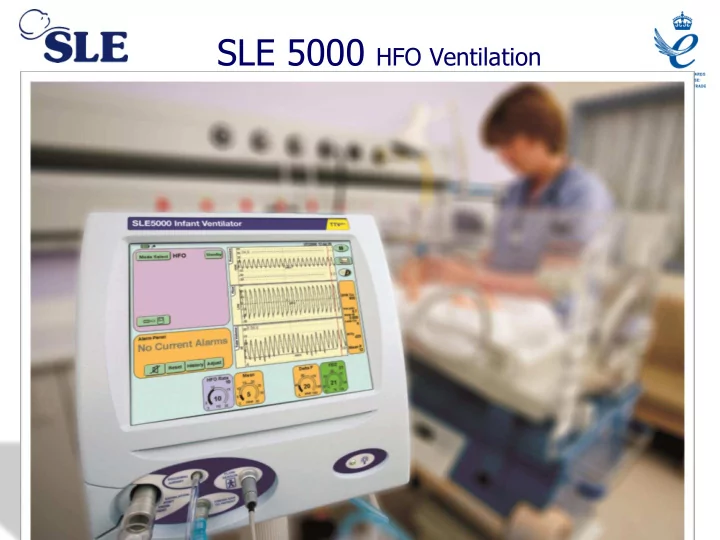
SLE 5000 HFO Ventilation When the smallest thing matters HFO Studies 2014, 2015 New Generation Neonatal High Frequency Ventilators: Effect of Oscillatory Frequency and Working Principles on Performance Serge Grazioli MD, Oliver Karam MSc MD,
When the smallest thing matters
“The Sensormedics A and B and the SLE5000 delivered square waves; all the other oscillators generated sine waves.” Harcourt et al. PCCM 2014
Edward R. Harcourt, BSc1,2; Jubal John, MD3; Peter A. Dargaville, MD4,5; Emanuela Zannin, PhD6; Peter G. Davis, MD3,4,7; David G. Tingay, PhD1,3,4,7 . ; PCCM 2014
Serge Grazioli MD, Oliver Karam MSc MD, and Peter C Rimensberger MD ; Respir Care 2015
“The SLE5000 was the most powerful neonatal HFO ventilator in terms of volume delivery with a performance similar to that of the Sensormedics 3100A.“
When the smallest thing matters
Harcourt ER1,2 , John J3, Dargaville PA4, Zannin E5, Davis PG3,6, Tingay DG1,3,6 1Royal Children’s Hospital, Parkville, Australia 2Swinburne University of Technology, Hawthorn 3Royal Women’s Hospital, Parkville 4Royal Hobart Hospital, Hobart 5Politecnico di Milano University, Milano, Italy 6Murdoch Children’s Research Institute, Parkville, Australia
“The Sensormedics A and B and the SLE5000 delivered square waves; all the other oscillators generated sine waves.” Harcourt et al. PCCM 2014
When the smallest thing matters
When the smallest thing matters
When the smallest thing matters
When the smallest thing matters Rapid rise in pressure in
0.1s 0.1s Rapid rise in pressure in
Rapid rise in pressure from the SLE5000 and Sensormedics. Greater amplitude achieved by SLE5000 on same settings.
When the smallest thing matters Rapid rise in pressure in
Slower rise in pressure in
Period = 0.1s at 10Hz Period = 0.1s at 10Hz
The pressure wave created by the rapid rise in pressure from the SLE5000 contains much more energy than the slow rise in pressure from the other ventilators.
When the smallest thing matters Rapid rise in pressure in
Slower rise in pressure in
0.1s 0.1s
When the smallest thing matters Rapid rise in pressure in
Slower rise in pressure in
0.1s 0.1s
When the smallest thing matters
Only the SLE achieved the target negative pressure of -5mbar (-7.2mbar at 10Hz). Even the Sensormedics 3100B failed to achieve a negative pressure. amplitude 21.4 (21.7 to 0.3) in 1:2 i:e ratio 15.9 (17.0 to 1.1) in 1:1 i:e ratio The settings for all ventilators were
Mean pressure: 10mbar Amplitude: 30mbar (+/-15mbar) thus, target pressures:
Target Amplitude
Target Amplitude
Note difference in scale
When the smallest thing matters
Data from Table 1, Harcourt et al, PCCM 2014
I:E Ratio Peak Pressure Trough Pressure Amplitude % Target Amplitude
Target (Ventilator Settings) 25.0
30.0
1:2 16.3 3.0 13.3 44%
1:1 16.5 0.7 15.8 53%
1:2 21.7 0.3 21.4 71%
1:1 17.0 1.1 15.9 53%
1:1 16.2
23.4 78%
1:2 15.6 0.3 15.3 51%
1:2 13.9 0.8 13.1 44%
1:2 14.3
14.6 49%
1:2 13.1 0.3 12.8 43%
1:2 10.7 2.2 8.5 28% Greatest amplitude was achieved by the SLE5000 at 23.4 mbar.
When the smallest thing matters
5 10 15 20 25
Measured Amplitude (delta P)
When the smallest thing matters Amplitude reduces at higher frequencies Amplitude maintained at higher frequencies
When the smallest thing matters
Reducing the frequency to achieve greater amplitude (slower
Rimensberger speaking on HFO at EAPS 2014). At higher frequencies, the lung does not have time to stretch even at high amplitude oscillation around the appropriate mean pressure.
When the smallest thing matters
All the ventilators capable of conventional ventilation and HFO, except for the SLE5000, lost amplitude in the pressure waveform at 10 Hz and lost more pressure at 15Hz.
Simulated Term infant 4kg:
Mean airway pressure 15 cm H2O , :E 1:1. “Note that, at a frequency of 15 Hz under full-term infant settings, the Babylog VN500 was not able to increase the pressure amplitude beyond 36 cm H2O (white marker)”
“The SLE5000 was the most powerful neonatal HFO ventilator in terms of volume delivery with a performance similar to that of the Sensormedics 3100A.“
When the smallest thing matters
When the smallest thing matters
When the smallest thing matters
HFO mode slowed down for illustration