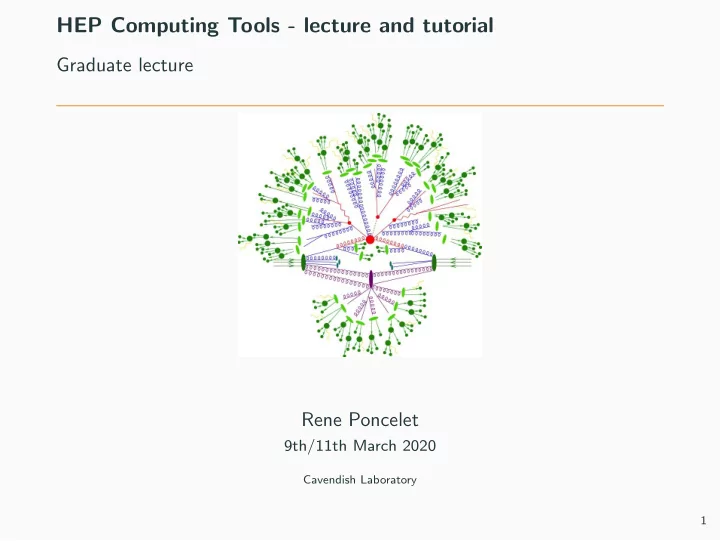
HEP Computing Tools - lecture and tutorial Graduate lecture Rene - - PowerPoint PPT Presentation

hep computing tools lecture and tutorial
SMART_READER_LITE
LIVE PREVIEW

HEP Computing Tools - lecture and tutorial Graduate lecture Rene - - PowerPoint PPT Presentation

HEP Computing Tools - lecture and tutorial Graduate lecture Rene Poncelet 9th/11th March 2020 Cavendish Laboratory 1 Disclaimer This course is meant to: Be a starting point in HEP computing. Provide a guided first contact with a


slide-1
SLIDE 1

HEP Computing Tools - lecture and tutorial

Graduate lecture Rene Poncelet

9th/11th March 2020

Cavendish Laboratory 1

slide-2
SLIDE 2

Disclaimer

This course is meant to:

  • Be a starting point in HEP computing.
  • Provide a guided first contact with a Monte-Carlo Event Generator.
  • Introduce various (abstract) concepts which HEP physicists encounter in

day-to-day basis.

  • Provide (hopefully) ”Ah, this is how it looks in practice” moments.

This course does not provide:

  • A complete or general overview over HEP computing.

This would be just to wide...

  • A theoretical background for introduced concepts.

This would take a long time...

  • A complete introduction into the usage of MC-event-generators.

They are just too complicated...

2

slide-3
SLIDE 3

What it is about?

3

slide-4
SLIDE 4

What it is about?

→ The study of fundamental interactions requires high energies → High energy scattering processes produce many particles, particularly if strongly interacting particles are involved → QCD → Interesting processes (production of massive particles like top-quarks, electroweak bosons (W,Z,H,γ)) are rare, due to large required energies or αEW couplings → How do we learn to distinguish interesting processes from the rest? ⇒ Modelling of such events is essential! Q: How one can understand these complex processes from a theoretical point

  • f view?

QFT + Lagrange density L → Events ⇐ Far too complicated!

4

slide-5
SLIDE 5

What it is about?

→ The study of fundamental interactions requires high energies → High energy scattering processes produce many particles, particularly if strongly interacting particles are involved → QCD → Interesting processes (production of massive particles like top-quarks, electroweak bosons (W,Z,H,γ)) are rare, due to large required energies or αEW couplings → How do we learn to distinguish interesting processes from the rest? ⇒ Modelling of such events is essential! Q: How one can understand these complex processes from a theoretical point

  • f view?

QFT + Lagrange density L → Something happens → Events

4

slide-6
SLIDE 6

The (theory) picture in mind

QCD tells how factorize processes at different energy scales Q:

  • Q ≫ ΛQCD Hard scattering

perturbative QCD

  • Q ≥ O(ΛQCD) Parton-shower,

PDF-evolution

  • Q ∼ O(ΛQCD) Hadronization,

Multi-parton interactions / Underlying event,. . . non-perturbative QCD

⇓ Monte Carlo Event Generators

5

slide-7
SLIDE 7

Monte Carlo Integration in a nut-shell

I =

dxf (x)

  • Numerical integration technique relying on

random numbers

  • Hit: ωmax · #1 ≤ f (#2)
  • Estimator for I:

ˆ I = # hits # trials

  • MC sampling with Hit-and-Miss algorithm:

Accepting event # if ωmax · #′ ≤ f (#) ⇓ Straight-forward translation to cross section: σ =

dΦ|M(Φ)|2 =

  • [0,1]n dn

xJ ( x)|M(Φ( x))|2

[source: Rajiv Gupta] 6

slide-8
SLIDE 8

The hard interaction: The fixed order picture

Hadronic cross section in collinear factorization:

σh1h2(P1, P2) =

  • ab

1 dx1 dx2 fa/h1(x1, µ2

F )fb/h2(x2, µ2 F )ˆ

σab(x1P1, x2P2; αS(µ2

R), µ2 R, µ2 F )

  • Factorization allows to describe the parton content of hadrons with the

help of PDFs

  • And partonic cross sections independent of the hadrons content or state

Partonic cross section as a perturbative series in αS: ˆ σab = ˆ σ(0)

ab

  • LO

+ ˆ σ(1)

ab

  • NLO

+ ˆ σ(2)

ab

  • NNLO

+O

  • α3

S

  • The leading order cross section:

ˆ σ(0)

ab =

  • dΦX|M(0)(ab → X)|2

7

slide-9
SLIDE 9

The hard interaction beyond LO

  • Higher order in the coupling → additional emissions
  • It is necessary to sum (incoherently) over processes with a different

number of final partons · · ·

  • Exchange or emission of partons lead to divergences

virtual - UV/IR virtual momentum arbitrarily large/small real - IR soft gluon energy arbitrarily small real - IR collinear angle between partons arbitrarily small

For example real emission:

1 (p+k)2 |p2,k2=0 = 1 2p·k = 1 p0k0(1−cos θ)

→ How to deal with these singularities? → Subtraction schemes

8

slide-10
SLIDE 10

The general idea of subtraction

  • Add to the original cross section σ = σLO + σNLO

σLO =

  • m

dσB , σNLO ≡

  • dσNLO =
  • m+1

dσR +

  • m

dσV

an identity involving approximations to the real radiation cross section

σNLO =

  • m+1
  • dσR − dσA

+

  • m+1

dσA +

  • m

dσV

and regroup the terms as

σNLO =

  • m+1
  • dσR

ǫ=0 −

  • dσA

ǫ=0

  • +
  • m
  • dσV +
  • 1

dσA

  • ǫ=0
  • for dσA it must be possible to
  • 1. obtain the Laurent expansion by integration over the single particle

unresolved space (preferably analytically)

  • 2. approximate dσR (preferably pointwise)
  • Schemes: Dipole Subt.

[Catani,Seymour’98], FKS [Frixione,Kunst,Signer’95], Antenna

Subtraction [Kosower’97], Nagy-Soper [Nagy,Soper’07]

9

slide-11
SLIDE 11

Parton-shower

  • How to simulate high

multiplicity matrix elements/ phase spaces?

  • Matrix elements diverge in the

IR limits (soft/collinear) → Probabilistic interpretation: most of the emissions are soft and collinear!

  • Using soft/collinear

factorization to describe cross section of additional emission: dσ(n+1) = dPσ(n)

10

slide-12
SLIDE 12

Parton-shower

  • Parton evolution with DGLAP:

dPa(z, Q2) = dQ2 Q2 αS 2π Pa→bc(z)dz

  • Initial vs. final state showers:

→ Initialstate shower → ΛQCD<Q< . . . <Q′<Qhard ← Finalstate shower ←

  • Different orderings of the

emissions:

  • Q2 ordered (example: old Pythia

versions)

  • pT ordered (example: modern

Pythia)

  • E 2(1 − cos θ) (angular) ordered

(example: Herwig)

  • Also important: Kinematics!

11

slide-13
SLIDE 13

Hadronization

  • After showering: Collection of individual partons
  • Not observed! → Color confinement bounds them into color neutral

hadrons

  • Intrinsically non perturbative effect → phenomenological models (Lund

string model, cluster model)

  • Example cluster model:
  • Leading Nc limit (most parton shower are defined in this limit): gluons are

color - anticolor pairs

  • Color neutral combinations of color charges are close in phase space

(collinear emissions!)

  • Combination of color neutral combinations to hadrons with the aid of fitted

probability functions (Fragmentation functions,similar to PDFs)

12

slide-14
SLIDE 14

The (theory) picture in mind

  • Q ≫ ΛQCD Hard scattering

perturbative QCD

  • Q ≥ O(ΛQCD) Parton-shower,

PDF-evolution

  • Q ∼ O(ΛQCD) Hadronization,

Multi-parton interactions / Underlying event,. . . non-perturbative QCD

⇓ Monte Carlo Event Generators

13

slide-15
SLIDE 15

MC-event generators: A try of a classification

  • Fixed-order programs (the hard interaction)
  • Provide fixed-order cross section. LO,NLO is the industry standard, and

NNLO starts to coming up.

  • Generation of hard process events of low multiplicity
  • Provide interfaces to parton-shower programs (LO,NLO events)
  • examples: MadGraph, Sherps, Herwig, POWHEG, MCFM, . . . and

uncounted number of in-house software

  • Parton-Showers and Hadronization (’Event Generators’)
  • Dressing up (fixed-order) events with additional radiation, to model

soft-collinear emissions

  • Modelling of hadronization/fragmentation, i.e. the transition between

partons and hadrons

  • Decaying the ’clustered’ hadrons to ’stable’ particles
  • Modelling of additional radiation activity such as Multi-Parton Interactions

(MPI) / Underlying Event (UE), color-reconnection, . . .

  • Pythia, Herwig, Sherpa, . . .

⇒ frameworks for event simulation

14

slide-16
SLIDE 16

MadGraph5 aMC@NLO

Website: https://launchpad.net/mg5amcnlo

  • Automated LO/NLO (QCD and EW) fixed order cross sections for the

Standard Model and beyond (UFO model files allow for ’arbitrary’ Lagrangian)

  • FKS subtraction scheme for NLO cross sections
  • Interfaces to parton-shower programs: probably most popular MC

framework: Madgraph+Pythia

  • Automated generation of tree-level and one-loop matrix elements (very

useful tool: stand-alone mode)

  • Various modules which allow for additional modelling and event analysis

(MadEvent/MadAnalysis/Mad. . . )

15

slide-17
SLIDE 17

Sherpa

Website: https://sherpa-team.gitlab.io/

  • Automated LO/NLO (QCD and EW) fixed order cross sections

(loop-matrix elements from third party tools like MadGraph or OpenLoops)

  • Catani-Seymour subtraction scheme
  • Matching to CSS dipole-shower (Catani-Seymour mappings) MC@NLO
  • Handling of Hadronization/Fragmentation (cluster-hadronization),

hadron-decays, MPI/UE, QED bremsstrahlung

  • Multi-jet merging (CKKW scheme)

See tutorial

16

slide-18
SLIDE 18

Pythia and Herwig

Pythia Website: http://home.thep.lu.se/~torbjorn/pythia81html/Welcome.html

  • features pT ordered shower which interleaves MPI
  • Hadronization with Lund fragmentation model
  • Takes LHE event files as input
  • Facilities for event-analysis

Herwig Website: https://herwig.hepforge.org/

  • features angular and pT ordered showers
  • Spin and color correlations can be incorporated
  • Does hard scattering and matching (MC@NLO) as well

17

slide-19
SLIDE 19

Other tools

  • Treatment of PDFs: LHAPDF (https://lhapdf.hepforge.org/)
  • Event analysis: Rivet (https://rivet.hepforge.org/)
  • One-loop matrix-elements:
  • OpenLoops (https://openloops.hepforge.org/)
  • Recola (https://recola.hepforge.org/)
  • MCFM (https://mcfm.fnal.gov)

18

slide-20
SLIDE 20

Tutorial

19

slide-21
SLIDE 21

Tutorial

Additional information about the tutorial:

  • Username: tutorial, Password: 1234test
  • Instructions can be found in the home directory ∼/tutorial.pdf
  • Exercise 3 is meant to be a homework exercise due to the extensive

running time

20