Help Plan the Future of the District We are preparing a new Local - - PowerPoint PPT Presentation

help plan the future of the district
SMART_READER_LITE
LIVE PREVIEW

Help Plan the Future of the District We are preparing a new Local - - PowerPoint PPT Presentation

Help Plan the Future of the District We are preparing a new Local Plan for the District and this is your first opportunity to take part in its preparation. Local Plan - Sets out how land and buildings should be used in future to achieve economic,


slide-1
SLIDE 1

Help Plan the Future of the District

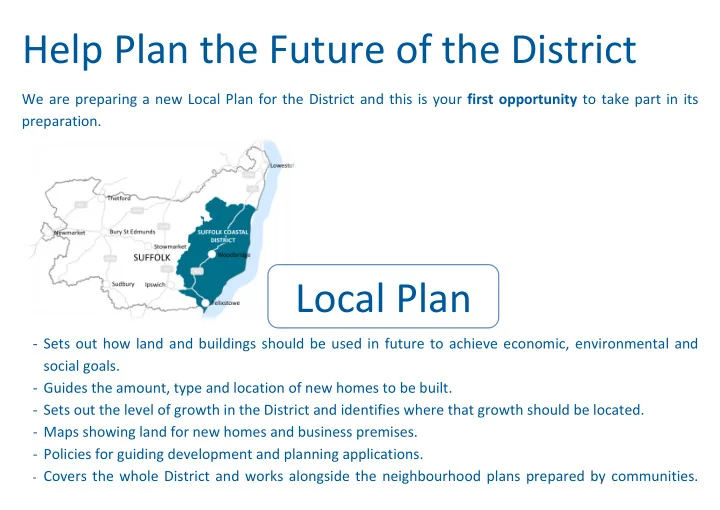
We are preparing a new Local Plan for the District and this is your first opportunity to take part in its preparation.

  • Sets out how land and buildings should be used in future to achieve economic, environmental and

social goals.

  • Guides the amount, type and location of new homes to be built.
  • Sets out the level of growth in the District and identifies where that growth should be located.
  • Maps showing land for new homes and business premises.
  • Policies for guiding development and planning applications.
  • Covers the whole District and works alongside the neighbourhood plans prepared by communities.

Local Plan

slide-2
SLIDE 2

Local Plan Review

www.eastsuffolk.gov.uk/suffolkcoastallocalplanreview

  • Public consultation 18th August to 30th October 2017.
  • A longer term plan for future growth up to 2036. The current

Local Plan is to 2027. Next Steps – There will be further opportunity to have your say as the Local Plan Review progresses through 2 further rounds of consultation and engagement.

  • First Draft Plan Spring 2018.
  • Final Draft Plan Autumn 2018.

Issues and Options

Do you have any comments about future development in Suffolk Coastal and what the Local Plan should contain?

slide-3
SLIDE 3

Issues and Options

  • The issues and options consultation seeks your views.
  • The consultation document is split into 2 parts.

Part 1 – Recognises relationships between Suffolk Coastal and Ipswich as well as other districts. This includes where people live, work, shop and spend their leisure time. Contains information about the amount of growth and where growth should be located. Part 2 – Local issues for Suffolk Coastal.

  • A wide range of topics such as tourism, climate change, environment and design.
  • A vision to describe how Suffolk Coastal District will look in 2036.

What makes a successful community in Suffolk Coastal? What is your vision for your local community?

slide-4
SLIDE 4

How much growth? The number of homes and jobs to plan for.

The local authorities need to consider the housing market and economic relationships of the wider geography of Suffolk Coastal, Ipswich, Babergh and Mid Suffolk.

Economic and Housing Market Evidence

slide-5
SLIDE 5

How much growth?

A Housing Market Assessment provides an objective assessment of the number of homes needed by District. An Employment Land Needs Assessment provides forecasts of jobs growth by District.

slide-6
SLIDE 6

How much growth? The number of homes and jobs

This scenario is based on the continuation of recent trends and modelling forecasts. In respect of housing growth, the official projections from the Office of National Statistics provide the starting point for consideration of housing requirements across the local authorities. The growth in households is primarily expected to be driven by those in the over 65 age bracket which will result in a need for additional people who are economically active across the area to support the economy across the area. For the scale of jobs growth, the economic trend-based forecasts of the East of England Forecasting Model have been used.

This means 460 homes each year in Suffolk Coastal District.

slide-7
SLIDE 7

How much growth? The number of homes and jobs

This scenario seeks to increase job targets based on an aspiration for significant economic development to take place across the Functional Economic Area. Significant economic development opportunities in the form of a new nuclear power station at Sizewell, offshore energy industries and further support for established key sectors such as the Port of Felixstowe or ICT Technologies could bring about a further increase in jobs.

slide-8
SLIDE 8

How much growth? The number of homes and jobs

This infrastructure-led scenario reflects the

  • pportunity to create a more successful and

prosperous area which benefits from improved infrastructure supporting an ambitious uplift in the housing requirement. Additional housing could be delivered on land

  • pened up through infrastructure

improvements, for example an Ipswich northern route.

slide-9
SLIDE 9

Options for Ipswich

A number of options for the distribution of housing growth in Ipswich are being considered as part of this Issues & Options consultation

Option 1 – Higher density urban regeneration (Higher density developments will make the best use of the space available) Option 2 – Increased development beyond the Borough boundary (Working with neighbouring districts to aid development) Option 3 – Changing the use of existing land in the Borough to housing (Using land protected for employment use for to meet housing requirements)

slide-10
SLIDE 10

Potential Housing Distribution Options

for Suffolk Coastal

Where should the growth go? What do you think?

slide-11
SLIDE 11

Potential Housing Distribution Options for Suffolk Coastal

Where should the growth go? What do you think?

Ideas for discussion

slide-12
SLIDE 12

Infrastructure

Infrastructure can cover a wide range of facilities and services, some of these are cross boundary and some are area specific but it is important to consider these as part of the Local Plan Review. Growth can support new and improved infrastructure in the District.

Health

The number of older people in Suffolk is projected to increase dramatically. The number of people aged 85 and is likely to double over the next twenty years.

Education

Improved education raises the quality

  • f life for communities and ensures

that skills are developed by children and young people to fulfil the jobs in the future. Education opportunities, which provide training to meet the needs of current and future business enterprises, are key to the success of an area.

Rail Services Transport

What do you think of?

slide-13
SLIDE 13

Education Provision Protecting Sensitive Environments

What do you think of?

Green Infrastructure and Habitats Regulations Assessment (HRA) mitigation

There is a tension which the Local Plan Review will need to address, between boosting leisure, recreation and tourism activities linked to the beauty and biodiversity of the natural environment and protecting the very assets which people come to visit or move to the area to be near.

Key Issues:

  • Need to improve the road and rail

(passenger and freight) network.

  • Provision of adequate public

transport infrastructure.

slide-14
SLIDE 14

Housing

Planning for and delivering a wide choice of housing across the district up to 2036 to meet needs and requirements.

Supporting Main Economic Drivers Key issues:

  • Population trends indicate

that the population of Suffolk Coastal is expected to grow by 8,259 between 2014-2036.

  • Limited land availability and

large areas of protected land.

  • High house prices and high

numbers of second homes in the district. Homes cost on average 9 times average income.

  • The impact of an ageing

population on housing supply. In particular increased demand for specialist housing.

Do you have any views or comments about?

slide-15
SLIDE 15

Business and Industry

The Local Plan can support local businesses to grow, better paid jobs and ambitious economic

  • pportunities.

Supporting Main Economic Drivers

Do you have any views or comments about?

Existing employment areas Business sites and premises Key Sectors:

  • Information and

Communications Technology (ICT)

  • Transport and

Logistics The Local Plan Review will need to ensure there is sufficient land to support new employment development whether for existing businesses seeking to expand or new investment into the area. Key issues:

  • An increasing number of young

people are leaving the district.

  • There is a need to ensure that the

local population can access new employment opportunities.

  • Promoting and supporting growth

in key employment sectors.

  • Competition for land from housing.

New employment land

slide-16
SLIDE 16

Town Centres, Retail, and Commercial Leisure

The town centres in Suffolk Coastal are the heart of communities and provide a range of services and facilities in accessible locations.

Key issues:

  • Changing nature of the high street, local and district centres and changing shopping

habits.

  • Distances between key services and facilities in rural areas.

What do you think about?

Individual town centres Out of town retail parks Does out of town retail affect your town centre or local area? If so how? Where is the best place for new retail? Historic market towns

slide-17
SLIDE 17

Tourism

Tourism is an important sector of the Suffolk Coastal economy which offers a diverse range of tourism experiences to satisfy all tastes. Tourism strengths include beaches, family attractions, landscape, culture and heritage.

Key issues:

  • Significant Area of Outstanding Natural

Beauty and areas of high landscape quality that need to be protected.

  • Promoting and supporting growth in

key employment sectors.

Types of Resort Activities Extending the Tourism Season

What do you think about?

slide-18
SLIDE 18

Vehicle Parking

Appropriate provision of vehicle parking is of great benefit to the vitality of communities and businesses across the District.

Key Issue:

  • Heavy reliance on private motor cars and lack of public transport

provision.

Parking Policy Approach Work Vehicles – Growth of Self- Employment

What do you think of?

Reliance on the car

slide-19
SLIDE 19

Community Facilities

Access to facilities is an important part of the success of a community. Facilities such as shops, schools and other meeting places contribute to the overall health and vitality of communities.

Key issue:

  • Distance to both primary and secondary

schools, especially in rural locations.

  • The District’s population is older than the

county, regional and national averages.

  • Rural isolation and poor access to fast

Broadband and reliable mobile coverage in rural areas.

Future delivery of community facilities How community facilities should be defined? Community Right to Bid Community Infrastructure Levy Existing Community Services and Facilities

What do you think about?

slide-20
SLIDE 20

Healthy Communities

Residents need to have appropriate access to leisure facilities and services to maintain a high level of health and well being

Key issues:

  • Limited access to health provision in the rural areas.
  • Due to the ageing population a high proportion of the population have long-term

health problems and disabilities.

  • Fear of crime needs to be addressed.
  • Need to extend and enhance the green infrastructure network.
  • Despite the relative affluence of the District there is still a need to address

pockets of deprivation.

Enhancing and Redeveloping Modern Leisure Centres and Sports Hub Facilities Public Rights of Way Networks Communications Infrastructure

What do you think about?

Deficiencies in Health Facilities

slide-21
SLIDE 21

Climate Change

Suffolk Coastal has a dynamic coastline, estuaries and low lying areas at risk from flooding but is well placed to benefit from renewable energy opportunities in the region.

Key issues:

  • The need to increase renewable

energy provision and deliver carbon neutral development.

  • An appropriate response to sea level

rise and an eroding coastline.

  • The need to ensure sustainable

construction techniques and green infrastructure are employed to mitigate climate change and address fuel poverty.

  • Low lying areas at risk of flooding

from drainage, rivers and coastal waters.

Response to the Eroding Coastline Encouraging New Developments to Reduce Carbon Emissions Sustainable Construction Relocation of Property at Risk from Erosion Coastal Change Management Area Boundaries Appropriate Areas in the District for Renewable Energy Development

What do you think of?

slide-22
SLIDE 22

Design

High quality design is a crucial part of making places better for people and businesses in the area.

Key issue:

  • Limited land availability and large areas
  • f protected land.

Development in Residential Back Gardens Estate-scale Development

What do you think about?

slide-23
SLIDE 23

Heritage

Suffolk Coastal benefits from numerous heritage assets which need to be protected and enhanced for the benefit of current and future generations. Landscape The district has a diverse landscape character with large parts of the district designated as an Area of Outstanding Natural Beauty

Non-Designated Heritage Assets Breaks and Gaps in-between Buildings Key issues:

  • High number of heritage assets.
  • Significant Area of Outstanding

Natural Beauty and areas of high landscape quality that need to be protected.

  • Extensive areas of high quality

agricultural land.

Landscape Character Identifying Areas of Tranquillity Settlement Coalescence

What do you think about? What protection should be given to?

slide-24
SLIDE 24

Biodiversity and Geodiversity

Suffolk Coastal is a District with a high quality natural environment, rich in Biodiversity and Geodiversity.

Biodiversity in New Development Green Infrastructure with Respect to Biodiversity and Geodiversity Key issue:

  • Numerous protected sites

across the District including large areas protected for species and habitat value which come under pressure from increased recreational and tourist activity.

What do you think

  • f?
slide-25
SLIDE 25

Potential land for development

The Local Plan will need to identify and allocate sufficient land for different types of development, such as housing, employment and retail.

Sites have been submitted by landowners, developers, agents and

  • ther interested stakeholders.

Not all sites will be required. The Council, taking into account the views expressed as part of this consultation, will thoroughly assess all the sites and filter the sites down to a smaller number which can meet the development needs of the District. Maps of land made available in different parts of Suffolk Coastal are on the tables to

  • view. The maps give the sites no status in planning terms.