HELLP HELLP vs HUS vs HUS Both HELLP syndrome and HUS present, - - PDF document

hellp hellp vs hus vs hus
SMART_READER_LITE
LIVE PREVIEW

HELLP HELLP vs HUS vs HUS Both HELLP syndrome and HUS present, - - PDF document

15/10/2012 HELLP S HELLP Syndrome vs Haemolytic Uraemic Syndrome in Pregnancy Marc Marco DiGirol o DiGirolamo mo Senior Senior Medica Medical Scien l Scientis ist IMVS Patho IMVS Pathology Women mens s and Children


slide-1
SLIDE 1

15/10/2012 1

HELLP S HELLP Syndrome vs Haemolytic Uraemic Syndrome in Pregnancy

Marc Marco DiGirol

  • DiGirolamo

mo

Senior Senior Medica Medical Scien l Scientis ist IMVS Patho IMVS Pathology Women’ men’s s and Children’ ildren’s H s Hospital, spital, N North h Adelaide elaide

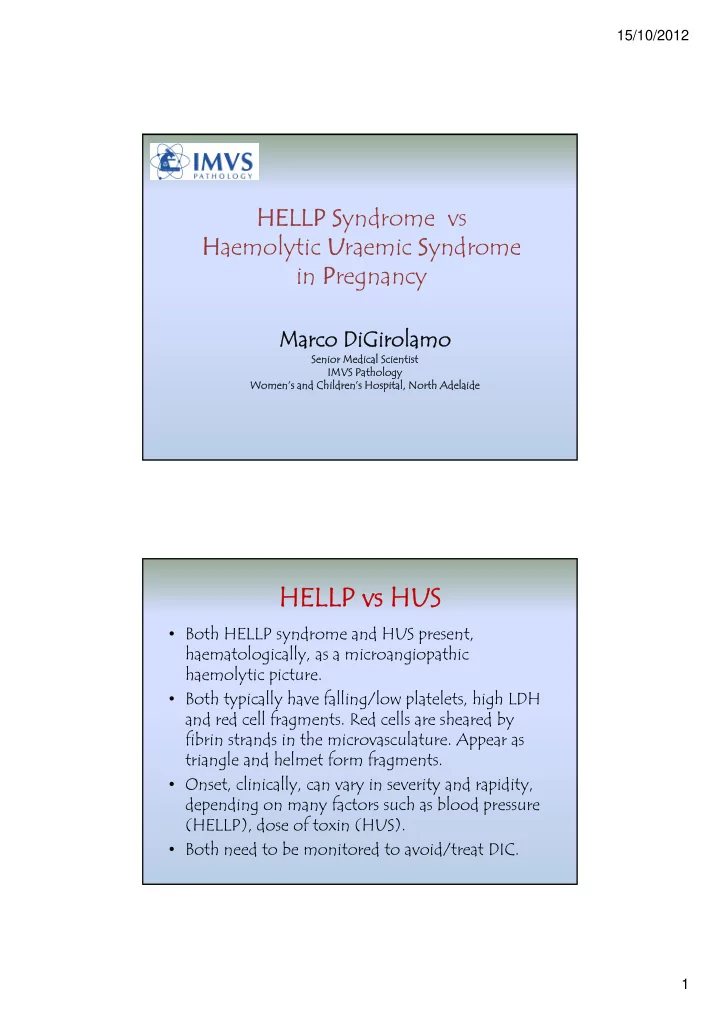
HELLP HELLP vs HUS vs HUS

  • Both HELLP syndrome and HUS present,

haematologically, as a microangiopathic haemolytic picture.

  • Both typically have falling/low platelets, high LDH

and red cell fragments. Red cells are sheared by fibrin strands in the microvasculature. Appear as triangle and helmet form fragments.

  • Onset, clinically, can vary in severity and rapidity,

depending on many factors such as blood pressure (HELLP), dose of toxin (HUS).

  • Both need to be monitored to avoid/treat DIC.
slide-2
SLIDE 2

15/10/2012 2

Incidence Incidence of HELLP

  • f HELLP and HUS in

and HUS in Pregnancy Pregnancy

  • HELLP

0.2 – 0.6 %

  • HUS

0.004 %

HELLP HELLP Syndrom Syndrome

  • Classic signs of HELLP

HELLP syndrome are falling platelets, raised LDH and liver enzymes, and red cell

  • fragmentaton. (Haemolysis, Elevated Liver enzymes,

Low Platelets). Red cell fragments are of helmet and triangle forms (schistocytes).

  • A severe condition of uncertain aetiology occurring

in 0.2-0.6% of pregnancies.

  • HELLP is generally listed with the pregnancy

hypertension disorders, but relationship is uncertain. Although HT, PE and eclampsia do play a role in severity of condition and onset.

slide-3
SLIDE 3

15/10/2012 3

The p The pregn egnancy hypertensive di ncy hypertensive disorders. sorders.

  • PIH

PIH : pregnancy induced hypertension – persisting high blood pressure (150/ 150/100 100 to 180/ 180/11 110 mmHg), no proteinuria.

  • PE

PE : Pre-eclampsia - HT plus proteinuria, +/- oedema. If severe, then headaches, visual disturbances can occur.

  • Eclampsia

Eclampsia : HT, proteinuria, oedema, visual disturbances, seizures.

HELLP HELLP Syndrom Syndrome

Recent studies and reviews have suggested that endothelial damage is the cause of pre-eclampsia pre-eclampsia, and that various organs can be affected.

  • Endothelial damage within the kidney results in

fenestration damage, leading to protein loss in the glomerulus.

  • If the liver is affected, then patient will develop

HELLP HELLP syndrome.

  • Endothelial damage in the brain may lead to

neurological sequelae such as seizures.

HELLP HELLP Syndrom Syndrome

slide-4
SLIDE 4

15/10/2012 4

HELLP HELLP Syndrom Syndrome

Assessment of Risk Factors

  • A severe coagulopathy can result, so an extended

coagulation screen, including PT, APTT, Fibrinogen and D-dimers (or equivalent) should be performed to assess status.

  • LDH, Platelet count and coag profile need to

monitored.

  • (Assessment of foetal lung maturity may be

worthwhile, such as amniotic fluid surfactant/albumin ratio.)

HELLP HELLP Syndrom Syndrome

Risk Reduction

  • The most effective measure to reduce both

maternal and foetal risk has always been to deliver the baby – in fact it is the delivery of the placenta which is responsible for the risk reduction.

  • Corticosteroids may be given to help infant lung

maturity, generally the day before delivery – particularly if gestation is less than 36 weeks. Resolutio Resolution is is usually usually spon sponta tane neous, and occurs over a

  • us, and occurs over a

few days. few days.

slide-5
SLIDE 5

15/10/2012 5

HUS HUS

  • Associated with a Shiga-like toxin produced by

specific strains of E coli bacteria (eg O157:H7).

  • Damage tends to focus on the kidney – namely

platelet fibrin thrombi in the glomeruli and renal microvasculature, although uncommonly, it can be systemic.

  • A severe coagulopathy can result, so an extended

coagulation screen, including PT, APTT, Fibrinogen and D-dimers (or equivalent) should be performed to assess status.

HUS HUS

Treatment

  • Baby may be induced, to allow for less restricted

treatment of HUS.

  • Monitoring of coagulation profiles (D-dimers)
  • Plasma exchange, corticosteroids, dialysis, platelet

transfusions, FFP, clotting factors (all at need).

  • Renal damage can be severe and permanent, with

prompt treatment reducing morbidity. (We are still treating patients affected by the Garibaldi-induced HUS out break 18 years ago.)

slide-6
SLIDE 6

15/10/2012 6

Case Studies Case Studies

  • HELLP -

HELLP - A 32 32 year old female, admitted year old female, admitted to hospital at to hospital at 36 36 weeks gestation with weeks gestation with hyperte hypertension and suspe nsion and suspecte ted d pre-e pre-eclamp lampsia. sia.

  • HUS

HUS – 30 0 year old admitted to year old admitted to hospital hospital at at 36 36 weeks gestation with stomach weeks gestation with stomach cramps, diarrhoea. No cramps, diarrhoea. No pre-eclampsia. pre-eclampsia. Had been to The Royal Adelaide Had been to The Royal Adelaide Show. Show.

HELLP HELLP Syndrom Syndrome

slide-7
SLIDE 7

15/10/2012 7

HUS HUS HELLP HELLP Syndrom Syndrome vs vs HUS HUS

HELLP Syndrome HUS Day 1 Day 2 Day 3 Day 1 Day 3 (am) Day 3 (pm) Sodium (131 – 142 mmol/L) 136 135 135 131 130 129 Potassium (3.3 – 4.7 mmol/L) 3.7 4.0 4.6 4.1 4.1 4.5 Chloride (97 – 109 mmol/L) 105 105 107 101 101 97 Bicarb (20 – 29 mmol/L) 18.2 19.7 22.0 18.4 18.4 24.7 Urea (1.2 – 4.0 mmol/L) 2.7 4.1 5.9 4.4 9.6 10.1 Urate (0.12 – 0.35mmol/L) 0.33 0.40 0.37 0.54 0.53 Creat (38 – 67 µmol /L) 68 87 99 65 255 239 Magnesium (Ther 1.7-3.5 mmol/L)

  • 3.68

Total Protein (58– 72 g/L) 61 63 50 61 50 45 Albumin (30 – 40 g/L) 31 31 25 27 22 20 Total Bili (2 – 24 µmol/L) 7 23 14 3 4 4 LDH (120 - 280 IU/L) 484 1054 594 253 962 825 GGT (5 - 30 IU/L) 78 96 70 44 25 23 ALT (5-30 IU/L) 96 117 83 24 24 24 ALP (50-215 IU/L) 194 160 119 232 152 130 Haemoglobin (110 - 160 g/L) 93 86 81 127 84 69 Platelets (150 – 450 x 109/L) 160 82 78 186 49 44 D-Dimers (< 0.5) 1.5 0.8 1.5 Red cell fragments + ++ +

  • ++

++

slide-8
SLIDE 8

15/10/2012 8

HELLP HELLP vs HUS vs HUS

  • Biochemically, HELLP tends to show more

abnormalities in the liver enzymes, whereas HUS affects the kidneys, elevating Urea and Creatinine.

  • The haematological pictures tend to look similar,

although HELLP tends to have less red cell fragments.

  • Clinical history is important, as HUS is caused by a

toxin, whereas HELLP is of less certain origin, although recent studies are suggesting an endothelial

  • problem. It is exacerbated by hypertension and

pre-eclampsia.

HELLP HELLP vs HUS vs HUS

  • It is important, in seeing red cell fragments in the

film, to ascertain if the platelet count is accurate. Are there fibrin strands, platelet clumps etc?

  • To any existing biochemistry, add an LDH, LFT,

renal function tests etc, that may differentiate the various haemolytic anaemias.

  • If you suggest the possibility of a HELLP syndrome
  • r HUS, then a repeat should be requested,

including extended coag screen.

slide-9
SLIDE 9

15/10/2012 9

Treatment Treatment

In each case, In each case, the baby the baby wa was d delivered o ered on d day 3 3.

  • In the HELLP

HELLP syndrome case, resolution occurred spontaneously.

  • In the HUS

HUS case, it was to allow more flexibility of treatment and dialysis. Although dialysis is generally quite safe in pregnancy, the added strain

  • f the HUS increased the risk. Long term renal

damage was minimal.

References References

  • AANA

AANA J.

  • J. 1997 Feb;65(

1997 Feb;65(1):37-4

  • 47.

7. HELLP syndrome (hemolysis, elevated liver enzymes, and low platelets) pathophysiology and anesthetic considerations. Po Port rtis R R, Jac Jacobs MA MA, Sk Skerman J JH, Sk Skerman EB EB.

  • Am

Am J J Obs Obstet Gyn

  • Gynecol. 20

2000 Aug Aug;183(2) 2):444- 44-8. 8. Risk factors for adverse maternal outcomes among women with HELLP (hemolysis, elevated liver enzymes, and low platelet count) syndrome. Hadda Haddad B B, Barton Barton JR JR, Liv Livingston JC JC, Cha Chahin ine R R, Siba Sibai B i BM.

  • Obstet G

stet Gynecol

  • necol. 2

2006 S 006 Sep;10 108(3 P 8(3 Pt 2 2):817-2 17-20. Thrombotic thrombocytopenic purpura masquerading as hemolysis, elevated liver enzymes, low platelets (HELLP) syndrome in late pregnancy. Rehbe Rehberg JF JF, Brie Briery C CM, Hu Hudson W

  • n WT, Bof

Bofill JA ll JA, Ma Martin JN JN Jr Jr.

  • J Gast

strointestin L rointestin Liver D ver Dis 2 2007 007 D Dec; 16(4):419-24 HELLP Syndrome – a Multisystemic Disorder. Mih Mihu D, Nico D, Nicole Co Costin in N, Mih N, Mihu M, M, Se Seic icean A, A, Cio Ciortea R.

slide-10
SLIDE 10

15/10/2012 10

References References

  • Mine

nerva G a Gine necol

  • col. 2008

008 O Oct;60 60(5):445 445-50. The development of disseminated intravascular coagulation in hemolysis, elevated liver enzymes, and low platelet count syndrome (HELLP) at very early gestational age. Indra Indraccolo U U, Gentile G ile G, Man Manfreda VM VM, Pomili G li G.

  • Blood. 20
  • Blood. 2005 Decem

December 15; 15; 10 106( 6(13) 4199 4199-4209 Hemolytic uremic syndrome–associated Shiga toxins promote endothelial-cell secretion and impair ADAMTS13 cleavage of unusually large von Willebrand factor multimers. Letici cia H. N a H. Nolasco, lasco, Nancy ncy A. T

  • A. Turner, Au

Aubrey Bern Bernar ardo, Zh Zhenyi yin n Tao,

  • , Thom
  • mas

as G

  • G. Clear

eary, , Jing Jing-fe

  • fei Dong

Dong, , and Joel and Joel L. Moak

  • L. Moake
  • Virchow

hows A Arch

  • ch. 2

. 2008 008 Octo tober; 4 ber; 453(4): 3 3(4): 387–400. 400. Placental Protein 13 (galectin-13) has decreased placental expression but increased shedding and maternal serum concentrations in patients presenting with preterm preeclampsia and HELLP syndrome Nandor

  • r Gabo

bor T r Than an, O , Omar ar Abdul R l Rahman, , Rita M ta Magenh nheim, B m, Balint t Nagy, gy, Tibor F r Fule, B , Beata a Hargitai, rgitai, Marei S rei Sammar, P ar, Petro tronella lla Hupuczi, A puczi, Adi L. T Tarca rca, G Gabor S r Szabo,

  • , I

Ilona K Kovalszky, H lszky, Hamutal M mutal Meiri iri, I Istvan an Szille iller, Jano Janos Rigo, s Rigo, Jr., Jr., Rober Roberto Rome Romero, and Zoltan and Zoltan Papp pp

  • Circ
  • Circulation. 201

2011 June 21; 21; 12 123(24): 28 2856 56–2869. Preeclampsia, a disease of the maternal endothelium: the role of anti-angiogenic factors and implications for later cardiovascular disease Cami Camille E.

  • E. Po

Powe, , Richard J. d J. Le Levi vine an and d S.

  • S. An

Anan anth Karu Karumanchi.

Thank You Thank You