Heightened IRS Scrutiny on Worker h d k Misclassification and Tax - - PowerPoint PPT Presentation

heightened irs scrutiny on worker h d k misclassification
SMART_READER_LITE
LIVE PREVIEW

Heightened IRS Scrutiny on Worker h d k Misclassification and Tax - - PowerPoint PPT Presentation

Presenting a live 110 minute teleconference with interactive Q&A Heightened IRS Scrutiny on Worker h d k Misclassification and Tax Compliance P Preparing for Federal and State Information Sharing; i f F d l d St t I f ti Sh i


slide-1
SLIDE 1

h d k

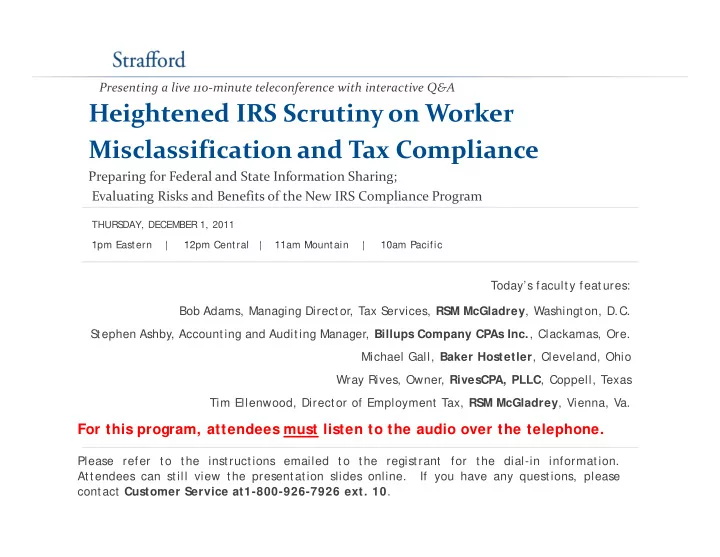
Presenting a live 110‐minute teleconference with interactive Q&A

Heightened IRS Scrutiny on Worker Misclassification and Tax Compliance

P i f F d l d St t I f ti Sh i Preparing for Federal and State Information Sharing; Evaluating Risks and Benefits of the New IRS Compliance Program

1pm Eastern | 12pm Central | 11am Mountain | 10am Pacific THURS DAY, DECEMBER 1, 2011

Today’s faculty features:

1pm Eastern | 12pm Central | 11am Mountain | 10am Pacific

Bob Adams Managing Director Tax S ervices RSM McGladrey Washington D C Bob Adams, Managing Director, Tax S ervices, RSM McGladrey, Washington, D.C. S tephen Ashby, Accounting and Auditing Manager, Billups Company CPAs Inc., Clackamas, Ore. Michael Gall, Baker Hostetler, Cleveland, Ohio Wray Rives, Owner, RivesCPA, PLLC, Coppell, Texas

For this program, attendees must listen to the audio over the telephone.

Wray Rives, Owner, RivesCPA, PLLC, Coppell, Texas Tim Ellenwood, Director of Employment Tax, RSM McGladrey, Vienna, Va. Please refer to the instructions emailed to the registrant for the dial-in information. Attendees can still view the presentation slides online. If you have any questions, please contact Customer Service at1-800-926-7926 ext. 10.

slide-2
SLIDE 2

Conference Materials

If you have not printed the conference materials for this program, please complete the following steps:

  • Click on the + sign next to “ Conference Materials” in the middle of the left-

hand column on your screen hand column on your screen.

  • Click on the tab labeled “ Handouts” that appears, and there you will see a

PDF of the slides for today's program.

  • Double click on the PDF and a separate page will open.

Double click on the PDF and a separate page will open.

  • Print the slides by clicking on the printer icon.
slide-3
SLIDE 3

Continuing Education Credits

FOR LIVE EVENT ONLY

Attendees must listen to the audio over the telephone. Attendees can still view the presentation slides online but there is no online audio for this program. Please refer to the instructions emailed to the registrant for additional

  • information. If you have any questions, please contact Customer Service

at 1-800-926-7926 ext. 10. at 1 800 926 7926 ext. 10.

slide-4
SLIDE 4

Tips for Optimal Quality

S d Q lit S

  • und Qualit y

For this program, you must listen via the telephone by dialing 1-866-873-1442 and entering your PIN when prompted. There will be no sound over the web connection. co ect o . If you dialed in and have any difficulties during the call, press *0 for assistance. Y

  • u may also send us a chat or e-mail sound@straffordpub.com immediately so

we can address the problem. Viewing Qualit y To maximize your screen, press the F11 key on your keyboard. To exit full screen, press the F11 key again press the F11 key again.

slide-5
SLIDE 5

Heightened IRS Scrutiny on Worker Mi l ifi ti d T C li Misclassification and Tax Compliance Seminar

Wray Rives RivesCP A PLLC

  • Dec. 1, 2011

S tephen Ashby Billups Company CP As Inc Wray Rives, RivesCP A, PLLC wray@rivescpa.com Bob Adams, RS M McGladrey S tephen Ashby, Billups Company CP As Inc. steve@billupscpa.com Tim Ellenwood, RS M McGladrey bob.adams@mcgladrey.com tim.ellenwood@mcgladrey.com Michael K. Gall, Baker Hostetler mgall@bakerlaw com mgall@bakerlaw.com

slide-6
SLIDE 6

Today’s Program

Review Of Federal, S tate Worker Classification Tests [S t ephen Ashby] S lide 7 – S lide 18 Ongoing IRS Research Proj ect On Employment Taxes [Wray Rives] IRS Labor Department Memorandum Of Understanding S lide 19 – S lide 22 S lide 23 S lide 27 IRS

  • Labor Department Memorandum Of Understanding

[Tim Ellenwood] IRS Voluntary Classification S ettlement Program S lide 28 – S lide 47 S lide 23 – S lide 27 [Wray Rives and Bob Adams] Best Practices For Determining Worker S tatus [Michael K. Gall] S lide 48 – S lide 69 [ ]

slide-7
SLIDE 7

REVIEW OF FEDERAL STATE

Stephen Ashby, Billups Company CPAs Inc.

REVIEW OF FEDERAL, STATE WORKER CLASSIFICATION TESTS

slide-8
SLIDE 8

Employee Vs. Contractor Classification: Employee Vs. Contractor Classification: A d A d Agenda Agenda

I t d ti

 Introduction  Common elements of the tests  Three approaches to independent contractor tests

  • Economic reality test
  • Economic reality test
  • IRS common law test
  • “ABC” test

The Billups Company CPA's Inc. Clackamas, Oregon 8

slide-9
SLIDE 9

Employee Vs. Contractor Classification: Employee Vs. Contractor Classification: I t d ti I t d ti Introduction Introduction

 Milton Friedman and tax withholding

Stakeholders in the issue

 Stakeholders in the issue

  • Taxing authorities – federal and state
  • Department of Labor
  • Employers

The Billups Company CPA's Inc. Clackamas, Oregon 9

slide-10
SLIDE 10

Employee Vs. Contractor Classification: Employee Vs. Contractor Classification: C El Of Th T C El Of Th T Common Elements Of The Tests Common Elements Of The Tests

 Facts and circumstances are key

Operational control

 Operational control  Financial or business control  Nature of the business relationship

The Billups Company CPA's Inc. Clackamas, Oregon 10

slide-11
SLIDE 11

Employee Vs. Contractor Classification: Employee Vs. Contractor Classification: E i R lit T t E i R lit T t Economic Reality Test Economic Reality Test

 U.S. Supreme Court – U.S. v. Silk, 331 U.S. 704 (1947)

Issue Employer Social Security taxes

 Issue – Employer Social Security taxes  Five-part test

The Billups Company CPA's Inc. Clackamas, Oregon 11

slide-12
SLIDE 12

Employee Vs. Contractor Classification: Employee Vs. Contractor Classification: E i R lit T t (C t ) E i R lit T t (C t ) Economic Reality Test (Cont.) Economic Reality Test (Cont.)

Fi t t t (C t )

 Five-part test (Cont.)

  • Degree of control by employer
  • Extent of the relative investments by the parties.

y

  • Degree to which the employee profit and loss are

determined by the employer.

  • The skill and initiative required for the job

The skill and initiative required for the job

  • The permanency of the relationship

The Billups Company CPA's Inc. Clackamas, Oregon 12

slide-13
SLIDE 13

Employee Vs. Contractor Classification: Employee Vs. Contractor Classification: “ABC” T t “ABC” T t “ABC” Test “ABC” Test

 Used by about two-thirds of states in making determinations

for state employment tax purposes

 The general requirement is that the worker must meet three,

(in some states, two) criteria to be considered independent.

The Billups Company CPA's Inc. Clackamas, Oregon 13

slide-14
SLIDE 14

Employee Vs. Contractor Classification: Employee Vs. Contractor Classification: “ABC” T t (C t ) “ABC” T t (C t ) “ABC” Test (Cont.) “ABC” Test (Cont.)

Th t t t

 Three-part test

  • A= Alone: Does the individual work independently of the

employer’s control?

  • B= Business: Does the individual maintain his own place of

business?

  • C= Control: Does the individual practice or work at an

p established trade, and exercise control over his own schedule and method of operation?

The Billups Company CPA's Inc. Clackamas, Oregon 14

slide-15
SLIDE 15

Employee Vs. Contractor Classification: Employee Vs. Contractor Classification: IRS C L T t IRS C L T t IRS Common Law Test IRS Common Law Test

T t i d f d t i i l ifi ti f f

 Test is used for determining classification, for purposes of

federal employment taxes.

 Based on common law, the economic reality test, the “ABC”

test

 IRS expands the list to 11, more detailed tests.

The Billups Company CPA's Inc. Clackamas, Oregon 15

slide-16
SLIDE 16

Employee Vs. Contractor Classification: Employee Vs. Contractor Classification: IRS C L T t (C t ) IRS C L T t (C t ) IRS Common Law Test (Cont.) IRS Common Law Test (Cont.)

El t t t

 Eleven-part test

  • Behavioral control

 Degree of supervision  Training

  • Financial control

 Reimbursed business expenses Reimbursed business expenses  Worker’s investment in his business  Availability to other employers f  Method of compensation  Profit potential for the worker

The Billups Company CPA's Inc. Clackamas, Oregon 16

slide-17
SLIDE 17

Employee Vs. Contractor Classification: Employee Vs. Contractor Classification: IRS C L T t (C t ) IRS C L T t (C t ) IRS Common Law Test (Cont.) IRS Common Law Test (Cont.)

El t t t (C t )

 Eleven-part test (Cont.)

  • Business relationship

 Written contracts  Provision of benefits  Permanency of the relationship  Importance of the worker’s services to the company Importance of the worker s services to the company

The Billups Company CPA's Inc. Clackamas, Oregon 17

slide-18
SLIDE 18

Employee Vs. Contractor Classification: Employee Vs. Contractor Classification: R With M I f ti R With M I f ti Resources With More Information Resources With More Information

 Department of Labor fact sheet on the Fair Labor Standards

p Act and employment relationships: http://www.dol.gov/whd/regs/compliance/whdfs13.htm

 Department of Labor Web site: http://www.dol.gov/whd/  Employer’s Supplemental Tax Guide Publication 15-A:

http://www.irs.gov/pub/irs-pdf/p15a.pdf

 IRS Web site: Independent contractor (self-employed) or

l ? employee? http://www.irs.gov/businesses/small/article/0,,id=99921,00.ht ml

United States v Silk 331 U S 704 (1947):

United States v. Silk, 331 U.S. 704 (1947): http://caselaw.lp.findlaw.com/scripts/getcase.pl?navby=case& court=us&vol=331&page=704

 Brock v. Mr. W Fireworks, Inc., 814 F.2d 1042 (5th Cir. 1987)

, , ( )

The Billups Company CPA's Inc. Clackamas, Oregon 18

slide-19
SLIDE 19

ONGOING IRS RESEARCH

Wray Rives, RivesCPA, PLLC

ONGOING IRS RESEARCH PROJECT ON EMPLOYMENT J TAXES

slide-20
SLIDE 20

Employment Tax National Research Project

I. 2,000 audits each year for 2010, 2011 and 2012 A. “ Random” selection 1 Geographic variety 1. Geographic variety 2. S ize variety B. Includes government entities and non-profits C. Review every line item in employment returns (1099s & W-2s) II. Audit issues A W k l ifi i A. Worker classification B. S

  • ect. 409A deferred compensation rules

1. S tock option plans, cash bonus plans, severance plans 1. S tock option plans, cash bonus plans, severance plans C. Fringe benefits, executive compensation, reimbursed expenses

20

slide-21
SLIDE 21

Employment Tax National Research Project (Cont.)

  • III. S

ecure statistically valid information to compute the “ employment tax gap” A $54 to $200 billion annually

  • A. $54 to $200 billion annually

B. 7– 10%

  • f workers are IC; 30–

60% are misclassified.

  • IV. Identify characteristics for future compliance efforts
  • A. 1988 Employment Tax Examination Program

21

slide-22
SLIDE 22

Employment Tax National Research Project (Cont.)

  • V. Expectations
  • A. 2007-2009 returns

B Li b li i f t d ti B. Line-by-line review of returns and supporting documents

  • C. 300 agents assigned

g g

  • VI. Voluntary Compliance S

ettlement Program (VCS P)

  • A. Announced halfway through ET NRP

B. Not available to taxpayers under audit

22

slide-23
SLIDE 23

IRS LABOR DEPARTMENT

Tim Ellenwood, RSM McGladrey

IRS‐LABOR DEPARTMENT MEMORANDUM OF UNDERSTANDING

slide-24
SLIDE 24

M d Of U d di Memorandum Of Understanding

I. Memorandum of understanding (MOU) A. S igned by IRS and Department of Labor (DOL) on S

  • ept. 19, 2011

B. Purpose: S haring of information and collaboration between IRS and DOL to reduce incidents of misclassification of employees as independent contractors. C. S pecific obj ectives include: 1. Expand the IRS

  • DOL partnership launched in the Questionable

Employment Tax Practice program 2. Reduce the employment tax portion of the tax gap 3. Increase compliance with federal employment and unemployment tax requirements 4. Increase compliance with federal labor laws enforced by the DOL p y

24

slide-25
SLIDE 25

Memorandum Of Understanding (Cont.)

1. Reduce fraudulent filings 2. Reduce abusive employment/ unemployment tax schemes 3 Reduce worker misclassification 3. Reduce worker misclassification 4. Reduce questionable employment tax practices 5. Work together to create educational and outreach materials and guidance for employers and workers A. Duties and responsibilities of the IRS

  • DOL team

1 Meet on a regular basis to discuss issues of concern review 1. Meet on a regular basis to discuss issues of concern, review MOU actions and make recommendations for improvement in partnership activites 2 The team will create processes with all stakeholders in 2. The team will create processes with all stakeholders in mind.

25

slide-26
SLIDE 26

Memorandum Of Understanding (Cont.)

A. Duties and responsibilities of the DOL 1. Refer to the IRS , DOL Wage and Hour Division investigation information and other data that DOL believes may raise IRS employment tax compliance issues related to misclassification 2. S hare DOL Wage and Hour Division training materials and

  • pportunities with the IRS

3. Participate in j oint outreach events with the IRS B. Duties and responsibilities of the IRS 1. Evaluate and classify employment tax referrals provided by the DOL and conduct examinations to determine compliance with p employment tax laws 2. S hare employment tax referrals provided by the DOL with state and municipal taxing agencies that are authorized to receive tax return information under approved agreements with the IRS

26

slide-27
SLIDE 27

Memorandum Of Understanding (Cont.)

1. Provide annual reports to the DOL summarizing results achieved by using DOL referrals 2. S hare employment tax training materials and opportunities with the DOL 3. Participate in j oint outreach events with the DOL 4. Annually provide DOL with aggregate data relating to trends in misclassification 5. Provide DOL with information (other than taxpayer return information) that may constitute evidence of a violation of any federal criminal law, not involving tax administration, that the , g , DOL enforces A. S tates signing MOU include Connecticut, Maryland, Massachusetts, Minnesota, Missouri, Utah and Washington , , g B. Hawaii, Illinois, Montana, New Y

  • rk also expected to sign MOU

27

slide-28
SLIDE 28

W Ri Ri CPA PLLC

IRS VOLUNTARY

Wray Rives, RivesCPA, PLLC Bob Adams, RSM McGladrey

IRS VOLUNTARY CLASSIFICATION SETTLEMENT PROGRAM

slide-29
SLIDE 29

VCSP: Voluntary Classification Settlement Program

I. Recognizing the importance of voluntary compliance, the IRS ’ goal is to narrow the tax gap by raising the voluntary compliance rate by 2.3 percentage points – from 83.7% in tax year 2001 to 86% by tax year 2009. II. Based on the latest IRS estimates for FY 2001, a 2.3-percentage-point increase in voluntary compliance could have generated another $48.8 billion that year – significantly more than the $33.8 billion the IRS brought in directly y g y g y through all enforcement activities in 2001. III. The IRS would need to increase direct enforcement revenue by 144% ($48.8 billion/ $33.8 billion) to match gains from a mere 2.3-percentage-point increase in voluntary compliance. Thus, increasing voluntary compliance is the only practical way for the IRS to significantly reduce the tax gap. IV. IRS Taxpayer Advocat e S ervice 2010 Report t o Congress

29

slide-30
SLIDE 30

VCSP: Voluntary Classification Settlement Program (Cont.)

Voluntarily reclassify contractors as employees The Voluntary Classification S ettlement Program (VCS P) allows eligible taxpayers to voluntarily reclassify their workers for eligible taxpayers to voluntarily reclassify their workers, for federal employment tax purposes, and to obtain relief similar to that obtained in the current classification settlement program. IRS Announcement 2011-64

30

slide-31
SLIDE 31

VCSP: Voluntary Classification Settlement Program (Cont.)

I. Only applies to federal employment taxes A O i f t t i

  • A. Opening for state agencies

B. S pecifically taxes under S

  • ect. 3509(a)

II. Does not have to apply to all contractors

  • A. Must apply to all workers in the same class
  • A. Must apply to all workers in the same class

31

slide-32
SLIDE 32

VCSP: Voluntary Classification Settlement Program (Cont.)

III Eli ibilit

  • III. Eligibility
  • A. Consistent past treatment

B All required 1099s filed for past three years B. All required 1099s filed for past three years

  • C. Not currently under audit by IRS

, DOL or any state agency

  • D. No prior examination or in compliance with terms of

prior audit E. Non-profits and government agencies (except S ect. 218) eligible F CS P (Classification S ettlement Program) for ineligible F. CS P (Classification S ettlement Program) for ineligible employers

32

slide-33
SLIDE 33

VCSP: Voluntary Classification Settlement Program (Cont.)

IV. Form 8952 Application for VCS P A. Filed 60 days prior to change in classification B. Must be signed by owner, general partner or corporate officer C. Number of workers affected D. Include Form 2848 POA, if applicable V. Liability A. Use S

  • ect. 3509(a) tax rates

B. 10%

  • f tax that would have been due for most recent complete tax

year C Two calculations C. Two calculations 1. 10.68%

  • f wages up to S

S wage base (10.28% after 12/ 31/ 11) 2. Plus 3.24%

  • f all wages above base

3 Pay 10%

  • f the sum

3. Pay 10%

  • f the sum

33

slide-34
SLIDE 34

VCSP: Voluntary Classification Settlement Program (Cont.)

  • VI. Results

A No additional interest and penalty liability for

  • A. No additional interest and penalty liability for

misclassification B. No employment tax audit for prior years

  • C. Treat all future workers in affected classes as

employees

  • D. Extend statute of limitations for each of the next
  • D. Extend statute of limitations for each of the next

three years, from three to six years 1. Applies to tax years beginning after the VCS P date

34

slide-35
SLIDE 35

VCSP: Possible Pitfalls And Risk Analysis

I. What if the IRS doesn’ t accept the application?

  • A. Y
  • u may reapply.

1 A li ti b j t d if f l th 1. An application may be rej ected if, for example, the applicant has not filed all workers’ Forms 1099 or did not treat the class of workers consistently for the previous three years. 2. Have to wait until requirements are met to reapply B Y

  • u are potentially exposing yourself to an IRS

audit B. Y

  • u are potentially exposing yourself to an IRS

audit , because they now know you may have misclassification risks in prior years.

35

slide-36
SLIDE 36

VCSP: Possible Pitfalls And Risk Analysis (Cont.)

C. The fact that you may have misclassification risks in prior years may be shared with DOL or states, since they are all sharing information. II. Is the extension of the statute of limitations to six years acceptable to the employer?

  • III. No alleviation of state taxes, penalties or interest?
  • IV. Questions about possible disclosure of submission made to IRS

A The VCS P closing agreement does not resolve potential

  • A. The VCS

P closing agreement does not resolve potential libaility arising from worker misclassification.

36

slide-37
SLIDE 37

VCSP: Possible Pitfalls And Risk Analysis (Cont.)

1. Federal and state “ minimum wage” and “ overtime laws” 2 S tate ” unemployment compensation” 2. S tate unemployment compensation 3. Laws pertaining to employee benefits under ERIS A B. DOL, or the employee, may come in seeking back wage- and-hour benefits (either minimum wage and/ or

  • vertime) against the employer This is after the employer
  • vertime) against the employer. This is after the employer

admits to the IRS that it has misclassified its employees as independent contractors.

37

slide-38
SLIDE 38

VCSP: Possible Pitfalls And Risk Analysis (Cont.)

C. The Office of Federal Contract Compliance Programs and the Occupational S afety and Health Administration will also be receiving and sharing this information. D. There will be additional costs in future years for the workers covered under the VCS P 1. FICA, Medicare, FUTA and S UTA 2 Possible increase in workers’ wages due to reduction 2. Possible increase in workers’ wages due to reduction

  • f take home pay, and/ or

3. Loss of workers and expense of hiring new ones

38

slide-39
SLIDE 39

VCSP: Possible Pitfalls And Risk Analysis (Cont.)

  • V. Is employer entitled to relief under S
  • ect. 530 and the

Classification S ettlement Program (CS P)? A S ect 530 of the Revenue Act of 1978 (S ect 530) as

  • A. S
  • ect. 530 of the Revenue Act of 1978 (S

ect . 530) as amended and made permanent – not an IRC section 1. A safe harbor provision that prevents the IRS from retroactively reclassifying “ independent contractors” as employees and subj ecting the employer to federal employment taxes, penalties and interest for such

  • misclassification. In order for an employer to qualify

for S

  • ect. 530 relief, it must have:

39

slide-40
SLIDE 40

VCSP: Possible Pitfalls And Risk Analysis (Cont.)

a. Consistently treated the workers (and similarly situated workers) as independent contractors b Complied with the Form 1099 reporting b. Complied with the Form 1099 reporting requirements with respect to the compensation paid the workers for the tax years at issue, and c. Had a reasonable basis for treating the workers as independent contractors. 2. Note similarity of S

  • ect. 530 to VCS

P , but for 2. Note similarity of S

  • ect. 530 to VCS

P , but for reasonable basis requirement

40

slide-41
SLIDE 41

VCSP: Possible Pitfalls And Risk Analysis (Cont.)

3. Reasonable basis N d fi iti f “ bl b i ” f S t 530 a. No definition of “ reasonable basis” for S

  • ect. 530

b. To be liberally construed in favor of the taxpayer c Four categories of authority can be relied on as c. Four categories of authority can be relied on as reasonable basis: (1) federal j udicial precedents and administrative rulings, (2) a prior audit of the taxpayer (3) industry custom and (4) a catch all taxpayer, (3) industry custom, and (4) a catch-all “ other” reasonable bases

41

slide-42
SLIDE 42

VCSP: Possible Pitfalls And Risk Analysis (Cont.)

B. CS P – Program developed in 1996 based on S

  • ect. 530

1. Amount of relief provided to an employer under the CS P is based on its S ect 530 argument CS P is based on its S ect . 530 argument. 2. CS P settlements can be as good as tax for one year at IRC S

  • ect. 3509 rates, if a business agrees to begin

treating the workers in question as employees prospectively. 3. CS P can be found at: 3. CS P can be found at:

http:/ / www.irs.gov/ irm/ part 4/ irm_04-023-006.html#d0e10

42

slide-43
SLIDE 43

VCSP: Possible Pitfalls And Risk Analysis (Cont.)

  • C. Once a company reclassifies its independent contractors

to employee status under the VCS P , the possibility of using a S

  • ect. 530 and CS

P settlement in the future is lost forever as to that category of independent contractor. 1. If employer could meet requirements of S

  • ect. 530

and CS P are the benefits of VCS P worth giving up that and CS P , are the benefits of VCS P worth giving up that possibility? 2. If employer not sure all requirements of S

  • ect. 530 and

CS P could be met, does a taxpayer need protection under VCS P (i.e., assurance against back audits, and no interest or penalties)?

43

p )

slide-44
SLIDE 44

VCSP: Possible Pitfalls And Risk Analysis (Cont.)

D. Given the potential non-employment tax related issues listed previously that could arise from the VCS P program, giving up the S

  • ect. 530 relief may not be worthwhile for

every taxpayer.

  • VI. Impact on other areas of the law when reclassifying an

employee for tax reasons

  • A. Federal and state labor laws?
  • A. Federal and state labor laws?

B. Healthcare law?

44

slide-45
SLIDE 45

VCSP: Possible Pitfalls And Risk Analysis (Cont.)

  • VII. Other considerations in risk analysis
  • A. VCS

P payments to IRS – really a “ toll charge” , or something else? something else? 1. Announcement 2011-64: “ A taxpayer who participates in the VCS P will agree to prospectively treat the class

  • f workers as employees for future tax periods. In

exchange, the taxpayer will pay 10 percent of the employment tax liability that may have been due on compensation paid to the workers for the most recent tax year, determined under the reduced rates of section 3509 of the Internal Revenue Code … ”

45

slide-46
SLIDE 46

VCSP: Possible Pitfalls And Risk Analysis (Cont.)

2. Deductibility by employer for all or part of the payment? 3 Creditability to worker’s benefit accounts for part of 3. Creditability to worker s benefit accounts for part of the payment? B. Does the employer plan M&A activity that would be enhanced or damaged by entering VCS P? 1 Clean up old years and any F AS 5 liabilities to enhance 1. Clean up old years and any F AS 5 liabilities to enhance value; align with buyer’s classification system before sale

46

slide-47
SLIDE 47

VCSP: Possible Pitfalls And Risk Analysis (Cont.)

2. Extend statutes, bind buyer/ future employer, diminish value of business due to misalignment of buyer’s classification system? C. Future rounds of VCS P – as was the case for Offshore Voluntary Disclosure Initiative? 1. Current VCS P: 10%

  • f one year’s tax obligation?

Will IRS terminate the program or add an end date? IRS terminate the program or add an end date? 2. Future VCS P: 20%

  • f two years’ tax obligation with

termination date?

47

3. After that – Back to common law?

slide-48
SLIDE 48

BEST PRACTICES FOR

Michael K. Gall, Baker & Hostetler LLP

BEST PRACTICES FOR DETERMINING WORKER STATUS

slide-49
SLIDE 49

Best Practices For Determining Worker Status

I. Overview A. Review of common law agency test applicable to federal employment taxes B. S tatutory and regulatory guidance 1. S tatutory employees and non-employees 2. Highly-trained professionals (e.g., attorneys and physicians) g y p ( g , y p y ) C. IRS training materials 1. Breakdown of the common law agency test B h i l t l fi i l t l d l ti hi f th a. Behavioral control, financial control and relationship of the parties D. What (if anything) is within your power to direct the legal status of the worker relationship? worker relationship? E. Different standards for other purposes (ADA, Title VII, ERIS A)?

49

slide-50
SLIDE 50

Best Practices For Determining Worker Status (Cont.)

I. Quick review of common law agency test applicable to federal employment taxes A. The test (generally speaking) is whether the principal has the right to direct and control the manner in which the work is done, and not j ust the end result. B. This common law agency test is explicitly adopted by the FICA g y p y p y and FUTA statutes. S ee IRC §§ 3121(d)(2) and 3306(i). While not adopted by the income tax withholding statute [see IRC § 3401(c)], the regulations to this statute clearly adopt the common law agency test. C. Treasury regulations adopt the “ right to control” consideration as paramount in the analysis. S ee Treas. Reg. §§ 31.3121(d)-1(c); p y g §§ ( ) ( ); 31.3306(i)-1(b); and 31.3401(c)-1(b).

50

slide-51
SLIDE 51

Best Practices For Determining Worker Status (Cont.)

I. Regulatory guidelines for applying the common law test [see generally, Treas.

  • Reg. §§31.3121(d)-1; 31.3306(i)-1; and 31.3401(c)-1]

A. Form (i.e., label as “ independent contractor,” “ partner,” etc.) does not t l control 1. But, consider statutory employee/ non-employee provisions discussed below B. All classes or grades of employees are to be tested, including supervisors and managers. C. The right to control is the paramount consideration, not the actual exercise of such right exercise of such right . D. Individuals such as attorneys, physicians, dentists, auctioneers and construction contractors engaged in the pursuit of an independent trade, business or profession in which they offer their services to the general business or profession in which they offer their services to the general public, are independent contractors.

51

slide-52
SLIDE 52

Best Practices For Determining Worker Status (Cont.)

I. Corporate officers and statutory employees

  • A. Corporate officers are employees.

1 S ll l t ti f ffi h f 1. S mall regulatory exception for officers who perform minor or no services and receive no remuneration and are entitled to none 2. Directors, acting in their capacity as such, are not employees. B S pecial consideration for small organizations and B. S pecial consideration for small organizations, and particularly charities and other non-profits, who may not have an extensive leadership structure

52

slide-53
SLIDE 53

Best Practices For Determining Worker Status (Cont.)

I. Corporate officers and statutory employees (Cont.) A. Certain drivers, fulltime insurance salesmen, home workers and salesmen are employees if: 1. The contract of service contemplates that the person performs substantially all of the services himself/ herself. 2. The worker does not have a substant ial investment in the facilities (other than transportation facilities) used in connection with the (other than transportation facilities) used in connection with the performance of services. 3. The services are part of a continuing relationship and not a single transaction. B. The provisions for fulltime insurance salesmen and home workers do not apply for FUTA purposes, while none applies for income tax withholding purposes. C. Any individual who performs services that are included under an agreement made pursuant to S

  • ect. 218 of the S
  • cial S

ecurity Act is an employee for FICA purposes only.

53

slide-54
SLIDE 54

Best Practices For Determining Worker Status (Cont.)

I S tatutory non-employees (for FICA FUTA and federal income I. S tatutory non-employees (for FICA, FUTA and federal income tax withholding purposes)

  • A. Under IRC §3506, companion sitters are not employees of

a referral service they utilize, if the referral service is paid on a fee basis. B Under IRC §3508 licensed real estate agents and certain B. Under IRC §3508, licensed real estate agents and certain direct sellers are not employees if: 1. S ubstantially all of their compensation is paid on a commission (rather than hours worked) basis. 2. They have a written contract with their principal providing that they are not employees, for federal tax providing that they are not employees, for federal tax purposes.

54

slide-55
SLIDE 55

Best Practices For Determining Worker Status (Cont.)

I. IRS Form S S

  • 8 (determination of worker status for purposes of federal

employment taxes and income tax withholding) A. Filing whereby the IRS will make a determination regarding the l t t t f k ( f k ) ll i th employment status of a worker (or group of workers), generally using the common law test B. May be filed by either the principal or the worker C. Information to be provided comes in five categories: 1. General information (e.g., description of principal’s business) 2. Behavioral control (e.g., training required) 3. Financial control (e.g., expenses incurred by the worker) 4. Relationship of the worker and firm (e.g., worker benefits) 5 Information for service providers and salespersons only 5. Information for service providers and salespersons only

55

slide-56
SLIDE 56

Best Practices For Determining Worker Status (Cont.)

I. IRS Training Manual 3320-102 (October 1996) A. This constitutes the most recent guidance to IRS field agents who are making determinations of worker status. B. Notes that Rev. Rul. 87-41 is merely a collection of 20 important factors for applying the common law test 1. Therefore, it does not, necessarily, take precedence over the Training Manual. 2. Also notes that factors can, and do, change over time a. Example: As the general public becomes more security conscious, it demands identification earlier and more often. Therefore, the fact that a worker must brandish a company logo early and often is less important of a consideration than in years past in years past. b. Consider this factor in the post-9/ 11 world

56

slide-57
SLIDE 57

Best Practices For Determining Worker Status (Cont.)

I. IRS Training Manual 3320-102 (Cont.) A. Guidelines for considering worker status and applying the common law test co

  • law test

1. Every piece of information that helps determine worker status is relevant. 2. But, the “ relative importance” of an individual consideration can “ vary significantly.” 3. Possibility of dual status (see Rev. Rul. 58-505, 1958-2 y ( , C.B. 728) 4. Manual reminds agents (and taxpayers) that the IRS audit process is designed to select returns with a “ high process is designed to select returns with a high probability of error.”

57

slide-58
SLIDE 58

Best Practices For Determining Worker Status (Cont.)

I IRS Training Manual 3320 102 (Cont ) I. IRS Training Manual 3320-102 (Cont.) A. Breaks down the common law test into three areas of consideration 1. Behavioral control a. The right to direct how the worker performs the j ob 2. Financial control a. The right to direct how the business aspects of the j ob are handled b. Opportunity for profit or loss 3. Relationship of the parties a. Factors indicating what the parties intend for their own g p relationship B. Note the obvious tie-in to the Form S S

  • 8, which further indicates the Training

Manual’s importance C. To the extent one area is inflexible, ot her areas take on greater importance (e.g., physicians).

58

slide-59
SLIDE 59

Best Practices For Determining Worker Status (Cont.)

I. IRS Training Manual 3320-102 (Cont.)

  • A. Behavioral control, such as control over:

1 Wh d h t d th k 1. When and where to do the work 2. What tools or equipment to use 3 What workers to hire to assist 3. What workers to hire to assist 4. Where to purchase supplies or services 5. Delegation of responsibilities among workers 5. Delegation of responsibilities among workers 6. What routines or patterns must be used 7. What order or sequence to follow

59

slide-60
SLIDE 60

Best Practices For Determining Worker Status (Cont.)

I. IRS Training Manual 3320-102 (Cont.) A. Behavioral control considerations 1. The degree of instruction is critical to the analysis, as are the 1. The degree of instruction is critical to the analysis, as are the repercussions to the worker (if any) for failing to follow them. a. Differentiate instructions vs. suggestions b What is included in any evaluation procedure? b. What is included in any evaluation procedure? 2. Government instructions vs. customer instructions 3. Are minimal instructions needed? a. Right to control vs. exercise of right 4. Is significant training required? a Distinguish between mandatory training and voluntary a. Distinguish between mandatory training, and voluntary training programs and general orientation

60

slide-61
SLIDE 61

Best Practices For Determining Worker Status (Cont.)

I IRS Training Manual 3320-102 (Cont ) I. IRS Training Manual 3320 102 (Cont.) A. Financial control 1. S ignificant investment tends to indicate independent contractor status status. 2. Unreimbursed expenses important, reimbursed expenses are not 3. S ervices available to the relevant market a. Advertising b. Maintaining a visible business location 4. Method of payment p y a. S alary and hourly compensation vs. flat fees vs. commissions 5. Opportunity for profit or loss Thi i th t id ti d th fi t f f t a. This is the paramount consideration, and the first four factors all affect the opportunity for profit or loss.

61

slide-62
SLIDE 62

Best Practices For Determining Worker Status (Cont.)

I. IRS Training Manual 3320-102 (Cont.) A. Relationship of the parties 1. Intent of the parties/ written contract 1. Intent of the parties/ written contract 2. Forms W-2 3. Incorporation 4. Employee benefits 5. S tate law characterization 6. Discharge/ termination rights or restrictions 6. Discharge/ termination rights or restrictions 7. Permanency of the relationship 8. Regular business activity B. Best opportunity for “ molding” the legal status, but other considerations are paramount if present and relevant

62

slide-63
SLIDE 63

Best Practices For Determining Worker Status (Cont.)

I. IRS Training Manual 3320-102 (Cont.) A. Facts of lesser importance 1. Part-time vs. fulltime work 1. Part time vs. fulltime work 2. Place of work 3. One location vs. many locations 4. Hours of work B. Weighing the evidence under all three factors 1. “ When you have explored the relevant evidence, you will 1. When you have explored the relevant evidence, you will probably find some facts that support independent contractor status and other facts that support employee status … Y

  • u will,

therefore, need to weigh the evidence before you in order to determine whether, looking at the relationship as a whole, evidence of control or autonomy predominates.”

63

slide-64
SLIDE 64

Best Practices For Determining Worker Status (Cont.)

I. IRS Training Manual 3320-102 (Cont.) g ( ) A. Practical application of the above analysis to your company’s workers 1 Basic considerations 1. Basic considerations a. What titles do the parties use? b. What terms/ phrases does the written contract use, if any? c. Does the worker operate under a separate trade name? i. Does the worker advertise his/ her services? d Are Forms W-2 or 1099 issued? d. Are Forms W-2 or 1099 issued? e. Is the worker included in company employee benefit programs? f. Does the worker use subordinates that are not under your company’s control?

64

slide-65
SLIDE 65

Best Practices For Determining Worker Status (Cont.)

I. IRS Training Manual 3320-102 (Cont.) A. Practical application of the above analysis to your company’s workers (Cont.) 1. Considerations requiring more careful analysis q g y a. What written instructions are provided to the worker? From whom? b To whom does the worker report? b. To whom does the worker report? c. Is the worker subj ected to regular performance reviews? i. What is the subj ect of the review? d. What are the termination procedures for the worker? Are there any restrictions or economic consequences? e. Taking all factors into account, is it possible for the worker to ff i l th gh th l ti hi ? suffer an economic loss through the relationship? f. What is the method for calculating compensation?

65

slide-66
SLIDE 66

Best Practices For Determining Worker Status (Cont.)

I IRS Training Manual 3320-102 (Cont ) I. IRS Training Manual 3320 102 (Cont.) A. Practical application of the above analysis to your company’s workers (Cont.) 1. Less obvious considerations that are subj ect to control by the principal a. Is the worker invited to company parties? b. Is the worker listed in the company directory? c. Does the worker have an office with a name plate? d. Is the worker eligible for employee awards? e. Does the worker have access to employee parking? f Does the worker receive an employee handbook with f. Does the worker receive an employee handbook with company policies?

66

slide-67
SLIDE 67

Best Practices For Determining Worker Status (Cont.)

I. Different standards for different purposes? A. Three different legal tests have developed at the federal level for determining who is an “ employee.” 1. Common law agency test a. Whether the principal has the right to control the method by which the work is performed in addition to method by which the work is performed, in addition to the end result 2. Economic reality test a. Whether the worker is economically dependent upon the business to which he/ she renders the services 3. Hybrid test y a. Combining characteristics of the other tests

67

slide-68
SLIDE 68

Best Practices For Determining Worker Status (Cont.)

I Different standards for different purposes (Cont ) I. Different standards for different purposes (Cont .) A. Do the different tests yield different results? 1. The latter two are generally considered broader and so they will t k th f i f th l t t capture some workers on the fringes of the common law test. 2. Certain federal statutes (because of their remedial nature) use the “ economic reality test.” a. Fair Labor S tandards Act b. Family and Medical Leave Act c Equal Pay Act c. Equal Pay Act d. Employee Polygraph Protection Act 3. Note, however, that other remedial statutes (e.g., Title VII and th A Di i i ti i E l t A t) tl th the Age Discrimination in Employment Act) currently use the common law agency test.

68

slide-69
SLIDE 69

Best Practices For Determining Worker Status (Cont.)

I. S ummary of procedures for determining and analyzing worker status A. S tatutory/ regulatory employee? For what purpose? B S tatutory non-employee? B. S tatutory non employee? C. Is Form S S

  • 8 worthwhile?

D. Can a determination be made under the IRS Training Manual? 1. Keep in mind regulatory guidelines E. Can the relationship be molded to create certainty? 1 Cl d “ l i hi f h i ” 1. Close cases and “ relationship of the parties” F. What is the impact on other areas of law?

69