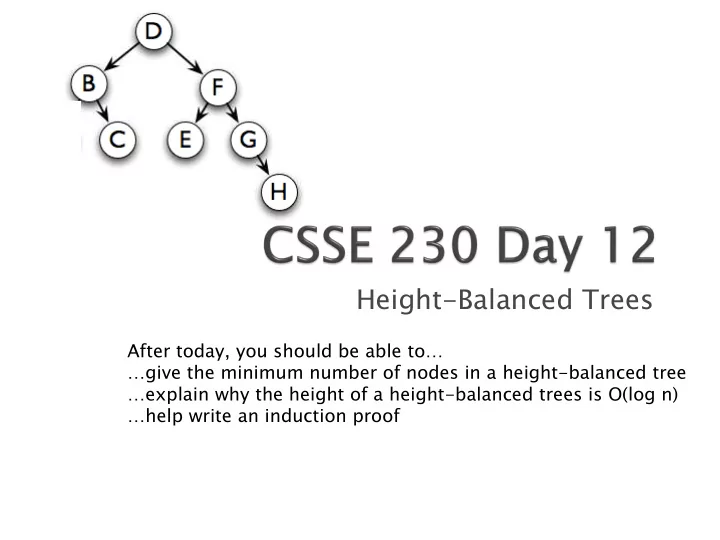
Height-Balanced Trees After today, you should be able to give the - - PowerPoint PPT Presentation

height balanced trees
SMART_READER_LITE
LIVE PREVIEW

Height-Balanced Trees After today, you should be able to give the - - PowerPoint PPT Presentation

Height-Balanced Trees After today, you should be able to give the minimum number of nodes in a height-balanced tree explain why the height of a height-balanced trees is O(log n) help write an induction proof Can voice preferences


slide-1
SLIDE 1

Height-Balanced Trees

After today, you should be able to… …give the minimum number of nodes in a height-balanced tree …explain why the height of a height-balanced trees is O(log n) …help write an induction proof

slide-2
SLIDE 2

 Can voice preferences for partners for the term

project (groups of 3, starting Thursday)

  • EditorTrees partner preference survey on Moodle

 Preferences balanced with experience level + work ethic

 If course grades close, I’ll honor mutual prefs.  If no mutual pref, best to list several potential members.  If you don’t want to work with someone, I’ll honor that. But if your homework or exam average is low, I will put you with

  • thers in a similar position. Sorry if that’s not your

preference, but I can’t burden someone who is doing well with someone who isn’t.

 Consider asking potential partners these things:

 Are you aiming to get an A, or is less OK?  Do you like to get it done early or to procrastinate?  Do you prefer to work daytime, evening, late night?  How many late days do you have left?  Do you normally get a lot of help on the homework?

  • If you don’t reply by tomorrow at 5:00 pm, no problem;

I’ll just assign you.

slide-3
SLIDE 3

 Announcements

  • Final exam: Weds, 11/18, 8:00 am. If you have a

conflict, let me know by Friday.

  • EditorTrees partner preference survey on Moodle
  • HW5 “late day” is extended until Friday of Fall break

 Another induction example  Recap: The need for balanced trees  Analysis of worst case for height-balanced

(AVL) trees

slide-4
SLIDE 4

 Recall our definition of the Fibonacci

numbers:

  • F0 = 0, F1 = 1, Fn+2 = Fn+1 + Fn

 An exercise from the textbook Recall: How to show that property P(n) is true for all n≥n0: (1) Show the base case(s) directly (2) Show that if P(j) is true for all j with n0≤j<k, then P(k) is true also Detai ails s of s step 2:

  • a. Write down the induction assumption for this specific problem
  • b. Write down what you need to show
  • c. Show it, using the induction assumption

Q1 Q1

slide-5
SLIDE 5
slide-6
SLIDE 6
slide-7
SLIDE 7

 BST algorithms are O(h(T))  Minimum value of h(T) is  Can we rearrange the tree after an insertion

to guarantee that h(T) is always minimized?

Q2 Q2

slide-8
SLIDE 8

 Height of the tree can vary from log N to N  Where would J go in this tree?  What if we keep the tree perfectly balanced?

  • so height is always proportional to log N

 What does it take to balance that tree?  Keeping completely balanced is too expensive:

  • O(N) to rebalance after insertion or deletion

rebalance

Solution: Height Balanced Trees (less is more)

Q3 Q3

slide-9
SLIDE 9

Q4 Q4

More precisely , a binary tree T is height balanced if

T is empty, or if

| h hei eight ght( ( TL ) ) - hei eight ght( ( TR ) |  1, and TL

L and TR are both height balanced.

Still height-balanced?

slide-10
SLIDE 10

A binary search tree T is height balanced if

T is empty, or if

| height( ht( TL ) ) - height ght( TR ) | |  1, and TL

L and TR are both height balanced.

Q5 Q5

Is it taller than a completely balanced tree?

  • Consider the dual concept: find the minimum

number of nodes for height h.

slide-11
SLIDE 11

 Named for authors of original paper,

Adelson-Velskii and Landis (1962).

 Max. height of an AVL tree with N nodes is:

H < 1. H < 1.44 log (N g (N+2) ) – 1.328 = O(log g N)

Q 6 6-7

slide-12
SLIDE 12

 Why?  Worst cases for BST operations are O(h(T

h(T)) ))

  • find, insert, and delete

 h(T) can vary from O(log

g N) to O(N)

 Height of a height-balanced tree is O(log

g N) N)

 So if we can rebalance after insert or delete in

O(log g N) N), then all operations are O(log g N) N)

Q8 Q8