/ AVL trees and rotations Q1 Q1 Operations (insert, delete, - - PowerPoint PPT Presentation

avl trees and rotations q1 q1 operations insert delete
SMART_READER_LITE
LIVE PREVIEW

/ AVL trees and rotations Q1 Q1 Operations (insert, delete, - - PowerPoint PPT Presentation

/ AVL trees and rotations Q1 Q1 Operations (insert, delete, search) are O(height) Tree height is O(log n) if perfectly balanced But maintaining perfect balance is O(n) Height-balanced trees are still O(log n) For T with


slide-1
SLIDE 1

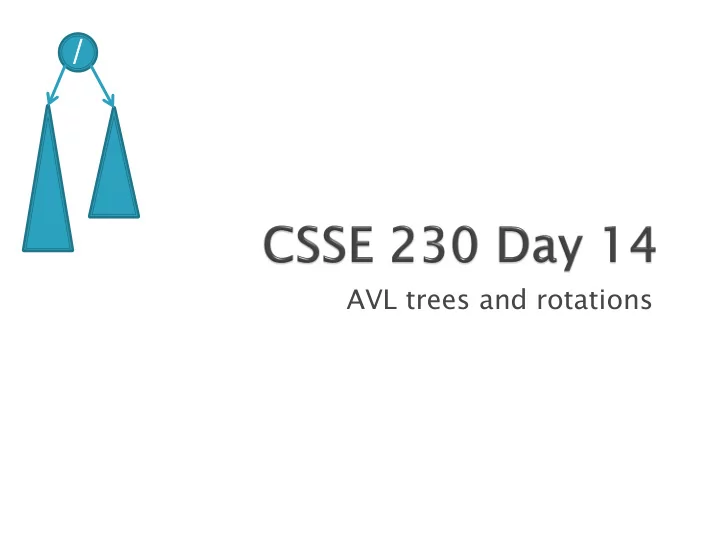
AVL trees and rotations

/

slide-2
SLIDE 2

 Operations (insert, delete, search) are

O(height)

 Tree height is O(log n) if perfectly

balanced

  • But maintaining perfect balance is O(n)

 Height-balanced trees are still O(log n)

  • For T with height h, N(T) ≤ Fib(h+3) – 1
  • So H < 1.44 log (N+2) – 1.328 *

 AVL (Adelson-Velskii and Landis) trees

maintain height-balance using rotations

 Are rotations O(log n)? We’ll see…

Q1 Q1

slide-3
SLIDE 3

Different representations for / = \ :

 Just two bits in a low-level language  Enum in a higher-level language

  • r
  • r

/ = \

  • r
  • r
slide-4
SLIDE 4

 Assume tree is height-balanced before

insertion

 Insert as usual for a BST  Move up from the newly inserted node

to the lowest “unbalanced” node (if any)

  • Use the ba

balance c code

  • de to detect unbalance -

how?

 Do an appropriate rotation to balance

the sub-tree rooted at this unbalanced node

/

slide-5
SLIDE 5

 For example, a single left rotation:

slide-6
SLIDE 6

 Two basic cases

  • “See saw” case:

 Too-tall sub-tree is on the outside  So tip the see saw so it’s level

  • “Suck in your gut” case:

 Too-tall sub-tree is in the middle  Pull its root up a level

slide-7
SLIDE 7

Dia iagrams a are re f fro rom Data S Structu ctures by E E.M.

  • M. Reingold

ld and W.J W.J. Hanse sen

Unbalanced node Middle sub-tree attaches to lower node

  • f the “see saw”

Q2-3

slide-8
SLIDE 8

Weiss calls this “right-left double rotation” Unbalanced node Pulled up Split between the nodes pushed down Q4 Q4-5

slide-9
SLIDE 9

 Write the method:

 static BalancedBinaryNode singleRotateLeft (

BalancedBinaryNode parent, /* A */ BalancedBinaryNode child /* B */ ) { }

 Returns a reference to the new root of this subtree.  Don’t forget to set the balanceCode fields of the nodes.

Q6 Q6

slide-10
SLIDE 10

 Write the method:

 BalancedBinaryNode doubleRotateRight (

BalancedBinaryNode parent, /* A */ BalancedBinaryNode child, /* C */ BalancedBinaryNode grandChild /* B */ ) { }

 Returns a reference to the new root of this subtree.  Rotation is mirror image of double rotation from an

earlier slide

slide-11
SLIDE 11

 Both kinds of rotation leave height the same

as before the insertion!

 Is insertion plus rotation cost really O(log N)? Q7 Q7-10 10

Insertion/deletion in AVL Tree: O(log n) Find the imbalance point (if any): O(log n) Single or double rotation: O(1) in deletion case, may have to do O(log N) rotations Total work: O(log n)

slide-12
SLIDE 12

Depends on the first two links in the path from the lowest node that has the imbalance (A) down to the newly-inserted node.

First link (down from A) Second link (down from A's child) Rotation type (rotate "around A's position") Left Left Single right Left Right Double right Right Right Single left Right Left Double left

slide-13
SLIDE 13

Insert HA into the tree, then DA, then O. Delete G from the original tree, then I, J, V.

slide-14
SLIDE 14

 Star

tart w with ith a an emp mpty A AVL VL tre tree.

 Add elements in the following order; do

the appropriate rotations when needed.

  • 1 2 3 4 5 6 11 13 12 10 9 8 7

 How should we rebalance if each of the

following sequences is deleted from the above tree?

  • ( 10 9 7 8 ) ( 13 ) ( 1 5 )
  • For each of the three sequences, start with the
  • riginal 13-element tree. E.g. when deleting

13, assume 10 9 8 7 are still in the tree.

Work

  • rk w

with ith y you

  • ur Dou

r Doublets pa partn rtner. When you

  • u f

fin inis ish, w work

  • rk on
  • n Dou

Doublets or

  • r WA5.

Or r write rite th the rotate teDou Double bleRigh ight code

  • de f

fro rom a a pre previous slide lide

slide-15
SLIDE 15