SLIDE 1
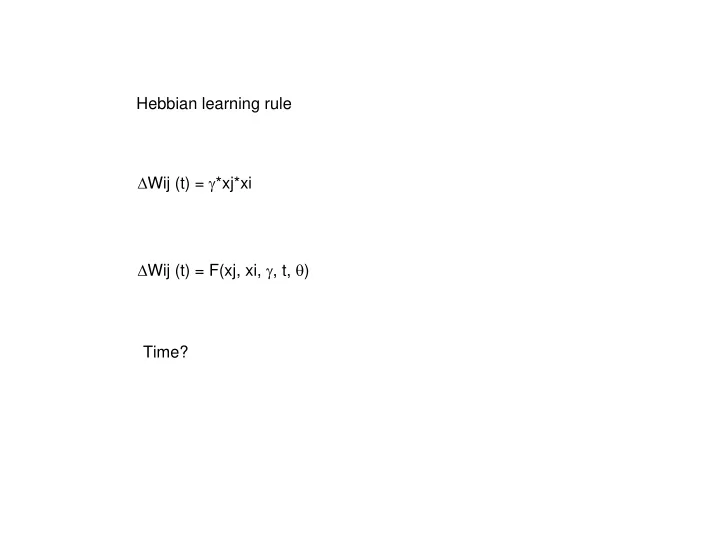
ΔWij (t) = γ*xj*xi Hebbian learning rule ΔWij (t) = F(xj, xi, γ, t, θ) Time?
SLIDE 2 Σ
tone airpuff eyeblink
Σ
tone airpuff eyeblink time airpuff tone weight airpuffeyeblink weight
SLIDE 3
What is an association? Pavlov: Eye blink: Other:
SLIDE 4 Linear associator: Notations and vectors
- 1. One postsynaptic neuron:
- 2. Many postsynaptic neurons:
SLIDE 5 xi = Ii xi = Σwij xj Δwij = γ * gi * fj
Write out for 3 pre and 3 post neurons
SLIDE 6 ⎥ ⎥ ⎥ ⎥ ⎥ ⎥ ⎥ ⎥ ⎦ ⎤ ⎢ ⎢ ⎢ ⎢ ⎢ ⎢ ⎢ ⎢ ⎣ ⎡ = fn . . fj 2 f 1 f f ⎥ ⎥ ⎥ ⎥ ⎥ ⎥ ⎥ ⎥ ⎦ ⎤ ⎢ ⎢ ⎢ ⎢ ⎢ ⎢ ⎢ ⎢ ⎣ ⎡ = gn . . gi 2 g 1 g g
Δwij = γ * gi * fj Pre post
[ ]
fn ... fi ,.. 2 f , 1 f gn . . gj 2 g 1 g ⎥ ⎥ ⎥ ⎥ ⎥ ⎥ ⎦ ⎤ ⎢ ⎢ ⎢ ⎢ ⎢ ⎢ ⎣ ⎡ = γ =
f
T
g w
⎥ ⎥ ⎥ ⎥ ⎦ ⎤ ⎢ ⎢ ⎢ ⎢ ⎣ ⎡ = = = = = = = = fngn wnn ... gnf2 w2n 1 gnf 1 wn 1 f 2 g 21 w g1fn w1n ... g1f2 w12 1 f 1 g 11 w w
SLIDE 7
SLIDE 8 layer f layer g f1 f2 fj fn g1 g2 gi gn weight matrix w w11 w12 w1n g1 = x(f1) w11 + x(f2) w12 ... x(fj) w1j ... + x(fn) w1n gi = x(f1) wi1 + x(f2) wi2 ... x(fj) wij ... + x(fn) win etc ..
SLIDE 9 Olfactory system Auditory system Grandmother baking cookies and talking
SLIDE 10 Olfactory system Auditory system Grandmother baking cookies and talking
Δwij = γ * gi * fj.
SLIDE 11 Olfactory system Auditory system Cookies
x(gi) = Σ wij * x(fj)
SLIDE 12
Olfactory system Auditory system Bread
x(gi) = Σ wij * x(fj)
SLIDE 13 Olfactory system Auditory system Cookies
x(gi) = Σ wij * x(fj)
SLIDE 14 Olfactory system Auditory system Aunt cooking stew and talking
SLIDE 15 Olfactory system Auditory system Aunt baking cookies and talking
Grandmother’s voice recalled!
SLIDE 16 Calculate example here
SLIDE 17 input from olfactory bulb feeback interactions (association fibers intrinsic cnnection)
SLIDE 18 input from olfactory bulb feeback interactions (association fibers intrinsic cnnection)
SLIDE 19 input from olfactory bulb feeback interactions (association fibers intrinsic cnnection)
SLIDE 20
SLIDE 21 "Hopfield networks", which have a recurrent structure and the development of which is inspired by statistical physics. They share the following features: Nonlinear computing units (or neurons) Symmetric synaptic connections (wij = wji) No connections of a neuron on itself (wii = 0) Abundant use of feedback (usually, all neurons are connected to all
(Feedback means that a neurons sends a synapse to a neuron it also receives a signal from, so that there is a closed loop).
SLIDE 22 state] previous its in remains j unit [if if 1
1 { and *
v v v x x w v
i N 1 j i i i j ij i
= < > + = = ∑
=
j i if j i if * N 1
w x x w
ij j i ij
= = ≠ =
∑∑
= =
− =
N 1 i N 1 j j i ij
* * 2 1 E
v v w
SLIDE 23 Initial condition Trajectory Minimum
SLIDE 24 N1 N2 w12 w21 v1, v2, v3: inputs to neuron 1, 2 x1, x2, x3: outputs of neuron 1,2 w12, w21 etc: connection strength N3 w13 w31 w32 w23
Show that (1,1,1) is stable when all w = 1
SLIDE 25 N1 N2 w12 w21 v1, v2, v3: inputs to neuron 1, 2 x1, x2, x3: outputs of neuron 1,2 w12, w21 etc: connection strength N3 w13 w31 w32 w23
Show that (-1,-1,-1) is stable when all w = 1
SLIDE 26 Initial condition Trajectory Minimum
Explain attractor and basin of attraction
SLIDE 27
E(1,1,1) = -3 E(-1,-1,-1) = -3 E(-1,1,-1) = 1 E(1,-1,1) = 1 E(-1,1,1)=1 (-1,-1,1) E(1,-1,-1) = 1 (1,1,,-1)
SLIDE 28 Calculate example from notes
SLIDE 29
Does it work well? Is it realistic?
SLIDE 30
Show matlab simulation