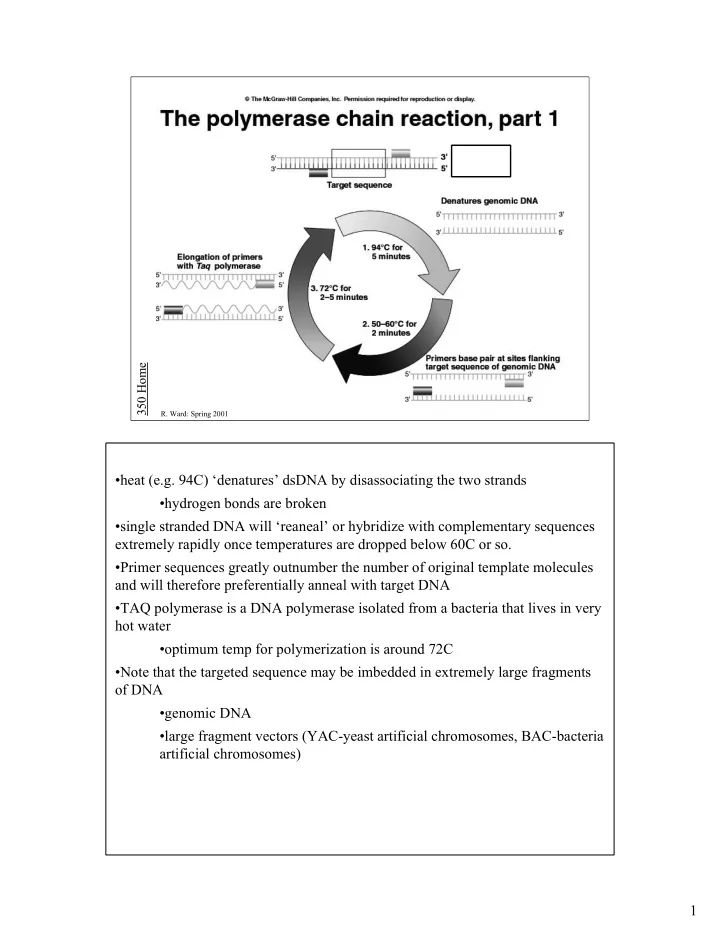
heat (e.g. 94C) denatures dsDNA by disassociating the two strands - - PDF document

heat e g 94c denatures dsdna by disassociating the two
SMART_READER_LITE
LIVE PREVIEW

heat (e.g. 94C) denatures dsDNA by disassociating the two strands - - PDF document

350 Home R. Ward: Spring 2001 heat (e.g. 94C) denatures dsDNA by disassociating the two strands hydrogen bonds are broken single stranded DNA will reaneal or hybridize with complementary sequences extremely rapidly once


slide-1
SLIDE 1

1

  • R. Ward: Spring 2001

350 Home

  • heat (e.g. 94C) ‘denatures’ dsDNA by disassociating the two strands
  • hydrogen bonds are broken
  • single stranded DNA will ‘reaneal’ or hybridize with complementary sequences

extremely rapidly once temperatures are dropped below 60C or so.

  • Primer sequences greatly outnumber the number of original template molecules

and will therefore preferentially anneal with target DNA

  • TAQ polymerase is a DNA polymerase isolated from a bacteria that lives in very

hot water

  • optimum temp for polymerization is around 72C
  • Note that the targeted sequence may be imbedded in extremely large fragments
  • f DNA
  • genomic DNA
  • large fragment vectors (YAC-yeast artificial chromosomes, BAC-bacteria

artificial chromosomes)

slide-2
SLIDE 2

2

  • R. Ward: Spring 2001

350 Home

  • after the first few cycles, most of the templates molecules are copies created

during the previous cycles of PCR.

  • all products or amplicons begin and end with primer sequences or their

complement

slide-3
SLIDE 3

3

  • R. Ward: Spring 2001

350 Home

PCR: Polymerase Chain Reaction: in vitro Selective exponential amplification (replication) of a defined sequence

  • f DNA

Requirements: DNA template that has the targeted sequence

  • genomic DNA (all there is from a plant)
  • small or large fragment clones

you know the bp sequence (15 or more bp) of the sequences flanking

the subsequence you want to amplify

  • ligonucleotide “primer” sequences complementary to the template

terminal sequences

Thermal-stable DNA polymerase (Taq)

  • active at 70C, and not denatured at 95C

all four deoxy-nucleotides (dNTP) “thermal cycler” unit to cyclically vary temperature with a defined

sequence and timing

See pages 294 and 295 in your text book. Notes:

slide-4
SLIDE 4

4

  • R. Ward: Spring 2001

350 Home

MSU PCR reaction steps for Wheat Microsatellite amplification

1. 95C 3 min. Denature 95C 25s anneal 55C (variable) 25s Extension (polymerize) 72C 45s 38 cycles 2.

  • 3. 72C 10 min
slide-5
SLIDE 5

5

  • R. Ward: Spring 2001

350 Home

TACCTACGTA AATTGGCCTT -5’ P: 3’- G1: 5’-ATGGATGC

FORWARD PRIMER

TTGGCCTT- 5’

REVERSE PRIMER

AT G1: 3’ -TACGTACGTA TTAACCGGAA -3’ AT ATGCATGCAT TTAACCGGAA P: 5’-

  • 3’

Reanneal and Polymerize 55C 25s, then 72C 25s III. ATGCATGCAT TTAACCGGAA P: 5’-

  • 3’

TACCTACGTA AATTGGCCTT -5’ P: 3’- Start I. ds Template DNA Denature ( 94C) TACCTACGTA AATTGGCCTT -5’ 3’- ATGCATGCAT TTAACCGGAA 5’-

  • 3’

II. ss Template DNA

slide-6
SLIDE 6

6

  • R. Ward: Spring 2001

350 Home

TACCTACGTA AATTGGCCTT -5’ P: 3’- TTGGCCTT- 5’ AT G1: 3’ -TACGTACGTA G1: 5’-ATGGATGC TTAACCGGAA -3’ AT ATGCATGCAT TTAACCGGAA P: 5’-

  • 3’

FORWARD PRIMER

TTGGCCTT- 5’

REVERSE PRIMER

AT G2: 3’ -TACGTACGTA G2: 5’-ATGGATGC

FORWARD PRIMER

TTAACCGGAA -3’ AT TTGGCCTT- 5’

REVERSE PRIMER

AT G2: 3’ -TACGTACGTA G2: 5’-ATGGATGC TTAACCGGAA -3’ AT

slide-7
SLIDE 7

7

  • R. Ward: Spring 2001

350 Home

PCR products

All “amplicons” or amplified fragments are

identical in length

and start and end with the primer sequences

# molecules of product vastly outnumbers the

number of initial template molecules

primers or nucleotides can be labeled for

subsequent auto-detection

slide-8
SLIDE 8

8

  • R. Ward: Spring 2001

350 Home

PCR Products (II)

different sources of template can be amplified

if they are complementary to the 3’ ends of both primers- even if they differ in the intervening sequences

exclusion of one primer results in a linear

increase in copies of one strand of a template duplex

slide-9
SLIDE 9

9

  • R. Ward: Spring 2001

350 Home

PCR: Ingredients

Template DNA Nucleotides (in great excess) Taq polymerase All in a single tube “eppendorf tube” forward and reverse primers (in great excess) plus buffer solution

slide-10
SLIDE 10

10

  • R. Ward: Spring 2001

350 Home

Multi-channel pipetter

slide-11
SLIDE 11

11

  • R. Ward: Spring 2001

350 Home

Tip attachment with Multi-chnnel pipetter

slide-12
SLIDE 12

12

  • R. Ward: Spring 2001

350 Home

96 well PCR plate

slide-13
SLIDE 13

13

  • R. Ward: Spring 2001

350 Home

MJ Quad PCR unit: 4 x 96 reactions