HCV in the era of Direct Acting Antiviral (DAA) Therapy Impact on - - PDF document

hcv in the era of direct acting antiviral daa therapy
SMART_READER_LITE
LIVE PREVIEW

HCV in the era of Direct Acting Antiviral (DAA) Therapy Impact on - - PDF document

Disclosure I have no relevant financial relationships with any companies related to the content of this course. HCV in the era of Direct Acting Antiviral (DAA) Therapy Impact on transplant candidates and recipients Lisa Catalli MSN, NP-C


slide-1
SLIDE 1

HCV in the era of Direct Acting Antiviral (DAA) Therapy

9/17/2018

Lisa Catalli MSN, NP-C

Impact on transplant candidates and recipients Disclosure

I have no relevant financial relationships with any companies related to the content of this course.

3

Objectives

  • Discuss the goals of DAA therapy in waitlisted patients with HCV

decompensated cirrhosis and the challenges regarding appropriate timing of treatment.

  • Explore how DAAs offer the opportunity to expand the organ donor

pool.

  • Review the guidance from International Societies regarding HCV

positive grafts for HCV +/- recipients

  • Discuss future research challenges to study the use DAAs at various

time points during the transplant continuum in patients with highest clinical need for organ transplantation

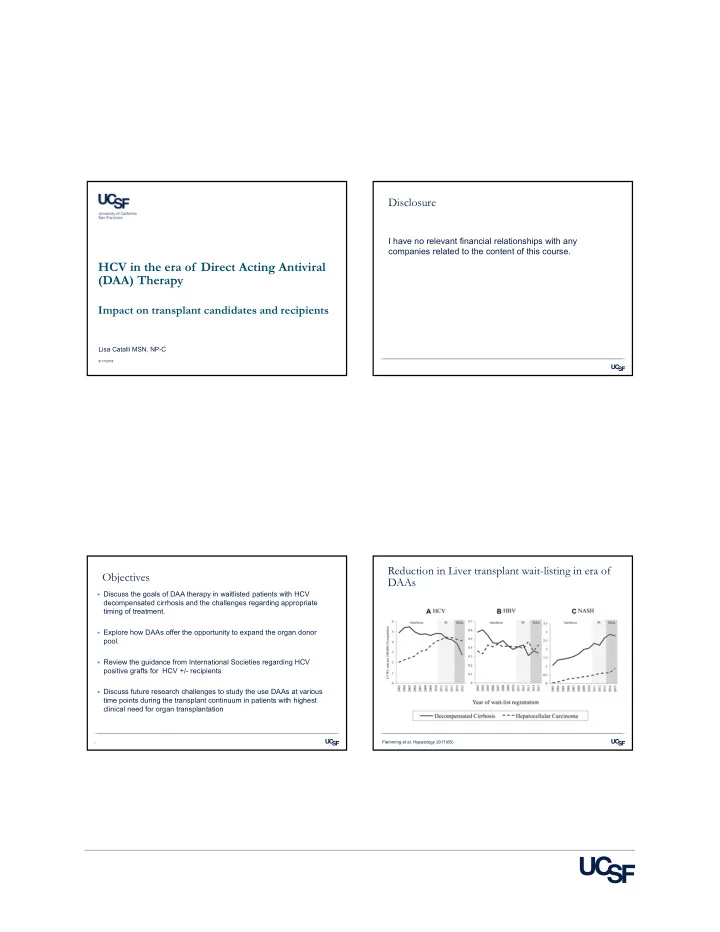
Reduction in Liver transplant wait-listing in era of DAAs

Flemming et al. Hepatology 2017(65)

slide-2
SLIDE 2

5

Clinical cases: which transplant candidate would you treat now?

Patient A: 59 year old woman with HCV GT 3 decompensated cirrhosis (CPT B) with ascites, blood type O, MELD 15 Patient B: 59 year old woman with HCV GT 3 decompensated cirrhosis (CPT B) with ascites, blood type O with HCC exception points MELD 28 Patient C: 62 year old man with HCV GT 1 decompensated cirrhosis and HRS, listed for combined liver/kidney blood type AB, MELD 29

HCV treatment in liver transplant candidates should be individualized

Key question: will patient achieve clinical benefit from HCV eradication? Treatment goals for decompensated patients with HCV:

1.

Stabilize liver disease, improve QOL, promote delisting

2.

Prevent HCV recurrence post transplant

3.

Prevent waitlist drop off due to worsening decompensation Treat selectively and individualized, considering:

  • Anticipated time to transplantation
  • Access to living donor LT

Terrault et al. Transplantation 107; 101: 945-955; Belli et al J Hepatol 2017; 101: 945-955 EASL guidelines J Hepatol 2018 69: 461-511

Presentation Title 7

Clinical cases: which transplant candidate would you treat now?

Patient A: 59 year old woman with HCV GT 3 decompensated cirrhosis (CPT B) with ascites, blood type O, MELD 15 Patient B: 59 year old woman with HCV GT 3 decompensated cirrhosis (CPT B) with ascites, blood type O with HCC exception points MELD 28 Patient C: 62 year old man with HCV GT 1 decompensated cirrhosis and HRS, listed for combined liver/kidney blood type AB, MELD-Na of 29

What are treatment options for patients with Decompensated Cirrhosis?

Case A: HCV GT3 woman with decompensated cirrhosis (CPB) with ascites, MELD 15

Sofosbuvir-Ledipasvir + RBV for 12 weeks GT 1,4-6 Sofosbuvir-Ledipasvir + RBV for 12 weeks GT 1,4-6 Sofosbuvir-Velpatasvir + RBV for 12 weeks GT 1-6 NS5a failure Sofosbuvir-Velpatasvir + RBV for 24 weeks OR Ledipasvir-Sofosbuvir + RBV x 24 weeks (GT 1, 4, 5, 6

  • nly)

NS5a failure Sofosbuvir-Velpatasvir + RBV for 24 weeks OR Ledipasvir-Sofosbuvir + RBV x 24 weeks (GT 1, 4, 5, 6

  • nly)

RBV ineligible Sofosbuvir-Velpatasvir x 24 weeks OR Sofosbuvir-Ledipasvir x 24 weeks (GT 1, 4, 5, 6 only) RBV ineligible Sofosbuvir-Velpatasvir x 24 weeks OR Sofosbuvir-Ledipasvir x 24 weeks (GT 1, 4, 5, 6 only)

AASLD-IDSA Hepatitis C Guidance, HCVguidelines.org. Accessed August 31, 2018 Charlton M, N Engl J Med. 2015;373:2618-28

Protease Inhibitors (PIs) contraindicated in patients with CPT B/C

RBV should be included in treatment of all patients with decompensated cirrhosis, especially G3

SVR of CPB GT3: with RBV ~ 85% without RBV ~ 50%
slide-3
SLIDE 3

Which patients may be able to avoid liver transplant?

Patients with a baseline MELD <16 have a 50% chance of delisting Patients with a baseline MELD >20 with only 15% chance of delisting

Belli, et al. J Hepatology 2016; 65:524-531.

DAA therapy has led to clinical benefit in select liver transplant candidates

European (ELTR/ELITA) registry study > 60,000 pts

  • 50% reduction in liver transplants for HCV

decompensated cirrhosis after DAAs

  • 30% of decompensated cirrhosis with MELD < 20

delisted due to clinical improvement after HCV clearance from DAAs UCSF CP B/C Cohort: 204 CP B/C pts without HCC who achieved SVR:

  • 26% of CP B/C patients re-compensated
  • 36% still decompensated “MELD Purgatory”
  • 17% deaths, 13% transplanted
  • Patients with more severe portal HTN at BL were

more likely to end up in MELD purgatory

Belli L et al, J Hepatol 2018, in press Radhakrishnan et al. accepted abstract AASLD 2018

Is There a “Point of No Return” for Patients with Decompensated Cirrhosis?

Primary reasons:

  • Insufficient time to improve

(before worsening decompensation, HCC or death

  • Inability to regenerate, repair

and reverse Almost certainly yes…..

Slide courtesy of Norah Terrault MD. El-Sherif et al., Gastro 2018, 154(8) 2111-2121

Impact of SVR on waitlist mortality and liver transplant

Achieving SVR is associated with lower likelihood of death and transplantation

slide-4
SLIDE 4

Baseline predictors associated with improvements after SVR in CP B/C cirrhosis

Category Findings Score BMI < 25 kg/m2 1 Encephalopathy No 1 Ascites No 1 ALT >1.5xULN 1 Albumin >3.5g/dL 1

BE3A score- baseline factors:

El-Sherif et al., Gastro 2018, 154(8) 2111-2121

Future challenge: Defining Who on the Waiting List Should NOT be Treated

Consider pre-treatment predictors when trying to determine whether or not to treat decompensated patients

  • MELD, severity of PHT complications, BE3A score

There are clues from available data but additional markers needed…

  • More studies need to capture delisting, MELD purgatory

AND wait-list mortality if untreated

Belli et al. J Hepatol 2018 in press; Curry et al. N Engl J Med. 2015; 373:2618-2628,

15

Clinical scenario, patient B

Patient B: 59 year old woman with HCV GT3 decompensated cirrhosis (CPB) with ascites, Blood type O, with HCC exception points MELD 28.

  • Ascites is refractory to diuretics
  • HCC still within Milan and likely has > 6-12 month wait

to LT.

  • You discuss options living donation but she has no living

donor.

You recommend deferring DAA therapy, and consent for high risk donor

  • ption to receive liver from donor with HCV

Timing of DAAs in patients listed for liver transplant

Cirrhosis

MELD STATUS

< 20 ≥ 20 DAA LT LT DAA post-LT HCC + Cirrhosis

Priority of LT

< 3-6 mo ≥ 6 mo

Slide courtesy of Norah Terrault MD Terrault N et al, Transplantation. 2017;101(5); Belli et al J Hepatol 2017; 101: 945-955

slide-5
SLIDE 5

17

Deferring treatment after organ transplant

Patient C: 62 year old man with HCV GT 1 decompensated cirrhosis and HRS, listed for combined liver/kidney Blood type AB, MELD 28

  • His HRS has progressed to CKD and he is now on HD
  • Note: No currently no FDA approved treatment option for

a decompensated patient with CrCl < 30ml/min.

You recommend deferring DAA therapy, and consent for high risk donor

  • ption to receive liver/kidney from donor with HCV

Use of HCV + donors in organ transplantation is changing

Proportion of patients who received HCV+ LT increased by 10% from 2010 to 2015 Discard rate declined from 28% to 11%

Levitsky et al. American J of Transplantation 2017. 17; 2790-2802; Bushyhead and Goldberg. Current Hepatol Reports 2017 16(1) 12-17

Median age of donors has decreased from 47 y.o. to 35 y.o

Guidance from International Societies Anti-HCV seropositive donor HCV viremic recipient

AST: The use of HCV+ donors in HCV viremic recipients is acceptable in routine clinical practice ILTS: Recommends the use of HCV+ grafts in HCV viremic recipients Caveats:

  • Anti HCV positive donors should be restricted to patients with high

clinical need.

  • Quality of graft should be carefully evaluated--younger donors, < F2

fibrosis

  • Since 2014, OPTN recommends HCV NAT testing, but if results not

available, consider organ to be HCV viremic

Levitsky et al. American J of Transplantation 2017. 17; 2790-2802 Bowring et al. Am J Transplant 2017; 17:519-527 Terrault N et al, Transplantation. 2017;101(5);

Guidance from International Societies HCV seropositive donor HCV PCR negative recipient

Suggest a limited use of anti-HCV positive grafts in anti-HCV or HCV RNA negative recipients. IRB approval needed to discuss risks with informed consent and recommend very early DAA therapy.

Levitsky et al. American Jounal of transplantation 2017; 17: 2790-2802; Terrault et al. Transplantation 2017

“DAA therapy makes the expansion of transplanting HCV seropositive donors into non-viremic recipients a possibility and can save lives. Urgent need exists for prospective research protocols that study the risk versus benefit of using organs from HCV infected donors”

slide-6
SLIDE 6

Transplant

Effective Use of Antivirals Can Prevent Graft Loss

Prevent graft infection and/or need for LT Pre‐Transplant Antiviral Therapy Prevent infection or hepatitis Prevent cirrhosis and graft failure

Listed Chronic hepatitis Graft loss Acute hepatitis

Prophylactic and Preemptive Therapies Antiviral therapy for recurrent disease

Multiple potential time‐points to intervene

x

DAA therapy and Impact on Survival of Transplant recipients

  • In the IFN era, post-transplant treatment was deferred until

evidence of significant fibrosis (F2 or higher) or severe cholestatic recurrence

  • Now, guidelines recommend treating earlier post-LT as

earlier treatment is possible with DAA therapy

  • Typically within first 3 months – ILTS
  • 3-6 months post-LT – ELITA
  • When patient is “clinically stable” and with stable IMS

Belli et al., J Hepatol 2018 in Press; Terrault N et al, Transplantation. 2017;101(5); Belli et al J Hepatol 2017; 101: 945-955

European Liver Transplant Registry: Since 2014, The 3-year post LT transplant survival has increased from 65% to 76% (comparable to post transplant pts with HBV)

Pan genotypic regimens in post organ transplant recipients

80 liver transplant recipients 20 kidney transplant recipients Mostly low stage fibrosis, no pts had cirrhosis Mostly on tacrolimus for IMS Reau et al. J Hepatol 2017; 66(1) S90-91

Glecaprevir/pibrentasvir for 12 weeks for transplant recipients

Protease Inhibitor(PI)-containing regimen DDI: Csa > 100mg per day not recommended with G/P

Pangenotypic regimen post liver transplant recipients

Sofosbuvir/velpatasvir for 12 weeks for transplant recipients

  • 3 patients did not achieve SVR: one early D/C and 2 relapses
  • 4/4 patients with baseline Y93H RASs (3 GT 3 and 1 GT 1b) achieved SVR12
  • No changes in immunosuppression were needed for rejection or suspected drug-drug interactions

Agarwal et al. J Hepatol 2018; 69(3) 603-607

DDI: PPI use discouraged, prefer D/C PPI or substitute with H2 blocker

slide-7
SLIDE 7

SOF/LDV still an option for GT 1,4-6 post transplant recipients—HCV TARGET Real World Experience

89.5

92.7

20 40 60 80 100 SOF/LDV

No RBV With RBV

Saxena V et al., Hepatology 2017; HCVguidelines.org. Accessed August 31, 2018

N=378, 48% received RBV

  • 53% Rx-experienced
  • 44% cirrhosis, 26% hx of decompensation

*Minimally adjusted for age, sex and cirrhosis

Factors Predictive of SVR

SVR

Although AASLD recommends + RBV, may consider SOF/LDV alone for early fibrosis

What About Preemptive HCV Therapy for liver transplant recipients?

  • Phase 2, multicenter, open-label study

in US (CRUSH-C), N=16

  • Key eligibility criteria:
  • Chronic HCV GT 1 or 4
  • Receipt of organ from an anti-

HCV negative donor

  • No concurrent HIV or HBV
  • No prior exposure to HCV NS5A

inhibitors

  • Creatinine clearance ≥30 mL/min

at screening and LT

Leviksky J, N Engl J Med, 2016; 375:2106-2018

1 Week 4 Week 16 Day −1

SVR12 1 dose LDV/SOF

Liver Transplant

14/16 Overall

1 discontinued Week 1 1 relapse

*Patient with relapse was retreated with LDV/SOF for 12 weeks and achieved SVR12

Preemptive Therapy for HCV Liver Transplant Recipients

  • Potential advantages of preemptive therapy
  • likely most cost-effective strategy
  • UCSF protocol for HCV D-/R+  SOF/VEL x 4 weeks “CRUSH”
  • UCSF protocol for HCV D+/R+ SOF/VEL x 12 weeks
  • Caveats:
  • Need CrCl >30 ml/min to use a SOF-based regimen
  • Centers are currently studying HCV + donor
  • What do the guidelines say?
  • Should be used selectively – ILTS
  • Not recommended on routine basis, consider early DAA treatment

before biochemical manifestations -ELITA

Terrault et al, Transplantation. 2017;101(5):956-967; Belli et al J Hepatol 2017; 101: 945‐955.

Risk of Rejection in Context of HCV Therapy

  • Interferon was associated with

allograft complications

  • AR/CR
  • Plasma cell (or alloimmune)

hepatitis

  • DAA therapy not directly associated

with these risks

  • Decline in IMS levels in association

with viral clearance reported  risk

  • f rejection if IMS doses not

adjusted

  • Immunologic graft dysfunction (IGD)

after DAAs occurred in 3.4% (median time 76 days post DAA) in multicenter study

Lai & Terrault, Plasma Cell Hepatitis, Zakim and Boyer 8th edition; Chan et al. Am J Transplant 2018: 1‐7

slide-8
SLIDE 8

29

SUMMARY

  • DAAs are changing the landscape of organ transplantation and should

be used selectively in decompensated waitlisted patients

  • More research needed to capture data on delisting, MELD purgatory

and waitlist mortality for treated/untreated patients with decompensated cirrhosis

  • HCV positive grafts for HCV viremic patients is recommended and pre-

emptive pan-genotypic DAA therapy offers an opportunity for significant cost savings

  • Use of HCV seropositive grafts for non-viremic recipients is currently

being entertained in the setting of prospective research protocols with very early pan-genotypic DAA therapy

  • Although post-transplant pan-genotypic DAA therapy has become

simplified without need for RBV in most patients, it still requires close monitoring of IMS levels and laboratory work to rule out rejection/IGD