Hastings Opportunity Area: Initial work was undertaken with - - PowerPoint PPT Presentation

hastings opportunity area
SMART_READER_LITE
LIVE PREVIEW

Hastings Opportunity Area: Initial work was undertaken with - - PowerPoint PPT Presentation

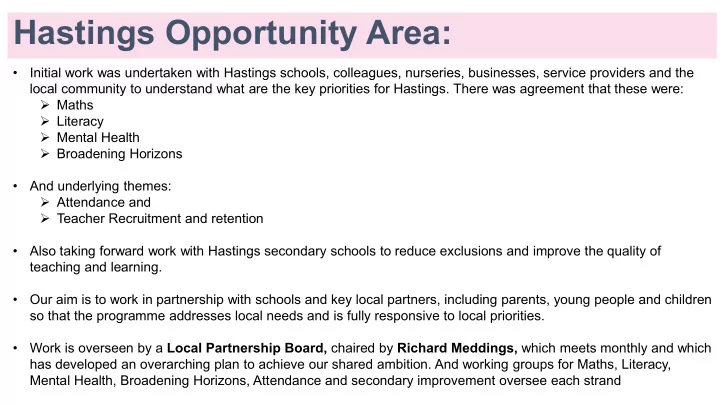
Hastings Opportunity Area: Initial work was undertaken with Hastings schools, colleagues, nurseries, businesses, service providers and the local community to understand what are the key priorities for Hastings. There was agreement that these


slide-1
SLIDE 1

Hastings Opportunity Area:

  • Initial work was undertaken with Hastings schools, colleagues, nurseries, businesses, service providers and the

local community to understand what are the key priorities for Hastings. There was agreement that these were:

  • Maths
  • Literacy
  • Mental Health
  • Broadening Horizons
  • And underlying themes:
  • Attendance and
  • Teacher Recruitment and retention
  • Also taking forward work with Hastings secondary schools to reduce exclusions and improve the quality of

teaching and learning.

  • Our aim is to work in partnership with schools and key local partners, including parents, young people and children

so that the programme addresses local needs and is fully responsive to local priorities.

  • Work is overseen by a Local Partnership Board, chaired by Richard Meddings, which meets monthly and which

has developed an overarching plan to achieve our shared ambition. And working groups for Maths, Literacy, Mental Health, Broadening Horizons, Attendance and secondary improvement oversee each strand

slide-2
SLIDE 2

Improving literacy

By 2020, at least 85% of pupils meet the expected standard in phonics By 2020, pupils in Hastings are in the top half of the country in reading and English at all key stages, with disadvantaged pupils making more progress than disadvantaged children nationally.

What are we doing?

  • Literacy programmes for children aged 3-6:
  • Improving Language and Literacy Skills for 3-6 year olds – 14 schools
  • Early Years Speech, Language and Communication Support – 25 early years settings
  • Get Hastings Reading – cross Hastings campaign.
  • National Literacy Trust delivered:
  • Bus tour of primary schools with local performance poet Lucas Howard;
  • Hastings 100 reads;
  • Greg James and Chris Smith launch of new Kid Normal Book
  • Lost Words Trial
  • Recently commissioned consortium led by Education Futures Trust to take this work
  • forward. They will be delivering campaign focused within local communities.
slide-3
SLIDE 3

Improving literacy

By 2020, at least 85% of pupils meet the expected standard in phonics By 2020, pupils in Hastings are in the top half of the country in reading and English at all key stages, with disadvantaged pupils making more progress than disadvantaged children nationally.

  • Daily Supported Reader and Destination Reader –

5 primary schools

  • Easy Peasy – schools across Hastings
  • Mind the Word Gap – 2 primaries and a secondary

school

  • Real Creative – early years settings
  • Communication for learning – 8 schools
  • Power of Words – 3 primary schools
  • Accelerated Reader – 1 secondary and 2

primaries

  • Lexonik – secondary school
  • Bedrock Learning – secondary school
  • Oracy Project – secondary school
  • Vocabulary in the curriculum – primaries and

secondary school

What are we doing?

  • Literacy Fund: Aim – for schools to lead on delivering evidence informed programmes

to improve literacy, that fit their needs and to work across one of more schools. We are funding 13 projects. These include:

slide-4
SLIDE 4

Raising attainment in maths

By 2020, schools in Hastings are expert in teaching maths for mastery approaches, as measured through evaluation surveys following the training of senior leaders, maths leaders and teachers By 2020, pupils in Hastings are in the top half of the country in maths attainment tat all key stages, with disadvantaged pupils making more progress than disadvantaged children nationally.

What are we doing?

  • ‘Mastery Mathematics’ - Supporting 12 schools and the college in Hastings to take part in an

intensive programme to improve how maths is taught, aiming for teachers to become experts in teaching ‘Maths Mastery’. We have recently funded the expansion of the programme, to include key stages 1, 4 and 5 alongside key stages 2 and 3.

  • We are funding the development of a bespoke curriculum for pupils resitting maths GCSE at

KS5.

  • Maths Challenges: We are working with a number of organisations, to deliver an exciting range
  • f maths challenges and events in Hastings schools from online competitions to innovative maths

sessions in schools

slide-5
SLIDE 5

Improving mental health and resilience What are we doing?

  • Funding i-ROCK to expand its service from three days a week to five days a week and to

enable i-ROCK to deliver interventions with young people.

  • In first 3 quarters – 641 number of young people accessed the service, an increase of 37% on the

previous 3 quarters. The average age of young people is 17.5 with the mode age peaking at 15.

  • Supporting the delivery of an emotional well-being service for 9-14 year olds (Key work

service). Work begun in Hastings secondary schools to deliver this short term key work service to year 7 pupils and working with primary schools with highest level of need.

  • Sept 2017 to July 2019 the service has delivered 185 1:1 interventions. 26 groups have been

delivered - 147 children and young people attending.

  • Drop in sessions delivered in secondary schools with 475 young people coming along to these.
  • Enabled expansion of Open for Parents, so that every school has named parenting worker – to

deliver evidence based parenting interventions; light touch seminars, one to one support, parenting groups. Schools can access more specialist support for parents who have more complex needs.

By 2020, pupils report increased personal and social wellbeing in school using the ‘Stirling Children’s Wellbeing Survey’. In 2017, 33% of boys and 34% of girls in Hastings aged ten recorded levels of high or maximum wellbeing for the ‘Stirling Children’s Wellbeing Scale. We will increase this to 50% by 2020.

slide-6
SLIDE 6

Improving mental health and resilience What are we doing?

  • Providing support for schools to develop their whole school approach to promoting children

and young people’s mental health. This includes:

  • Mental Health First Aid Training for senior leaders in all Hastings schools;
  • 13 schools have booked places ( 42 staff), 3 sessions in November and 1 in January still to take

place

  • Support for schools (consultancy support from Boingboing to work with schools to develop

approaches, policies and practice to promote mental health and emotional well-being). This could include training or mentoring.

  • Consultancy support and training for schools re whole school approaches
  • Training for primary schools re promoting MHEW
  • 13 schools currently engaging with Boingboing re the ‘offer’
  • Further 5 schools – initial engagement work in place
  • Commissioned BoingBoing to work with schools re PHSE/EHWB sessions – to co-produce

and co-deliver quality sessions with schools

By 2020, pupils report increased personal and social wellbeing in school using the ‘Stirling Children’s Wellbeing Survey’. In 2017, 33% of boys and 34% of girls in Hastings aged ten recorded levels of high or maximum wellbeing for the ‘Stirling Children’s Wellbeing Scale. We will increase this to 50% by 2020.

slide-7
SLIDE 7

Broadening Horizons

What are we doing?

  • Appointed two enrichment managers to work with schools and local communities to maximise

impact of the broadening horizons strand

  • Provided funding direct to all schools and colleges. Funding allocated according to number of

children/yp in receipt of PP in the schools (£600k over the 2 years). All schools have engaged with the programme

  • 77% children across Hastings schools have engaged with school based enrichment activities in the

last year

  • Plans to exceed the 10,000 new additional places filled in 2018-19 and schools’ exceed PP profile
  • Additional funding for secondary schools and the College to co-ordinate and embed activities

All secondary and college aged pupils have at least four meaningful encounters with employers over the life of the Opportunity Area programme. All school and college pupils participate in regular extra-curricular enrichment activity. Young people have positive attitudes towards extra-curricular enrichment activity

slide-8
SLIDE 8

Broadening Horizons

What are we doing?

  • Delivered Grant programme for Hastings wide Summer enrichment programme :
  • 2018 - 9 organisations delivered a Summer Holiday Enrichment programme reaching over 700

children.

  • 2019 – 16 providers commissioned, targetting activiites in 9 most deprived wards. 16 organisations

commissioned to deliver activities. 1867 children took part 79% disadvantaged

  • Winter programme 2018-19 - 12 organisations delivering Hastings wide activities
  • Winter programme 2019-20 17 providers delivering activities in 9 most deprived wards, linking with

schools (stepping stones). Aim to increase numbers engaged and percentage of PP from 900 children 52% PP in 2018-19

  • Aim to increase numbers engaged and percentage of PP
  • Co-ordinating and delivering range of Broadening Horizons Activities
  • Hastings Opportunity Day – October 25
  • Motivational speakers in all secondaries from Oct 19
  • Canary Wharf – June 2020 for year 9 disadvantaged able students as identified by academies
  • Kidzania – primaries booking in for 2020 ‘wow’ trip with careers focus
  • Athlete Mentor visits – 15 schools involved and now additionally members of Youth Sport Trust cluster
  • Badge Bonanza – launching across Hastings primary schools

All secondary and college aged pupils have at least four meaningful encounters with employers over the life of the Opportunity Area programme. All school and college pupils participate in regular extra-curricular enrichment activity. Young people have positive attitudes towards extra-curricular enrichment activity

slide-9
SLIDE 9

Attendance

What are we doing?

  • Worked with schools to develop and launch a Hastings Wide Attendance Charter, that all

schools that can, have signed up to:

  • Funded a number of projects, designed by schools, to help them improve attendance in their
  • school. These include:
  • 4 schools employing key workers to support families around attendance
  • Funding towards the cost of running school minibuses in 4 schools
  • Two additional educational welfare officers, working across 7 primary schools and 2 secondary

schools

  • School Attendance managers/inclusion managers and additional pastoral support staff in 3
  • Support for alternative provision in 2 schools for children who find attending school challenging

We have, in agreement with the Attendance Working Group, set a number of internal targets for attendance. These are for primary schools: Overall attendance to be in line with national average by July 2020 (aim 96%, current 94.8%) and reduce the numbers of persistently absent pupils in Hastings to bring in line with national averages by July 2020. And for secondary schools: Overall attendance to be in line with national average by July 2020 (aim 95%, current 93.6%) and to reduce the numbers of persistently absent pupils in Hastings to bring in line with national averages by July 2020

slide-10
SLIDE 10

Attendance

What are we doing?

  • Funded ESCC to deliver an enhanced free attendance support service for schools, for pupils

whose attendance is between 85-95%

  • Commissioned a social marketing company, to work with schools, parents and young people to

create a positive campaign around attending school. We are aiming to launch this shortly.

  • Holding a seminar to share good practice – November 2019
  • An event to celebrate improvements in attendance across Hastings schools and for individuals

– Summer 2020

We have, in agreement with the Attendance Working Group, set a number of internal targets for attendance. These are for primary schools: Overall attendance to be in line with national average by July 2020 (aim 96%, current 94.8%) and reduce the numbers of persistently absent pupils in Hastings to bring in line with national averages by July 2020. And for secondary schools: Overall attendance to be in line with national average by July 2020 (aim 95%, current 93.6%) and to reduce the numbers of persistently absent pupils in Hastings to bring in line with national averages by July 2020

slide-11
SLIDE 11

Secondary sch chool im improvement

What are we doing?

  • Support for improving the quality of teaching.
  • Funding Ark Alexandra to support the development of Expert Teachers for English, Maths

and Science

  • Funding The Hastings Academy and The St Leonards Academy to implement a programme

called Teacher Effectiveness Enhancement Programme

  • Reducing Exclusions.
  • Working closely with Principals from the 3 mainstream schools to develop shared approach to

preventing exclusions across the 3 schools. Alongside this

  • Agreed funding for 3 mainstream secondary schools for in school provision for pupils most

at risk of exclusion and initiated peer review process to support exclusions policy and behaviour management

  • Agreed and holding first Hastings review meeting of Hastings mainstream secondary

schools principals – re shared strategy for pupils most at risk of PEX

The HOA is providing funding for mainstream secondary schools to improve the quality of teaching and provision within each school. This funding is focused around initiatives to embed quality teaching and learning and reducing exclusions.