Hard lepton-hadron processes in pQCD (I) Inclusive deep-inelastic - - PowerPoint PPT Presentation

hard lepton hadron processes in pqcd i
SMART_READER_LITE
LIVE PREVIEW

Hard lepton-hadron processes in pQCD (I) Inclusive deep-inelastic - - PowerPoint PPT Presentation

Generalized double-logarithmic large- x resummation Andreas Vogt (University of Liverpool) mainly with G. Soar, A. Almasy (UoL), S. Moch (DESY), J. Vermaseren (NIKHEF) Hard lepton-hadron processes in higher-order perturbative QCD Large- x/ large-


slide-1
SLIDE 1

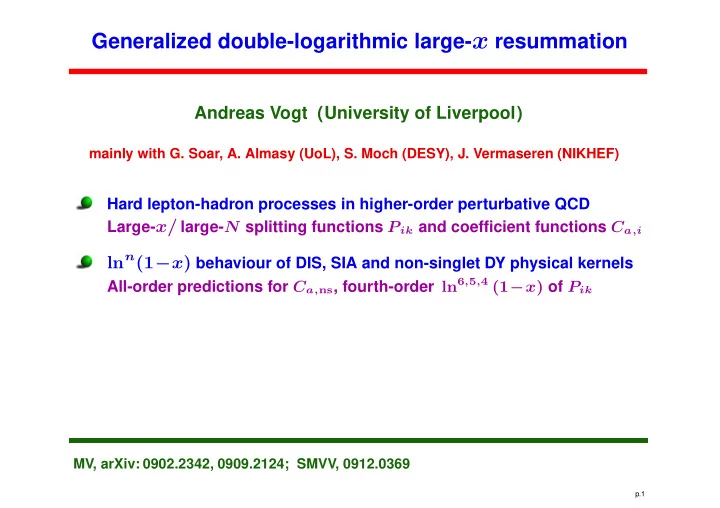
Generalized double-logarithmic large-x resummation

Andreas Vogt (University of Liverpool)

mainly with G. Soar, A. Almasy (UoL), S. Moch (DESY), J. Vermaseren (NIKHEF)

Hard lepton-hadron processes in higher-order perturbative QCD Large-x/ large-N splitting functions Pik and coefficient functions Ca,i

lnn(1−x) behaviour of DIS, SIA and non-singlet DY physical kernels

All-order predictions for Ca,ns, fourth-order ln6,5,4 (1−x) of Pik

MV, arXiv: 0902.2342, 0909.2124; SMVV, 0912.0369

p.1

slide-2
SLIDE 2

Generalized double-logarithmic large-x resummation

Andreas Vogt (University of Liverpool)

mainly with G. Soar, A. Almasy (UoL), S. Moch (DESY), J. Vermaseren (NIKHEF)

Hard lepton-hadron processes in higher-order perturbative QCD Large-x/ large-N splitting functions Pik and coefficient functions Ca,i

lnn(1−x) behaviour of DIS, SIA and non-singlet DY physical kernels

All-order predictions for Ca,ns, fourth-order ln6,5,4 (1−x) of Pik, CL,g Iteration of (next-to) leading-log unfactorized 1/N structure functions LL resummation of off-diagonal splitting and coefficient functions General D-dimensional structure of large-x DIS and SIA amplitudes Verification and extension to higher logarithmic accuracy for DIS/SIA

MV, arXiv: 0902.2342, 0909.2124; SMVV, 0912.0369; A.V., 1005.1606; ASV, 1010.nnnn

p.1

slide-3
SLIDE 3

Hard lepton-hadron processes in pQCD (I)

Inclusive deep-inelastic scattering (DIS), semi-incl. l+l− annihilation (SIA)

l fh

i

cai

γ∗(q) h(p) i(P )

Left → right: DIS, q spacelike, Q2 = −q2

P = ξp , f h

i = parton distributions

Top → bottom: l+l−, q timelike, Q2 = q2

p = ξP , fragmentation distributions

Drell-Yan (DY) l+l− production: bottom → top, 2nd hadron from right ({. . .}) Structure functions/normalized cross sections Fa: coefficient functions

Fa(x, Q2) = h Ca,i{j}(αs(µ2), µ2/Q2) ⊗ fh

i (µ2){ ⊗fh′ j (µ2)}

i (x) + O(1/Q(2))

Scaling variables: x = Q2/(2p·q) in DIS etc. µ: renorm./mass-fact. scale

p.2

slide-4
SLIDE 4

Hard lepton-hadron processes in pQCD (II)

Parton/fragmentation distributions fi : (renorm. group) evolution equations d d ln µ2 fi(ξ, µ2) = h P (S,T )

ik

(αs(µ2)) ⊗ fk(µ2) i (ξ) ⊗ = Mellin convolution. Initial conditions: fits to reference observables Expansion in αs: splitting functions P , coefficient fct’s ca of observables P = αs P (0) + α2

s P (1) + α3 s P (2) + α4 s P (3) + . . .

Ca = α na

s

» c(0)

a

+ αs c(1)

a

| {z } + α2

s c(2) a

+ α3

s c(3) a

+ . . . – NLO: first real prediction of size of cross sections NNLO, P (2), c(2)

a : first serious error estimate of pQCD predictions

N3LO: for high precision (αs from DIS), slow convergence (Higgs in pp/p¯

p )

The 2010 frontier: α4

s /α3 s for DIS/SIA (+ DY)

Baikov, Chetyrkin; MV, . . .

p.3

slide-5
SLIDE 5

MS splitting functions at large x/ largeN

Mellin trf. f(N) = R 1

0 dx (xN −1{−1}) f(x){+}: M-convolutions → products

lnn(1−x) (1−x)+

M

= (−1)n+1 n + 1 lnn+1N + . . . , lnn(1−x)

M

= (−1)n N lnnN + . . .

Diagonal splitting functions: no higher-order enhancement at N 0, N −1

P (l−1)

qq/gg (N) = A(l) q/g ln N + B(l) q/g + C(l) q/g

1 N ln N + . . . , Ag = C

A/C F Aq

. . . ; Korchemsky (89); Dokshitzer, Marchesini, Salam (05)

p.4

slide-6
SLIDE 6

MS splitting functions at large x/ largeN

Mellin trf. f(N) = R 1

0 dx (xN −1{−1}) f(x){+}: M-convolutions → products

lnn(1−x) (1−x)+

M

= (−1)n+1 n + 1 lnn+1N + . . . , lnn(1−x)

M

= (−1)n N lnnN + . . .

Diagonal splitting functions: no higher-order enhancement at N 0, N −1

P (l−1)

qq/gg (N) = A(l) q/g ln N + B(l) q/g + C(l) q/g

1 N ln N + . . . , Ag = C

A/C F Aq

. . . ; Korchemsky (89); Dokshitzer, Marchesini, Salam (05)

Off-diagonal: double-log behaviour, colour structure with C

A F = C A −CF

C −1

F

P (l)

gq / n f −1P (l) qg

=

1 N ln2lN # C l A F

+

1 N ln2l−1N ( # C A F + # C F + # n f ) C l−1 A F

+ . . .

Double logs lnnN, l+1 ≤ n ≤ 2l vanish for CF = C

A (→ SUSY case)

Aim: obtain, at least, these (next-to) leading terms to all orders l in αs

p.4

slide-7
SLIDE 7

MS coefficient functions at large x/ largeN

‘Diagonal’ [O(1)] coeff. fct’s for F2,3,φ in DIS, FT ,A,φ in SIA, FDY =

1 σ0 dσq¯

q

dQ2

C (l)

2,q/φ,g/... = # ln2l N + . . . + N −1(# ln2l−1 N + . . .) + . . .

N 0 parts: threshold exponentiation

Sterman (87); Catani, Trentadue (89); . . . Exponents known to next-to-next-to-next-to-leading log (N3LL) accuracy - mod.A(4) ⇒ highest seven (DIS), six (SIA, DY, Higgs prod.) coefficients known to all orders DIS: MVV (05), DY/Higgs prod.: MV (05); Laenen, Magnea (05); Idilbi, Ji, Ma, Yuan (05) (+ more papers, esp. using SCET, from 2006), SIA: Blümlein, Ravindran (06); MV (09)

p.5

slide-8
SLIDE 8

MS coefficient functions at large x/ largeN

‘Diagonal’ [O(1)] coeff. fct’s for F2,3,φ in DIS, FT ,A,φ in SIA, FDY =

1 σ0 dσq¯

q

dQ2

C (l)

2,q/φ,g/... = # ln2l N + . . . + N −1(# ln2l−1 N + . . .) + . . .

N 0 parts: threshold exponentiation

Sterman (87); Catani, Trentadue (89); . . . Exponents known to next-to-next-to-next-to-leading log (N3LL) accuracy - mod.A(4) ⇒ highest seven (DIS), six (SIA, DY, Higgs prod.) coefficients known to all orders DIS: MVV (05), DY/Higgs prod.: MV (05); Laenen, Magnea (05); Idilbi, Ji, Ma, Yuan (05) (+ more papers, esp. using SCET, from 2006), SIA: Blümlein, Ravindran (06); MV (09)

‘Off-diagonal’ [O(αs)] quantities: leading N −1 double logarithms

C (l)

φ,q/2,g/... = N −1(# ln2l−1N + # ln2l−2N + . . .) + . . .

Longitudinal DIS/SIA structure functions [ recall: l = order in αs – 1]

C (l)

L,q = N −1(# ln2lN + . . .) + . . . ,

C (l)

L,g = N −2(# ln2lN + . . .) + . . .

Aim: predict highest N −1 [ N −2 for CL,g ] double logarithms to all orders

p.5

slide-9
SLIDE 9

Non-singlet and singlet physical kernels

Eliminate parton densities from scaling violations of observables (µ = Q)

dF d ln Q2 = KF ≡ X

l=0

a l+1

s

KlF = d C d ln Q2 q + CP q = “ β(as) dC das C −1 + [C, P ]C −1 + P ” F

p.6

slide-10
SLIDE 10

Non-singlet and singlet physical kernels

Eliminate parton densities from scaling violations of observables (µ = Q)

dF d ln Q2 = KF ≡ X

l=0

a l+1

s

KlF = d C d ln Q2 q + CP q = “ β(as) dC das C −1 + [C, P ]C −1 + P ” F

Non-singlet: F =F2,3,φ and FL in DIS, FT ,A,φ and FL in SIA, FDY =

1 σ0 dσ

q ¯ q

dQ2

Singlet: a) F = (F2, Fφ) with large-mtop Higgs-exchange DIS

Furmanski, Petronzio (81); . . .

Coefficient functions for Fφ to order α2

s /α3 s

Daleo, Gehrmann-De Ridder, Gehrmann, Luisoni; SMVV (09)

b) F = (F2, b FL) with b FL = FL/asc(0)

L,q

Catani (96); Blümlein et al. (00)

p.6

slide-11
SLIDE 11

Non-singlet and singlet physical kernels

Eliminate parton densities from scaling violations of observables (µ = Q)

dF d ln Q2 = KF ≡ X

l=0

a l+1

s

KlF = d C d ln Q2 q + CP q = “ β(as) dC das C −1 + [C, P ]C −1 + P ” F

Non-singlet: F =F2,3,φ and FL in DIS, FT ,A,φ and FL in SIA, FDY =

1 σ0 dσ

q ¯ q

dQ2

Singlet: a) F = (F2, Fφ) with large-mtop Higgs-exchange DIS

Furmanski, Petronzio (81); . . .

Coefficient functions for Fφ to order α2

s /α3 s

Daleo, Gehrmann-De Ridder, Gehrmann, Luisoni; SMVV (09)

b) F = (F2, b FL) with b FL = FL/asc(0)

L,q

Catani (96); Blümlein et al. (00)

NNLO/N3LO: all physical kernels K above single-log enhanced at large N Conjecture: double-log contributions also vanish at all higher orders in αs

p.6

slide-12
SLIDE 12

Non-singlet evolution kernels and predictions

DIS/SIA a=L leading-logarithmic kernels, with pqq(x) = 2/(1−x)+−1−x

Ka,0(x) = 2 C

F pqq(x)

Ka,1(x) = ln (1−x) pqq(x) ˆ −2 C

F β0 ∓ 8 C 2 F ln x

˜ Ka,2(x) = ln2(1−x) pqq(x) ˆ 2 C

F β 2 0 ± 12 C 2 F β0 ln x + O(ln2 x)

˜ Ka,3(x) = ln3(1−x) pqq(x) ˆ −2 C

F β 3 0 ∓ 44/3 C 2 F β 2 0 ln x + O(ln2 x)

˜ Ka,4(x) = ln4(1−x) pqq(x) ˆ 2 C

F β 4 0 ± ξK4C 2 F β 3 0 ln x + O(ln2 x)

˜

First term: leading large n

f , all orders via C2 of Mankiewicz, Maul, Stein (97)

p.7

slide-13
SLIDE 13

Non-singlet evolution kernels and predictions

DIS/SIA a=L leading-logarithmic kernels, with pqq(x) = 2/(1−x)+−1−x

Ka,0(x) = 2 C

F pqq(x)

Ka,1(x) = ln (1−x) pqq(x) ˆ −2 C

F β0 ∓ 8 C 2 F ln x

˜ Ka,2(x) = ln2(1−x) pqq(x) ˆ 2 C

F β 2 0 ± 12 C 2 F β0 ln x + O(ln2 x)

˜ Ka,3(x) = ln3(1−x) pqq(x) ˆ −2 C

F β 3 0 ∓ 44/3 C 2 F β 2 0 ln x + O(ln2 x)

˜ Ka,4(x) = ln4(1−x) pqq(x) ˆ 2 C

F β 4 0 ± ξK4C 2 F β 3 0 ln x + O(ln2 x)

˜

First term: leading large n

f , all orders via C2 of Mankiewicz, Maul, Stein (97)

Conjecture ⇒ coefficients of highest three logs from fourth order in αs,

ln7,6,5(1−x) at order α4

s

for F1,2,3 in DIS and FT,I,A in SIA etc

Leading terms: K1 = K2, KT = KI [ total (‘integrated’) fragmentation fct.] ⇒ also three logarithms for space- and timelike FL: ln6,5,4(1−x) at α4

s etc

Alternative derivation: physical kernels for FL, agreement non-trivial check

p.7

slide-14
SLIDE 14

All-order resummation of the 1/N terms (I)

For F1,2,3, FT,I,A and FDY, up to terms of order 1/N 2, with L ≡ ln N

Ca(N) − Ca ˛ ˛ ˛

N 0Lk

= 1 N “h d (1)

a,1L + d (1) a,0

i as + h e d

(2) a,1 L + d (2) a,0

i a 2

s + . . .

” exp {Lh1(asL) + h2(asL) + ash3(asL) + . . . } Exponentiation functions defined by expansions hk(asL) ≡ P

n=1 hkn(asL)n

p.8

slide-15
SLIDE 15

All-order resummation of the 1/N terms (I)

For F1,2,3, FT,I,A and FDY, up to terms of order 1/N 2, with L ≡ ln N

Ca(N) − Ca ˛ ˛ ˛

N 0Lk

= 1 N “h d (1)

a,1L + d (1) a,0

i as + h e d

(2) a,1 L + d (2) a,0

i a 2

s + . . .

” exp {Lh1(asL) + h2(asL) + ash3(asL) + . . . } Exponentiation functions defined by expansions hk(asL) ≡ P

n=1 hkn(asL)n

Coefficients for DIS/SIA (upper/lower sign) relative to N 0Lk resummation

h1k = g1k glk = coefficients in soft-gluon exponentiation h21 = g21 + 1 2 β0 ± 6 C

F

h22 = g22 + 5 24 β2

0 ± 17

9 β0 C

F − 18 C 2 F

h23 = g23 + 1 8 β 3

0 ±

„ ξK4 8 − 53 18 « β 2

0 C F − 34

3 β0 C 2

F ± 72 C 3 F

First term of h3 also known, but non-universal within DIS and SIA ( ⇔ FL)

p.8

slide-16
SLIDE 16

All-order resummation of the 1/N terms (II)

For space-like (-) and time-like (+) structure/fragmentation functions FL

C(±)

L

(N) = N −1(d (±)

1

as + d (±)

2

a2

s + . . .) exp {Lh1(asL) + h2(asL) + . . . }

with

h11 = 2 C

F ,

h12 = 2 3 β0 C

F ,

h13 = 1 3 β 2

0 C F

h21 = β0 + 4 γeC

F − C F + (4 − 4 ζ2)(C A − 2C F )

h22 = 1 2 ( β0 h21 + A2) | {z } − 8 (C

A − 2C F )2(1 − 3 ζ2 + ζ3 + ζ 2 2 )

| {z }

as g22 in soft-gluon exp.

Who ordered THIS?

p.9

slide-17
SLIDE 17

All-order resummation of the 1/N terms (II)

For space-like (-) and time-like (+) structure/fragmentation functions FL

C(±)

L

(N) = N −1(d (±)

1

as + d (±)

2

a2

s + . . .) exp {Lh1(asL) + h2(asL) + . . . }

with

h11 = 2 C

F ,

h12 = 2 3 β0 C

F ,

h13 = 1 3 β 2

0 C F

h21 = β0 + 4 γeC

F − C F + (4 − 4 ζ2)(C A − 2C F )

h22 = 1 2 ( β0 h21 + A2) | {z } − 8 (C

A − 2C F )2(1 − 3 ζ2 + ζ3 + ζ 2 2 )

| {z }

as g22 in soft-gluon exp.

Who ordered THIS?

Remarks/questions Less predictive than N 0Lk exponentiation: nothing new, but A2, in g22 NLL exponentiation – complete h2(asL) – could be feasible for Fa=L NNLL exponentiation for F1,2,3 etc, NLL for FL: possible at all?

p.9

slide-18
SLIDE 18

Second- and third-order C2 in DIS in N-space

  • 2

2 4 6 8 5 10 15 20

N

c2,2(N)

all N 0 + all N −1 exact

nf = 4 (∗ 1/160)

N

c2,3(N)

all N 0 + all N −1 exact

nf = 4 (∗ 1/2000)

  • 5

5 10 15 20 5 10 15 20

N −1 terms relevant over full range shown, O(N −2) sizeable only at N < 5 Sum of N −1 lnkN looks almost constant: half of maximum only at N ≃ 150

p.10

slide-19
SLIDE 19

Second- and third-order CDY in N-space

20 40 60 80 100 5 10 15 20

N

cDY,2(N)

all N 0 + all N −1 exact

nf = 5 (∗ 1/160)

N

cDY,3(N)

  • exp. N 0

+ exp. N −1

nf = 5 (∗ 1/2000) 100 200 300 400 500 600 5 10 15 20

  • Exp. N 0: all logs, exp. N −1: 3 of 5 logs – ξDY3 numerically insignificant

N −1 contributions small down to even lower moments than in the SIA case

p.11

slide-20
SLIDE 20

Singlet results: α4

s splitting function P (3) qg (x)

3-loop coefficient functions + single-log K(3)

2φ,φ2 ⇒ predictions for P (3) qg,gq

P (3)

qg (x)

= ln6(1−x) · 0 C

A F ≡ C A − C F

+ ln5(1−x) » 22 27 C 3

A F n f − 14

27 C 2

A F C F n f + 4

27 C 2

A F n2 f

– + ln4(1−x) » „293 27 − 80 9 ζ2 « C 3

A F n f +

„4477 16 − 8ζ2 « C 2

A F C F n f

− 13 81 C

A F C 2 F n f − 116

81 C 2

A F n2 f + 17

81 C

A F C F n2 f − 4

81 C

A F n3 f

– + O ` ln3(1−x) ´

p.12

slide-21
SLIDE 21

Singlet results: α4

s splitting function P (3) qg (x)

3-loop coefficient functions + single-log K(3)

2φ,φ2 ⇒ predictions for P (3) qg,gq

P (3)

qg (x)

= ln6(1−x) · 0 C

A F ≡ C A − C F

+ ln5(1−x) » 22 27 C 3

A F n f − 14

27 C 2

A F C F n f + 4

27 C 2

A F n2 f

– + ln4(1−x) » „293 27 − 80 9 ζ2 « C 3

A F n f +

„4477 16 − 8ζ2 « C 2

A F C F n f

− 13 81 C

A F C 2 F n f − 116

81 C 2

A F n2 f + 17

81 C

A F C F n2 f − 4

81 C

A F n3 f

– + O ` ln3(1−x) ´

Vanishing of the coefficient of the leading term at order α4

s :

accidental (??) cancellation of contributions, for all four splitting fct’s Remaining terms vanish in the supersymmetric case C

A = CF (= n f )

Nontrivial check: same as for P (2)

qg , not obvious from above construction

This prediction + single-logarithmic K(3)

2L

⇒ (1−x) ln6,4,3(1−x) of c(3)

L,g

p.12

slide-22
SLIDE 22

Threshold logarithms before factorization (I)

Unfactorized partonic structure functions in D = 4−2ε dimensions

Ta,j = e Ca,i Z ij , −γ ≡ P = dZ d ln Q2 Z−1 , das d ln Q2 = −εas + βD=4

an

s : ε−n . . . ε−2: lower-order terms,

ε−1: n-loop splitting functions + . . . , ε0: n-loop coefficient fct’s + . . . , εk, 0 < k < l: required for order n+l

p.13

slide-23
SLIDE 23

Threshold logarithms before factorization (I)

Unfactorized partonic structure functions in D = 4−2ε dimensions

Ta,j = e Ca,i Z ij , −γ ≡ P = dZ d ln Q2 Z−1 , das d ln Q2 = −εas + βD=4

an

s : ε−n . . . ε−2: lower-order terms,

ε−1: n-loop splitting functions + . . . , ε0: n-loop coefficient fct’s + . . . , εk, 0 < k < l: required for order n+l N 0 and N −1 transition functions Z to next-to-leading log (NLL) accuracy

Z ˛ ˛ ˛

an

s

= 1 εn γ n−1 n! h γ0 − β0 2 n(n−1) i +

n−1

X

l=1

1 εn−l

n−l−1

X

k=1

γ n−l−k−1 γlγ k (l+k)! n! l! − β0 2

n−2

X

l=1

1 εn−l

n−l−2

X

k=1

γ n−l−k−2 γlγ k (l+k)! n! l! (n(n−1) − l(l+k+1)) + NNLL contributions (explicit expressions) + . . .

ε−n+l off-diagonal entries: contributions up to N −1 lnn+l−1 N

Diagonal cases: γ0 only for N 0 part, second term with l=1 for N −1 NLL

p.13

slide-24
SLIDE 24

Threshold logarithms before factorization (II)

D-dimensional coefficient functions e Ca: finite for ε→0

e Ca,i = 1(diagonal cases) +

X

n=1 ∞

X

l=0

an

s εlc(n,l) a,i

c(n,l)

a,i : l additional factors ln N relative to c(n,0) a,i

≡ c(n)

a,i discussed above

Full NmLO calc. of Ta,j : highest m+1 powers of ε−1 to all orders in αs Extension to all powers of ε: all-order resummation of highest m+1 logs

p.14

slide-25
SLIDE 25

Threshold logarithms before factorization (II)

D-dimensional coefficient functions e Ca: finite for ε→0

e Ca,i = 1(diagonal cases) +

X

n=1 ∞

X

l=0

an

s εlc(n,l) a,i

c(n,l)

a,i : l additional factors ln N relative to c(n,0) a,i

≡ c(n)

a,i discussed above

Full NmLO calc. of Ta,j : highest m+1 powers of ε−1 to all orders in αs Extension to all powers of ε: all-order resummation of highest m+1 logs Example: Leading-log (LL) 1/N terms of T (n)

φ,q and T (n) 2,g , with L ≡ ln N

1 C

F

T (n)

φ,q =

1 n

f

T (n)

2,g

= Ln−1 Nεn

X

k=0

(εL)kLn,k “ C n

− 1 F

+ C n

− 2 F

C

A + . . . + C n − 1 A

to all orders in ε (calc. + D-dim. structure), with same coefficients Ln,k ⇒ all-order relation for one colour structure of either amplitude sufficient

p.14

slide-26
SLIDE 26

All-order off-diagonal leading-log amplitudes

. . .

T (n)

φ,q

˛ ˛ ˛

C

F only

LL

= 1 n T (1)

φ,q T (n−1) 2,q

| {z }

LL

= 1 n! T (1)

φ,q (T (1) 2,q )n−1 1 (n−1)! (T (1) 2,q )n−1

Three-loop diagram calculation + P (3)

gq LL

= 0 + general mass factorization: first four powers in ε known at any order. Rest → higher-order predictions

Tφ,q ˛ ˛ ˛

C

F only

LL

= T (1)

φ,q

exp(asT (1)

2,q ) − 1

T (1)

2,q

p.15

slide-27
SLIDE 27

All-order off-diagonal leading-log amplitudes

. . .

T (n)

φ,q

˛ ˛ ˛

C

F only

LL

= 1 n T (1)

φ,q T (n−1) 2,q

| {z }

LL

= 1 n! T (1)

φ,q (T (1) 2,q )n−1 1 (n−1)! (T (1) 2,q )n−1

Three-loop diagram calculation + P (3)

gq LL

= 0 + general mass factorization: first four powers in ε known at any order. Rest → higher-order predictions

Tφ,q ˛ ˛ ˛

C

F only

LL

= T (1)

φ,q

exp(asT (1)

2,q ) − 1

T (1)

2,q

Exact D-dimensional leading-log expressions for the one-loop amplitudes

T (1)

φ,q LL

= −2C

F

1 ε(1−x)−ε

M

= − 2C

F

N 1 ε exp(ε ln N) T (1)

2,q LL

= −4C

F

1 ε(1−x)−1−ε + virtual

M

= 4C

F

1 ε2 (exp(ε ln N) − 1)

⇒ leading-log expression for Tφ,q and T2,g completely determined

p.15

slide-28
SLIDE 28

Leading-log splitting and coefficient functions

Expansions and iterative mass factorization to ‘any’ order [done in FORM ]

⇒ All-order expressions for LL off-diagonal splitting and coefficient fct’s

P LL

qg (N, αs) =

n

f

N αs 2π

X

n=0

Bn (n!)2 ˜ a n

s ,

˜ as = αs π (C

A −C F ) ln2N

Bernoulli numbers Bn: zero for odd n ≥ 3 ⇒ P (3)

gq (N) LL

= 0 not accidental

B0 = 1, B1 = −1 2 , B2 = 1 6 , B4 = − 1 30 , B6 = 1 42 , . . . , B12 = − 691 2730 , . . .

p.16

slide-29
SLIDE 29

Leading-log splitting and coefficient functions

Expansions and iterative mass factorization to ‘any’ order [done in FORM ]

⇒ All-order expressions for LL off-diagonal splitting and coefficient fct’s

P LL

qg (N, αs) =

n

f

N αs 2π

X

n=0

Bn (n!)2 ˜ a n

s ,

˜ as = αs π (C

A −C F ) ln2N

Bernoulli numbers Bn: zero for odd n ≥ 3 ⇒ P (3)

gq (N) LL

= 0 not accidental

B0 = 1, B1 = −1 2 , B2 = 1 6 , B4 = − 1 30 , B6 = 1 42 , . . . , B12 = − 691 2730 , . . . C LL

2,g

= 1 2N ln N n

f

C

A −C F

˘ exp(2C

F as ln2N) B0(˜

as) − exp(2C

Aas ln2N)

¯

exp(. . .): LL soft-gluon exponentials Parisi; Curci, Greco; Amati et al. (80)

B0(x) =

X

n=0

Bn (n!)2 xn

P LL

gq , C LL φ,q : same functions but with

CF ↔ C

A (also in ˜

as), then n

f → CF

p.16

slide-30
SLIDE 30

First properties of the new B-functions

Relation between even-n Bernoulli numbers and the Riemann ζ-function

B0(x) = 1 − x 2 − 2

X

n=1

(−1)n (2n)! ζ2n „ x 2π «

2n

B0(2πi) numerically known (Wolfram MathWorld, Sloane’s A093721), no closed form

p.17

slide-31
SLIDE 31

First properties of the new B-functions

Relation between even-n Bernoulli numbers and the Riemann ζ-function

B0(x) = 1 − x 2 − 2

X

n=1

(−1)n (2n)! ζ2n „ x 2π «

2n

B0(2πi) numerically known (Wolfram MathWorld, Sloane’s A093721), no closed form

x B0(x)

  • 10

10 20 30 40

  • 40
  • 20

20 40 60 80 100

Further B-functions for later use

Bk(x) =

X

n=0

Bn n!(n + k)! xn B−k(x) =

X

n=k

Bn n!(n − k)! xn

Relations to B0(x)

dk dxk (xkBk) = B0 , xk dk dxk B0 = B−k

p.17

slide-32
SLIDE 32

Next-to-leading logarithmic iteration for T (n)

φ,q

Ansatz for T (n)

φ,q in terms of first-order quantity and diagonal amplitudes

T (n)

φ,q NL

= 1 n T (1)

φ,q

8 < :

n−1

X

i=0

T (i)

φ,q T (n−i−1) 2,q

f(n, i) − β0 ε

n−2

X

i=0

T (i)

φ,q T (n−i−2) 2,q

g(n, i) 9 = ;

All-order agreement with known highest four powers of ε−1 for

f(n, i) = „ n−1 i «−1h 1 + ε · ` known simple function of n and i ´ i g(n, i) = „ n i +1 «−1

p.18

slide-33
SLIDE 33

Next-to-leading logarithmic iteration for T (n)

φ,q

Ansatz for T (n)

φ,q in terms of first-order quantity and diagonal amplitudes

T (n)

φ,q NL

= 1 n T (1)

φ,q

8 < :

n−1

X

i=0

T (i)

φ,q T (n−i−1) 2,q

f(n, i) − β0 ε

n−2

X

i=0

T (i)

φ,q T (n−i−2) 2,q

g(n, i) 9 = ;

All-order agreement with known highest four powers of ε−1 for

f(n, i) = „ n−1 i «−1h 1 + ε · ` known simple function of n and i ´ i g(n, i) = „ n i +1 «−1

Soft-gluon exponentiation: also T (n)

φ,g and T (n) 2,q known at all powers of ε

⇒ next-to-leading logarithmic expression for Tφ,q completely predicted

Mass factorization ⇒ P NLL

gq

, c NLL

φ,q

to all orders. P NLL

qg

, c NLL

2,g

analogous Extension of this approach to higher logarithmic accuracy problematic

p.18

slide-34
SLIDE 34

D-dim. structure of unfactorized observables

Maximal phase space for deep-inelastic scattering/semi-incl. annihilation

NLO : 2 → 2 / 1 → 1 + 2 (1−x)−1−ε x ... R 1

0 one other variable

N2LO : 2 → 3 / 1 → 1 + 3 (1−x)−1−2ε x ... R 1

0 four other variables

N3LO : 2 → 4 / 1 → 1 + 4 (1−x)−1−3ε x ... R 1

0 seven other variables

. . . N2LO: Matsuura, van Neerven (88), Rijken, vN (95), Nn≥3LO, indirectly: MV[V] (05)

p.19

slide-35
SLIDE 35

D-dim. structure of unfactorized observables

Maximal phase space for deep-inelastic scattering/semi-incl. annihilation

NLO : 2 → 2 / 1 → 1 + 2 (1−x)−1−ε x ... R 1

0 one other variable

N2LO : 2 → 3 / 1 → 1 + 3 (1−x)−1−2ε x ... R 1

0 four other variables

N3LO : 2 → 4 / 1 → 1 + 4 (1−x)−1−3ε x ... R 1

0 seven other variables

. . . N2LO: Matsuura, van Neerven (88), Rijken, vN (95), Nn≥3LO, indirectly: MV[V] (05)

Purely real contributions to unfactorized structure functions

T (n)R

a,j

= (1−x)−1−nε X

ξ=0

(1−x)ξ 1 ε2n−1 n R(n)LL

a,j,ξ

+ εR(n)NLL

a,j,ξ

+ . . .

  • Mixed contributions (2 → r+1 with n−r loops in DIS)

T (n)M

a,j

=

n

X

l=r

(1−x)−1−lε X

ξ=0

(1−x)ξ 1 ε2n−1 n M(n)LL

a,j,l,ξ + εM(n)NLL a,j,l,ξ

+ . . .

  • Purely virtual part (diagonal cases, η = 0 present): γ∗qq, Hgg form factors

T (n)V

a,j

= δ(1−x) 1 ε2n n V (n)LL

a,j

+ εV (n)NLL

a,j

+ . . .

  • p.19
slide-36
SLIDE 36

Resulting resummation of large-x double logs

KLN cancellation between purely real, mixed and purely virtual contributions

T (n)

a,j

= T (n)R

a,j

+ T (n)M

a,j

“ + T (n)V

a,j

” = 1 εn n T (n)0

a,j

+ εT (n)1

a,j

+ . . .

Up to n−1 relations between the coeff’s of (1−x)−1−lε, l = 1, . . . , n

p.20

slide-37
SLIDE 37

Resulting resummation of large-x double logs

KLN cancellation between purely real, mixed and purely virtual contributions

T (n)

a,j

= T (n)R

a,j

+ T (n)M

a,j

“ + T (n)V

a,j

” = 1 εn n T (n)0

a,j

+ εT (n)1

a,j

+ . . .

Up to n−1 relations between the coeff’s of (1−x)−1−lε, l = 1, . . . , n Log expansion: NkLL higher-order coefficients completely fixed, if first k+1 powers of ε known to all orders – provided by NkLO calculation, see above Present situation: (a) N3LO for non-singlet Fa=L in DIS – recall DMS (05) (b) N2LO for SIA, non-singlet FL in DIS, and singlet DIS

resummation of the (a) four and (b) three highest N −1 lnkN terms to all orders in αs: consistent with, and extending, our previous results

p.20

slide-38
SLIDE 38

Resulting resummation of large-x double logs

KLN cancellation between purely real, mixed and purely virtual contributions

T (n)

a,j

= T (n)R

a,j

+ T (n)M

a,j

“ + T (n)V

a,j

” = 1 εn n T (n)0

a,j

+ εT (n)1

a,j

+ . . .

Up to n−1 relations between the coeff’s of (1−x)−1−lε, l = 1, . . . , n Log expansion: NkLL higher-order coefficients completely fixed, if first k+1 powers of ε known to all orders – provided by NkLO calculation, see above Present situation: (a) N3LO for non-singlet Fa=L in DIS – recall DMS (05) (b) N2LO for SIA, non-singlet FL in DIS, and singlet DIS

resummation of the (a) four and (b) three highest N −1 lnkN terms to all orders in αs: consistent with, and extending, our previous results Soft-gluon exponentiation of the (1−x)−1/N 0 diagonal coefficient functions:

(1−x)−1−ε, . . . , (1−x)−1−(n−1)ε at order n: products of lower-order quantities

⇒ NnLO [+A(n+

1)] → NnLL exponentiation; 2n[+1] highest logs predicted

p.20

slide-39
SLIDE 39

Selection of some new results

NS cases: Ka,4(x) of p.7 confirmed with ξK4 = 100/3: fourth log for c(n≥4)

a,ns

Off-diagonal splitting functions

˜ as = αs π (C

A −C F ) ln2N

NP NL

qg (N, αs) = 2asn f B0(˜

as) + a2

s lnN n f

n (6C

F −β0)

“ 2 ˜ as B−1(˜ as) + B1(˜ as) ” + β0 ˜ as B−2(˜ as)

  • NP NL

gq (N, αs) = 2asC F B0(−˜

as) + a2

s lnN C F

n (12C

F − 6β0) 1

˜ as B−1(−˜ as) −β0 ˜ as B−2(−˜ as) + (14C

F − 8C A − β0) B1(−˜

as)

  • Gluon contribution to FL – ‘non-singlet’ CF =0 part done before

MV (09)

N2c NL

L,g(N, αs) = 8asn f exp(2C Aas ln2N) + 4asC F NC LL 2,g (N, αs)

+ 16a2

s lnN n f

n 4C

A − C F + 1

3as ln2N C

Aβ0

  • exp(2C

Aas ln2N)

NNLL contributions known to ‘any’ order, but (mostly) no closed expressions

p.21

slide-40
SLIDE 40

Summary and outlook

Non-singlet physical kernels for nine observables in DIS, SIA and DY: single-log large-x enhancement at NNLO/N3LO to all orders in 1−x All-order conjecture ⇒ leading three (DY: two) logs of higher-order Ca Singlet kernels for (F2, Fφ) and (F2, FL) in DIS also single-logarithmic ⇒ Prediction of three logs in N3LO α4

s splitting and FL coefficient fct’s

p.22

slide-41
SLIDE 41

Summary and outlook

Non-singlet physical kernels for nine observables in DIS, SIA and DY: single-log large-x enhancement at NNLO/N3LO to all orders in 1−x All-order conjecture ⇒ leading three (DY: two) logs of higher-order Ca Singlet kernels for (F2, Fφ) and (F2, FL) in DIS also single-logarithmic ⇒ Prediction of three logs in N3LO α4

s splitting and FL coefficient fct’s

Iterative structure of (next-to) leading-log N −1 amplitudes for C2,g/φ,q ⇒ All-order (N)LL off-diagonal splitting functions and coefficient fct’s D-dimensional structure of unfactorized DIS/SIA structure functions Verification, extension of above results to N4LL or N3LL for N −1 terms

p.22

slide-42
SLIDE 42

Summary and outlook

Non-singlet physical kernels for nine observables in DIS, SIA and DY: single-log large-x enhancement at NNLO/N3LO to all orders in 1−x All-order conjecture ⇒ leading three (DY: two) logs of higher-order Ca Singlet kernels for (F2, Fφ) and (F2, FL) in DIS also single-logarithmic ⇒ Prediction of three logs in N3LO α4

s splitting and FL coefficient fct’s

Iterative structure of (next-to) leading-log N −1 amplitudes for C2,g/φ,q ⇒ All-order (N)LL off-diagonal splitting functions and coefficient fct’s D-dimensional structure of unfactorized DIS/SIA structure functions Verification, extension of above results to N4LL or N3LL for N −1 terms Complementary approach: Laenen, Magnea, Stavenga, White (from 08) Limited phenomenol. relevance now: assess relevance of NS 1/N terms Near/mid future: combine with other results, esp. fixed-N calculations (close to) feasible now: 4-loop sum rules Baikov, Chetyrkin, Kühn (10)

p.22