
SLIDE 1
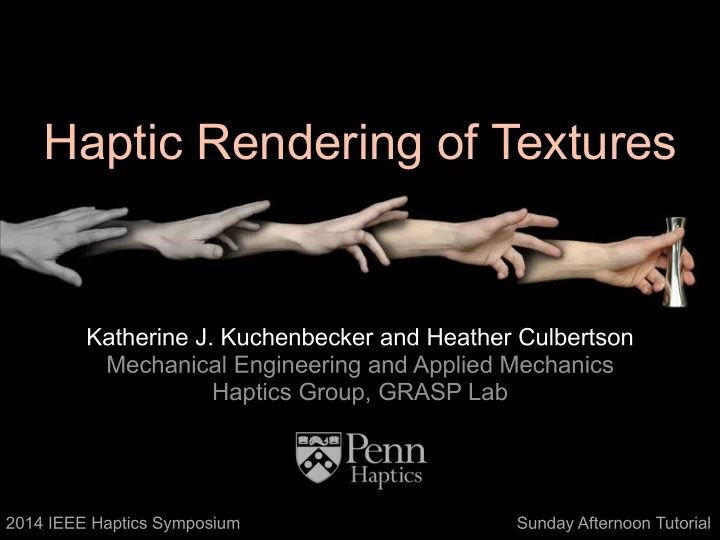
Haptic Rendering of Textures
Katherine J. Kuchenbecker and Heather Culbertson Mechanical Engineering and Applied Mechanics Haptics Group, GRASP Lab
2014 IEEE Haptics Symposium Sunday Afternoon Tutorial
Haptic Rendering of Textures Katherine J. Kuchenbecker and Heather - - PowerPoint PPT Presentation
Haptic Rendering of Textures Katherine J. Kuchenbecker and Heather Culbertson Mechanical Engineering and Applied Mechanics Haptics Group, GRASP Lab 2014 IEEE Haptics Symposium Sunday Afternoon Tutorial Katherine J. Kuchenbecker, Ph.D. Heather
Katherine J. Kuchenbecker and Heather Culbertson Mechanical Engineering and Applied Mechanics Haptics Group, GRASP Lab
2014 IEEE Haptics Symposium Sunday Afternoon Tutorial
Katherine J. Kuchenbecker, Ph.D. Associate Professor Heather Culbertson Ph.D. Candidate
!2
!3
We love textures and haptic texture rendering.
Please introduce yourself: Name Institution Position
!4
Please ask questions throughout the tutorial!
!5
Haptic Rendering of Textures
Katherine J. Kuchenbecker and Heather Culbertson
kuchenbe@seas.upenn.edu hculb@seas.upenn.eduHaptics Group, GRASP Laboratory Mechanical Engineering and Applied Mechanics University of Pennsylvania, USA February 23, 2014: 1:30 p.m. – 5:00 p.m. IEEE Haptics Symposium Houston, Texas, USA Overview
This half-day Sunday afternoon tutorial will overview the problem of haptic texture rendering and then carefully explain a new set of methods the presenters have developed for creating highly realistic haptic virtual textures. While some of the discussion will be relevant to bare-finger haptic interactions, we will focus on situations where the user touches the surface through a rigid tool. Interestingly, even though the skin is not in contact with the surface, humans can perceive many properties of a texture by dragging a rigid tool across it. Such interactions frequently arise in the areas of art, design, manufacturing, and medicine, as well as in everyday tasks such as writing a grocery list.Agenda
1:30 – 1:40 Introductions 1:40 – 1:55 Activity 1: Passive and active interaction with textures using a tool and the fingertip (KJK) 1:55 – 2:10 Perception of Textures (HC) 2:10 – 2:20 Background on Texture Rendering (KJK) 2:20 – 2:30 Data-Driven Modeling (KJK) 2:30 – 2:45 Activity 2: Passive tool-mediated interaction with textures moving slow/fast and pressing hard/soft (KJK) 2:45 – 3:00 Recording Hardware and Demo 1: Haptic Camera (HC) 3:00 – 3:30 Coffee Break: Demos will be available during this time 3:30 – 3:40 Friction Modeling (HC) 3:40 – 3:55 Texture Modeling (HC) 3:55 – 4:05 Texture Signal Generation (KJK) 4:05 – 4:25 Rendering Hardware and Demo 2: TexturePad (KJK) 4:25 – 4:40 Perception of Virtual Textures (HC) 4:40 – 5:00 Penn Haptic Texture Toolkit and Demo 3: Toolkit Textures on Omni (HC) http://repository.upenn.edu/meam papers/299/ 1 References
[1] Allison M. Okamura, Katherine J. Kuchenbecker, and Mohsen Mahvash. Measurement-based modeling for haptic rendering. In Ming Lin and Miguel Otaduy, editors, Haptic Rendering: Algorithms and Applications, chapter 21, pp. 443–467. A. K. Peters, May 2008. [2] Katherine J. Kuchenbecker, Joseph M. Romano, and William McMahan. Haptography: Capturing and recreating the rich feel of real surfaces. In C´ edric Pradalier, Roland Siegwart, and Gerhard Hirzinger, editors, Robotics Research: the 14th International Symposium (ISRR 2009), volume 70 of Springer Tracts in Advanced Robotics, pp. 245–260. Springer, 2011. [3] William McMahan and Katherine J. Kuchenbecker. Haptic display of realistic tool contact via dynam- ically compensated control of a dedicated actuator. In Proc. IEEE/RSJ International Conference on Intelligent Robots and Systems, pp. 3171–3177. St. Louis, Missouri, USA, October 2009. [4] William McMahan, Joseph M. Romano, Amal M. Abdul Rahuman, and Katherine J. Kuchenbecker. High frequency acceleration feedback significantly increases the realism of haptically rendered textured!6
texture samples.
a pen, fat end down, in the air, and close your eyes.
kind of texture you are touching, noticing the sensations.
!7
and move it back and forth against the fat end of the chopstick.
the texture stationary and let your partner move the tool.
texture.
using your bare finger.
!8
through an intermediary object.
the tool or finger remains stationary.
!9
What did you notice during this activity?
!10
position
force torque contact location pressure shear slip vibration temperature
!11
!12
“Coding and use of tactile signals from the fingertips in
by Johansson and Flanagan, 2009
!13
“Coding and use of tactile signals from the fingertips in
by Johansson and Flanagan, 2009
!14
“Coding and use of tactile signals from the fingertips in
by Johansson and Flanagan, 2009
!15
“Coding and use of tactile signals from the fingertips in
by Johansson and Flanagan, 2009
!16
“Psychophysical Dimensions of Tactile Perception of Textures” by Okamoto et al., 2013
!17
“Psychophysical Dimensions of Tactile Perception of Textures” by Okamoto et al., 2013
!18
– FAI and FAII
“Psychophysical Dimensions of Tactile Perception of Textures” by Okamoto et al., 2013
!19
– Skin stretch or adhesion
“Psychophysical Dimensions of Tactile Perception of Textures” by Okamoto et al., 2013
!20
and finger
“Psychophysical Dimensions of Tactile Perception of Textures” by Okamoto et al., 2013
!21
and object is important
“Psychophysical Dimensions of Tactile Perception of Textures” by Okamoto et al., 2013
!22
– Skin deformation from tool, not from surface
!23
rated roughness values between finger and tool
“Texture Perception Through Direct and Indirect Touch: An Analysis of Perceptual Space for Tactile Textures in Two Modes of Exploration” by Yoshioka et al., 2007
roughness increased as power of vibrations increased
!24
through tool
“Texture Perception Through Direct and Indirect Touch: An Analysis of Perceptual Space for Tactile Textures in Two Modes of Exploration” by Yoshioka et al., 2007
increased as friction between probe and texture increased
!25
through tool
– Amount of surface indentation (SAII)
“Texture Perception Through Direct and Indirect Touch: An Analysis of Perceptual Space for Tactile Textures in Two Modes of Exploration” by Yoshioka et al., 2007
decreased as compliance increased
!26
“Texture Perception Through Direct and Indirect Touch: An Analysis of Perceptual Space for Tactile Textures in Two Modes of Exploration” by Yoshioka et al., 2007
!27
!28
!29
Real-time dynamic simulation of tool-texture contacts is computationally prohibitive [Otaduy and Lin, 2008]
!31
[10] Craig G. McDonald and Katherine J. Kuchenbecker. Dynamic simulation of tool-mediated texture interaction. In Proc. IEEE World Haptics Conference, pp. 307–312. Daejeon, South Korea, April 2013.
1 2 Normal Force (N)
Recorded Simulated
0.05 0.1 0.15 0.2 −10 10 20 30 40 50 60 Axial Lateral Acceleration (m/s2) Time (s) 0.05 0.1 0.15 0.2 Axial Lateral Time (s) )
height field at probe location [Minsky 1995]
gradient of texture offset field [Ho et al. 1999]
penetration-based feedback [Siira and Pai 1996]
probabilistic model [Pai at al. 2001]
Prior Approaches
!33
!34
i i
21
Measurement-Based Modeling for Haptic Rendering
and M. Mahvash
Measurement-based modeling is a technique for creating virtual environ- ments based on real-world interactions. For the purpose of haptic ren- dering, measurement-based models are formed from data recorded during contact between an instrumented tool and a real environment. The created model can be a databaseof recorded responsesto varioushaptic stimuli, an empirical input-output mapping, or a set of physics-based equations (Fig- ure 21.1). In the database approach, recordings of a movement variable, such as position or force, are played back during haptic rendering, similar to audio recordings played on a stereo. Input-output models are created by fitting simple phenomenological models to the recorded data and tuning the haptic response as needed to provide the desired feel. Physics-based models are constructed from a fundamental understanding of the mechani- cal principles underlying the recorded haptic interaction; numerical values for the model’s physical parameters can be selected either by fitting the model’s response to the recorded data or by derivation from basic material
to create virtual environments that feel significantly more realistic than models that are designed and tuned without incorporation of real-world
Record data during real-world interaction Database Input- Physics-based model[1] Allison M. Okamura, Katherine J. Kuchenbecker, and Mohsen Mahvash. Measurement- based modeling for haptic rendering. In Ming Lin and Miguel Otaduy, editors, Haptic Rendering: Algorithms and Applications, chapter 21, pp. 443–467. A. K. Peters, May 2008.
!35
h
Capturing the Feel
a Sensorized Tool Recreating the Feel
an Active Stylus
Haptograph
[2] Katherine J. Kuchenbecker, Joseph M. Romano, and William McMahan. Haptography: Capturing and recreating the rich feel of real surfaces. In Cedric Pradalier, Roland Siegwart, and Gerhard Hirzinger, editors, Robotics Research: the 14th International Symposium (ISRR 2009), volume 70 of Springer Tracts in Advanced Robotics, pp. 245–260. Springer, 2011. NSF #IIS-0845670: “CAREER: Haptography: Capturing and Recreating the Rich Feel of Real Surfaces”
Tool with Accelerometer
!36
faux wood desktop anodized aluminum computer case
Sample Data
!38
!39
!40
v
Fn t Ft t Fl t Fn F
Real Interaction
v
Fn t Ft t Fl t a t Fn F
Virtual Interaction
How to record and model texture interactions?
chopstick.
pen, fat end down, in the air, and close your eyes. Pay attention to the sensations that you feel.
move it back and forth against the fat end of the chopstick. Move with low and high speed, with low and high force.
texture.
!41
!42
What did you notice during this activity?
!43
– Force – Position – Orientation – High-Frequency Acceleration
!44
content of acceleration strongly depend on normal force and scanning speed
!45
!46
!47
!48
!49
!50
!51
!52
!53
Please be back by 3:30
!54
Demos are available to try during the break.
!55
!56
Viscous damping Coulomb model Coulomb and viscous Stiction Karnopp’s model Stribeck effect
“Friction Identification for Haptic Display” by Richard et al., 1999
Coulomb model
!57
!58
!59
!60
Estimate normal and tangential directions
!
Project
!
Project Low-pass filter Low-pass filter
!61
!62
!63
!64
Accelerometer ADC DFT321 Convert Units High Pass Filter Separate Signals & Convert Units Haptic Recording Device Force Sensor Motion Sensor Low- Pass Filter Magnetic Motion Tracker Unwrap Angles & Resample All Signals at 10 kHz Rotate to Tool Rotate to World Calculate Position
Calculate Speed Estimate Normal & Tangential Directions Low- Pass Filter Project Project Low- Pass Filter Low- Pass Filter Linear Fit
[13] Heather Culbertson, Juliette Unwin, and Katherine J. Kuchenbecker. Modeling and rendering realistic textures from unconstrained tool-surface interactions, 2014. Under revisions for IEEE Transactions on Haptics.
!65
– Acceleration
! !
– Position
! !
– Orientation
! !
– Force
!66
!
DFT321
!67
[6] Nils Landin, Joseph M. Romano, William McMahan, and Katherine J. Kuchenbecker. Dimensional reduction of high-frequency accelerations for haptic rendering. In Astrid Kappers, Jan van Erp, Wouter Bergmann Tiest, and Frans van der Helm, editors, Haptics: Generating and Perceiving Tangible Sensations, Proc. EuroHaptics, Part II, volume 6192 of Lecture Notes in Computer Science, pp. 79–86. Springer, July 2010.
Discrete- time derivative Low-pass filter
!68
Estimate normal and tangential directions
!
Project
!
Project Low-pass filter Low-pass filter
!69
– All-pole infinite impulse response (IIR) filter
previous outputs
!70
[5] Joseph M. Romano, Takashi Yoshioka, and Katherine J. Kuchenbecker. Automatic filter design for synthesis of haptic textures from recorded acceleration data. In Proc. IEEE International Conference on Robotics and Automation, pp. 1815–1821. May 2010.
! !
!71
[5] Joseph M. Romano, Takashi Yoshioka, and Katherine J. Kuchenbecker. Automatic filter design for synthesis of haptic textures from recorded acceleration data. In Proc. IEEE International Conference on Robotics and Automation, pp. 1815–1821. May 2010.
– Power and frequency content depend on force and speed
strong stationarity
– Break signal into stationary segments – Create AR model for each segment
!72
[9] Heather Culbertson, Juliette Unwin, Benjamin E. Goodman, and Katherine J.
– Genetic algorithm – Optimize minimum description length (MDL)
* “Structural break estimation for nonstationary time series models” by Davis et al., 2006 !73
!74
!75
Autoregressive model Coefficients V a r i a n c e
!76
!77
!78
!79
!80
Store AR Models in Delauney Triangulation
Segment Signal Make AR Models Median Median by Segment Convert Coefficients to LSF Remove Outliers
[13] Heather Culbertson, Juliette Unwin, and Katherine J. Kuchenbecker. Modeling and rendering realistic textures from unconstrained tool-surface interactions, 2014. Under revisions for IEEE Transactions on Haptics.
!81
!82
AR Models in Delauney Triangulation by Normal Force and Scanning Speed The haptic rendering system must continually measure the user's normal force and scanning speed.
!83
Both scanning speed and normal force vary significantly over time; filter signals to balance responsiveness with smoothness.
!84
!85
λ1 λ2 λ3
Calculate Filter Coefficients and White Noise Variance
!86
!87
Interpolation must be done on Line Spectral Frequencies instead of coefficients to preserve stability.
[7] Heather Culbertson, Joseph M. Romano, Pablo Castillo, Max Mintz, and Katherine J. Kuchenbecker. Refined methods for creating realistic haptic virtual textures from tool-mediated contact acceleration data. In Proc. IEEE Haptics Symposium, pp. 385–391. March 2012.
White-Noise Variance Changes Over Time Coefficients Change Over Time
!88
Create White Gaussian Noise with Calculated Variance (Magnitude)
AR Filter with Calculated Coefficients (Frequency Response) Yields a Unique Waveform Whose Spectrum Blends the Spectra of the Recorded Data from which the Three Models were Made
!89
Synthesizing a New Texture Output
One Original Recording
!90
One Original Recording Six Synthetic Texture Signals
Synthesizing a New Texture Output Texture signal must be generated at 1000 Hz or faster. Interpolation can occur at a slower rate.
!91
Output Spectrum Matches Spectrum of Recorded Data
!92
Identify Three Surrounding Nodes Convert LSF to Coefficients Tablet Stylus Haptuator Convert Units Low- Pass Filter Calculate Speed Check for Motion Interpolate Via Barycentric Coordinates Generate Signal White Noise Compensate for Dynamics Convert Units Current Amplifier Sound Card
[13] Heather Culbertson, Juliette Unwin, and Katherine J. Kuchenbecker. Modeling and rendering realistic textures from unconstrained tool-surface interactions, 2014. Under revisions for IEEE Transactions on Haptics.
!93
!94
Haptic Interface Motors are Far from the Hand
Voice-Coil Actuator Suspension Handle User’s Hand
!95
[3] William McMahan and Katherine J. Kuchenbecker. Haptic display of realistic tool contact via dynamically compensated control of a dedicated actuator. In Proc. IEEE/ RSJ International Conference on Intelligent Robots and Systems, pp. 3171–3177.
Vibration Actuation Approach: Dedicated Actuator on Handle
!96
Linear Voice- Coil Actuator Accelerometer SensAble Phantom Omni Springs
[3] William McMahan and Katherine J. Kuchenbecker. Haptic display of realistic tool contact via dynamically compensated control of a dedicated actuator. In Proc. IEEE/ RSJ International Conference on Intelligent Robots and Systems, pp. 3171–3177.
!97
[4] William McMahan, Joseph M. Romano, Amal M. Abdul Rahuman, and Katherine
realism of haptically rendered textured surfaces. In Proc. IEEE Haptics Symposium,
Master Slave Real Surface Custom Handle
Acetal sleeve bearing End cap Pen-mounted housing Moving magnet Weight Flexure spring Mounting screw Electromagnetic coil
!98
[8] Joseph M. Romano and Katherine J. Kuchenbecker. Creating realistic virtual textures from contact acceleration data. IEEE Transactions on Haptics, volume 5(2):pp. 109–119, April-June 2012.
!99
!100
Bracket Rigidly Attaches Haptuator to Handle
!101 0.5 1 1.5 2 2.5 3 −0.2 0.2 Current (A) Actuator Command Signal 0.5 1 1.5 2 2.5 3 −1 −0.5 0.5 1 Voltage (V) 0.5 1 1.5 2 2.5 3 −30 −20 −10 10 20 30 Time (s) Handle Acceleration (m/s2) Current Voltage
Characterization of Actuator Dynamics
[12] William McMahan and Katherine J. Kuchenbecker. Dynamic modeling and control of voice-coil actuators for high-fidelity display of haptic vibrations. In Proc. IEEE Haptics
!102 10
1
10
2
10
3
10
−1
10 10
1
10
2
Response Magnitude 10
1
10
2
10
3
−360 −270 −225 −180 −135 −90 −45 90 180 Frequency (Hz) Phase (degrees) Experimental Data: Hand Identified Model: Hand Experimental Data: No Hand Identified Model: No Hand
Empirical Transfer Function Estimates: Strong Resonance
[12] William McMahan and Katherine J. Kuchenbecker. Dynamic modeling and control of voice-coil actuators for high-fidelity display of haptic vibrations. In Proc. IEEE Haptics
!103
10 20 30 40 50 60 70 80 90 100 1 2 3 4 Vibration Gain Realism Rating
0% 50% 100% 150%
Perfectly Realistic Completely Unrealistic
Vibration gain significantly affects perceived realism. (F(3,215) = 242, p < 0.001, η2 = 0.705)
!104
[8] Joseph M. Romano and Katherine J. Kuchenbecker. Creating realistic virtual textures from contact acceleration data. IEEE Transactions on Haptics, volume 5(2):pp. 109–119, April-June 2012.
!105
!106
!107
textures
to virtual textures
!108
!109
recorded
!110
!111
!112
!113
!114
!115
!116
!117
correlated
– Both physical roughness and fineness contribute to perceived roughness
– To fully capture hardness, surface stiffness must be rendered separately – Slipperiness (friction) should be rendered directly
!118
!119
!120
[11] Heather Culbertson, Juan José López Delgado, and Katherine J. Kuchenbecker. One hundred data- driven haptic texture models and open-source methods for rendering on 3D
– 10 seconds each
models
– 10 kHz
!121
!122
!123
!124
either 10 kHz or 1 kHz sampling rate
!125
!126
!127
!128
textures at sampling rate less than 10 kHz
– Models become autoregressive moving-average (ARMA)
– Model variance must be scaled
!129
– AR coefficients
!
– MA coefficients
!
!130
!131
– Reduce noise – Remove movement caused by displaying texture
!132
– Provides general shape and hardness – Follows Hooke’s law relationship to proxy’s penetration depth
!133
– Uses modeled Coulomb friction coefficient – Modified Coulomb friction model
!134
– Vibrations synthesized at 1000 Hz – Scale acceleration by effective mass
!135
!136
!137
[11] Heather Culbertson, Juan José López Delgado, and Katherine J. Kuchenbecker. One hundred data- driven haptic texture models and open-source methods for rendering on 3D
!138
!139
http://repository.upenn.edu/meam_papers/299/
!140
!141
!142
!143
Acknowledgments
NSF #IIS-0845670: “CAREER: Haptography: Capturing and Recreating the Rich Feel of Real Surfaces” University of Pennsylvania students and colleagues
!144
NSF Graduate Research Fellowship under Grant #DGE-0822
Katherine J. Kuchenbecker kuchenbe@seas.upenn.edu
!147
http://haptics.grasp.upenn.edu Heather Culbertson hculb@seas.upenn.edu