Halls B G Theorem E(H) L(H) R(H) Hall.1 Hall.2 Albert R - - PowerPoint PPT Presentation

hall s
SMART_READER_LITE
LIVE PREVIEW

Halls B G Theorem E(H) L(H) R(H) Hall.1 Hall.2 Albert R - - PowerPoint PPT Presentation

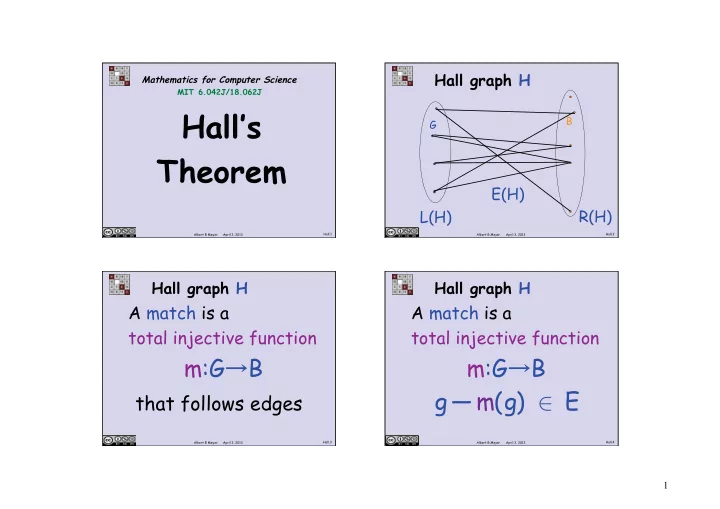
HallgraphH MathematicsforComputerScience MIT6.042J/18.062J Halls B G Theorem E(H) L(H) R(H) Hall.1 Hall.2 Albert R Meyer. April 3, 2013 Albert R Meyer. April 3, 2013 HallgraphH HallgraphH A match is a A match is a


slide-1
SLIDE 1 Albert R Meyer. April 3, 2013

Hall’s Theorem

Hall.1

Mathematics for Computer Science

MIT 6.042J/18.062J

Albert R Meyer. April 3, 2013

G B

Hall.2

Hall graph H L(H) R(H) E(H)

Albert R Meyer. April 3, 2013 Hall.3

Hall graph H

A match is a total injective function

m:GB

that follows edges

Albert R Meyer. April 3, 2013 Hall.4

Hall graph H

A match is a total injective function

m:GB

g — m(g) ∈ E

1

slide-2
SLIDE 2
  • Albert R Meyer.
April 3, 2013 Hall.5

Hall graph H

A match is a total injective function

B

graph(m) ⊆ E

Albert R Meyer. April 3, 2013

If |S|≤|E(S)| for all sets of girls, S, then there is a match.

Hall’s Theorem

Hall.6

Hall’s condition

Albert R Meyer. April 3, 2013

How to verify no bottlenecks?

fairly efficient matching procedure is known

(explained in algorithms subjects)

Hall.7

…but there is a special situation that ensures a match…

Albert R Meyer. April 3, 2013

How to verify no bottlenecks?

If every girl likes ≥ d boys, and every boy likes ≤ d girls, then no bottlenecks.

Hall.8

a degree-constrained Hall graph

2

m:G

slide-3
SLIDE 3

How to verify no bottlenecks? How to verify no bottlenecks?

If every girl likes ≥ d boys, and every boy likes ≤ d girls, then no bottlenecks.

proof:

Albert R Meyer. April 3, 2013 Hall.9

If every girl likes ≥ d boys, and every boy likes ≤ d girls, then no bottlenecks.

proof: say set S of girls has e

incident edges:

d |S| ≤ e ≤ d |E(S)| so |S| ≤ |E(S)| no bottleneck

Albert R Meyer. April 3, 2013 Hall.10

Proof of Hall’s Theorem Proof of Hall’s Theorem

Suppose no bottlenecks. Suppose no bottlenecks.

Lemma: If S a set of girls with

Lemma: No bottlenecks

|S|=|E(S)|,

within any set S of girls.

then no bottlenecks between

  • bviously

s and E(S) either

Albert R Meyer. April 3, 2013 Hall.11 Albert R Meyer. April 3, 2013 Hall.12

3

slide-4
SLIDE 4 Albert R Meyer. April 3, 2013

bottleneck between &

?

T

then T ∪ S is a bottleneck

X

s

E(S) E(S)

S

s E(S)

bottleneck

Hall.13 Albert R Meyer. April 3, 2013

No bottlenecks implies there is a perfect match.

proof:

by strong induction

  • n # girls
Hall.14

Proof of Hall’s Theorem

Albert R Meyer. April 3, 2013

Case 1: there is a nonempty proper subset S of girls with |S|=|E(S)|. by Lemmas, no bottlenecks in Hall graph (S, E(S)), and none in

(S, E(S))

Hall.15

Proof of Hall’s Theorem

Albert R Meyer. April 3, 2013

by induction, match (S, E(S)) and separately. (S, E(S))

Hall.16

Proof of Hall’s Theorem

4

slide-5
SLIDE 5 Albert R Meyer. April 3, 2013

by induction, match (S, E(S)) and

  • separately. Matchings

don’t overlap, so union is a complete matching. (S, E(S))

Hall.17

Proof of Hall’s Theorem

Albert R Meyer. April 3, 2013

Case 2: |S|<|E(S)| for all nonempty proper subsets S. Pick a girl, g.

Hall’s Theorem

Hall.18 Albert R Meyer. April 3, 2013

Case 2: |S|<|E(S)| for all nonempty proper subsets S. Pick a girl, g. She must be compatible with some boy, b (in fact, at least 2 boys).

Hall’s Theorem

Hall.19 Albert R Meyer. April 3, 2013

Case 2: |S|<|E(S)| for all nonempty proper subsets S. Match g with b.

Hall’s Theorem

Hall.20

5

slide-6
SLIDE 6

Hall’s Theorem Hall’s Theorem

Case 2: |S|<|E(S)| for all nonempty proper subsets S. Match g with b. Removing b still leaves |S|≤|E(S)|, so no bottlenecks.

Albert R Meyer. April 3, 2013 Hall.21

Case 2: |S|<|E(S)| for all nonempty proper subsets S. By induction, can match remaining girls & boys. This match along with g—b is complete match. QED

Albert R Meyer. April 3, 2013 Hall.22

6

slide-7
SLIDE 7

MIT OpenCourseWare http://ocw.mit.edu

6.042J / 18.062J Mathematics for Computer Science

Spring 2015 For information about citing these materials or our Terms of Use, visit: http://ocw.mit.edu/terms.