Habitat Enhancement Master Plan Chatham Borough River Road Site - - PowerPoint PPT Presentation

habitat enhancement master plan
SMART_READER_LITE
LIVE PREVIEW

Habitat Enhancement Master Plan Chatham Borough River Road Site - - PowerPoint PPT Presentation

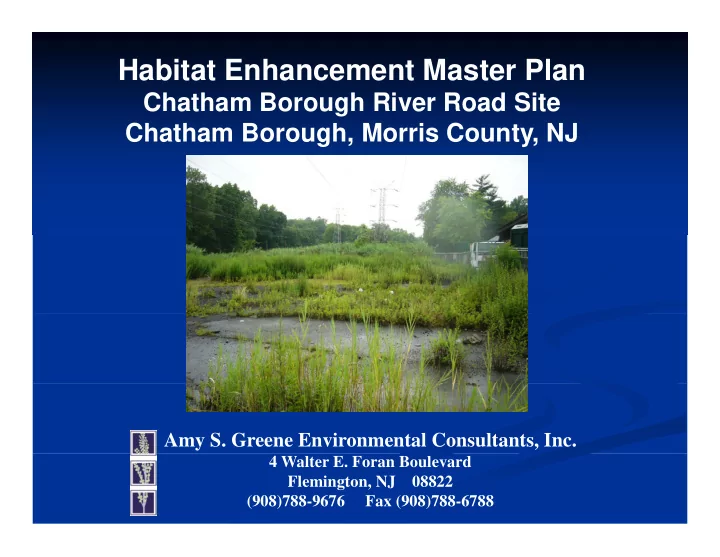
Habitat Enhancement Master Plan Chatham Borough River Road Site Chatham Borough River Road Site Chatham Borough, Morris County, NJ Amy S. Greene Environmental Consultants, Inc. 4 Walter E. Foran Boulevard Flemington, NJ 08822 (908)788-9676


slide-1
SLIDE 1

Habitat Enhancement Master Plan

Chatham Borough River Road Site Chatham Borough River Road Site Chatham Borough, Morris County, NJ

Amy S. Greene Environmental Consultants, Inc.

4 Walter E. Foran Boulevard Flemington, NJ 08822 (908)788-9676 Fax (908)788-6788

slide-2
SLIDE 2

River Road Site River Road Site

12 6 acre parcel

12 6 acre parcel

12.6 acre parcel

12.6 acre parcel

Upper Passaic

Upper Passaic W t h d W t h d Watershed Watershed

Bordered by the

Bordered by the

Passaic River

Passaic River

River Road &

River Road & Commercial & Commercial & residential residential properties properties

slide-3
SLIDE 3

Southern Section Southern Section: : mostly mostly undeveloped undeveloped undeveloped, undeveloped, forested uplands forested uplands and forested and forested and forested and forested wetlands wetlands

slide-4
SLIDE 4

Northern Section Northern Section: :

JCP&L Utility

JCP&L Utility

JCP&L Utility

JCP&L Utility easement easement

deteriorated

deteriorated h l ki l h l ki l asphalt parking lot asphalt parking lot

slide-5
SLIDE 5

Debris Piles Debris Piles

Empty 250 gal. tank

Empty 250 gal. tank

Empty 250 gal. tank

Empty 250 gal. tank

Tarps, bubble wrap,

Tarps, bubble wrap, tires, old concrete tires, old concrete , culvert, asphalt culvert, asphalt tailings, electronic tailings, electronic parts parts

slide-6
SLIDE 6

Early & Late Early & Late Successional Successional Field Field Field Field

(Utility Easement) (Utility Easement)

  • Invasive Species

Invasive Species

Mugwort

Mugwort

  • Native Species

Daisy fleabane

Mugwort

Mugwort

Japanese knotweed

Japanese knotweed

Common Reed

Common Reed Curled dock Curled dock – Daisy fleabane – Bush clover – Wild bergamot Pokeweed

Curled dock

Curled dock

Field bindweed

Field bindweed

Common mullein

Common mullein Purple Loosestrife Purple Loosestrife – Pokeweed – Goldenrod spp. – Switchgrass Hickory

Purple Loosestrife

Purple Loosestrife

Queen Anne’s lace

Queen Anne’s lace

Orchard grass

Orchard grass Wi b Wi b – Hickory – Northern red oak

Wineberry

Wineberry

Multiflora rose

Multiflora rose

Tatarian honeysuckle

Tatarian honeysuckle Chi i t Chi i t

Chinese privet

Chinese privet

Autumn olive

Autumn olive

Tree

Tree-

  • of
  • f-
  • heaven

heaven

slide-7
SLIDE 7

Hardwood Forest Hardwood Forest

(Between Utility Easement & River) (Between Utility Easement & River) N ti S i Invasive Species Invasive Species Native Species

  • Red maple
  • Silver maple
  • Sugar maple

p

  • Tree

Tree-

  • of
  • f-
  • heaven

heaven

  • Norway maple

Norway maple

  • Multiflora rose

Multiflora rose

Sugar maple

  • Box elder
  • Pin oak
  • Northern red oak
  • Tatarian

Tatarian honeysuckle honeysuckle

  • Japanese barberry

Japanese barberry

  • White ash
  • Sassafras
  • Tulip poplar
  • Black walnut
  • Wineberry

Wineberry

  • Japanese

Japanese honeysuckle honeysuckle

  • Shagbark hickory
  • Black haw viburnum
  • Blackberry

A i bl dd t

  • Stiltgrass

Stiltgrass

  • Garlic mustard

Garlic mustard

  • Curled Dock

Curled Dock

  • American bladdernut
  • Poison ivy
  • Virginia creeper
  • Ferns
  • Reed canary grass

Reed canary grass

  • Jack-in-the-pulpit
  • sedges
slide-8
SLIDE 8

Snags (dead/dying

Snags (dead/dying trees) trees)

Important habitat

Important habitat for bats & birds for bats & birds for bats & birds for bats & birds

slide-9
SLIDE 9

Forest Understory Forest Understory Forest Understory Forest Understory

Heavy deer browse

Heavy deer browse y

Feeding pressure

Feeding pressure

  • n native plants
  • n native plants

Reduces plant

Reduces plant diversity diversity

Many of the

Many of the understory plants understory plants ti ti are non are non-

  • native,

native, invasive species invasive species (i e stiltgrass) (i e stiltgrass) (i.e. stiltgrass) (i.e. stiltgrass)

slide-10
SLIDE 10

Forested Riparian Forested Riparian Floodplain Floodplain

  • River birch

River birch

Floodplain Floodplain

  • American sycamore

American sycamore

  • Silver maple

Silver maple

  • Red maple

Red maple p

  • Green ash

Green ash

  • American elm

American elm

  • Persimmon

Persimmon

  • Persimmon

Persimmon

  • Box elder

Box elder

  • Northern red oak

Northern red oak

  • American Bladdernut

American Bladdernut

  • Black Haw virbunum

Black Haw virbunum

  • Skunk cabbage

Skunk cabbage g

  • Blue flag iris

Blue flag iris

  • Arrowhead

Arrowhead

  • Trout lily

Trout lily

  • Trout lily

Trout lily

  • Sedges

Sedges

  • Stout wood reed

Stout wood reed

slide-11
SLIDE 11

Forested Wetlands Forested Wetlands Forested Wetlands Forested Wetlands

Ri i fl d l i Ri i fl d l i

Riparian floodplain

Riparian floodplain

  • f the Passaic
  • f the Passaic

Ri Ri River River

Temporary (vernal)

Temporary (vernal) pools pools

Sparsely vegetated

Sparsely vegetated p y g p y g

Habitat for

Habitat for amphibians amphibians amphibians amphibians

slide-12
SLIDE 12

Emergent Wetlands Emergent Wetlands g

(Utility Easement Area) (Utility Easement Area)

S ilk d S ilk d

Swamp milkweed

Swamp milkweed

Wool grass

Wool grass

Soft rush

Soft rush

Soft rush

Soft rush

Broad

Broad-

  • leaved cattail

leaved cattail

Jewelweed

Jewelweed

Sensitive fern

Sensitive fern

Sedges

Sedges

Common reed

Common reed

Purple loosestrife

Purple loosestrife

slide-13
SLIDE 13

Open Water Open Water – Passaic River Passaic River Open Water Open Water Passaic River Passaic River

  • Approx. 50’ wide
  • Approx. 50’ wide

along project area along project area

Wildlife observed:

Wildlife observed:

Great blue heron

Great blue heron

Kingfisher

Kingfisher

Warm water fish

Warm water fish

Warm water fish

Warm water fish

slide-14
SLIDE 14

Sensitive Species Known to Occur Sensitive Species Known to Occur i hi h P j Vi i i i hi h P j Vi i i within the Project Vicinity within the Project Vicinity

Wood Turtle

Wood Turtle

Wood Turtle

Wood Turtle

NJ threatened

NJ threatened

Inhabits streams

Inhabits streams

Inhabits streams

Inhabits streams with deep pools and with deep pools and banks with banks with

  • verhanging roots
  • verhanging roots
  • verhanging roots
  • verhanging roots

and logs and logs

Riparian areas in

Riparian areas in p project area provide project area provide potential habitat potential habitat

slide-15
SLIDE 15

Indiana Bat Indiana Bat

Federally & State

Federally & State Endangered in NJ Endangered in NJ Endangered in NJ Endangered in NJ

Known from Great

Known from Great Swamp NWR Swamp NWR p

Occupies large trees

Occupies large trees with peeling bark & with peeling bark & dead trees dead trees

Forages in riparian

Forages in riparian and forested and forested floodplains floodplains

slide-16
SLIDE 16

Red Shouldered Hawk Red Shouldered Hawk Red Shouldered Hawk Red Shouldered Hawk

Breeding population

Breeding population Breeding population Breeding population is NJ State is NJ State Endangered; Endangered; winter/migratory winter/migratory population is NJ population is NJ State Threatened State Threatened State Threatened State Threatened

Prefers secluded

Prefers secluded mature forested mature forested mature forested mature forested wetlands & riparian wetlands & riparian forests forests forests forests

slide-17
SLIDE 17

Barred Owl Barred Owl Barred Owl Barred Owl

NJ State Threatened

NJ State Threatened Large tracts of Large tracts of

Large tracts of

Large tracts of undisturbed forest, mature undisturbed forest, mature

  • ld growth & high canopy
  • ld growth & high canopy

g g py g g py cover in wetlands with cover in wetlands with cavity trees cavity trees

Unlikely to use the project

Unlikely to use the project site for breeding, it would site for breeding, it would be expected to forage be expected to forage be expected to forage be expected to forage within the riparian zones within the riparian zones

  • f the Passaic River
  • f the Passaic River
slide-18
SLIDE 18

Enhancement Considerations Enhancement Considerations & Recommendations & Recommendations

Remove deteriorated

Remove deteriorated

Develop gardens

Develop gardens

Remove deteriorated

Remove deteriorated asphalt & install small asphalt & install small gravel parking area gravel parking area Develop gardens Develop gardens

Community Vegetable

Community Vegetable

Butterfly

Butterfly N ti Pl t Di l N ti Pl t Di l

gravel parking area gravel parking area

Construct walking trail

Construct walking trail through forest & early through forest & early

Native Plant Display

Native Plant Display

Rain Garden

Rain Garden

g y g y successional field successional field

Develop kayak/canoe

Develop kayak/canoe p y p y launch launch

slide-19
SLIDE 19
slide-20
SLIDE 20

Raingardens Raingardens Raingardens Raingardens

A rain garden is a landscaped, shallow depression A rain garden is a landscaped, shallow depression th t ll i d lt t b ll t d th t ll i d lt t b ll t d that allows rain and snowmelt to be collected that allows rain and snowmelt to be collected and seep naturally into the ground. and seep naturally into the ground. What are the benefits of a Rain Garden? What are the benefits of a Rain Garden?

Increases groundwater recharge

Increases groundwater recharge

Reduces surface water runoff

Reduces surface water runoff

Aesthetically pleasing landscape amenity

Aesthetically pleasing landscape amenity

Benefits to wildlife

Benefits to wildlife

Benefits to wildlife

Benefits to wildlife

Reduces flooding and stream bank erosion

Reduces flooding and stream bank erosion

slide-21
SLIDE 21
slide-22
SLIDE 22

Habitat Enhancement & Habitat Enhancement & Maintenance Maintenance

Eradicate invasive

Eradicate invasive species in field and species in field and

Install bird & bat

Install bird & bat boxes boxes forest habitats forest habitats

Install native plantings

Install native plantings

Girdle trees to create

Girdle trees to create snags snags

Create brush piles

Create brush piles

Install deer

Install deer exclosures exclosures

slide-23
SLIDE 23

Invasive Plant Species Invasive Plant Species – – What are they? What are they?

A species that become established in a new ecosystem in which it has not “co-evolved”

Produce large numbers of new plants each season Tolerate many soil types and weather conditions Spread easily usually by wind, water, or animals Grow rapidly, displace slower growing plants Negatively impact native wildlife by reducing habitat variability

slide-24
SLIDE 24

Why are Native Plants Important? Why are Native Plants Important?

Plants form the first trophic

Plants form the first trophic level level – – converting sunlight converting sunlight into stored energy into stored energy

Fothergilla

into stored energy into stored energy

Native insects do not (or

Native insects do not (or rarely) eat non native plants rarely) eat non native plants rarely) eat non native plants rarely) eat non native plants

Most of our native animals

Most of our native animals rely on insects for part of or rely on insects for part of or y p y p all of their diet all of their diet

slide-25
SLIDE 25

Why are Insects Important? Why are Insects Important? y p y p

“Insects are exceedingly effective at “Insects are exceedingly effective at converting plant tissue into insect tissue. A converting plant tissue into insect tissue. A large percentage of the worlds fauna depends large percentage of the worlds fauna depends

  • n insects to access the energy stored in
  • n insects to access the energy stored in

plants” (E.O. Wilson, 1987) plants” (E.O. Wilson, 1987) “A land without insects is a land without most “A land without insects is a land without most forms of higher life” (E.O. Wilson, 1987) forms of higher life” (E.O. Wilson, 1987)

slide-26
SLIDE 26

Animals rely on the insects that Animals rely on the insects that feed on plants for survival feed on plants for survival

Approximately 96% of North America’s terrestrial

Approximately 96% of North America’s terrestrial birds rely on insects to feed their young birds rely on insects to feed their young (Dickinson 1999) (Dickinson 1999) (Dickinson 1999) (Dickinson 1999)

Pound for pound insects contain more energy

Pound for pound insects contain more energy

Pound for pound, insects contain more energy

Pound for pound, insects contain more energy than beef than beef

The diversity of animals in a habitat is closely

The diversity of animals in a habitat is closely linked to the diversity of the plant community in linked to the diversity of the plant community in th t h bit t (R i 1995) th t h bit t (R i 1995) that habitat (Rosenzweig , 1995) that habitat (Rosenzweig , 1995)

slide-27
SLIDE 27

Many species of plants = Many species of plants = many species of animals! many species of animals!

Th t i t hi h i l di it Th t i t hi h i l di it

The tropics support very high animal diversity.

The tropics support very high animal diversity.

One hectare (2.47 ac) of tropical rainforest has as many

One hectare (2.47 ac) of tropical rainforest has as many

One hectare (2.47 ac) of tropical rainforest has as many

One hectare (2.47 ac) of tropical rainforest has as many as 473 tree species (Valencia, Balslev and Paz y Mino as 473 tree species (Valencia, Balslev and Paz y Mino 1994) 1994)

All of Pennsylvania supports only 134 species of trees

All of Pennsylvania supports only 134 species of trees (Rhoades and Block 2005) (Rhoades and Block 2005)

slide-28
SLIDE 28

Mugwort Mugwort

(Artemisia Artemisia vulgaris vulgaris) (Artemisia Artemisia vulgaris vulgaris) )

Field/Utility Easement Field/Utility Easement

Open sunny habitat

Open sunny habitat

Grows from underground root

Grows from underground root network network

Forms dense stands that

Forms dense stands that restrict growth of natives, restrict growth of natives, reduces plant diversity reduces plant diversity Th t ff ti t l i Th t ff ti t l i

The most effective control is

The most effective control is repeated application of repeated application of Glyphosate Glyphosate (Roundup™) or (Roundup™) or Glyphosate Glyphosate (Roundup™) or (Roundup™) or Clopyralid Clopyralid

slide-29
SLIDE 29

Japanese knotweed Japanese knotweed

(P l P l id t id t ) (Polygonum Polygonum cuspidatum cuspidatum)

Field/Utility Easement Field/Utility Easement y

Prefers sunny, riparian

Prefers sunny, riparian areas areas

Extremely persistent

Extremely persistent

Grows to about 10’ high

Grows to about 10’ high

Spreads via stout

Spreads via stout underground rhizomes underground rhizomes which can extend 45 which can extend 45-60’ 60’ which can extend 45 which can extend 45 60 60

Cutting & spraying the re

Cutting & spraying the re-

  • sprouts with

sprouts with Roundup™

Roundup™ in

in p p

p

late summer/early fall late summer/early fall provides effective control provides effective control

slide-30
SLIDE 30

Common reed Common reed (Phragmites

Phragmites australis australis) ) Field/Utility Easement Field/Utility Easement

  • Colonizes wetlands, marshes,

Colonizes wetlands, marshes, floodplains and ditches floodplains and ditches

  • Can grow 15’ high

Can grow 15’ high

  • Forms dense monocultures that

Forms dense monocultures that eliminate plant diversity eliminate plant diversity

  • Aggressive rhizomes grow overland 30’

Aggressive rhizomes grow overland 30’

  • r more in 1 season
  • r more in 1 season
  • Spraying with Glyphosate (

Spraying with Glyphosate (Roundup™

Roundup™)

) Sept15 Sept15-

  • Oct 15 controls common reed

Oct 15 controls common reed

  • Cutting twice annually will reduce vigor

Cutting twice annually will reduce vigor t t i l h ld b d i t t i l h ld b d i – – cut material should be removed since cut material should be removed since cut stock will readily root especially in cut stock will readily root especially in the Spring the Spring

  • Burning will reduce the abundant and

Burning will reduce the abundant and

  • Burning will reduce the abundant and

Burning will reduce the abundant and persistent litter and open up the ground persistent litter and open up the ground level to additional wildlife level to additional wildlife

slide-31
SLIDE 31

Japanese barberry Japanese barberry (Berberis

Berberis thunbergii thunbergii) Forest Forest Forest Forest

  • Forms dense stands in closed

Forms dense stands in closed canopy forests, meadows, pastures canopy forests, meadows, pastures and wetlands and wetlands

  • Branches have sharp spines, not

Branches have sharp spines, not browsed by deer browsed by deer

  • Spreads by seeds eaten by birds

Spreads by seeds eaten by birds

  • Individual plants can be cut or pulled

Individual plants can be cut or pulled

  • ut with a weed wrench.
  • ut with a weed wrench.
  • Pull plants when the soil is moist

Pull plants when the soil is moist which allow roots to be removed which allow roots to be removed more efficiently. Make certain to more efficiently. Make certain to wear heavy gloves due to the sharp wear heavy gloves due to the sharp wear heavy gloves due to the sharp wear heavy gloves due to the sharp spines. spines.

  • Treatment with the herbicides

Treatment with the herbicides Glyphosate Glyphosate (Roundup™) and (Roundup™) and Glyphosate Glyphosate (Roundup ) and (Roundup ) and triclopyr triclopyr ( (Garlon Garlon ™) are effective. ™) are effective.

slide-32
SLIDE 32

Japanese honeysuckle Japanese honeysuckle

(Lonicera Lonicera japonica japonica) ( j p j p ) Forest Forest

  • Perennial climbing vine will girdle

Perennial climbing vine will girdle g g g g shrubs and trees shrubs and trees

  • Spreads by seeds, underground

Spreads by seeds, underground rhizomes & above ground runners rhizomes & above ground runners g which can grow 30’ in 1 year which can grow 30’ in 1 year

  • Can form dense thickets of vines &

Can form dense thickets of vines &

  • utcompete most plants
  • utcompete most plants

p p p p

  • Individual plants can be pulled when

Individual plants can be pulled when soil is moist, some root fragments soil is moist, some root fragments may remain behind & may remain behind & resprout resprout. . y p

  • The plant can be treated with the

The plant can be treated with the herbicide herbicide Glyphosate Glyphosate (Roundup™) (Roundup™) relatively late in the season when relatively late in the season when y the leaves are still green but other the leaves are still green but other plants have senesced. plants have senesced.

slide-33
SLIDE 33

Japanese Japanese stiltgrass stiltgrass (Microstegium

Microstegium vimineum vimineum)

Forest Forest Forest Forest

  • Grows in full sun or dense shade

Grows in full sun or dense shade

  • Readily colonizes disturbed sites &

Readily colonizes disturbed sites &

  • utcompetes native plants
  • utcompetes native plants
  • utcompetes native plants
  • utcompetes native plants
  • Spreads

Spreads vegetatively vegetatively by rooting at by rooting at stems & from seed. One plant can stems & from seed. One plant can produce 100 produce 100 -

  • 1000 seeds which remain

1000 seeds which remain i bl t 5 i bl t 5 viable up to 5 yrs. viable up to 5 yrs.

  • It is not browsed by deer

It is not browsed by deer

  • Seeds are dispersed by surface water

Seeds are dispersed by surface water runoff & on feet of animals & humans. runoff & on feet of animals & humans. runoff & on feet of animals & humans. runoff & on feet of animals & humans.

  • The plant has shallow roots and small

The plant has shallow roots and small infestations can be hand pulled, weed infestations can be hand pulled, weed whacked or mowed. whacked or mowed.

  • Perform removal prior to seed set: mid

Perform removal prior to seed set: mid to late Sept in our area. to late Sept in our area.

  • Treat with the herbicide

Treat with the herbicide Glyphosate Glyphosate (R d ™)f b f i (R d ™)f b f i (Roundup™)for a number of years in (Roundup™)for a number of years in

  • rder to exhaust the seed bank.
  • rder to exhaust the seed bank.
slide-34
SLIDE 34

Purple loosestrife Purple loosestrife (Lythrum

Lythrum salicaria salicaria) Field/Utility Easement Field/Utility Easement

Adapts readily to natural and

Adapts readily to natural and dist rbed etlands dist rbed etlands disturbed wetlands disturbed wetlands

Rapidly displaces native

Rapidly displaces native plants and creates plants and creates monocultures monocultures

Results in reduced plant

Results in reduced plant diversity and with little wildlife diversity and with little wildlife benefit benefit O l t d 2 O l t d 2 3

One plant can produce 2

One plant can produce 2-3 3 million seeds. Also spreads million seeds. Also spreads by rhizomes by rhizomes

Manual weeding of small

Manual weeding of small

Manual weeding of small

Manual weeding of small number of plants number of plants

Herbicide (

Herbicide (Glyphosate Glyphosate = = Roundup™ = Rodeo) will = Rodeo) will control purple loosestrife control purple loosestrife control purple loosestrife control purple loosestrife – apply in mid to late summer apply in mid to late summer

slide-35
SLIDE 35

Tree Tree-

  • of
  • f-
  • heaven

heaven (Ailanthus

Ailanthus altissima altissima) ) Forest Forest

  • Native to China

Native to China

  • Grows up to 80’ high

Grows up to 80’ high

  • Single female tree can produce

Single female tree can produce up to 300,000 winged seeds up to 300,000 winged seeds

  • Compounds from roots prevents

Compounds from roots prevents the growth of nearby plants the growth of nearby plants

  • Overtakes sites, replaces native

Overtakes sites, replaces native plants plants

  • Herbicides (Roundup™ ,

Herbicides (Roundup™ , Garlon Garlon) applied to the leaves, ) applied to the leaves, green stems, sprouts and green stems, sprouts and suckers is effective suckers is effective

  • Cutting & girdling trees &

Cutting & girdling trees & spraying sprouts & stems with spraying sprouts & stems with herbicide is effective herbicide is effective

slide-36
SLIDE 36

Norway maple Norway maple (Acer

Acer platinoides platinoides) Forest Forest Forest Forest

  • Most common shade tree in US

Most common shade tree in US

  • Produce copious quantities of winged

Produce copious quantities of winged seed seed seed seed

  • Casts heavy shade and has dense

Casts heavy shade and has dense shallow root system shallow root system

  • Tolerates urban soils and pollution

Tolerates urban soils and pollution

  • Tolerates urban soils and pollution

Tolerates urban soils and pollution

  • Norway maple forests result in very

Norway maple forests result in very limited plant diversity limited plant diversity

  • Small trees can be hand pulled or a

p weed wrench can be used.

  • The use of an herbicide (Roundup™,

Rodeo, Garlon) applied to the leaves, t t d k green stems, sprouts and suckers.

  • Cutting & girdling trees & spraying

stumps, sprouts & stems with herbicide is effectiv is effectiv

  • Wood has been used for Stradivarius

violins!

slide-37
SLIDE 37

Multiflora Multiflora Rose Rose (Rosa

Rosa multiflora multiflora) ) ( ) Forest & Field Forest & Field

  • Grows aggressively birds disperse fruits

Grows aggressively birds disperse fruits

  • Grows aggressively, birds disperse fruits

Grows aggressively, birds disperse fruits

  • A single plant can produce up to a million

A single plant can produce up to a million seeds that will survive in the soil seed seeds that will survive in the soil seed bank for 20 years bank for 20 years bank for 20 years. bank for 20 years.

  • Dense thickets of shrubs exclude most

Dense thickets of shrubs exclude most

  • ther plants
  • ther plants
  • Provide nest sites for birds

Provide nest sites for birds

  • Provide nest sites for birds

Provide nest sites for birds

  • Glyphosate

Glyphosate (Roundup™) is extremely (Roundup™) is extremely effective if it is applied to the foliage after effective if it is applied to the foliage after the plant flowers in the early Spring the plant flowers in the early Spring the plant flowers in the early Spring the plant flowers in the early Spring

  • Individual plants can be cut or pulled out

Individual plants can be cut or pulled out with a weed wrench. with a weed wrench.

  • The plant base should be grubbed out or

The plant base should be grubbed out or p g p g treated with an herbicide. treated with an herbicide.

slide-38
SLIDE 38

Weed Wrench Weed Wrench

slide-39
SLIDE 39

Costs Costs