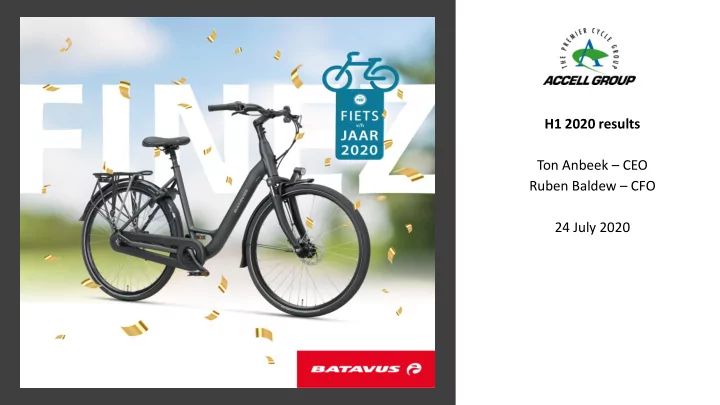
H1 2020 results Ton Anbeek CEO Ruben Baldew CFO 24 July 2020 - - PowerPoint PPT Presentation

h1 2020 results
SMART_READER_LITE
LIVE PREVIEW

H1 2020 results Ton Anbeek CEO Ruben Baldew CFO 24 July 2020 - - PowerPoint PPT Presentation

H1 2020 results Ton Anbeek CEO Ruben Baldew CFO 24 July 2020 Disclaimer This presentation may contain forward-looking statements. These are based on our current plans, expectations and projections about future events. Any


slide-1
SLIDE 1

H1 2020 results Ton Anbeek – CEO Ruben Baldew – CFO 24 July 2020

slide-2
SLIDE 2

Disclaimer

2

  • This presentation may contain forward-looking statements. These are based on our current plans, expectations

and projections about future events.

  • Any forward-looking statement is subject to risks, uncertainties and assumptions and speak only as of the date

they are made. Our results could differ materially from those anticipated in any forward-looking statement.

  • The financial statements and other reported data in this presentation have not been audited.
slide-3
SLIDE 3

Ton Anbeek - CEO

3

slide-4
SLIDE 4

Strategic objectives and financial targets

4

  • Increasing dealer and consumer satisfaction
  • Increasing market share
  • Increasing net profit
  • Strong and healthy balance sheet
  • Corporate Social Responsibility
  • Turnover
  • Added value / Turnover
  • EBIT / Turnover
  • Trade working capital / Turnover
  • Return on capital employed

€ 1.4 - € 1.5 bn 31% 8.0% < 25% > 15%

2022 financial targets Strategic objectives

slide-5
SLIDE 5

H1 highlights

5

  • Steep post lockdown sales rebound in May and June bringing YTD net sales to +4%
  • Intensified focus on cash delivery; strict governance on expenses and working capital reduction in response

to COVID-19 outbreak

  • Added value down 359 bps due to negative mix, discounts during lockdown and higher supply chain costs

mainly due to disruptions caused by COVID-19

  • Opex down € 6 mio. Excluding one-offs down € 8 mio driven by cost savings
  • Working capital improved 243 bps to 29.7% of net sales versus end-June 2019 due to substantially reduced

inventory levels

  • Strong cash generation resulting in a positive cash flow of € 129 mio and a net debt / rolling EBITDA of 2.0
  • Additional headroom secured to deal with uncertainty and depth of COVID-19
  • Strategy progressing further with improved innovation, strong P&A expansion and optimized omnichannel

plans

slide-6
SLIDE 6

H1 key financial performance indicators

+4.0% € 45 mio € 48 mio

  • 359 bps
  • 243 bps

Net sales growth EBIT / EBIT excl. one-offs Added value % vs PY TWC YoY / Avg TWC

+368 bps

6

slide-7
SLIDE 7

Recap of strategy

7

Lead Global. Win Local Winning at the point of purchase Consumer centric

  • mnichannel

Innovation Centralised & integrated P&A business

Fit to compete

slide-8
SLIDE 8

H1 strategic progress

8

Lead Global Point of purchase

Velosophy expanding further across Europe Brand teams in place, coordinated by country leads Innovation centrally led with sign-off in local brand innovation team Strong growth in the Netherlands. Availability

  • n top runners hampering further uplift

Strong recovery in Germany after lockdown; German stock has been shared with UK and Nordics during lockdown Nordics, UK, Southern Europe strong consumer demand and penetration growth of e-bikes Continued award winning bikes in the Netherlands (eg. Batavus Finez bike of the Year) Premium e-cargo bike Carqon launched and well received with strong demand so far Haibike Flyon production up and running Cash delivery and product availability main focus points in 2020 Higher costs per bike due to COVID-19 disruptions Complexity (# SKUs) further reduced and good progress booked with standardization (frame platforms) Additional brands added to portfolio Continued excellent growth of online sales (third parties) 29% growth XLC business in H1

Omnichannel

Focus on brand websites:

  • Strong availability through search
  • Click and collect functionality
  • Go live Raleigh.co.uk
  • D2C growth Raleigh UK of 460%

Optimizing dealer stock and order management through CRM and order entry tools

Innovation P&A Fit to Compete

slide-9
SLIDE 9

Well on track with ample room for further improvement

9

  • Supply chain disruptions hampering availability and

costs

  • Lower added value due to negative mix, discounts and

higher supply chain costs

  • Average working capital and inventory levels

On track

  • Continued strong underlying demand for our products

and brands as seen in May and June recovery

  • Working capital reduction
  • Overall cash delivery with additional headroom secured
  • Fixed costs increase halted
  • Urban mobility growth continued, with launch Carqon
  • P&A growth

Improvement needed

slide-10
SLIDE 10

Ruben Baldew - CFO

10

slide-11
SLIDE 11

Net sales and profit

11

H1 PY H1

+4.0% +8.8%

Net sales

% Growth

  • 359 bps

+35 bps € 45 mio € 56 mio

Profit

€ 48 mio

% Added value

Y-o-Y

EBIT EBIT

  • excl. one-offs

H1 PY H1

€ 56 mio

slide-12
SLIDE 12

Performance per region

Net sales numbers in € mio, based on geographical location of customer. P&A and Velosophy excluded.

  • March & April lockdowns affected sales H1
  • Strong recovery after lockdown
  • Stock of German brands have been sold in

Nordics and UK during lockdown

  • Flyon fully in production and rolled out
  • Order book MY 2021 looks promising

Central

  • COVID-19 impact was only limited as

shops remained open

  • Growth driven by Batavus thanks to strong

portfolio and activation

Benelux

  • Growth in Nordics and UK very strong driven

across brands thanks to growth bike market

  • France sales slightly down due to lockdown

from March into 2nd week of May

Other

250 225 H1

  • 10,3%

122 128 H1 +5,0% 135 143 H1 +5,5% 2019 2020 2019 2020 2020 2019

12

Dach renamed into Central as Eastern European countries are also included

slide-13
SLIDE 13

Performance Velosophy and Parts & Accessories

  • Cargo bike sales continued strongly also

thanks to D2C model in various countries

  • Growth held back by lockdowns in France

& Germany

  • Next generation e-cargo bike Carqon

successfully launched in June

Velosophy

  • Excellent growth of P&A driven by:
  • Indoor trainer sales during lockdown
  • Strong growth from repair shops
  • Additional business through (new)
  • nline customers
  • XLC brand grows 29%

P&A

17 21 H1 22.3% 127 161 H1 +27.3%

Net sales numbers in € mio

2020 2019 2019 2020

13

slide-14
SLIDE 14

Growth track continues

14

495 2017 2016 443 428 559 598 651 2018 2015 2020 2019 2014 580 2013 677 +6.8% +4.0%

Net sales H1 2013 - H1 2020

  • Average growth over last 7 years 6.8%
  • 2020 growth below 7-year average

due to sales impact of lockdowns, particularly in Germany and France Comments

2013-2017 core (Accell Group excl. North America); 2018 - 2020 continuing operations

slide-15
SLIDE 15

Change in mix due to strong growth P&A and stable e-bikes

15

  • Traditional bikes down 9% in line with

historical average

  • Cargo bikes now at +3% of business;

majority of cargo bikes are e-bikes

  • Parts up 27% growth due to online and

repair shops

  • E-bikes continue to grow in every

country except Germany due to lockdown Categories as % of net sales Comments

61% 62% 60% 20% 16% 14% 20% 19% 24% Cargo 0% 3% 2020 H1 2018 H1 2019 H1 3% Parts Traditional E-bikes 598 651 677

  • 9%
  • 1%

22% Parts Traditional E-bikes Cargo 27%

% Growth H1 vs PY

slide-16
SLIDE 16

Added value down to 27.6%

16

0% 27% 26% 1% 28% 32% 29% 30% 31% 33%

2019 H1

32.5%

2015 H1 2013 H1

31.2%

2018 H1

31.4% 29.5%

2016 H1

27.6%

2014 H1

32.4%

2017 H1 2020 H1

31.5% 30.8%

Added value % H1 2013 – H1 2020

Actuals

  • COVID-19 breaks added value trend
  • Margin down 359 bps due to:
  • Mix effects
  • Discounts
  • Higher supply chain costs as a

result of COVID-19 combined with adverse forex Comments

2013-2017 core (Accell Group excl. North America); 2018 - 2020 June continuing operations. 2018 Added value is restated by excl. the IC deliveries towards North American operations, 30.8% vs 30.9% in H1 2019 presentation.

slide-17
SLIDE 17

17

Opex H1 2019 – H1 2020

2 2 2 2019 Core One-off 20 Allocated Charges US 2019 Discontinued

  • 5

Production Distribution

  • 5

Other savings 2020A 145 147 142

  • Opex reduced by € 5.5 mio from € 147.3 to € 141.8 mio.

As % of net sales, Opex decreased 170 bps

  • Excluding one-offs Opex decreased € 7.9 mio (195 bps)

with main movements

  • One-offs € 2.4 mio:

1) € 3.0 mio charge due to impairment (IT related) plus some restructuring effects 2) € 0.6 mio benefit government support mainly in Germany, France and Turkey

  • Variable costs down € 2.6 mio:

1) Lower spend of € 4.8 mio in production as reduced need for flexible labor due to lockdowns 2) Distribution increase of € 2.2 mio attributable in full to P&A volume growth with underlying improved average dropsize

  • Other cost reduction of € 5.3 mio in marketing and
  • verheads as part of the COVID-19 measures

Comments

20.9% of net sales 22.3% of net sales

Opex reduced by € 5.5 mio

22.6% of net sales

slide-18
SLIDE 18

EBIT-margin down at 6.7% due to lower added value

18

  • EBIT down € 10.6 mio and 189 bps

versus H1 2019

  • Decrease driven by:
  • Lower added value -359 bps
  • Partly compensated by lower

Opex as percentage of net sales (-170 bps)

  • EBIT excluding one-offs at 7.0%

Comments

8.3% 8.9% 10.4% 10.4% 8.9% 8.1% 8.6% 6.7% 7.0% 0% 2% 4% 6% 8% 10% 12% 2014 2019 2017 2020 2015 2013 2016 2018 2020 excl. One-offs Strat Target Actuals/Plan

EBIT% H1 2013 – H1 2020

2013-2017 core (Accell Group excl. North America); 2018, 2019 and 2020 continuing operations

slide-19
SLIDE 19

19

Net profit declines to € 28.6 mio due to added value shortfall

Comments

  • Growth 4% versus 8.8% last year while added value

decreased 359 bps

  • Opex reduced by € 5.5 mio leading to EBIT excluding
  • ne-offs at € 48 mio
  • Interest costs up due to higher borrowings
  • Income tax down due to lower profit
  • Previous year discontinued were operating losses of the

divested non core North American operation Profit & Loss H1 2020 - H1 2019 EBIT excl. one-offs H1 2020 – H1 2019

slide-20
SLIDE 20

June - Average

Trade working capital improved due to inventory reductions

20

30.5% 31.5% 29.4% 33.1% 28.8% 15.0% 14.9% (13.9%) 30.4% (13.3%) (14.7%) 2017 2018 29.4% 14.7% 2019 33.0% 15.1% (15.0%) 2020 +2.6% +3.7% 16.7% 17.7% 17.1% 17.3% 27.6% 29.2% 30.7% 27.9%

  • 14.9%
  • 12.6%
  • 15.6%
  • 15.5%

29.4% 34.2% 32.2% 29.7% 2017 2018 2020 2019 +0.3%

  • 2.4%

June - Periodic

Inventory Debtors Creditors TWC%

Comments

June Periodic

  • Working capital at end of June down 243 bps at 29.7% of net

sales, driven by lower inventory (-272 bps)

  • Reduction driven by strong May and June sales
  • Focus in H2 2020 and Q1 2021 is to ensure right availability

whilst continuing strong governance on working capital June Average

  • Average at +368 bps driven by inventory +360 bps
  • High inventory position in Q4 2019
  • Inventory increased further till May due to:
  • Normal season build up Jan/Feb into March
  • Lockdowns hampering sales March and April

2013-2018 core (Accell Group excl. North America); 2019 -2020 continued operations 2013-2018 core (Accell Group excl. North America); 2019 -2020 continued operations

slide-21
SLIDE 21

Q1 Q2 29.7% Q3 Q4 12.2% 27.9% 17.3%

  • 14.2%
  • 18.1%

Q1 17.4% 33.0% 12.2% 18.6% 40.9%

  • 15.5%

Q2 36.1% 33.1% 29.0% 29.5% 38.6% 30.0% 34.6% 19.6%

  • 15.7%
  • 12.9%

28.2%

  • 20.8%

Rec Inv Lia

Trade working capital avg 2018-2019 (% on net sales) Cash out Cash out Cash in Cash in Production peak Delivery peak Orders new year Inventory new season

TWC regular seasonal patterns. Cash conversion from Q2 to Q3

Cash out Production peak Cash in Delivery peak Trade working capital H1 2020 (% on net sales)

21

slide-22
SLIDE 22

29.0% 12.2% 40.9% 17.4% Q1

  • 15.7%

Q2 Q1 19.6% 34.6% Q3

  • 18.1%

30.0%

  • 14.2%

28.2% 12.2% 17.3% 29.7% 29.5%

  • 20.8%
  • 12.9%

Q2 18.6% 27.9% 38.6% Q4

  • 15.5%

33.1% 33.0% 36.1% Rec Inv Lia

Trade working capital avg 2018-2019 (% on net sales) Cash out Cash out Cash in Cash in Production peak Delivery peak Orders new year Inventory new season

TWC patterns distorted due to lock down. Reductions as of May

Cash out Production peak Cash in Delivery peak Trade working capital H1 2020 (% on net sales)

22

slide-23
SLIDE 23

23

Strong cash generation due to focus on cash, costs and TWC

Operating cash flow € 129.1 mio driven by:

  • Profit corrected for depreciation,

amortization, finance costs and tax € 58.8 mio

  • Change in working capital € 66.9 mio
  • Provision, employee benefit and

deferred revenue € 3.4 mio Increase cash at bank € 297.3 mio driven by

  • Free cash flow € +115.9 mio
  • Financing activities € +181.5 mio
  • Accordion € +50 mio
  • GO-C financing € +60 mio
  • Facility A € +70 mio
  • Other € +1.5 mio

Cash flow H1 2019 Cash flow H1 2020

59 129 122 116 70 Cash from working capital Net Cash Increase Cash from profits Cash flows from

  • perations
  • 8

Interest & Taxes Cash from

  • perating

activities

  • 6

Free cash flow Cash from investing activities 181 297 Cash from financing activities 58

  • 11
  • 21
  • 28

1

  • 10
  • 7

Cash from profits Cash from

  • perating

activities

  • 69

Cash from investing activities Cash from working capital Cash flows from

  • perations

Interest & Taxes Free cash flow 29 Cash from financing activities Net Cash Increase

Comments

slide-24
SLIDE 24

24

Additional headroom secured and adjusted covenants

Relevant Period ending Outstandings/EBITDA 30-Sep-21 4.64:1 31-Dec-21 3.11:1 Each Relevant Period thereafter 2.50:1

  • 1. Term loan leverage: N/A

Relevant Period ending Solvency Ratio 30-Jun-20 15.0% 31-Dec-20 15.0% 30-Jun-21 16.2% 31-Dec-21 18.6% Each Relevant Period thereafter 25.0%

Financing Covenants 2020

Financing Q1: 1. Term loan € 125 mio (incl. € 50 mio drawn in March under the Accordion) 2. Revolving Facility A € 175 mio 3. Revolving Facility B € 100 mio seasonal facility running from 1 December to 15 July Additional financing Q2: 1. GO-C bank loan € 115 mio until 30 June 2022. Government backed loan (80%)

  • > Drawings: € 60 mio H2 2020 and € 55 mio in Q1 2021 (if needed)

2. France government bank backed (90%) loan of € 5 mio Other conditions during GO-C and before back to original covenants:

  • No dividend distribution
  • Limitations on disposals and acquisitions; approval needed above

certain thresholds

  • Margin increase of 30 bps (10 bps permanently on seasonal facility)

Relevant Period ending LTM EBITDA (EUR) 30-Jun-20

  • 30,000,000

31-Sep-20

  • 58,900,000

31-Dec-20

  • 70,600,000

31-Mar-21

  • 51,400,000

30-Jun-21 5,600,000

  • 2. Solvency ratio:
  • 3. LTM Normalized EBITDA:
  • 4. Minimum liquidity: € 416 mio (not less than € 25 mio)
  • 5. Borrowing reference: headroom € 255 mio (remains unchanged)

Q2 2020 = 23.4% (cash and borrowings netted = 32.3%) Q2 2020 = € 58.1 mio

slide-25
SLIDE 25

25

Total group return on capital and net debt H1 2020

9.1% 2.0 1.9

  • Excl. IFRS 16 & one-offs

H1 2019: 10.2%

  • Excl. IFRS 16, one-offs 10.9%

ROCE

H1 2019: 3.1

  • Excl. IFRS 16 & one-offs 2.8

Net debt / rolling EBITDA

Strong € 70.6 mio reduction of net debt

  • ROCE at 9.1%; decreased versus previous

year due to lower EBIT

  • Net debt reduced by € 70.6 mio versus end-

June 2019 and € 112 mio vs year-end 2019. Main driver reduced working capital

  • Net debt / rolling EBITDA at 2.0 (1.9 excl.
  • ne-offs and IFRS 16). Decrease due to cash

management and working capital reduction Comments

€ 123 mio

  • Excl. IFRS 16

H1 2019 € 224 mio

  • Excl. IFRS 16 € 195 mio

Net debt

€ 154 mio 9.0%

  • Excl. IFRS 16 & one-offs
slide-26
SLIDE 26

26

Balance sheet

Assets Equity & Liabilities

  • Decrease in TWC versus December 19 and June 19
  • Higher overall balance sheet driven by higher cash and borrowings. Will be optimized in H2
slide-27
SLIDE 27

Financial summary

27

  • Net sales growth 4.0%
  • Added value % decreasing due to higher supply chain costs, negative mix and prioritising cash over margin %
  • Opex decreased underlying by € 8 mio driven by reduction of costs in factories and overheads
  • EBIT at € 45 mio, excluding one-offs € 48 mio
  • Working Capital reduction 243 bps driven by inventory decrease, average working capital still up due to

higher Q4 inventory and high inventory during lockdown

  • Positive cash flow of € 129 mio. Net debt/rolling EBITDA at 2.0
  • Additional headroom secured to deal with uncertainty and depth of COVID-19

Main conclusions H1 2020

slide-28
SLIDE 28

Ton Anbeek - CEO

28

slide-29
SLIDE 29

2020 Priorities

29

1. Health and safety employees 2. Deliver positive cash flow 1. Strict expenses control 2. Strict working capital management 3. Drive product availability as much as possible both for H2 2020 as well as for H1 2021 4. Continue improving demand planning/forecasting 5. Continue improvements in time in full innovation delivery 6. Continue complexity reduction (business/assortment/platform/components) 7. Drive cargo/urban mobility solutions

slide-30
SLIDE 30

2020 Outlook

30

  • Market momentum driven by electrification trend, investments in infrastructure and tax benefits. Recent

events have further propelled this

  • However supply chain disruption as a result of COVID-19 has led and will continue to lead to lower

availability and higher costs. We therefore expect EBIT in 2020 to be lower than in 2019

slide-31
SLIDE 31