H&P Key Factors in Decision-Making 73F with DM, COPD, PAD - - PowerPoint PPT Presentation

h p
SMART_READER_LITE
LIVE PREVIEW

H&P Key Factors in Decision-Making 73F with DM, COPD, PAD - - PowerPoint PPT Presentation

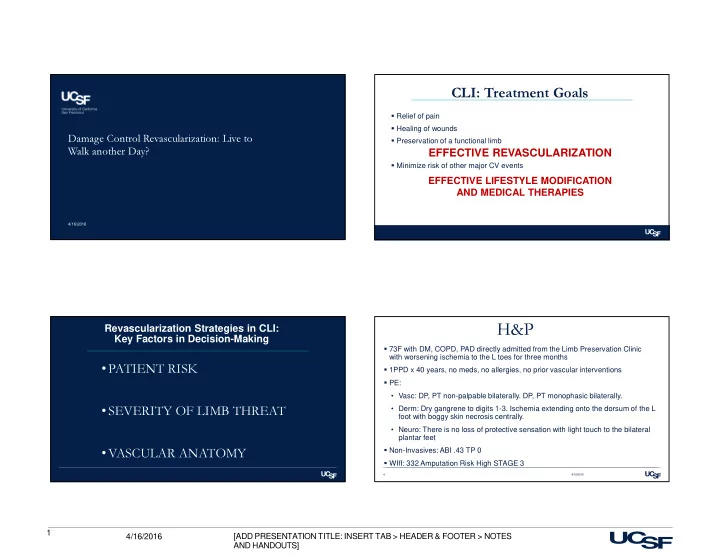
CLI: Treatment Goals Relief of pain Healing of wounds Preservation of a functional limb Damage Control Revascularization: Live to EFFECTIVE REVASCULARIZATION Walk another Day? Minimize risk of other major CV events EFFECTIVE


slide-1
SLIDE 1

[ADD PRESENTATION TITLE: INSERT TAB > HEADER & FOOTER > NOTES AND HANDOUTS] 4/16/2016 1

Damage Control Revascularization: Live to Walk another Day?

4/16/2016

CLI: Treatment Goals

Relief of pain Healing of wounds Preservation of a functional limb Minimize risk of other major CV events

EFFECTIVE REVASCULARIZATION

EFFECTIVE LIFESTYLE MODIFICATION AND MEDICAL THERAPIES

General health of the patient

  • Age, comorbidities, ambulatory status

Foot: likelihood of functional salvage Severity of limb ischemia Anatomic distribution of disease Prior vascular interventions Availability of autogenous vein for LEB

  • Ipsilateral GSV > contralateral GSV > alternative veins
  • Prosthetics and other non-autogenous conduits inferior

Revascularization Strategies in CLI: Key Factors in Decision-Making

  • PATIENT RISK
  • SEVERITY OF LIMB THREAT
  • VASCULAR ANATOMY

H&P

73F with DM, COPD, PAD directly admitted from the Limb Preservation Clinic with worsening ischemia to the L toes for three months 1PPD x 40 years, no meds, no allergies, no prior vascular interventions PE:

  • Vasc: DP, PT non-palpable bilaterally. DP, PT monophasic bilaterally.
  • Derm: Dry gangrene to digits 1-3. Ischemia extending onto the dorsum of the L

foot with boggy skin necrosis centrally.

  • Neuro: There is no loss of protective sensation with light touch to the bilateral

plantar feet Non-Invasives: ABI .43 TP 0 WIfI: 332 Amputation Risk High STAGE 3

4/16/2016 4

slide-2
SLIDE 2

[ADD PRESENTATION TITLE: INSERT TAB > HEADER & FOOTER > NOTES AND HANDOUTS] 4/16/2016 2

4/16/2016 5

Is this limb salvageable?

  • A. YES
  • B. NO

Angiogram

4/16/2016 7

NO AUTOGENOUS VEIN AVAILABLE

4/16/2016

slide-3
SLIDE 3

[ADD PRESENTATION TITLE: INSERT TAB > HEADER & FOOTER > NOTES AND HANDOUTS] 4/16/2016 3

How would you manage this patient?

  • A. Primary BKA
  • B. Endovascular revascularization via contralateral access
  • C. Endovascular revascularization via antegrade and pedal

access (leave iliac alone)

  • D. Endovascular common iliac stenting alone
  • E. Open bypass with PTFE +/- vein cuff
  • F. Open bypass with cryopreserved allograft

4/16/2016 9

Initial Debridement

4/16/2016 10

What would be the next level of amputation to consider?

  • A. BKA
  • B. TMA
  • C. Chopart’s amputation
  • D. Lis Franc amputation

4/16/2016 11

Hybrid Therapy

  • Left common femoral endarterectomy with patch

angioplasty.

  • Left common iliac artery angioplasty and stent with 7

mm x 38 mm iCAST.

  • Left common femoral to anterior tibial artery bypass

with CryoVein.

  • Chopart’s Amputation

4/16/2016 12

slide-4
SLIDE 4

[ADD PRESENTATION TITLE: INSERT TAB > HEADER & FOOTER > NOTES AND HANDOUTS] 4/16/2016 4

Post-Procedural Angiogram

4/16/2016 13

4 week Post-Op Visit

Wound healing nicely Palpable Graft Pulse and Biphasic AT signal at 1 month Patient ambulatory with prescription shoe provided by podiatry

4/16/2016 15

3 Month F/U

Wound still with complete healing Patient ambulating with FWW

4/16/2016 16

slide-5
SLIDE 5

[ADD PRESENTATION TITLE: INSERT TAB > HEADER & FOOTER > NOTES AND HANDOUTS] 4/16/2016 5

Keys to Success in Limb Salvage

Treat the patient and the limb, not the lesion. Goal is to maintain FUNCTION Multidisciplinary care – limb preservation team TIME IS TISSUE- “don’t fiddle and diddle” Infection control always the first priority Success of the FIRST vascular procedure matters Technical success, then vigilant surveillance Long-term relationship with the patient includes medical management, vascular and podiatric surveillance