H&N Cancer, 2014: Vital Statistics Estimated new cases (USA), - - PowerPoint PPT Presentation

h n cancer 2014 vital statistics
SMART_READER_LITE
LIVE PREVIEW

H&N Cancer, 2014: Vital Statistics Estimated new cases (USA), - - PowerPoint PPT Presentation

11/8/2014 P ROSPECTIVE C LINICAL T RIALS IN Disclosure T RANSORAL E NDOSCOPIC H&N SURGERY FOR O ROPHARYNGEAL I have no conflicts of interest to disclose C ANCER : ECOG3311 & RTOG1221 Chris Holsinger, MD, FACS Professor of


slide-1
SLIDE 1

11/8/2014 1

PROSPECTIVE CLINICAL TRIALS IN TRANSORAL ENDOSCOPIC H&N

SURGERY FOR OROPHARYNGEAL

CANCER: ECOG3311 & RTOG1221

Chris Holsinger, MD, FACS Professor of Otolaryngology Chief, Head and Neck Surgery Stanford Cancer Center

November 8, 2014

Disclosure

I have no conflicts of interest to disclose

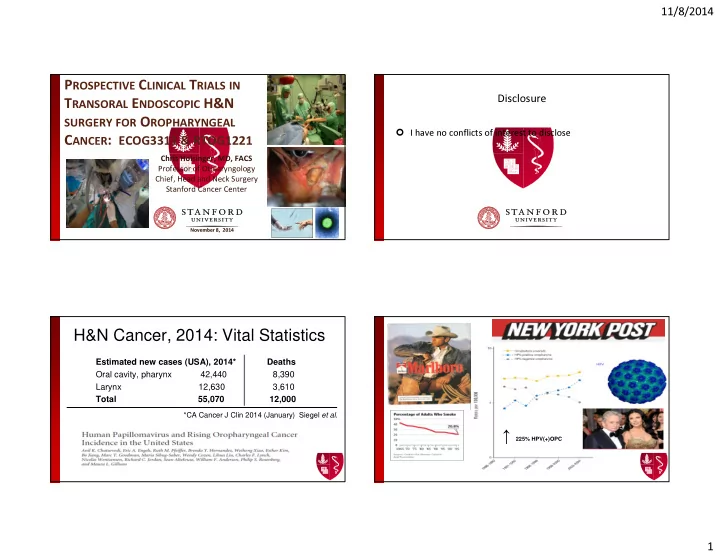
Estimated new cases (USA), 2014* Deaths Oral cavity, pharynx 42,440 8,390 Larynx 12,630 3,610 Total 55,070 12,000

*CA Cancer J Clin 2014 (January) Siegel et al.

H&N Cancer, 2014: Vital Statistics

225% HPV(+)OPC

slide-2
SLIDE 2

11/8/2014 2

CNX CNXII

Cranial neuropathy: 48% ORN: 10%

HPV & Transoral eHNS: Evolution of Treatment

Clinical Equipoise has been lost.

Why? Not efficacy. But rather, ever increasing

toxicity and concern about long-term function following chemoRT

NEJM 1987

eHNS = Endoscopic Head & Neck Surgery

Transoral Endoscopic H&N Surgery is an adaptive endoscopic head and neck surgical technique, providing comprehensive margin resection and good functional outcomes:

  • Transoral laser microsurgery (TLM)
  • Transoral robotic surgery (TORS)

Larynx/pharynx heals by

secondary intention.

No reconstruction No disassembly of the neck Tracheotomy not needed Low rate <10% of G-tube

dependency rate

T1 T2b/3

slide-3
SLIDE 3

11/8/2014 3

Robotic Scanner

eHNS: Operating through Endoscopes

Transoral Endoscopic H&N Surgery (eHNS)

“Virtual” Environment Real Surgery

Surgeon Console

The Surgical Cart

“Remote Manipulators”

The “Vision Cart” 0º vs. 30º

slide-4
SLIDE 4

11/8/2014 4

Transoral Resection of Pharynx Cancer

The Clinical Trials Planning Meeting* November 2011 Ridge & Adelstein

* R13 funded!

RTOG1221 HPV-

  • Surgical Intensification

ECOG3311 HPV+

  • Descalation (?) with surgery

INTERMEDIATE: Clear/close margins < 1mm ECS 2-4 metastatic LN PNI LVI HIGH RISK: Positive Margins > 1mm ECS or ≥5 metastatic LN Radiation Therapy IMRT 60 Gy/30 Fx Evaluate 2-year PFS Local-Regional Recurrence, Functional Outcomes/QOL

ECOG 3311 – “HPV-positive”/ p16+ trial

Assess Eligibility: HPV (p16)+ SCC

  • ropharynx

(tonsil, tongue-base, GPC) Stage III-IV: cT1-2, N1- 2b Baseline Functional/ QOL Assessment Observation RAN DO MIZ E Radiation Therapy IMRT 66 Gy/33 Fx + CDDP 40 mg/m2 weekly LOW RISK: T1-T2N0-N1 negative margins

Accrual goal = 377

Transoral Resection (any approach) with neck dissection Radiation Therapy IMRT 50Gy/25 Fx

slide-5
SLIDE 5

11/8/2014 5

Primary objective is to evaluate the 2-yr PFS in HPV+ SCC patients

treated with low-dose RT (assume 85% per arm)

Secondary end points: Early/late toxicities, swallowing function, QOL,

and oral/serum/tissue biomarkers in predicting clinical outcome

17

3311

T Stage

  • 1. T1
  • 2. T2

N stage

  • 1. N1
  • 2. N2

Zubrod Status

  • 1. 0
  • 2. 1

STRA TIFY

Arm 2: Chemoradiotherapy (Control Arm) IMRT (70 Gy) + Weekly cisplatin

Arm 1: eHNS* + Neck Dissection (Experimental Arm) “Risk-based” post-operative Adjuvant Therapy, +/- IMRT (60 Gy) +/- Weekly cisplatin **for high-risk patients with ≥ 5 metastatic nodes, extracapsular extension, or positive surgical margins on final surgical pathology

RTOG 1221: Phase IIb Schema

*eHNS = TLM or TORS

**italicized text will be added at next protocol amendment (in progress)

Eligible

  • Oropharyngeal SCC: Tonsil, BOT, GPC
  • Stage III-IV: T1-2, N1-2b
  • p16 NEGATIVE (IHC)

R A N D O M I Z E

Accrual goal = 144 (72 vs. 72)

Primary Objective

Primary: To determine if surgical intensification

for patients with HPV-negative OPC will improve progression-free survival by 10%

  • Based on stage-matched patients enrolled in RTOG

0129, we estimate that 2-year PFS for patients in the control arm of the proposed trial is 55%.

Phase II-b Design (Control Arm)

Radiotherapy w/concurrent chemotherapy

  • IMRT: 70 Gy over 6 weeks: 2 Gy, 35 fractions
  • Concurrent weekly cisplatin (40 mg/m2 IV)

Unilateral neck IMRT can be used

For T1-2 lateralized tonsil tumors with < 1 cm invasion into the soft palate No or limited lateral invasion of BOT N1 neck involvement

  • For “big T2” or N2b, bilateral IMRT allowed

RadOnc PI: Wade Thorstad (Wash U.)

slide-6
SLIDE 6

11/8/2014 6

Phase II-b Design: Experimental (Surgical) Arm

Transoral eHNS (TORS vs. TLM)

& Neck Dissection

Risk-based post-operative adjuvant therapy will

be guided by pathological findings of the primary tumor and within cervical nodes.

Post-Op ChemoRT

Patients w/ positive margins or extracapsular spread (ECS) in cervical

nodes (or with ≥ 5 metastatic nodes without ECS) will receive postoperative cisplatin, 40 mg/m2 IV on days 1, 8, 15, 22, 29, and 36, for a total of 6 weekly doses concurrent with IMRT (60 Gy at 2 Gy in 30 fractions over 6 weeks).

Patients with involved surgical margins or ECS may receive a 6 Gy boost

at 2 Gy per fraction to the area of the positive margin or ECS.

Post-Op RT only

Patients with “close” margins (<3mm), lymphovascular (LVI) or perineural

invasion (PNI), >1 metastatic lymph nodes will receive IMRT (60 Gy at 2 Gy) in 30 fractions over 6 weeks.

Subclinical regions at risk for microscopic disease (e.g. contralateral

hemineck, when indicated) will receive 54 Gy (1.8 Gy/fraction, using integrated boost technique)

No PORT

Indication for No Post-operative Radiation Therapy

For patients with pT1-2, pN0 OPC, negative margins (>3mm), no adverse features (LVI or PNI), no adjuvant therapy would be given.
slide-7
SLIDE 7

11/8/2014 7

Prospective Clinical Trials in Endoscopic H&N Surgery?

How can we ensure and maintain quality?

(since we can’t operate on a phantom)

Credentialing: Standardizing Technique of Transoral eHNS IRB Approval TORS vs. TLM

  • “Bovie” and headlight

10 CASES: paired op/path report Questionnaire

Credentialing Update

37 Surgeons Credentialed; 10 pending

slide-8
SLIDE 8

11/8/2014 8

Online Upload of Credentials

Standardizing Surgical Margins

Being Systematic is Important Dimensions: Four (4) quadrants + Deep Mucosal Medial, lateral, anterior, posterior Mucosal/superficial margin: 3mm=clear Deep May vary by site, tonsil vs. BOT Intact superior constrictor without tumor on the deep margin is considered “negative”

slide-9
SLIDE 9

11/8/2014 9

The Deep Margin of Superior Constrictor in transoral eHNS (TORS/TLM)

Maxillary Mandibular SP SP T T

PPS PPS BOT BOT

MedPtyg MedPtyg

Holsinger & Laccourreye Arch.Otolaryngol.Head.Neck.Surg 2005

Maxillary Mandibular

Pathology Assessment

Margin: submission and orientation

Defect based (submitted by surgeons) or Resection based (from specimen by pathologist

Final reporting

Intraoperative (frozen) or permanent with the rest of the specimen (post-fixation)

ECOG Path PI: Joaquin Garcia, MD (Mayo) RTOG Path PI: Diana Bell, MD (MDACC)

Neck Dissection

Levels II-IV; 20 nodes minimum per side Neck Dissection Impairment Index

NDII, Taylor et al. OTOHNS 2002

  • 10-item validated PRO instrument used to specifically

measure QOL-related shoulder dysfunction in patients who have undergone neck dissection

slide-10
SLIDE 10

11/8/2014 10

Stopping Rules and Q/A

Severe bleeding rate > 10% (defined as return

to OR or "catastrophic" grade 4/5)

Positive margin rate of 2/10 consecutive cases

leads to surgeon "on hold" status with reactivation after 10 off-study cases with 0-1 positive margin

Functional Outcomes: Swallowing

  • To assess swallowing function, the MDADI, and PSS-HN

will be administered in both arms (TRUONG; Tufts)

Defined endpoints, pre and post treatment Post-Tx: post-op, 3-6 months, 2yrs

  • To enhance the PRO data, objective correlates include a

MBS performed at baseline, 6 and 24 months after treatment and clinician grading (CTCAE, v.4) to compare with MDADI scores. (LEWIN; MDACC)

Prospective baseline MBS data to predict swallowing outcomes

Videofluoro Imaging (standard): 30 frames/sec

ECOG3311: 39 pts.

1st Pt: Jan 22, Stanford

RTOG1221: 1 pt

  • Outreach to VAMCs
  • International Surgeons

Accrual, as of 10/31/2014

slide-11
SLIDE 11

11/8/2014 11

Not available for sale within the United States

FUTURE INNOVATION Single Port Surgeon Cart

Ducati Sp may faciliate true “two-handed surgery” of the head & neck

Davinci Sp Game-changing Technology

for H&N Surgery

Conceptual Advance

  • Two-handed surgery in confined space
  • Surgeon control (from console) of H&N surgical

anatomy Technical / Engineering Advances

  • Bendable, Flexible Instrumentation
  • Angled Endoscopy at point of service (0-45°)
  • Smaller scale

Summary

NCI-sponsored trials Transoral eHNS

  • ECOG3311: HPV+ Deintensification
  • RTOG1221: HPV- Intensification

Standardized Path & Surgery

Credentialing

Focus on Function, QOL

slide-12
SLIDE 12

11/8/2014 12

Thank you

bit.ly/HolsingerRobotics

46