H ( ) = c ij i j h i i . i , j i Note: Here | X | = n ! . - - PowerPoint PPT Presentation

h c ij i j
SMART_READER_LITE
LIVE PREVIEW

H ( ) = c ij i j h i i . i , j i Note: Here | X | = n ! . - - PowerPoint PPT Presentation

T79.4201 Search Problems and Algorithms T79.4201 Search Problems and Algorithms 3 Search Spaces and Objective Functions. Complete Search Methods Search Spaces and Objective Functions (2/4) 3.1 Search Spaces and Objective Functions (1/4)


slide-1
SLIDE 1

T–79.4201 Search Problems and Algorithms

3 Search Spaces and Objective Functions. Complete Search Methods 3.1 Search Spaces and Objective Functions (1/4)

An instance I of a combinatorial search or optimisation problem Π determines a search space X of candidate solutions. The computational difficulty in such problems arises from the fact that X is typically exponential in the size of I (= HUGE). E.g. SAT: Instance F = propositional formula on n variables {x1,...,xn}. Search space X = all truth assignments t : {x1,...,xn} → {0,1}. Goal: find t ∈ X that makes F true. Size of X = 2n points (0/1-vectors).

I.N. & P .O. Autumn 2006 T–79.4201 Search Problems and Algorithms

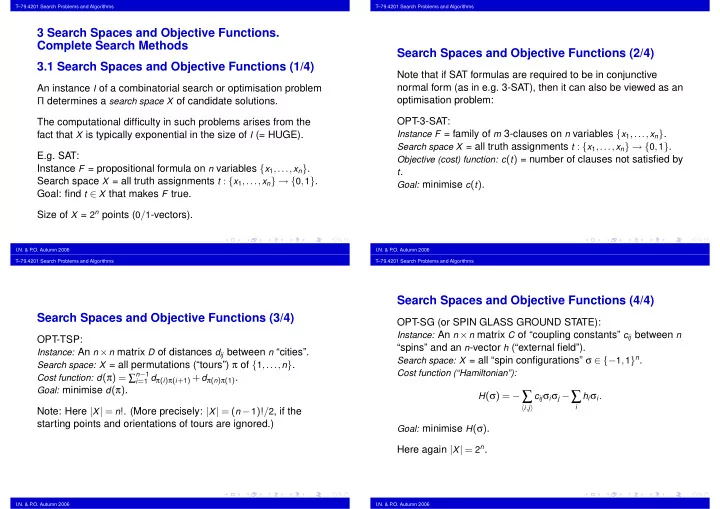
Search Spaces and Objective Functions (2/4)

Note that if SAT formulas are required to be in conjunctive normal form (as in e.g. 3-SAT), then it can also be viewed as an

  • ptimisation problem:

OPT-3-SAT:

Instance F = family of m 3-clauses on n variables {x1,...,xn}. Search space X = all truth assignments t : {x1,...,xn} → {0,1}. Objective (cost) function: c(t) = number of clauses not satisfied by t. Goal: minimise c(t).

I.N. & P .O. Autumn 2006 T–79.4201 Search Problems and Algorithms

Search Spaces and Objective Functions (3/4)

OPT-TSP:

Instance: An n × n matrix D of distances dij between n “cities”. Search space: X = all permutations (“tours”) π of {1,...,n}. Cost function: d(π) = ∑n−1

i=1 dπ(i)π(i+1) + dπ(n)π(1).

Goal: minimise d(π).

Note: Here |X| = n!. (More precisely: |X| = (n − 1)!/2, if the starting points and orientations of tours are ignored.)

I.N. & P .O. Autumn 2006 T–79.4201 Search Problems and Algorithms

Search Spaces and Objective Functions (4/4)

OPT-SG (or SPIN GLASS GROUND STATE):

Instance: An n × n matrix C of “coupling constants” cij between n

“spins” and an n-vector h (“external field”).

Search space: X = all “spin configurations” σ ∈ {−1,1}n. Cost function (“Hamiltonian”): H(σ) = −∑

i,j

cijσiσj −∑

i

hiσi. Goal: minimise H(σ).

Here again |X| = 2n.

I.N. & P .O. Autumn 2006

slide-2
SLIDE 2

T–79.4201 Search Problems and Algorithms

3.2 Complete Search Methods: Backtrack Search (1/2)

Bactrack search is a systematic method to search for a

satisfying, or an optimal solution x in a search space X.

I.N. & P .O. Autumn 2006 T–79.4201 Search Problems and Algorithms

function backtrack(I:instance; x:partialsol): if x is a complete solution then return x else for all extensions e1,...ek to x do x′ ← backtrack(I,x ⊕ ei); if x′ is a complete solution then return x′ end for; return fail end if.

I.N. & P .O. Autumn 2006 T–79.4201 Search Problems and Algorithms

Backtrack Search (2/2)

For instance, in the case of SAT, each partial truth assignment

t : {x1,... ,xi} → {0,1} has two possible extension e0 and e1: one

assigns value 0 to variable xi+1 and the other assigns value 1. In the case of TSP , the partial solutions could be nonrepeating sequences of cities (initial segments of tours), and the extensions could be choices of next city. (Also other arrangements are possible).

I.N. & P .O. Autumn 2006 T–79.4201 Search Problems and Algorithms

3.3 Backtrack Search in Games

A backtrack search generates a search tree of increasingly complete partial solutions. Let us illustrate this in the case of evaluating position values in a game of 3× 3 noughts-and-crosses. Associate to each incomplete position t in the game its payoff

value for player X:

payoff(t) =     

1

if X has a winning strategy from t, −1 if O has a winning strategy from t, if neither has a winning strategy from t. The complete annotated search, or game tree of this game is illustrated on the next slide.

I.N. & P .O. Autumn 2006

slide-3
SLIDE 3

T–79.4201 Search Problems and Algorithms X X X X X X X X X X X X X X X X X X O O O O O O O O O O O O

  • 1

1 1 Turn: Position: X O X O . . . .

  • 1

1 X O 1 .... X X X X X X X X X X X X X X X X X X X X X X X X X X X X X X X O O O O O O O O O O O O O O O O O O O O O O O O O O O O I.N. & P .O. Autumn 2006 T–79.4201 Search Problems and Algorithms

The Minimax Rule

The payoff values for all positions can be computed by augmenting a backtrack search of the game tree with computations according to the following minimax rules:

Position type Payoff value

final (complete) can be determined directly X moves payoff = max {payoff values of immed. extensions} O moves payoff = min {payoff values of immed. extensions}

I.N. & P .O. Autumn 2006 T–79.4201 Search Problems and Algorithms

Bounded Depth Search

Game trees in realistic games are usually evaluated only to some predetermined lookup depth k, at which some heuristic

evaluation function eval(t) is applied to estimate the payoff values

  • f the incomplete positions t.

I.N. & P .O. Autumn 2006 T–79.4201 Search Problems and Algorithms

function payoff (t:position; k:depth; m:{MIN, MAX}): if k = 0 or t is a final position then return eval(t) else if m = MAX then v ← −∞ else v ← ∞; for all t’s extensions s do if m = MAX then v ← max(v, payoff(s, k − 1, MIN)) else v ← min(v, payoff(s, k − 1, MAX)) end if; return v end if.

I.N. & P .O. Autumn 2006

slide-4
SLIDE 4

T–79.4201 Search Problems and Algorithms

3.4 Alpha-Beta Pruning

The size of a search tree can often be considerably reduced by eliminating branches that cannot improve an already known

  • solution. In the case of game trees this process is known as

alpha-beta pruning.

During the backtrack search of the game tree, maintain at each node t an intermediate payoff value, which for MIN nodes is an upper bound on the eventual true payoff value, and for MAX nodes a lower bound. Then when it is clear that no further search below a given node t can improve the payoff value of its father, the remaining subtrees of t cab be pruned. (See next slide.)

I.N. & P .O. Autumn 2006 T–79.4201 Search Problems and Algorithms

MIN MAX ... < 10 10 15 Can be left unsearched, since it is already known that p t > 15 payoff(p) < 10 and payoff(t) > 15.

I.N. & P .O. Autumn 2006 T–79.4201 Search Problems and Algorithms

function payoffαβ (t, k, m, pv); pv = father’s intermediate payoff if k = 0 or t is a final position then return eval(t) else if m = MAX then v ← −∞ else v ← ∞; for all t’s extensions s do if m = MAX then v ← max(v, payoffαβ(s, k − 1, MIN, v)); if v ≥ pv then return v else v ← min(v, payoffαβ (s, k − 1, MAX, v)); if v ≤ pv then return v end if; return v end if.

I.N. & P .O. Autumn 2006 T–79.4201 Search Problems and Algorithms

3.5 Branch-and-Bound Search (1/2)

Similar pruning techniques can greatly improve the efficiency of backtrack search in optimisation problems. Consider e.g. the TSP problem and choose:

Partial solution: A set of edges (links) that have been decided to

either include or exclude from the complete solution tour.

Bounding heuristic: Let the TSP instance under consideration be

given by distance matrix D = dij. Then the following inequality holds for any complete tour π:

d(π)

=

1 2 ∑

i

{(dij + djk) | at city j tour π uses links ij and jk} ≥

1 2 ∑

j

min

i,k (dij + djk).

This estimate can be used to lower bound the length of tours achievable from any given partial solution, and prune the search tree correspondingly.

I.N. & P .O. Autumn 2006

slide-5
SLIDE 5

T–79.4201 Search Problems and Algorithms

Branch-and-Bound Search (2/2)

Consider the following small TSP instance:

d c b a e 6 5 6 8 4 7 2 3 3 4

Using the above lower-bounding heuristic, the search tree for the minimum tour on this instance can be pruned as presented

  • n the following slide.

I.N. & P .O. Autumn 2006 T–79.4201 Search Problems and Algorithms

acebda abecda abceda tour tour tour tour acbeda be be bc no constr. ab ab ac ac bc C = 19 C = 21 C = 23 C = 23 ac ad ae ad ae ae ad ad ae ad ae ac ad ae C > 18 C > 18 C > 18,5 C > 18,5 C > 17,5 C > 17,5 C > 18,5 C > 23 C > 23,5 C > 20,5 C > 21 MINIMUM 1 2 ((2+3)+(3+3)+(4+4)+(2+5)+(3+6)) a c b d e prune prune prune prune

I.N. & P .O. Autumn 2006 T–79.4201 Search Problems and Algorithms

3.6 The A* Algorithm

A* is basically a reformulation of the branch-and-bound search technique in terms of path search in graphs.

Given:

◮ search graph [neighbourhood structure] (X,N) ◮ start node x0 ∈ X ◮ set of goal nodes X ∗ ⊆ X ◮ edge costs c(x,x′) ≥ 0 for x ∈ X, x′ ∈ N(x)

Task: find a (minimum-cost) path from x0 to some x ∈ X ∗.

I.N. & P .O. Autumn 2006 T–79.4201 Search Problems and Algorithms

A*: Path Length Estimation

An important characteristic of A* is that the remaining distance from a node x to a goal node is estimated by some heuristic

h(x) ≥ 0.

As the algorithm visits a new node, it is placed in a set OPEN. Nodes in OPEN are selected for further exploration in increasing order of the evaluation function

f(x) = g(x)+ h(x),

where g(x) = dist(x0,x) is the shortest presently known distance from the start node. A heuristic h(x) is admissible, if it underestimates the true remaining minimal distance h∗(x), i.e. if for all x ∈ X:

h(x) ≤ h∗(x) := min

x∗∈X∗ dist(x,x∗).

I.N. & P .O. Autumn 2006

slide-6
SLIDE 6

T–79.4201 Search Problems and Algorithms

function A*(X, N, x0, c, h):

place x0 in OPEN; set g(x0) = 0;

while OPEN = /

0 do choose some x ∈ OPEN for which f(x) is minimum;

if x ∈ X ∗ then return {found path to x};

move x from OPEN to CLOSED;

for all x′ ∈ N(x) do if x′ is not yet in OPEN or CLOSED then

estimate h(x′); compute f(x′) = g(x′)+ h(x′), where g(x′) = g(x)+ c(x,x′); place x′ in OPEN

else {x′ is already in OPEN or CLOSED}

recompute f(x′) = g(x′)+ h(x′);

if x′ was in CLOSED and its f-value decreased then

move x′ from CLOSED to OPEN

end while; return fail {no path to goal found}.

I.N. & P .O. Autumn 2006 T–79.4201 Search Problems and Algorithms

A*: Convergence

A basic property of the A* algorithm is the following:

  • Theorem. Assume that the heuristic h is admissible. If the graph

(X,N) is finite, and some path from x0 to X ∗ exists, then A* returns one with a minimum cost.

Note 1: This result holds even for infinite search graphs

satisfying some structural conditions. (Every node has only finitely many neighbours and all infinite paths have infinite cost.)

Note 2: Convergence of the algorithm can be guaranteed also

for nonadmissible heuristics, but very little can be said about the cost of the paths returned in that case.

Note 3: The special case h(x) ≡ 0 reduces to the well-known

Dijkstra’s algorithm for shortest paths in graphs.

I.N. & P .O. Autumn 2006 T–79.4201 Search Problems and Algorithms

A*: Examples

In these two examples of A* search in graphs with obstacles, the heuristic h(x) is taken to be the Manhattan (square-block) distance from a node x to the goal node x∗ when the obstacles are ignored. The white nodes are in OPEN and the black nodes in CLOSED when the algorithm terminates.

22 22 23 21 24 20 19 18 17 16 15 14 13 8 8 8 7 9 6 10 5 11 4 3 2 2 2 3 24 24 20 6 4 21 5 6 6 6 6 6 6 6 8 7 7 5 7 5 7 5 7 6 8 8 8 8 4 4 10 7 7 9 9 7 5 3 9 4 10 10 10 2 2 5 9 11 9 3 1 12 2 8 8 4 4 13 3 11 9 7 5 3 14 14 14 15 1 15 13 16 2 12 12 17 1 1 13 11 18 4 2 10 10 10 10 23 19 3 3 11 9 11 9 22 20 4 12 12 8 8 6 21 5 5 13 11 9 7

20 23 22 33 17 34 4 16 24 33 5 19 23 34 34 4 18 22 7 13 6 12 9 15 8 14 10 10 11 10 10 10 13 12 11 10 14 31 29 5 21 32 30 4 4 20 29 32 30 4 9 25 8 24 27 7 28 6 3 4 5 6 7 8 9 21 21 21 21 21 22 20 20 22 20 19 19 19 23 20 22 18 18 33 17 23 19 21 17 32 18 20 20 16 15 21 21 15 16 22 22 14 13 13 14 12 11 11 12 10 9 9 10 8 9 9 11 5 5 5 5 5 5 7 7 9 12 8 8 8 6 6 4 4 6 4 8 9 7 7 7 3 3 7 9 7 5 11 10 6 4 6 8 2 6 10 8 6 10 5 9 9 1 9 1 11 9 3 4 8 10 8 2 10 4 12 13 3 7 11 7 3 3 11 1 2 8 10 6 4 2 12 2 29 3 3 3 19 13 13 13 13 13 28 4 20 2 12 12 14 12 14 31 3 11 11 15 11 17 15 1 19 30 2 10 12 14 10 18 16 2 18 7 25 5 9 9 9 17 17 9 17 3 8 4 8 10 10 16 18 16 8 4 24 27 5 23 7 7 11 11 15 19 15 7 19 5 23 26 6 24 6 8 10 12 16 18 14 6 20 6 22

I.N. & P .O. Autumn 2006