Gursharan Singh Tatla 27-Mar-2011 Data Link Layer in Internet We - - PDF document

gursharan singh tatla 27 mar 2011
SMART_READER_LITE
LIVE PREVIEW

Gursharan Singh Tatla 27-Mar-2011 Data Link Layer in Internet We - - PDF document

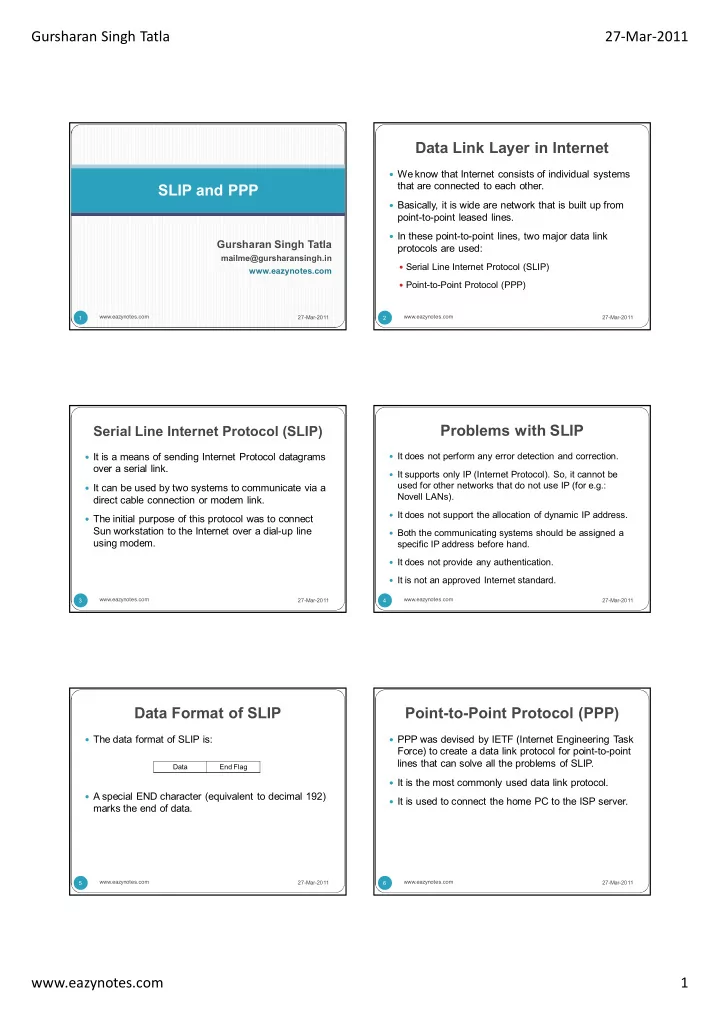
Gursharan Singh Tatla 27-Mar-2011 Data Link Layer in Internet We know that Internet consists of individual systems that are connected to each other. SLIP and PPP Basically, it is wide are network that is built up from point-to-point


slide-1
SLIDE 1

Gursharan Singh Tatla 27-Mar-2011 www.eazynotes.com 1

Gursharan Singh Tatla

mailme@gursharansingh.in www.eazynotes.com

SLIP and PPP

27-Mar-2011 1 www.eazynotes.com

Data Link Layer in Internet

 We know that Internet consists of individual systems

that are connected to each other.

 Basically, it is wide are network that is built up from

point-to-point leased lines.

 In these point-to-point lines, two major data link

protocols are used:

 Serial Line Internet Protocol (SLIP)  Point-to-Point Protocol (PPP)

27-Mar-2011 2 www.eazynotes.com

Serial Line Internet Protocol (SLIP)

 It is a means of sending Internet Protocol datagrams

  • ver a serial link.

 It can be used by two systems to communicate via a

direct cable connection or modem link.

 The initial purpose of this protocol was to connect

Sun workstation to the Internet over a dial-up line using modem.

27-Mar-2011 www.eazynotes.com 3

Problems with SLIP

 It does not perform any error detection and correction.  It supports only IP (Internet Protocol). So, it cannot be

used for other networks that do not use IP (for e.g.: Novell LANs).

 It does not support the allocation of dynamic IP address.  Both the communicating systems should be assigned a

specific IP address before hand.

 It does not provide any authentication.  It is not an approved Internet standard.

27-Mar-2011 www.eazynotes.com 4

Data Format of SLIP

 The data format of SLIP is:  A special END character (equivalent to decimal 192)

marks the end of data.

27-Mar-2011 www.eazynotes.com 5

Data End Flag

Point-to-Point Protocol (PPP)

 PPP was devised by IETF (Internet Engineering Task

Force) to create a data link protocol for point-to-point lines that can solve all the problems of SLIP.

 It is the most commonly used data link protocol.  It is used to connect the home PC to the ISP server.

27-Mar-2011 www.eazynotes.com 6

slide-2
SLIDE 2

Gursharan Singh Tatla 27-Mar-2011 www.eazynotes.com 2 Benefits of PPP

 PPP defines the format of the frame to be exchanged

between the devices.

 It defines Link Control Protocol (LCP) for:  Establishing the link between two devices.  Maintaining this established link.  Configuring this link.  Terminating this link after the transfer.

27-Mar-2011 www.eazynotes.com 7

Benefits of PPP (Contd…)

 It provides error detection.  Unlike SLIP, that supports only IP, it supports multiple

protocols.

 It supports dynamic allocation of IP address.  It provides authentication.  It provides NCP (Network Control Protocol), that

supports variety of network layer protocol.

27-Mar-2011 www.eazynotes.com 8

PPP Frame Format

 Frame format of PPP is similar to HDLC frame:  Flag Field: It marks the beginning and end of the

PPP frame. Flag byte is 01111110.

 Address Field: This field is of 1 byte and is always

  • 11111111. This address is the broadcast address i.e.

all stations accept this frame.

27-Mar-2011 www.eazynotes.com 9

Flag Address Control Protocol Information FCS Flag

01111110 11111111 00000011 01111110 1 Byte 1 Byte 1 Byte 1 or 2 Byte Variable 2 or 4 Byte 1 Byte

PPP Frame Format

 Frame format of PPP is similar to HDLC frame:  Control Field: It is also of 1 byte. It uses the format

  • f U-Frame in HDLC. The value is always 00000011

to show that the frame does not contain any sequence number and there is no flow control or error control.

 Protocol Field: This field specifies the kind of

protocol of the data in the information field.

27-Mar-2011 www.eazynotes.com 10

Flag Address Control Protocol Information FCS Flag

01111110 11111111 00000011 01111110 1 Byte 1 Byte 1 Byte 1 or 2 Byte Variable 2 or 4 Byte 1 Byte

PPP Frame Format

 Frame format of PPP is similar to HDLC frame:  Information Field: Its length is variable. It carries

user data or other information.

 FCS Field: It stands for Frame Check Sequence. It

contains checksum. It is either 2 bytes or 4 bytes.

27-Mar-2011 www.eazynotes.com 11

Flag Address Control Protocol Information FCS Flag

01111110 11111111 00000011 01111110 1 Byte 1 Byte 1 Byte 1 or 2 Byte Variable 2 or 4 Byte 1 Byte

Transition Phases in PPP

 The PPP connection goes through different states:

27-Mar-2011 www.eazynotes.com 12

slide-3
SLIDE 3

Gursharan Singh Tatla 27-Mar-2011 www.eazynotes.com 3 Transition Phases in PPP

 Down:  In down phase, the link is not used.  Establish:  Connection goes into this phase when one of the nodes

start communication.

 Authenticate:  This phase is optional. The two nodes may decide

during establishment phase, to use this phase.

27-Mar-2011 www.eazynotes.com 13

Transition Phases in PPP

 Up:  In this phase, data transfer takes place. The connection

remains in this phase until one of the node wants to end the connection.

 Terminate:  In this phase, connection is terminated.

27-Mar-2011 www.eazynotes.com 14

PPP Stack

 PPP uses several other protocols to establish link,

authenticate users and to carry the network layer data:

 The various protocols used are:  Link Control Protocol  Authenticate Protocol  Network Control Protocol

27-Mar-2011 www.eazynotes.com 15

Link Control Protocol

 It is responsible for establishing, maintaining,

configuring and terminating the link.

 It provides negotiation mechanism to set options

between two nodes.

 All LCP packets are carried in the information field of

the PPP frame.

27-Mar-2011 www.eazynotes.com 16

Authentication Protocol

 Authentication protocol helps to validate the identity

  • f a user who needs to access the resources.

 There are two authentication protocols:  Password Authentication Protocols (PAP)  Challenge Handshake Authentication Protocol (CHAP)

27-Mar-2011 www.eazynotes.com 17

Password Authentication Protocol (PAP)

 This protocol provides two step authentication

procedure:

 Step 1: Username and password is provided by the

user who wants to access the system.

 Step 2: The system checks the validity of username

and password, and either accepts or rejects the connection.

27-Mar-2011 www.eazynotes.com 18

slide-4
SLIDE 4

Gursharan Singh Tatla 27-Mar-2011 www.eazynotes.com 4

Challenge Handshake Authentication Protocol (CHAP)

 It provides more security than PAP

.

 In this method, password is kept secret.  It is a three way authentication protocol:  Step 1: System sends a challenge packet to the user. It contains a value, usually a few bytes.  Step 2: Using a predefined function, a user combines this challenge value with the user password and sends the resultant packet back to the system.  Step 3: System then applies the same function to the password of the user & challenge value, and creates a result. If the result is same as the result sent in the response packet, access is granted,

  • therwise, it is denied.

27-Mar-2011 www.eazynotes.com 19

 After establishing the link & authenticating the user,

PPP connects to the network layer.

 This connection is established by NCP.  Therefore, NCP is a set of control protocols that

allow the encapsulation of the data coming from the network layer.

 After the network layer configuration is done by one

  • f the NCP, the user can exchange data from the

network layer.

27-Mar-2011 www.eazynotes.com 20

Network Control Protocol (NCP) Differences Between SLIP & PPP

  • S. No.

SLIP PPP 1. SLIP stands for Serial Line Internet Protocol. PPP stands for Point-to-Point Protocol 2. SLIP does not perform error detection & correction. PPP performs error detection & correction. 3. SLIP supports only IP. PPP supports multiple protocols. 4. IP address is assigned statically. IP address is assigned dynamically 5. SLIP does not provide any authentication. PPP provides authentication. 6. SLIP is not approved Internet standard. PPP is approved Internet standard.

27-Mar-2011 www.eazynotes.com 21 27-Mar-2011 22 www.eazynotes.com