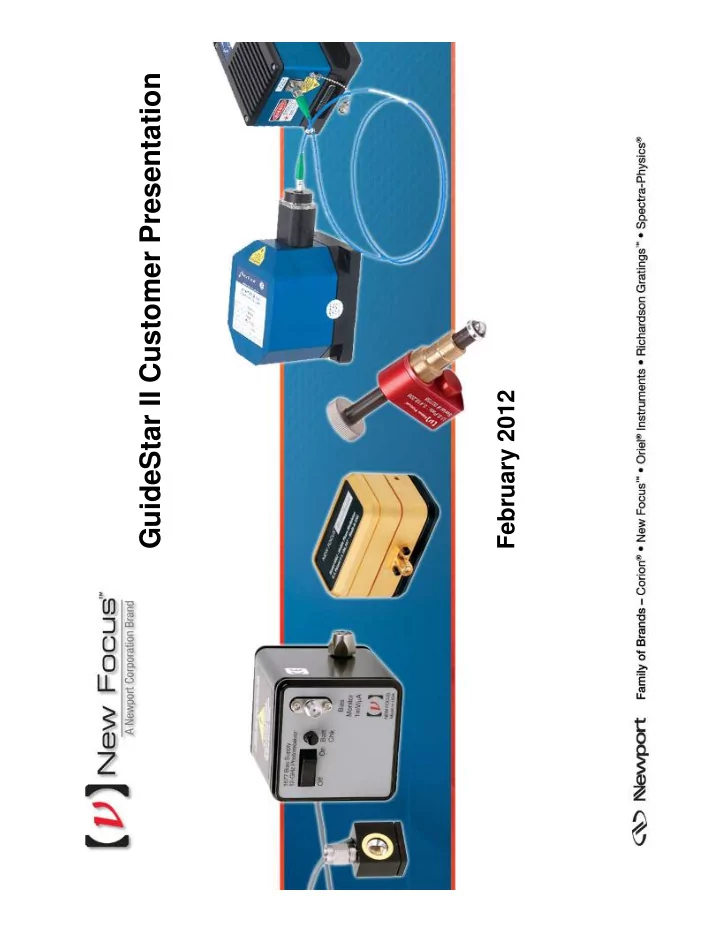
GuideStar II Customer Presentation February 2012 Outline Product - - PDF document

guidestar ii customer presentation
SMART_READER_LITE
LIVE PREVIEW

GuideStar II Customer Presentation February 2012 Outline Product - - PDF document

GuideStar II Customer Presentation February 2012 Outline Product Overview Description Applications and Features Specifications Technical Details Picomotor Mirror Mounts 8784 Cameras Alignment Layout and Algorithm


slide-1
SLIDE 1

February 2012

GuideStar II Customer Presentation

slide-2
SLIDE 2

2

Outline

Product Overview

  • Description
  • Applications and Features
  • Specifications

Technical Details

  • Picomotor Mirror Mounts
  • 8784 Cameras
  • Alignment Layout and Algorithm
  • 8783 Controller and Computer Interface
  • Demo on kHz Ultrafast Laser
  • Configurations for Sale
slide-3
SLIDE 3

3

The GuideStarTM II Laser Beam Steering Correction System

  • guarantees Critical Alignment of complex systems.
  • Picomotor Mirror Mounts Actuators
  • provide High Precision control with
  • utstanding Intrinsic Stability
  • Model 8784 GuideStar II Camera Sensors
  • provide complete Position, Pointing

and Profile measurement

  • Model 8783 GuideStar II Controller
  • provides the System Hub and the

Picomotor Drive pulses

  • Computer Display and Control
  • provides Complete Control with

flexible Data Display and Tracking Designed for accuracy, reliability, and ease-of-use, the GuideStar™ II System is the answer to laser beam drift correction for the most demanding laser applications.

GuideStarTM II

slide-4
SLIDE 4

4

GuideStarTM II System Description

The GuideStar II Laser Beam Steering Correction System provides high-reliability high- precision compensation of laser pointing and position drift. Two independent New Focus™ Picomotor™ actuated mirror mounts provide both manual and active 4-axis control with excellent passive stability. Two Model 8784 GuideStar™ II Camera Sensors provide continuous tracking of both laser beam positions and laser beam profiles. The position data is fed back to the mirror motion using our patented control algorithm (US Patent # 7,528,364 Optical Beam Steering and Sampling Apparatus and Method, 2009), the only technique that completely corrects the laser beam alignment in both x and y and near and farfield. The system is anchored by the Model 8783 GuideStar™ II Controller and controlled through your

  • wn computer with a host of user-friendly and convenient features. Full beam profiles and

position and shape date are available live or can be tracked, stored and analyzed. An easy Set-up Menu guides new users through the install an simple settings menus allow complete control of a wide range of camera and beam stabilization parameters including >100:1 dynamic camera exposure time adjustment to optimize profile levels and complete control of beam position target sizes and signal time averaging.

slide-5
SLIDE 5

5

GuideStarTM II Application

Problem Critical Laser Beam Alignment with Slow or Regular Pointing Drift. Examples

  • Ultra-fast Regenerative Amplifiers with warm-up and power dependent

Pointing Drift affecting critical alignment into Nonlinear Optical Wavelength conversion systems.

  • High Power Solid State Lasers with power dependent Pointing Drift affecting

critical alignment into precision Material Processing systems.

  • High Peak Power Fiber Lasers with power and temperature dependent free-

space Pointing Drift affecting critical alignment into precision Surgical Systems. Solution Continuous Tracking of external Laser Beam Position and Pointing. Intermittent Pointing Correction Only When Required.

slide-6
SLIDE 6

6

GuideStarTM II Product Features

Benefits

  • Guarantees Critical Alignment of complex systems.
  • Allows the use of Lower Cost passive pointing stabilization designs.

Zero Risk

  • Intrinsically Stable Picomotor Mirror Mounts: No voltage = No motion
  • Very Calm Servo: Motion only applied when drift limit is reached
  • Intelligent Position Sensing: Never mis-steers the beam

User Friendly and Flexible

  • Mirror Mounts both fully Manual and Motor-Controlled
  • Full Beam Profiles displayed as well as Position
  • Easy Setup Menus
  • All Data versus Time stored and displayed
slide-7
SLIDE 7

7

GuideStarTM II System Specs

Power in 2mm diameter beam needed to saturate GSII Camera

1 .E-09 1 .E-08 1 .E-07 1 .E-06 1 .E-05 1 .E-04 1 .E-03 1 .E-02 1 .E-01 1 .E+00

300 400 500 600 700 800 900 1 000 1 1 00 1 200 1 300

Wavelength (nm)

1 W 1 mW 1 uW 1 nW

Laser

  • Laser Wavelength : 355nm -1200nm
  • Laser Repetition Rate : >500 Hz* to cW
  • Laser Beam Size: <10mm diameter
  • Detected Power Required : <1mW **

Beam Position Control

  • Beam Pointing Adjustment Range: +/- 3 degrees, +/- 50mrad
  • Minimum Pointing Step Size < 1urad
  • Response Time: <10 second
  • Refresh rate for beam profile and display: >3Hz

* trigger option for lower rep rates available on request ** typical power versus wavelength data in graph

slide-8
SLIDE 8

8

GuideStarTM II Component Specs

Picomotor Mirror Mounts Model 8807*

  • 1" Diameter Mirror
  • +/- 4 degrees Angular Range

* Alternate Model #s: 8809, 8812,8816,8852,8885,8886,8887 GuideStar II Camera Sensor Model 8784

  • 1 Megapixel CMOS
  • Image Size >10mm diameter
  • Beam Position Resolution <1um
  • USB 2.0 interface
  • Computer Controlled Exposure Range >20dB

GuideStar II Controller Model 8783

  • USB connections to Cameras and Computer
  • RJ-22 connections to Picomotor Mirror Mounts
  • Executable GUI installer provided for user computer
  • User Computer
  • 64 and 32 Bit Windows OS
  • Full HD Display: 1920 x 1080
slide-9
SLIDE 9

9

GuideStarTM II Picomotor Mirror Mounts

Large Range of Compatible Mirror Mounts

  • ½ “, 1” and 2” diameter optic options
  • High thermal stability
  • Very low optic distortion
  • Lifetime warrantee

Picomotor Actuators

  • Patented PZT actuated 80 threads per inch screw mechanism
  • <30nm step size
  • 2kHz rep rate
  • >109 step reliability
  • widely used in oem semiconductor manufacturing systems

Active Mirror Mounts

  • Excellent shock and vibration resistance
  • Vacuum and UV compatible versions
  • Widely used in ultrafast laser and surgical laser systems

Model 8807 Center Mount, 1 in. Diameter

slide-10
SLIDE 10

10

Other Picomotor Mirror Mount Examples

Model 8816 Stability™ Mount, 1 in. Diameter Model 8817 Vacuum Stability™ Mount 1 in. Diameter Model 8852 Corner Mount, 2 in. Diameter Model 8887 Pint-Sized Corner Mount, 1 in. Diameter Model 8886 Pint-Sized Corner Mount, 0.5 in. Diameter Model 8885 Pint-Sized Center Mount, 0.5 in. Diameter

slide-11
SLIDE 11

11

Power in 2mm diameter beam needed to saturate GSII Camera

1 .E-09 1 .E-08 1 .E-07 1 .E-06 1 .E-05 1 .E-04 1 .E-03 1 .E-02 1 .E-01 1 .E+00

300 400 500 600 700 800 900 1 000 1 1 00 1 200 1 300

Wavelength (nm)

1 W 1 mW 1 uW 1 nW

GuideStar™ II Camera Sensors

  • 1 Megapixel CMOS
  • USB 2.0 interface
  • Image Size >10mm diameter
  • Beam Position Resolution <1um
  • Computer Controlled Exposure Range >20dB
  • Manually Controlled Exposure Range >60dB (ND 1,2,4)
  • W x H x D: 45 x 45 x 70mm

Detachable Filters with ND1, ND2 & ND4 on front in series to handle a wide range of input beam powers The GuideStar II Laser Beam Steering Correction System uses two Model 8784 GuideStar™ II Camera Sensors to provide continuous measurement of both laser beam Positions and laser beam Profiles. Model 8784

slide-12
SLIDE 12

12

GuideStarTM II Patent

slide-13
SLIDE 13

13

2 Pointing Actuators and 2 Position Sensitive Detectors Full and complete control of near-field beam Position and far-field beam Pointing requires both

  • f the 2 Pointing Actuators to be in front of the two Detectors. Only then can the control

matrix be really separated and the Actuators driven independently. And otherwise there is not a clean separation and the correction of far-field pointing will affect the near-field position and vice versa.

MM1 MM2 CAM2 CAM1 MM1 MM2 CAM2 CAM1 If Camera 1 is after Mirror Mount 2 If Camera 1 is before Mirror Mount 2

Unique Solution Multiple “Correct” Positions

GuideStarTM II Patent Explained

slide-14
SLIDE 14

14

GuideStarTM II Optical Layout Examples

MIRROR MOUNT 1 MIRROR MOUNT 2 CAMERA 1 LASER BEAM IN LASER BEAM OUT CAMERA 2

Separation Between Components The best control is achieved when MM1 and MM2 are separated as much as possible and also CAM1 and CAM2 are separated by as much as

  • possible. We therefore advise setting up MM1

close to the beam origin, CAM1 directly following MM2 somewhere in the middle, and CAM2 imaging the beam destination. Beam Pick-offs for Cameras The power required for the cameras is very low so we recommend using the leakage through normal HR mirrors already in the beam train as beam “pickoffs.” Other options include reflections off AR surfaces or uncoated beam-splitters in the beam.

slide-15
SLIDE 15

15

GuideStar™ II Controller

The GuideStar II Laser Beam Steering Correction System is anchored by the Model 8783 GuideStar™ II Controller This compact box provides the system Hub and the Picomotor Drive pulses

  • Executable GUI installer provided for user computer
  • USB connections to Cameras and Computer
  • RJ-22 connections to Picomotor Mirror Mounts
  • W x H x D: 140 x 80 x 200mm
  • 12VDC via 100-240 VAC power adapter provided

CAM1 CAM2 USB3

MCU PICOMOTOR DRIVER

TTL

MUX HV

MUX

POWER SUPPLY

PC POWER

USB 2.0 HUB

Block Diagram

DC Power Supply, PC cable and connections for 2 additional picomotor and one additional camera included. Model 8783

slide-16
SLIDE 16

16

GuideStar™ II System Connection

MIRROR MOUNT 1 MIRROR MOUNT 2 CAMERA 1 COMPUTER GUIDESTAR II CONTROLLER LASER BEAM IN LASER BEAM OUT CAMERA 2

slide-17
SLIDE 17

17

GuideStar™ II Computer Display and Control

The GuideStar II Laser Beam Steering Correction System is controlled through your own computer with an easy to install executable program with a host of user-friendly and convenient features. An easy Set-up Menu guides new users through the install and simple settings menus allow complete control of a wide range of camera and beam stabilization parameters including >100:1 dynamic camera exposure time adjustment to

  • ptimize profile levels and complete control of beam position target sizes and signal time
  • averaging. Full beam profiles and position and shape data are available live or can be tracked,

stored and analyzed. Features:

  • Precision Beam Position Display
  • User Friendly Setup
  • Adjustable Camera Exposure Time
  • Adjustable Target Sizes, Positions
  • Adjustable Loop Gain and Time Averaging
  • Full Beam Profiling
  • Beam Position Monitoring Tracking and Analysis

Screen Tabs: Screen 1 – Controls for Camera and Positioning Screen 2 – Beam Profiler Screen 3 – Position Stability Screen 4 - Position Stability Analysis Main Screen

Manual Picomotor Controls Manual Picomotor Controls

slide-18
SLIDE 18

18

GuideStar™ II System Main Screen

Manual Picomotor Controls

slide-19
SLIDE 19

19

GuideStar™ II Pointing Tracking

slide-20
SLIDE 20

20

GuideStar™ II Beam Profiling

slide-21
SLIDE 21

21

August 2011 Laser Focus World Article

slide-22
SLIDE 22

22

1 kHz Femtosecond Amplifier Demonstration

Beam Position at Camera 2 measured on 2 days from a “cold” start. The GuideStar II System removes >100rad pointing over the initial 2 hours. Cameras monitoring <1mW leakage through HR turning mirrors.

800nm, 1kHz, 35fs

Mirror Mount #2 Mirror Mount #1 Camera #1 Camera #2 2:1 Telescope Experiment

Ultrafast Laser

slide-23
SLIDE 23

23

8783 Controller with power supply, PC cable, Software, and manual 8784 Camera with ND filters and cable Picomotor Mirror Mount 8806,8807,8808, 8812, 8816, 8817, 8885, 8886, 8887, 8852,8853,8854 with cable Extras: Optics, Pick-off Mounts, Laser, Optical Table… Computer

GuideStar™ II System Configuration

Core Components

8784 Camera with ND filters and cable

Other Required Components

Monitor Picomotor Mirror Mount 8806,8807,8808, 8812, 8816, 8817, 8885, 8886, 8887, 8852,8853,8854 with cable

slide-24
SLIDE 24

24