SLIDE 1
1 GUIDED PATHWAYS ESSENTIAL PRACTICES: SCALE OF ADOPTION SELF-ASSESSMENT CALIFORNIA COMMUNITY COLLEGES’ ASSESSMENT OF PROGRESS IN THE IMPLEMENTING OF GUIDED PATHWAYS
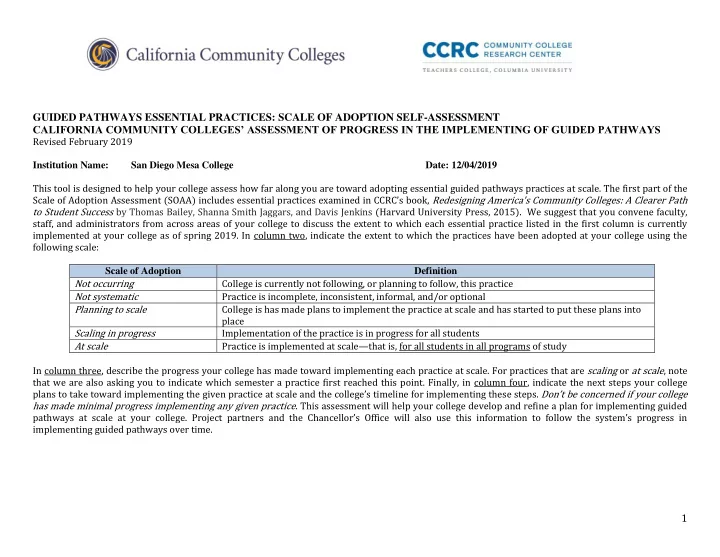
Revised February 2019 Institution Name: San Diego Mesa College Date: 12/04/2019 This tool is designed to help your college assess how far along you are toward adopting essential guided pathways practices at scale. The first part of the Scale of Adoption Assessment (SOAA) includes essential practices examined in CCRC’s book, Redesigning America's Community Colleges: A Clearer Path to Student Success by Thomas Bailey, Shanna Smith Jaggars, and Davis Jenkins (Harvard University Press, 2015). We suggest that you convene faculty, staff, and administrators from across areas of your college to discuss the extent to which each essential practice listed in the first column is currently implemented at your college as of spring 2019. In column two, indicate the extent to which the practices have been adopted at your college using the following scale: Scale of Adoption Definition Not occurring College is currently not following, or planning to follow, this practice Not systematic Practice is incomplete, inconsistent, informal, and/or optional Planning to scale College is has made plans to implement the practice at scale and has started to put these plans into place Scaling in progress Implementation of the practice is in progress for all students At scale Practice is implemented at scale—that is, for all students in all programs of study In column three, describe the progress your college has made toward implementing each practice at scale. For practices that are scaling or at scale, note that we are also asking you to indicate which semester a practice first reached this point. Finally, in column four, indicate the next steps your college plans to take toward implementing the given practice at scale and the college’s timeline for implementing these steps. Don’t be concerned if your college has made minimal progress implementing any given practice. This assessment will help your college develop and refine a plan for implementing guided pathways at scale at your college. Project partners and the Chancellor’s Office will also use this information to follow the system’s progress in implementing guided pathways over time.
SLIDE 2
2 Page intentionally left blank A new addition to the SOAA in fall 2018: Equity Considerations
SLIDE 3
3 A fundamental goal of guided pathways is to increase the rate at which underrepresented students earn college credentials, particularly degrees and credentials in fields of high economic value, while also closing gaps for low-income students, students of color, returning adults, students with disabilities, and other groups with inequitable outcomes. As colleges seek to strengthen supports for all students to explore options for careers and college and choose and complete a program of study suited to their interests and aspirations, we encourage colleges to critically examine each practice to think about how the college is serving students who have been historically underrepresented and/or underserved in higher education. The SOAA was recently updated to include “Equity Considerations” in each practice area so that your pathways team can discuss and articulate connections between the college’s pathways reforms and equity goals. Your team does not need to answer all of these questions as part of the SOAA process and they are not intended to be used as “assessments.” Also, don’t be concerned if your college has had minimal discussion and/or efforts related to any given question. We hope the questions help initiate or advance conversations about whether and how institutional practices are having differential impact on historically underserved groups and how your college can leverage your pathways work to close equity gaps by identifying and addressing causes of inequity, removing systemic barriers, and focusing design decisions and resource allocation in ways that more effectively address needs of underserved groups. In doing so, you may want to include details about how the college is addressing these concerns in the “progress to date” and/or “next steps/timeline” column. As your team completes the SOAA, please refer to the equity consideration questions to facilitate conversations about connections between the college’s pathways and equity efforts. Ple Please submit th the initial l SOAA via email l to the Chancellor’s Office by April 30, 2019. A certified version within the NOVA syste tem should ld be submitte tted by Septe tember r 30, , 2019. For the initial submission or more information about the SOAA, please email guidedpathwaysinfo@cccco.edu. NOTE: For those 20 colleges who participate in the California Guided Pathways Demonstration Project, this SOAA has been updated (a few additions and changes in order) since the version you completed in September. So please use this current version for submission.
SLIDE 4 4 Guided Pathways Essential Practices Scale of Adoption at Our College Progress to Date Implementing Practice
(If Scaling in Progress or At Scale, please indicate which term (e.g., fall 2015) the college first reached this point)
Next Steps Toward Implementing Practice at Scale & Timeline
We are interested in how colleges connect equity efforts to their pathways work, planning, and discussions. The guiding questions in each of the four areas can help colleges consider how equity intersects with specific pathways practices. As themes, ideas, or areas for future work emerge during your discussion, please note the ways in which equity issues connect with guided pathways implementation in “Progress to Date” and “Next Steps”. Equity ity Con
iderati tion
in Area 1: Are the college’s website and program pages easy to navigate and understand for students and families without prior experience with higher education? How could the college ensure that access to and use of this information is equitable for students who have been historically underrepresented and/or underserved in higher education (e.g., racial/ethnic minority students, lower-income students, first-generation students, students with disabilities, indigenous students, formerly incarcerated students, veterans, undocumented students, etc.)?
How are financial costs, potential debt, and economic benefits of program completion (including paths to program-relevant regional employment, projected earnings, and transfer outcomes) made clear for prospective students? Do program websites clarify differences in earnings potential between related certificates and degrees and across levels of educational attainment?
1.
PPING G PATHWAYS TO STUDENT E END GO GOALS
- a. Programs are organized and marketed
in broad career-focused academic and communities or “meta-majors”. (Note: This practice was added to the SOAA in February 2019) ☒ Not occurring ☐ Not systematic ☐ Planning to scale ☐ Scaling in progress ☐ At scale Progress to date:
Mesa is wrestling with the concept and development of meta-majors. The Guided Majors and Mapping workgroup has been charged with furthering discussion with this topic. Two preliminary discussions and work towards having more dialogue opportunities around this topic have
- ccurred. As such, no formal work has been
completed.
Term, if at scale or scaling: Click or tap here to enter text. Next steps:
The Guided Majors and Mapping work group will facilitate discussion on this topic. The campus will ensure clear communication of definitions, goals, and outcomes as they relate to broad career- focused academic communities or “meta-majors”. The process for moving this work forward will start with the work group and then move to the Mesa Pathways Committee and then to participatory governance groups across the institution.
Timeline for implementing next steps:
Spring 2020
- b. Every program is well designed to
guide and prepare students to enter employment and further education in fields of importance to the college’s service area. ☐ Not occurring ☒ Not systematic ☐ Planning to scale ☐ Scaling in progress ☐ At scale Progress to date:
Programs exist but are currently not working in unison/alignment with each other. Some departments especially in CTE areas have developed this area within their programs well. Interdisciplinary mapping and curriculum degree clean-up are underway across campus-in order to best serve all Mesa students (i.e. transfer, degree and certificate, career, and lifelong learners).
Term, if at scale or scaling: Next steps:
Mapping and degree clean-up will continue, with guiding principles being to avoid limiting student choice in exploring the various fields of academia, and allowing flexibility based on student goals. Ensure that program design functions to ensure clear guidance and accessibility for students.
Timeline for implementing next steps:
Spring/Fall 2020
SLIDE 5 5 Guided Pathways Essential Practices Scale of Adoption at Our College Progress to Date Implementing Practice
(If Scaling in Progress or At Scale, please indicate which term (e.g., fall 2015) the college first reached this point)
Next Steps Toward Implementing Practice at Scale & Timeline Click or tap here to enter text.
- c. Detailed information is provided on the
college’s website on the employment and further education opportunities targeted by each program. ☐ Not occurring ☒ Not systematic ☐ Planning to scale ☐ Scaling in progress ☐ At scale Progress to date:
College’s website does not have a standard which provides information regarding employment
- pportunities and / or additional educational
requirements consistently posted for each program. However, this information is available on the website for some programs, especially in CTE areas.
Term, if at scale or scaling:
Click or tap here to enter text.
Next steps:
Once mapping is complete programs will be able to include information regarding employment
- pportunities and /or additional educational
requirements for inclusion on the website. Additonally, web tools will be researched to determine potential functionality at our mult- campus district.
Timeline for implementing next steps:
Fall 2020
- d. Programs are clearly mapped out for
- students. Students know which courses
they should take and in what sequence. Courses critical for success in each program and other key progress milestones are clearly identified. All this information is easily accessible on the college’s website. ☐ Not occurring ☒ Not systematic ☐ Planning to scale ☐ Scaling in progress ☐ At scale Progress to date:
Mapping of programs is occurring on the campus. Strides have been made to move this forward including a retreat n January 2019, Mapping the Mesa in May and Pathways Institute in June, 2019. This academic year, discipline faculty have been meeting with counselors and across disciplines to map requirements and electives for degrees and continue to engage in the completion of this work.
Term, if at scale or scaling: Click or tap here to enter text. Next steps:
Continue working on program mapping. Counselors and discipline faculty will continue the integration work already being done across the
- campus. Upon completion of maps, campus will
conduct a systematic review of all maps to ensure consistency in format and other criteria that is established and agreed upon by the campus.
Timeline for implementing next steps:
Spring/Fall 2020
- e. Required math courses are
appropriately aligned with the student’s field of study (Note: This essential practice was moved from Area 2) ☐ Not occurring ☒ Not systematic ☐ Planning to scale ☐ Scaling in progress ☐ At scale Progress to date:
Currently, math classes are aligned based on their broad major categories: STEM, SLAM (Statistics, Liberal Arts, Math), and Business or Life Sciences. Additionally, the math department has created rack cards with this information.
Term, if at scale or scaling: Next steps:
Clearly align required math courses with major and transfer institution requirements, which will be posted on the website.
Timeline for implementing next steps:
Fall 2020
SLIDE 6
6 Guided Pathways Essential Practices Scale of Adoption at Our College Progress to Date Implementing Practice
(If Scaling in Progress or At Scale, please indicate which term (e.g., fall 2015) the college first reached this point)
Next Steps Toward Implementing Practice at Scale & Timeline
Click or tap here to enter text.
SLIDE 7 7 Guided Pathways Essential Practices Scale of Adoption at Our College Progress to Date Implementing Practice
(If Scaling in Progress or At Scale, please indicate which term (e.g., fall 2015) the college first reached this point)
Next Steps Toward Implementing Practice at Scale & Timeline
Equity ity Con
iderati tion
in Area 2: Does the college assess whether historically underrepresented and high needs students are disproportionately enrolled in programs that lead to lower remuneration careers? Has the college considered how it can help underrepresented students raise their educational and career expectations while at the same time meeting their more immediate economic needs? For critical program courses, does the college disaggregate enrollment, pass rate, and subsequent success data by student characteristics? What strategies has the college used to improve overall student success in these courses?
Does the college proactively partner with feeder high schools that serve predominantly underrepresented and high needs students to help students explore academic and career interests and develop viable plans for college? Are dual enrollment opportunities made available to high school students who are deemed “not yet college ready”? Is the college building bridges to high-opportunity college programs for students in adult basic skills programs?
2.
G STUDENTS CHOOSE AND ENTER R A PROGRAM PATHWAY
- a. Every new student is helped to
explore career/college options, choose a program of study, and develop a full-program plan as soon as possible. ☐ Not occurring ☒ Not systematic ☐ Planning to scale ☐ Scaling in progress ☐ At scale Progress to date:
Career tools are available to every student from the Career and Transfer Center, but not all students are helped with these tools. Currently researching a variety of career planning tools to determine viability of integration into the admission/orientation process. Increase faculty and classified professional involvement, through workshops and email communications, in the career and/or transfer mentoring of students. Some faculty, programs, and departments are more active and systematic in career/transfer advising.
Term, if at scale or scaling: Click or tap here to enter text. Next steps:
Continue to research and review career planning technologies with the goal of selection and inclusion into the admission/orientation process. Also continue systematic alignment of academic courses and degree programs with transfer institutions through the articulation process. Explore opportunities for discipline faculty to interact with students around career and transfer mentoring with appropriate training.
Timeline for implementing next steps:
Spring 2020
- b. Special supports are provided to help
academically underprepared students to succeed in the “gateway” courses for the college’s major pr progra ram a are reas. ☐ Not occurring ☐ Not systematic ☒ Planning to scale ☐ Scaling in progress ☐ At scale Progress to date:
We have support programs such as Promise, Tutoring (drop-in, by appointment, online, and classroom), Peer Navigators, Mathletics, weekly Math and English workshops, and co-requisites in both English and math as well as in other programs (Chemistry). Mesa also has support programs for special populations including EOPS, CARE, NextUp, FAST Scholars, Borderless Scholars, Project Restart, STAR TRIO, DSPS, and CalWORKs. Umoja, Mesa Academy, Chicana/Chicano Studies, Puente, and
- ther Learning Communities and support services
are evolving and utilized.
Next steps:
Provide early and sustained support to all
- students. Replicate support mechanisms similar
to those in place for Promise students (i.e. CRUISE, Peer Navigators, etc.) to students across the board. Begin process to scale these supports to an institutional level.
Timeline for implementing next steps:
Fall 2021
SLIDE 8 8 Guided Pathways Essential Practices Scale of Adoption at Our College Progress to Date Implementing Practice
(If Scaling in Progress or At Scale, please indicate which term (e.g., fall 2015) the college first reached this point)
Next Steps Toward Implementing Practice at Scale & Timeline Term, if at scale or scaling: Click or tap here to enter text.
- c. Special supports are provided to help
academically underprepared students to succeed in the program-relevant “gateway” math th courses by the end of their first year. (Note: This practice was added to the SOAA in February 2019) ☐ Not occurring ☐ Not systematic ☒ Planning to scale ☐ Scaling in progress ☐ At scale Progress to date:
We have Mathletics, learning communities, tutoring including embedded tutors and other support services exist. Co-requisite support math courses are available to all students at the gateway level. Planning to provide supports for all students through an intentional equity lens.
Term, if at scale or scaling:
Click or tap here to enter text.
Next steps:
Provide support for all students with increased focus on equity. Begin process to scale these supports to an institutional level. Analyze enrollment data and student needs to determine how many co-requisite support classes we offer.
Timeline for implementing next steps:
Fall 2021
- d. Special supports are provided to help
academically underprepared students to succeed in the “gateway” Engli lish courses by the end of their first year. (Note: This practice was added to the SOAA in February 2019) ☐ Not occurring ☐ Not systematic ☐ Planning to scale ☒ Scaling in progress ☐ At scale Progress to date:
We have a robust tutoring program that offers a variety of tutoring services. These include: learning communities such as Umoja and Puente, the Writing Center, and embedded tutors. English
- ffers classes with corequisite support at the
transfer level. Some students are placed into these classes, but they are open to any student who wishes to take them.
Term, if at scale or scaling:
Spring 2019
Next steps:
Continue to explore tutoring opportunities or service for specific groups of students and modalities that increase student success, completion, and retention.
Timeline for implementing next steps:
Spring 2020
- e. Intensive support is provided to help
very poorly prepared students to succeed in college-level courses as soon as possible. ☐ Not occurring ☒ Not systematic ☐ Planning to scale ☐ Scaling in progress ☐ At scale Progress to date:
We have co-requisite support courses and tutoring. For English: graduate tutoring in classroom and co- requisite support cohort (for English 101x). For Math: working on institutionalizing Mathletics along with embedded tutoring. Mesa also has various programs that require students to request their progress form the current enrolled classes by completing a progress report form. The form is then submitted to a respective student support program and students meet with a faculty counselor or peer mentor to review academic progress.
Next steps:
Identify ways to increase meaningful interventions that support all students with the goal to improve and increase, equity, retention, copmpletion, and success. Additional intervention might include offering personal growth classes in the high schools to more holistically consider psychology and mindset of students. Another area of interest is to improve the college’s early alert and follow-up process to allow everyone entailed to track the progress and close the loop. For English: having graduate tutors + embedded counseling + co-requisite support for 101x; For Math: complete the process to institutionalize
SLIDE 9 9 Guided Pathways Essential Practices Scale of Adoption at Our College Progress to Date Implementing Practice
(If Scaling in Progress or At Scale, please indicate which term (e.g., fall 2015) the college first reached this point)
Next Steps Toward Implementing Practice at Scale & Timeline Term, if at scale or scaling: Click or tap here to enter text.
Matheletics and implement online platform to support Math remediation
Timeline for implementing next steps:
Spring 2021
f. The college works with high schools and other feeders to motivate and prepare students to enter college-level coursework in a program of study when they enroll in college. ☐ Not occurring ☒ Not systematic ☐ Planning to scale ☐ Scaling in progress ☐ At scale Progress to date:
CCAP and ACP are both dual enrollment programs
- ffering a wide range of courses. ACP offers transfer
level math and political science while CCAP focuses predominantly on transfer and gateway classes in math and English. CCAP course offerings include Health Sciences and Business and Technology, with more classes in CTE and personal growth on the
- horizon. Dual enrollment helps students prepare for
college and offer the opportunity to earn transferable college credit withile still in high
- school. General counseling faculty work
collaboratively with the Office of Outreach and Student Relations to conduct pre-registration workshops that include career exploration and education planning, at the high schools. Mesa also develops and maintains credit by exam agreements with local high schools and continuing education.
Term, if at scale or scaling: Click or tap here to enter text. Next steps:
Provide CTE, transfer/degree preparation, and personal growth classes at the high school level.
Timeline for implementing next steps:
Spring 2021
SLIDE 10 10 GUIDED PATHWAYS ESSENTIAL PRACTICES Scale of Adoption at Our College Progress to Date Implementing Practice
(If Scaling in Progress or At Scale, please indicate which term (e.g., fall 2015) the college first reached this point)
Next Steps Toward Implementing Practice at Scale & Timeline
Equity ity Con
iderati tion
in Area 3: How does the institution support advisors to incorporate engaging, proactive, and culturally relevant advising practices to better support underrepresented students’ success in their programs? How does the college ensure that underrepresented students are not disproportionately directed away from competitive, limited access programs? How does the college integrate academic and student support services into pathways so that the support is unavoidable and therefore less stigmatized? How does the college ensure that low-income students' financial stability needs (e.g., nutrition, transportation, childcare, public benefits, emergency assistance) are being met so they can make progress toward program completion?
3.
ING S STUDENTS O ON PATH
- a. Advisors monitor which program every
student is in and how far along the student is toward completing the program requirements. ☒ Not occurring ☐ Not systematic ☐ Planning to scale ☐ Scaling in progress ☐ At scale Progress to date:
Currently, with the existing information system, access to pull data like this and/or distribute it to counselors is not possible. This process is being done manually in the Allied Health programs out of necessity.
Term, if at scale or scaling: Click or tap here to enter text. Next steps:
Campus Solutions will warehouse this data. Learn new Campus Solutions system and work to gain access to data. Create networks of counselors/ discipline faculty mentors/peers/classified professionals to support students; develop the student portal with progress information.
Timeline for implementing next steps:
Spring 2023
- b. Students can easily see how far they
have come and what they need to do to complete their program. ☐ Not occurring ☒ Not systematic ☐ Planning to scale ☐ Scaling in progress ☐ At scale Progress to date:
Some models exist for this, such as CTE or Allied
- Health. Currently Ed Plans are required, but they
are hard for students to read and understand.
Term, if at scale or scaling: Click or tap here to enter text. Next steps:
Campus Solutions will record the student’s area of study, paths to completion, courses completed, and goal date of graduation. Develop/make student portal available with progress tab; reach
- ut to students who have left their courses of
study with retention teams.
Timeline for implementing next steps:
Spring 2022
- c. Advisors and students are alerted
when students are at risk of falling off their program plans and have policies and supports in place to intervene in ways that help students get back on track. ☐ Not occurring ☒ Not systematic ☐ Planning to scale ☐ Scaling in progress ☐ At scale Progress to date:
We have an early alert “button” in the faculty portal that generates a counseling letter instructing students to see a counselor. This current tool isn’t entirely effective. However, there are programs such as Promise, EOPS, athletics, Star TRIO, and Allied Health that effectively employ this kind of support.
Next steps:
Define “at risk.” Develop strategies to distinguish between students needing support to return to their map, and students whose goals may be better served with a new map. Create systems (a faculty and classified professionals toolkit) through which faculty and classified professionals can reach out to their students and connect them to counseling. Once counselors have determined
SLIDE 11 11 Term, if at scale or scaling: Click or tap here to enter text.
necessary interventions, services would stand ready to support that student through personal
- utreach between colleagues. Explore
possibilities of monitoring the status of students that have entered the early alert system “workflow” to ensure that they are assisted and do not get lost in the process. Analyze how current programs instill these practices to create ideas for how to scale.
Timeline for implementing next steps:
Fall 2022
- d. Assistance is provided to students who
are unlikely to be accepted into limited-access programs, such as nursing or culinary arts, to redirect them to another more viable path to credentials and a career ☐ Not occurring ☒ Not systematic ☐ Planning to scale ☐ Scaling in progress ☐ At scale Progress to date:
Mesa College currently has a system in place to assist students with viable alternative options for students applying to limited access programs (Allied Health).
Term, if at scale or scaling: Click or tap here to enter text. Next steps:
Analyze how the current program operates and glean best practices and / or provide disciplines with a variety of tools to assist them in developing the best plans for their students.
Timeline for implementing next steps:
Spring 2021
- e. The college schedules courses to
ensure students can take the courses they need when they need them, can plan their lives around school from one term to the next, and can complete their programs in as short a time as possible. ☐ Not occurring ☒ Not systematic ☐ Planning to scale ☐ Scaling in progress ☐ At scale Progress to date:
Enrollment management is occurring but is hampered by lack of modern information system. Some CTE programs, for example, may be more successful at this than the college at large. The
- ffice of Institutional Research (IR) has developed
dashboards for the college to use as part of enrollment management. Over the past couple of years, Department Chairs and Deans have been meeting to discuss Enrollment Management techniques-with an emphasis on maximizing availability of required and elective courses.
Term, if at scale or scaling: Click or tap here to enter text. Next steps:
The analysis of data available from our new information system will help. For example, we expect to be able to pull course needs from student ed plans. We need to allow the IR office to conduct meaningful surveys, including those deployed through the new student portal. Continued conversation between Deans, Chairs, and schedulers to understand on-the-ground
- needs. We need methods to base our supply of
classes on student demand. Faculty and Administration will collaborate to devise schedules that balance access to courses needed by students with productivity targets set by the District.
Timeline for implementing next steps:
Fall 2021
SLIDE 12 12 Guided Pathways Essential Practices Scale of Adoption at Our College Progress to Date Implementing Practice
(If Scaling in Progress or At Scale, please indicate which term (e.g., fall 2015) the college first reached this point)
Next Steps Toward Implementing Practice at Scale & Timeline
Equity ity Con
iderati tion
in Area 4: How is the college ensuring that underrepresented students participate in program-relevant active and experiential learning opportunities? As faculty make curricular changes to better align course assignments with program learning outcomes, how does the college support faculty to implement pedagogical changes that better support learning outcomes success for underrepresented students (e.g., culturally responsive teaching)? What opportunities exist for faculty or advisors to critically examine their role in advancing equity-minded teaching and advising practices at the college (e.g., critically examining the role of unconscious bias in the classroom or advising that could affect student aspirations for a particular field and/or program selection)?
Is the college disaggregating program learning outcomes data, program retention and completion data, and other assessment measures by race, income, age, and gender to examine equity gaps? How is this data disseminated and discussed among college staff, with students, and with the outside community?
4.
G THAT S STUDENTS ARE LEARNIN ING
- a. Program learning outcomes are aligned
with the requirements for success in the further education and employment
- utcomes targeted by each program.
☐ Not occurring ☐ Not systematic ☐ Planning to scale ☐ Scaling in progress ☒ At scale Progress to date:
This is being completed through our assessment process particularly in our CLOs and PLOs.
Term, if at scale or scaling:
Fall 2018
Next steps:
Ask programs to review PLOs to ensure alignment with the requirements for successful targeted
- utcomes are achieved for further education and
- r employment.
Timeline for implementing next steps:
Spring 2022
- b. Instruction across programs
(especially in program introductory courses) engages students in active and applied learning, encouraging them to think critically, solve meaningful problems, and work and communicate effectively with others. (Note: This practice was added to the SOAA in February 2019) ☐ Not occurring ☐ Not systematic ☐ Planning to scale ☒ Scaling in progress ☐ At scale Progress to date:
Active and applied learning strategies are inherent within the course content of introductory courses in some disciplines. At varying levels, students are actively engaged in applied learning which is demonstrated through artifacts which incorporate problem solving, critical thinking, and effective communication skills. Central to the college’s mission is the achievement of its ILO’s which inclue critical thinking, communication skills, and global
- consciousness. All academic programs align their
PLOs, course-level outcomes (CLOs), and instruction to these campus-wide goals.
Term, if at scale or scaling:
Fall 2018
Next steps:
Continue to ensure that students are engaged in active and applied learning as demonstrated through artifacts that incorporate problem solving, critical thinking, and effective communication skills. Continue to provide faculty with professional learning opportunities that address active and applied learning pedagogies, where appropriate.
Timeline for implementing next steps:
Fall 2019
- c. Students have ample opportunity to
apply and deepen knowledge and skills through projects, internships, co-ops, clinical placements, group projects
- utside of class, service learning, study
☐ Not occurring ☒ Not systematic ☐ Planning to scale Progress to date:
Occurs in multiple programs across campus. As Subject Matter Experts, faculty in each discipline introduce a variety of pedagogical techniques into their courses, techniques which are suited to the
Next steps:
Continue to generate awareness of work-based and experiential learning and generate equitable
- pportunities inside and outside the classroom for
students to develop and deepen skills through
SLIDE 13 13 Guided Pathways Essential Practices Scale of Adoption at Our College Progress to Date Implementing Practice
(If Scaling in Progress or At Scale, please indicate which term (e.g., fall 2015) the college first reached this point)
Next Steps Toward Implementing Practice at Scale & Timeline abroad and other experiential learning activities that program faculty intentionally embed into coursework. ☐ Scaling in progress ☐ At scale
subject matter itself and to the variety of student learning styles. However, practices are currently
- siloed. The Work Based Learning (WBL) team
recently analyzed the practices occurring across campus.
Term, if at scale or scaling:
Click or tap here to enter text.
projects, interships, placements, service learning, and other applied learning assignments. Some disciplines, when appropriate, will adopt techniques utilized by the College’s WBL team. Other disciplines will continue to explore pedagogical methodologies that best serve their students.
Timeline for implementing next steps:
Fall 2019
- d. Faculty/programs assess whether
students are mastering learning
- utcomes and building skills across
each program, in both arts and sciences and career/technical programs. ☐ Not occurring ☐ Not systematic ☐ Planning to scale ☒ Scaling in progress ☐ At scale Progress to date:
Class, program, and institutional learning outcomes are assessed across the campus, but not sure there is an assessment of building skills across all programs. Most CTE programs are required to do this for funding and accreditation standards.
Term, if at scale or scaling:
Spring 2019
Next steps:
Create systematic opportunities for programs to review assessment tools that provide equitable
- pportunities for students to demonstrate
mastery in respective programs.
Timeline for implementing next steps:
Fall 2019
- e. Results of learning outcomes
assessments are used to improve teaching and learning through program review, professional development, and
- ther intentional campus efforts.
☐ Not occurring ☐ Not systematic ☐ Planning to scale ☐ Scaling in progress ☒ At scale Progress to date:
All programs are continually reassessing this information through the annual Program Review process.
Term, if at scale or scaling:
Fall 2018
Next steps:
Continue all current efforts and the conversations generated from outcomes assessment, to ensure continuous improvement.
Timeline for implementing next steps:
Fall 2019
f. The college helps students document their learning for employers and universities through portfolios and
- ther means beyond transcripts.
☐ Not occurring ☒ Not systematic ☐ Planning to scale ☐ Scaling in progress ☐ At scale Progress to date:
Occurs in only a few programs. College introduced Portfolium through WBL Department for
- implementation. As of now, information about such
practices has not been fully disseminated across campus.
Term, if at scale or scaling: Next steps:
Review and assess use of Portfolium by campus and develop plan for promoting and encouraging use of this technology. The college will encourage disciplines to explore the current WBL recommendations and other such possibilities.
Timeline for implementing next steps:
SLIDE 14 14 Guided Pathways Essential Practices Scale of Adoption at Our College Progress to Date Implementing Practice
(If Scaling in Progress or At Scale, please indicate which term (e.g., fall 2015) the college first reached this point)
Next Steps Toward Implementing Practice at Scale & Timeline Click or tap here to enter text.
Spring 2020
- g. The college assesses effectiveness of
educational practice (e.g. using CCSSE
- r SENSE, etc.) and uses the results to
create targeted professional development. ☐ Not occurring ☒ Not systematic ☐ Planning to scale ☐ Scaling in progress ☐ At scale Progress to date:
College has Faculty and Classified Professional Development Committees who assess educational practices and uses results to create opportunities for professional development. Currently, the committees primarily use a campus survey as means
- f data gathering. In Spring 2019, IR deployed a
survey to all graduates assessing ILOs, program and service engagement, and campus climate.
Term, if at scale or scaling:
Click or tap here to enter text.
Next steps:
The Committees will continue to administer and analyze the results of campus surveys to determine the professional learning needs and interests of
- employees. The campus will continue to assess the
learning outcomes which should not supersede or be incorporated into the current faculty, peer evaluation process.
Timeline for implementing next steps:
Spring 2022