Guide for Designing Mandatory Greenhouse Gas Reporting Programs - - PowerPoint PPT Presentation

guide for designing mandatory greenhouse gas reporting
SMART_READER_LITE
LIVE PREVIEW

Guide for Designing Mandatory Greenhouse Gas Reporting Programs - - PowerPoint PPT Presentation

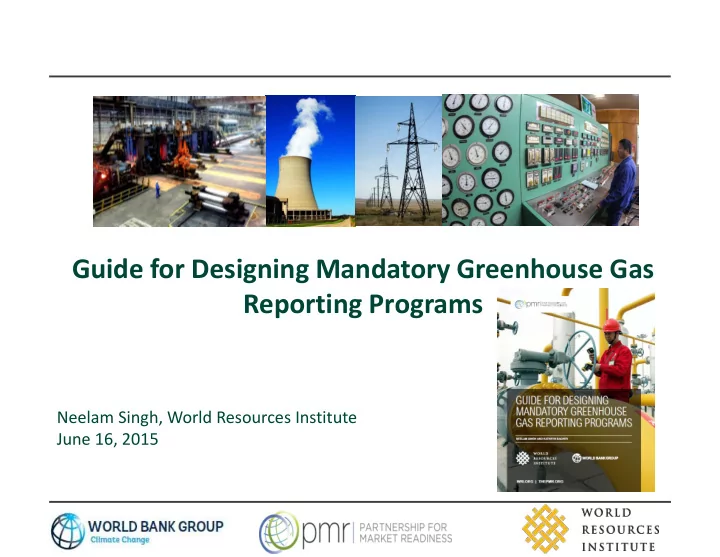
Guide for Designing Mandatory Greenhouse Gas Reporting Programs Neelam Singh, World Resources Institute June 16, 2015 Overview MRV and GHG Reporting Programs Key steps in designing reporting programs Where to begin Whats next

slide-1
SLIDE 1

Guide for Designing Mandatory Greenhouse Gas Reporting Programs

Neelam Singh, World Resources Institute June 16, 2015

slide-2
SLIDE 2

Overview

  • MRV and GHG Reporting Programs
  • Key steps in designing reporting programs
  • Where to begin
  • What’s next
  • Discussion
slide-3
SLIDE 3
  • Collect and track

emissions data at the level of individual emitters at regular intervals

  • Encompass a set of

components

  • Voluntary or

mandatory

GHG Reporting Programs

GHG Reporting Program Reporting entities Accounting framework & calculation methods Database management system Program administrators Associated services (verifiers, auditors)

slide-4
SLIDE 4
  • MRV – measuring, reporting, verifying
  • MRV of emissions – at emitters level
  • Transparency
  • Accuracy/data quality
  • Comparability
  • Tracking progress/demonstrating impact
  • Access to finance

Reporting programs help MRV emissions

slide-5
SLIDE 5

Mandatory GHG Reporting Programs Researched

slide-6
SLIDE 6

Mandatory vs voluntary reporting programs

  • More prescriptive -

greater consistency in reporting

  • More likely to be at

facility level

  • Purely reporting

scheme, no targets

Mandatory

  • Greater flexibility
  • More likely to be at

corporate level

  • Companies may

report on emissions reductions

Voluntary

slide-7
SLIDE 7
  • Discusses good practices

while recognizing different country contexts/ priorities/

  • bjectives
  • Helps develop a sound

framework for GHG reporting A Guide for policymakers

slide-8
SLIDE 8

Steps to Establish GHG Reporting Programs

slide-9
SLIDE 9
  • Objectives influence program design decisions
  • Programs can serve a range of objectives that can

evolve over time

– Inform the analysis of emissions mitigation opportunities – Directly support policies that require detailed entity-level data, e.g., ETS & carbon tax – Improve data quality and consistency – Provide information to stakeholders – Inform national inventories – Help entities assess their climate risks and opportunities

Program Objectives

slide-10
SLIDE 10

Enabling Environment

slide-11
SLIDE 11

Enabling Environment Legal Architecture

Existing vs new legislation Laws and regulations

slide-12
SLIDE 12
  • Building capacity:

– Institutional capacity – Human resources and technical capacity – Financial capacity

Enabling Factors

slide-13
SLIDE 13

Stakeholder Engagement

slide-14
SLIDE 14

Reporting Program Design Elements

slide-15
SLIDE 15

Program Coverage

  • Facility/Company

Reporting entity

  • Direct/Indirect

Emissions to report

  • Thresholds

Program applicability

  • All Kyoto/Only CO2/Others (e.g., black

carbon) GHGs to report

slide-16
SLIDE 16
  • Calculation-based approaches
  • Direct measurement
  • Policymakers’ role:

– Methodologies

  • Tiers
  • Uncertainty
  • GWP

Emissions Quantification

slide-17
SLIDE 17
  • Specify the type of information to be

reported, the frequency of reporting, deadlines, recordkeeping

  • Reporting platform – data management

system to facilitate reporting, organization and analysis of data

– Simple spreadsheets to sophisticated systems – Independent or integrated systems

Reporting requirements and Reporting platforms

slide-18
SLIDE 18

Programs can focus on QC measures in:

  • Calculation and monitoring methods
  • Data validation
  • Compliance assistance

Quality control

slide-19
SLIDE 19

Quality assurance approaches

slide-20
SLIDE 20

Program review Benefits

Demonstrate impact Lend credibility Facilitate feedback Identify good practices

Emphasis

Process Substantive details Impact

slide-21
SLIDE 21

6/16/2015 21

Where to begin?

Build capacity Raise awareness and build a constituency Gradually expand participation and scope over time

slide-22
SLIDE 22
  • Framework for GHG reporting programs

– Insights from 13 reporting programs – Step by step process

  • Reference for policymakers: Key considerations,

checklist questions

  • Potentially save time and cost in developing a new

program

Why use this guide

slide-23
SLIDE 23
  • An e-learning course on Designing GHG Reporting

Programs – under preparation

  • Tentative – Portuguese and Spanish version of the

guide

On the horizon

slide-24
SLIDE 24
  • Support jurisdictions in developing reporting programs

through:

– Webinars and workshops for a group of policymakers in one country

  • r across countries

– Supporting individual countries (e.g., collaborate with individual countries to provide context-specific design recommendations)

  • Jointly develop fundraising proposals with interested

countries/networks/organizations in either of these activities Further activities

slide-25
SLIDE 25

YOU CAN DOWNLOAD THE GUIDE AT

HTTPS://OPENKNOWLEDGE.WORLDBANK.ORG/HANDLE/10986/21981 HTTP://WWW.WRI.ORG/PUBLICATION/GUIDE-DESIGNING-MANDATORY- GREENHOUSE-GAS-REPORTING-PROGRAMS

FOR MORE INFORMATION ON THE PARTNERSHIP FOR MARKET READINESS (PMR),

PLEASE CONTACT: PMRSECRETARIAT@WORLDBANK.ORG WWW.THEPMR.ORG

FOR MORE INFORMATION ON THE WORLD RESOURCES INSTITUTE (WRI), PLEASE CONTACT: NSINGH@WRI.ORG

WWW.WRI.ORG

Thank You