Growth and/or Inequality? Preparing for the Future Prof. Avi Weiss - - PowerPoint PPT Presentation

growth and or inequality
SMART_READER_LITE
LIVE PREVIEW

Growth and/or Inequality? Preparing for the Future Prof. Avi Weiss - - PowerPoint PPT Presentation

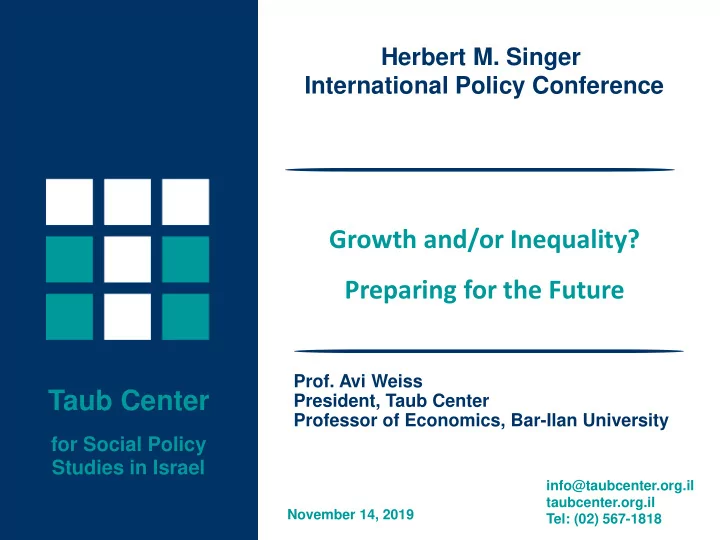
Herbert M. Singer International Policy Conference Growth and/or Inequality? Preparing for the Future Prof. Avi Weiss Taub Center President, Taub Center Professor of Economics, Bar-Ilan University for Social Policy Studies in Israel


slide-1
SLIDE 1

Growth and/or Inequality? Preparing for the Future

  • Prof. Avi Weiss

President, Taub Center Professor of Economics, Bar-Ilan University

Taub Center

for Social Policy Studies in Israel

info@taubcenter.org.il taubcenter.org.il Tel: (02) 567-1818 November 14, 2019

Herbert M. Singer International Policy Conference

slide-2
SLIDE 2

The Kuznets (Inverted-U) Curve (1955) Income per capita Inequality

  • Move from a rural society

(agriculture based) to an urban society (cities) results in increased incomes for those who move, thereby leading initially to greater inequality

  • Once a large portion becomes

urbanized, the continued flow continues to increase income, but also lowers inequality as more people earn “city” wages

  • Other changes, such as use of

modern technologies, can yield the same type of dynamic

slide-3
SLIDE 3

Growth and Inequality – A dynamic

  • Socialist economy (A Kibbutz): all income is pooled and equally divided no inequality
  • Open economy to free trade and allow capital accumulation
  • Increased growth as incentives lead to increased effort and entrepreneurial activities
  • Increase inequality as some succeed more and some less
  • The less successful – those in (relative or absolute) poverty could face inequality in
  • pportunities, and not just in income or wealth, and a distortion of incentives
  • Poor access to imperfect credit markets
  • Poor access to quality education
  • Stress that affects productivity
  • Welfare benefits distort labor market decision (education and participation)
  • Lower income individuals have a greater incentive to engage in crime, etc.
  • As the inequalities grow these distortions increase, which can lead to a decrease in growth

as the potential of the population is not realized

  • Increased inequality in opportunities may lead to
  • Decreased growth
slide-4
SLIDE 4

The processes that link between family socioeconomic background and cognitive development and academic achievement

Source: Dana Vaknin, Yossi Shavit, and Isaac Sasson, Taub Center

Cognitive development and educational achievements Parenting styles Stress Sensory stimulation Qualtiy of education Socioeconomic background

slide-5
SLIDE 5

Predicted score

  • n the Meitzav

exam in math, grade 5

Source: Dana Vaknin, Yossi Shavit, and Isaac Sasson, Taub Center Data: CBS

Children birth to age 2 Children ages 3 to 5

slide-6
SLIDE 6

Growth and Inequality in Israel

slide-7
SLIDE 7

The real cumulative change in household income and consumption, 2012-2017

Note: the real change is calculated using a differential price index that utilizes each income quintile’s consumption basket. Source: Gilad Brand, Taub Center | Data: CBS, Household Expenditure Survey

Income quintile

slide-8
SLIDE 8

The Gini index and GDP per capita in Israel

Index year: 1998=100

Source: Gilad Brand, Taub Center | Data: IMF, NII

0.32 0.33 0.34 0.35 0.36 0.37 0.38 0.39 0.40 20 40 60 80 100 120 140 160 GDP per capita Gini index (disposable income)

slide-9
SLIDE 9

Gini index after taxes and transfer payments in Israel and selected countries, 1998-2017

Source: Benjamin Bental and Gilad Brand, Taub Center | Data: OECD.Stat

ISRAEL Germany Canada US UK France Finland 0.24 0.26 0.28 0.30 0.32 0.34 0.36 0.38 0.40 1998 2000 2002 2004 2006 2008 2010 2012 2014 2017

slide-10
SLIDE 10

Return to academic studies, selected OECD countries, 2012-2015

Source: Gilad Brand, Taub Center | Data: OECD, PIAAC

5.0% 9.4%

  • 20%

0% 20% 40% 60% 80% 100%

32.8% 33.3%

  • 20%

0% 20% 40% 60% 80% 100%

Upper half of the skills distribution Lower half of the skills distribution

62.7% 55.3%

slide-11
SLIDE 11

Thank you!!

info@taubcenter.org.il taubcenter.org.il Tel: (02) 567-1818 September 2019

  • Prof. Avi Weiss

President, Taub Center Professor, Bar-Ilan University